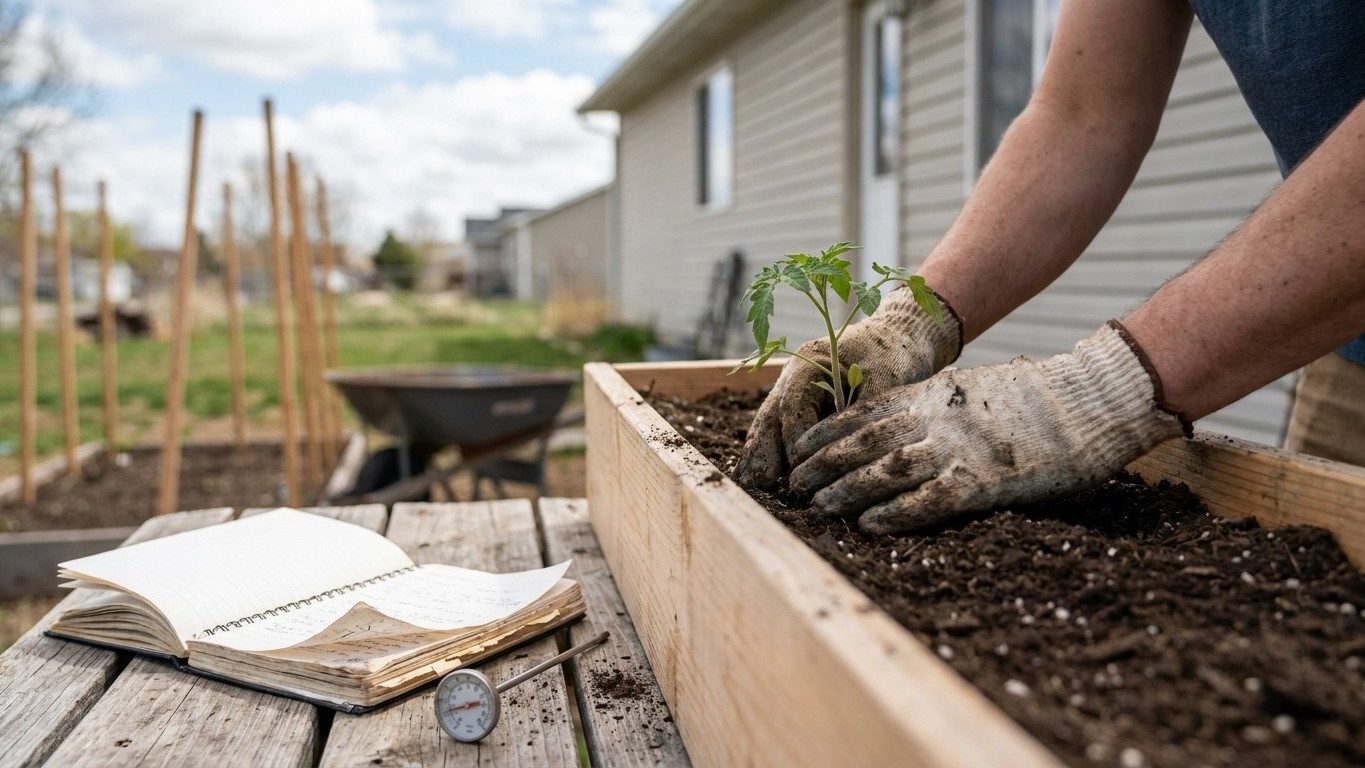

Boise’s last spring freeze can land anywhere from April 23 to May 7 — a two-week spread that wrecks the idea of one clean planting date. Treat the earlier end of that range as a warning, not permission. Idaho’s whole tomato calendar hangs on this single frost record, since it’s the only long-run station data the state has, and it leaves growers a frost-free run of about five months if both ends cooperate. The real question isn’t the date on a chart. It’s how much of that risk you’re willing to eat for extra ripening time.
What this comes down to in Idaho

Idaho’s tomato calendar starts and ends with frost, and the state’s only long-run frost record comes from Boise. NOAA’s 1991-2020 climate normals put Boise’s last spring freeze at April 23 to May 7, and its first fall freeze at October 7 to October 21, both measured at station USW00024131. That gives Boise growers a frost-free stretch of roughly five months in a good year, tighter if either end of the range falls unfavorably. Growing tomatoes in Idaho starts with getting transplants past that spring window alive, so treat the earlier dates in the range as a risk rather than a target.
The safe transplant window
The safe transplant window for Boise-area gardens runs from early May to late May, once the worst of the frost risk has passed and the soil has had time to warm. That’s not a single day. It’s a stretch of about three weeks during which nighttime lows are unlikely to fall to 32°F, though a late cold snap can still sneak in through early May. A gardener who transplants at the front edge of that window takes on more risk in exchange for a longer harvest. One who waits until the back edge trades a few weeks of ripening time for safety.
This page is only about timing, not about which tomato to grow or which insect shows up when a plant is already in the ground. Those questions have their own answers elsewhere on this site.
Everywhere outside the Boise valley, this window shifts later and narrows. The USDA’s Plant Hardiness Zone Map places Idaho across zones 3b to 7b, a spread wide enough to include high mountain valleys that can see frost in a summer month and warmer low-elevation ground close to Boise’s own numbers. Treat the Boise dates as the mildest case for the state, not the average.
Working it out for your own garden
Every tomato variety’s days-to-maturity number is counted from the day it goes into the ground as a transplant, not from the day you sowed the seed indoors. Idaho’s frost windows let you turn that single number into a usable date range, but the math has to stay in ranges the whole way through, because the frost date feeding it is a range too.
Doing the arithmetic
Start from NOAA’s Boise last-frost window of April 23 to May 7. Add the week or two most Idaho gardeners give the soil to warm and any late cold snap to pass, and you land on a safe transplant window of early May to late May. From there, add the variety’s days-to-maturity figure to get an approximate first-ripe date, and check that date against NOAA’s Boise fall frost window of October 7 to October 21 to see how much margin is left before the season ends.
Take Sun Gold, a 57-day cherry tomato. Transplanted in the early May to late May window, it counts forward to a first ripe fruit in mid July, leaving roughly 82 days of margin before Boise’s earliest fall frost date. That’s a wide enough cushion that a cool August or a slightly early frost wouldn’t cost the harvest.
Now take Amish Paste, an 85-day paste tomato. The same transplant window puts first ripe fruit in mid August, and the margin before Boise’s fall frost narrows to about 54 days. At Boise itself that’s still enough for a full crop, but in a higher, colder part of the state where the frost-free season runs noticeably shorter than Boise’s, an 85-day variety like this one may not finish before frost shuts the garden down. This is the kind of variety where the season decides the outcome, not the gardener. For more cultivars worked through this same math, see Tomato Varieties That Ripen in Time in Idaho.
| Variety | Days to Maturity | Set-Out Window | First Ripe (calculated) | Margin Before Boise’s Fall Frost |
|---|---|---|---|---|
| Sakura | 55 | Early May to late May | Mid July | 84 days |
| Sun Gold | 57 | Early May to late May | Mid July | 82 days |
| Jasper | 60 | Early May to late May | Mid July | 79 days |
| Amalfi | 68 | Early May to late May | Late July | 71 days |
| Cherokee Purple | 72 | Early May to late May | Early August | 67 days |
| Amish Paste | 85 | Early May to late May | Mid August | 54 days |
The margin column is only as good as the frost window feeding it, so treat every figure in this table as a Boise-area estimate and recalculate it once you have your own measured last-frost date.
What changes across the state
Boise sits in the Treasure Valley at a relatively low elevation for Idaho, and that’s exactly why its frost dates run milder than most of the state’s. Move up into the mountains, the Panhandle, or any of the high desert valleys of eastern Idaho, and the frost-free season shrinks fast as elevation climbs. A few thousand feet of elevation gain can push the last spring frost weeks later and the first fall frost weeks earlier, squeezing the growing season from both ends at once.
North versus south, and everything in between
Southern Idaho’s valleys, including the Snake River Plain around Boise, sit at lower elevation and warm earlier in spring than the mountainous terrain that dominates the Panhandle and central Idaho. The USDA’s hardiness map reflects this spread directly, placing the state across zones 3b to 7b. A garden near the cold end of that range works with a season that’s shorter by weeks, not days, compared to Boise’s numbers.
Local topography matters just as much as latitude. Valley bottoms collect and hold cold air overnight, so a garden at the base of a slope can see frost when a garden partway up the same hillside stays clear. Air drainage, not just elevation or distance north, decides whether a particular yard runs a week or two colder than the nearest weather station. Idaho also has no large lake or coastline to moderate its temperature swings the way some states do, so the gap between one valley and the next comes down mostly to elevation and cold-air drainage. That makes local observation, not a statewide average, the more reliable guide once you’re outside the Boise area.
The mistakes this state punishes

Cold soil, not just cold air
The most common mistake in Idaho gardens is transplanting the moment a warm week shows up in April, before NOAA’s Boise frost window has even started to close. A string of 70°F days in early spring doesn’t mean the frost risk is over. Soil temperature lags behind air temperature by days, and a late freeze can still land inside the April 23 to May 7 window Boise growers are working against. Wait for the window to actually pass, not just for a warm afternoon.
The second mistake is choosing a variety whose days-to-maturity number doesn’t leave enough room for the season. An 85-day paste tomato like Amish Paste works fine on Boise’s numbers, with roughly 54 days of margin, but in a shorter-season part of the state that same variety can run out of summer before it ripens a full crop. Matching the variety to the actual local margin, rather than to what looks good in a catalog photo, is the difference between a full basket and a bucket of green tomatoes in October.
A third, smaller mistake is setting transplants straight from a warm greenhouse into open ground without hardening them off first. Even inside the safe early May to late May window, a transplant that hasn’t spent several days adjusting outdoors can stall or scorch, costing a week or two of growth it can’t always make back before fall frost closes the season.
Timing a planting date well doesn’t help if a pest arrives on schedule later in the season and goes unmanaged. See Tomato Pests in Idaho: Which Ones Actually Show Up Here for what to watch for and when it typically appears.
Checking this against your county
Every figure here is measured at or near Boise, at NOAA’s station USW00024131, and Idaho is too large and too varied in elevation for one station to stand in for the whole state. Before committing to a transplant date, check your own county’s numbers against the University of Idaho Extension office, which tracks local conditions and tomato guidance county by county. A phone call to your local extension office is worth more than any statewide range, especially if you garden above the valley floor or far from Boise. If you’ve never recorded your own last frost date, this is the year to start.
Common questions
Can I plant tomatoes outside in April in Idaho?
Not safely in most years at Boise, since NOAA’s 1991-2020 normals put the last spring freeze there at April 23 to May 7. Anywhere higher or farther from the valley floor, April transplanting is even riskier.
What if I don’t know my county’s frost dates?
Start with the Boise figures as a rough upper bound on how early you could plant, then check with your county extension office for a number closer to your own conditions. Elevation and cold-air drainage can move the real date by weeks in either direction.
Does starting seeds indoors change these transplant dates?
No, the transplant date is set by frost risk, not by when you started seeds. Most tomato seed packets call for starting indoors roughly six to eight weeks before the transplant date, so count backward from your own planned set-out window rather than from a fixed calendar day.
Is it too late to plant tomatoes in June in Idaho?
It depends on the variety. A fast cultivar such as Sun Gold, at 57 days to maturity, transplanted in early June can still ripen well before Boise’s October 7 to October 21 fall frost window, while a longer-season variety like Amish Paste, at 85 days, leaves much less room for error starting that late.
If you follow the almanac, here is when to plant tomatoes by the moon. It is a tradition, not a proven method.