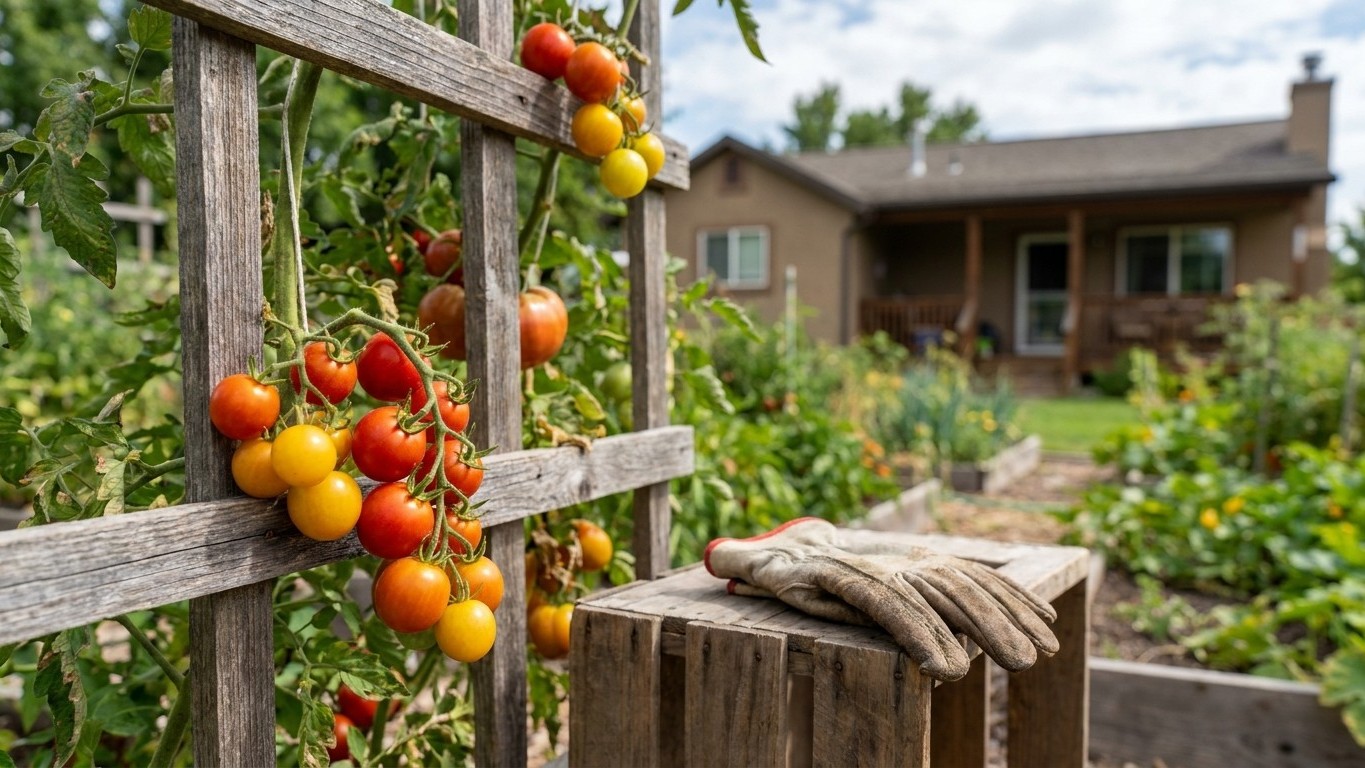

Tomatoes in Idaho go in the ground once the last spring frost has passed, and for the Boise area NOAA’s 1991-2020 climate normals from station USW00024131 put that date between April 23 and May 7. That’s a range, not a single day, and it applies to the valley floor, not the whole state. Check your own county’s frost history with University of Idaho Extension before you set plants outside, especially if you garden at higher elevation or farther north.
When to plant Tomatoes in Idaho

Boise’s frost window of April 23 to May 7 is the anchor for everything else: count back six to eight weeks and you land on late February to late March as the right time to start tomato seed indoors, later still in colder parts of the state. Sow a quarter inch deep, get seedlings under strong light fast, and give them seven to ten days of hardening off before they ever touch open ground.
Starting seed indoors and hardening off
Tomato seed needs six to eight weeks of indoor growth before it’s ready to go in the ground as a sturdy transplant. Counting six to eight weeks back from the Boise frost window of April 23 to May 7 lands seed-starting in late February to late March for that area, with colder parts of the state starting later once you know their own frost window. Sow seed about a quarter inch deep in a seed-starting mix, keep it near room temperature until it germinates, then move seedlings under strong light right away so they don’t stretch and go leggy.
Seven to ten days before transplanting, start hardening off. Set the trays outdoors in a sheltered, shaded spot for an hour or two the first day, and add time daily while introducing more direct sun and wind. Skipping this step is the most common reason a healthy indoor tomato collapses within days of being moved outside, because leaf tissue grown under lights has no defense against real sun and wind until it’s built up gradually.
Transplanting outside
Don’t transplant the moment the calendar clears the frost window. Soil temperature matters as much as air temperature, and tomato roots stall in cold ground even when the air itself won’t freeze again. Wait until the frost window has passed and nights are reliably mild before moving plants to their final spot, and keep a floating row cover on hand in case a late, light frost slips in after planting. Gardeners working a shorter season at elevation, the kind of challenge covered in our guide to Growing Tomatoes in Montana, will want to lean on their own county’s frost records rather than borrowing Boise’s dates.
Soil and site preparation
Tomatoes want at least six to eight hours of direct sun a day, and more helps in a state where summer light is intense but the season is short. Pick the warmest, most open spot available, ideally with south or southwest exposure that catches afternoon heat, and stay clear of the shade cast by trees, fences or buildings.
Soil texture matters more than fertility for a plant this size. Tomatoes need deep, loose ground that drains quickly after a heavy watering, since standing water around the roots invites the fungal problems that stunt or kill the plant outright. Heavy clay shows up in parts of Idaho, and if a test hole still has water sitting in it an hour after filling, build a raised bed instead of fighting the native soil.
Start bed prep weeks before planting, not the same afternoon. Work two to three inches of finished compost into the top eight to ten inches of soil as soon as the ground is workable in early spring, giving it time to settle and start feeding soil biology before roots arrive. If a soil test shows acidic ground or low phosphorus, correct it now. Lime and rock phosphate both take weeks to shift soil chemistry and do nothing applied on transplanting day.
Space plants generously. Indeterminate varieties that keep vining all season need 30 to 36 inches between plants and at least 36 inches between rows so air moves through the foliage. Determinate, bush-type varieties can go tighter, closer to 24 inches, since they stop growing once they set their main flush of fruit. Warming the bed ahead of time with black plastic or landscape fabric for a couple of weeks gives roots a head start in ground that often stays cold well into spring.
Varieties that suit Idaho
With a frost-free season that starts in late April at the earliest around Boise, and considerably later at elevation, days to maturity is the trait that decides whether a variety ripens at all across much of Idaho. Catalogue day counts are measured from the transplant date, not from seed, and they assume steady warm weather that mountain valleys don’t always deliver, so treat the figures below as a starting point that can run a week or two longer in a cool season. Disease resistance matters too, since a plant that shrugs off verticillium and fusarium wilt keeps producing in soil that’s grown tomatoes before.
Determinate varieties set most of their fruit in one flush and finish earlier, suiting a short season or a gardener who wants one big canning harvest. Indeterminate varieties keep flowering and fruiting until frost cuts them down, stretching the harvest but demanding a longer season and taller support.
Sun Gold

Sun Gold is a small, golden-orange cherry tomato with thin, sweet skin on a sprawling indeterminate vine. At 57 days from transplant, setting plants out during Boise’s April 23 to May 7 window points to a harvest running roughly mid-June to early July. It resists Tobacco Mosaic Virus and Fusarium Wilt race 1, both rated high, which helps it keep bearing through a long hot stretch.
Sakura

Sakura produces small, glossy red cherry tomatoes on an indeterminate vine and, at 55 days, is the fastest variety on this list to reach harvest. Counting from the Boise frost window, fruit should start ripening from mid-June into early July. It carries intermediate resistance to nematodes and high resistance to Tomato Mosaic Virus and Fusarium Wilt races 1 and 2, useful in a bed that’s carried tomatoes before.
Celebrity Plus

Celebrity Plus is a compact, determinate plant bearing medium-large, smooth, round red fruit, and its bushier habit is easier to support than a tall vine. At 78 days from transplant, the Boise frost window puts harvest roughly mid-July to late July. It carries high resistance to Gray Leaf Spot and Tomato Mosaic Virus plus intermediate resistance to nematodes.
Amalfi

Amalfi is a determinate paste tomato producing elongated, red, plum-shaped fruit suited to sauce and canning. At 68 days from transplant, harvest in the Boise area should run roughly late June to mid-July. It carries intermediate resistance to nematodes, Late Blight and Early Blight, useful in a wetter spring when foliar disease runs higher than usual.
Big Beef Plus

Big Beef Plus is a large, round, deep red beefsteak-type tomato on a vigorous indeterminate vine that needs a sturdy cage or stake. At 72 days from transplant, the Boise window points to harvest running roughly early to mid-July. It resists Gray Leaf Spot and Tomato Mosaic Virus at a high level and nematodes at an intermediate level, a dependable choice for a gardener who wants one large-format slicer instead of several specialty types.
Brandywine

Brandywine is a large, pink-red heirloom beefsteak with ruffled shoulders, soft potato-leaf foliage and a sprawling indeterminate habit. At 78 days from transplant it needs the full length of a warm valley season, and even in the Boise area harvest doesn’t arrive until roughly mid- to late July. It carries none of the disease resistance bred into the newer hybrids on this list, so it does best in fresh soil with good airflow, and it’s a riskier choice at elevation or in a shortened season.
| Variety | Days to maturity | Type | Estimated Boise harvest window | Best for |
|---|---|---|---|---|
| Sakura | 55 | Indeterminate | Mid-June to early July | Fastest cherry to ripen |
| Sun Gold | 57 | Indeterminate | Mid-June to early July | Snacking cherry, long harvest |
| Amalfi | 68 | Determinate | Late June to mid-July | Sauce and canning |
| Big Beef Plus | 72 | Indeterminate | Early to mid-July | All-purpose slicer |
| Celebrity Plus | 78 | Determinate | Mid- to late July | Compact plant, disease pressure |
| Brandywine | 78 | Indeterminate | Mid- to late July | Heirloom flavor, warm valley only |
Gardeners working a shorter season at elevation should lean toward the fastest varieties on this list and skip the 78-day types unless they’re gardening in a warm, low valley like Boise’s.
What to plant alongside
Basil is the classic tomato companion for good reason. It likes the same heat, water and sun, so the two share a bed without competing for different conditions, and some gardeners find it keeps certain flying pests off the tomato foliage. Borage draws in pollinators and predatory insects with its blue flowers, and it’s loose enough not to shade out a tomato plant’s lower leaves. Nasturtium works as a trap crop, drawing aphids to itself and away from the tomato, and it can trail along the ground as a living mulch that helps hold soil moisture.
Marigolds get credited with repelling nearly everything, and the truth is narrower. The evidence for marigolds repelling aboveground insects like aphids or hornworms is thin, but French marigold roots do release compounds that suppress some root-knot nematode populations in the soil around them, which matters more in a bed with a nematode history than as a general pest deterrent.
Keep tomatoes away from other nightshades. Potatoes, peppers and eggplant share the same family, and planting them close together concentrates the same soil-borne diseases, verticillium and fusarium wilt among them, in one patch of ground instead of spreading the risk. Corn draws the same fruitworm that attacks tomatoes, since the tomato fruitworm and corn earworm are the same insect, so growing them side by side gives that pest an easy hop between crops. Fennel is worth avoiding outright, since it releases compounds into the soil that slow the growth of many neighboring plants, tomatoes included, and does better grown alone.
Dill sits somewhere in between. Young dill is sometimes said to help nearby tomatoes, and mature, flowering dill draws in the parasitic wasps that control tomato hornworm, but that same flowering dill can also draw hornworm moths to lay eggs nearby. Treat it as a pollinator plant worth having in the garden generally, not a guaranteed tomato bodyguard.
Watering, feeding and support
Tomatoes want deep, consistent moisture, not frequent shallow sips. Watering deeply once or twice a week, enough to soak the top eight to ten inches of soil, trains roots to grow down instead of staying shallow near the surface where they dry out fast on a hot day. Once fruit starts sizing up, keeping the schedule steady matters more than the amount, since a plant that swings from dry to soaked and back is exactly what causes cracked fruit or blossom end rot.
Mulch and feeding
Lay two to three inches of mulch, straw or shredded leaves both work, once the soil has warmed through in early summer. Mulch keeps soil moisture even between waterings, blocks weeds that would otherwise compete for water and nutrients, and stops soil-borne fungal spores from splashing up onto the lower leaves during watering or rain.
Feed at planting with a balanced fertilizer worked into the hole, then hold off on more nitrogen until the first fruit sets. Too much nitrogen too early grows a huge, leafy plant with few flowers, since the plant puts its energy into leaves instead of fruit. Once fruit is sizing, side-dress with a fertilizer lower in nitrogen and higher in potassium and phosphorus every three to four weeks through the rest of the season.
Staking, caging and pruning
Get support in the ground at transplanting, not after the plant has already sprawled. Indeterminate varieties like Big Beef Plus or Brandywine need a sturdy cage or a stake at least five feet tall, since they keep growing all season and get heavy once loaded with fruit. Determinate varieties like Celebrity Plus or Amalfi stay compact and can often get by with a shorter cage.
Pruning suckers, the small shoots that grow in the joint between the main stem and a branch, is worth doing on indeterminate varieties to keep the plant from turning into a tangled thicket that traps humidity and invites disease. Pinch them out while they’re a couple of inches long, using clean fingers or snips. Determinate varieties need little to no pruning, since removing growing points cuts into the one flush of fruit they’re built to produce.
Common problems

Most tomato problems show up as a specific, readable symptom rather than a mystery, and matching the symptom to the cause saves a season of guessing.
Fruit problems
Blossom end rot shows up as a flat, dark, leathery patch on the bottom of the fruit while the rest still looks healthy. It comes from a calcium shortage inside the fruit itself, usually caused by uneven watering rather than a true lack of calcium in the soil, since dry stretches interrupt the plant’s ability to move calcium where it’s needed. Consistent watering fixes it faster than any calcium spray.
Cracking, whether it rings the top of the fruit or splits straight down the side, comes from the same root cause: a dry spell followed by a heavy soak or a big rain, which swells the inside of the fruit faster than the skin can stretch. Mulch and a steady watering schedule fix this too.
Poor fruit set, where the plant flowers heavily but drops blossoms without setting fruit, usually traces back to temperature stress, either a cold snap that stalls pollen or a stretch of very hot weather that leaves pollen sterile. There’s no quick fix. The plant sets fruit again once temperatures settle into a more moderate range.
Leaf and vine problems
Leaf curl on its own, without discoloration, is often just the plant’s response to heat and bright sun and isn’t a disease at all. Curling paired with yellowing or a mottled pattern points toward a virus or nutrient problem instead, and it’s worth checking the undersides of leaves for pests before assuming disease.
Wilt that hits one side of the plant or one branch first, especially with leaves yellowing from the bottom up, usually means verticillium or fusarium wilt living in the soil. Neither is treatable once a plant is infected, and the only real defense is planting a resistant variety next time. Several on this list, including Sakura, Big Beef Plus and Celebrity Plus, carry resistance to one or both.
Pests
- Aphids: small, soft-bodied insects clustered on new growth and leaf undersides, best knocked back with a strong water spray or insecticidal soap.
- Spider mites: nearly invisible but leave fine webbing and stippled, pale leaves, and they build up fastest in hot, dry, dusty conditions common in Idaho summers.
- Tomato hornworm: a large green caterpillar the length of a finger, best controlled by handpicking it off in the evening when it’s easiest to spot.
- Colorado potato beetle: a striped yellow-and-black beetle that moves onto tomatoes from nearby potatoes, another reason to keep the two crops apart.
Gardeners dealing with wilt pressure in a wetter climate, like the guide to Growing Tomatoes in Vermont covers, often lean harder on fungicide programs than Idaho’s dry summer air usually requires, since low humidity slows most fungal disease down here even without spraying.
Pests that actually show up in Idaho
Idaho’s vegetable garden pest list, compiled by University of Idaho Extension in Homan and Bechinski’s Insect Pest Management for the Home Vegetable Garden, runs to eleven species, but most of them never touch a tomato plant. Squash bug stays on squash and pumpkin, imported cabbageworm and cabbage looper work the brassica bed, onion thrips and onion maggot stick to alliums, carrot rust fly larvae feed on carrot roots left in the ground past late September in northern Idaho, and pea leaf weevil is a pea-crop problem confined to northern Idaho and the Magic Valley. Wireworms attack potatoes and root vegetables more than tomato fruit. If you grow a mixed garden, all of those are worth knowing, but they belong to other rows.
Four pests on that same list do go after tomatoes. Colorado potato beetle shows up first as ragged, chewed holes eaten straight through the leaf, working from the edges inward, usually once plants are well established in early summer. Hand-picking the yellow-and-black striped adults and the reddish larvae off the undersides of leaves keeps small plantings clean, since the beetle builds resistance to many sprays fast.
Cutworms do their damage overnight and low, severing young transplant stems right at the soil line so a healthy seedling is just gone by morning. A cardboard collar pushed an inch into the soil around each new transplant stops them cold.
Tomato hornworm announces itself through stripped foliage and stems, often before you spot the thick green caterpillar itself, camouflaged against the vine. Check plants in the evening and pick the caterpillars off by hand. They are large enough to find once you know to look.
Aphids, whether green peach, cabbage, or pea species, cluster on new growth and the undersides of leaves, leaving foliage curled and often coated in a sticky residue. A strong jet of water knocks most colonies down, and that alone is usually enough on tomatoes before populations build.
Grasshoppers are the outlier: they build up in dry pasture and rangeland through the season and move into gardens in late summer when that forage dries out, chewing leaf edges on tomatoes along with everything else nearby. Idaho’s Master Gardener Handbook, chapter 21, covers row cover and timing as the main home-garden defenses against a late-summer influx.
Harvest and end of season
Pick tomatoes once they’ve reached full color for the variety, whether that’s the deep red of Big Beef Plus or the golden-orange of Sun Gold, giving the fruit a gentle twist rather than pulling straight off the vine. Fruit that’s just starting to change color from green to its final shade will keep ripening off the vine on a kitchen counter, out of direct sun, which is useful for anything picked ahead of a surprise storm or an early cold snap.
Don’t refrigerate fresh tomatoes if you can help it. Cold storage dulls both flavor and texture, so counter storage out of direct sun, used within a few days, keeps them tasting like what they’re supposed to.
Watching for the first fall frost
As nights start cooling toward the end of the season, watch the forecast rather than the calendar. The frost data available for the Boise area only covers the spring window, and fall freeze timing runs on its own schedule that varies by elevation and by year, so check University of Idaho Extension or your local weather service office for a fall outlook specific to your county rather than assuming a date.
Once a hard freeze is close, pick everything left on the vine, including the green fruit, and bring it inside. Green tomatoes ripen slowly indoors over several weeks at room temperature, or you can use them right away for fried green tomatoes or green tomato relish. Pull the spent plants and clean up fallen fruit and foliage promptly, since leaving diseased plant material in the bed over winter gives fungal spores and overwintering pests a head start on next year’s crop.
Local help
Frost dates, soil test results and pest pressure all vary by county in a state with Idaho’s range of elevation, from the Snake River plain to mountain valleys above 5,000 feet. University of Idaho Extension publishes county-level planting guidance and offers soil testing that a statewide average can’t replace, so check UIdaho Extension before locking in a planting date. For other crops suited to the state’s varied climate, our Idaho guides cover the same county-by-county differences.
Where to Go Next
Everything above is background. The real work of growing tomatoes in Idaho comes down to three questions, and each one has its own page here.
First, when do you actually put plants in the ground? That two-week spread in Boise’s last freeze date means a single “plant on this day” answer doesn’t hold up, so Idaho’s tomato planting calendar walks through counting back from your own frost window instead of borrowing someone else’s date.
Second, will the variety you’re eyeing actually ripen before fall shuts things down? A rundown of tomato varieties that ripen in time in Idaho matches days-to-maturity numbers against the frost-free window NOAA’s climate data records for Boise, so you’re not gambling on a slicer that needs three more weeks than you’ll get.
Third, what’s going to attack the plants once they’re in? Skip the national pest guides with their long lists of bugs that never show up here — the page on tomato pests that actually show up in Idaho narrows it down to the six insects home gardeners across the state deal with reliably, starting with cutworms and flea beetles right at transplanting.
Common questions
Can I grow tomatoes at high elevation in Idaho, like near Sun Valley or McCall?
Yes, but the season runs much shorter than in the Boise valley, so fast varieties like Sakura or Sun Gold work better than a 78-day heirloom. Season-extending tools like row cover or a wall-of-water device around new transplants buy extra weeks on both ends, and your local extension office can tell you how much shorter your actual frost-free window runs compared to Boise’s.
My tomato leaves are curling, is that blight?
Not usually. Curling on its own, without yellowing or spots, is most often a heat and sun response and clears up on its own once temperatures moderate. Blight and virus problems almost always come with discoloration or a mottled pattern alongside the curl, not curling by itself.
Do determinate tomatoes need pruning like indeterminate ones?
No, and pruning them can actually cost you fruit. Determinate varieties like Celebrity Plus or Amalfi set one main flush of fruit and stop, so removing suckers or growing tips just cuts into the harvest they’re built to produce.
I missed the seed-starting window, can I still get a harvest?
Yes, buy started transplants from a local nursery instead of starting from seed. As long as you’re still inside the transplant window for your area, a nursery start loses you little time compared to a seed you’d have started weeks earlier, and it’s a common way to catch up after a late spring.
How many tomato plants should I plant for a family?
There’s no fixed number, since it depends on how much fresh eating versus canning you plan to do. Many home gardeners plant one or two indeterminate slicers per person for fresh eating, plus several determinate plants like Amalfi or Celebrity Plus if they’re putting up sauce or canned tomatoes in one big batch.