
Idaho’s short growing season keeps the tomato pest list here shorter than what a national gardening guide describes. Six insects show up reliably in home gardens across the state: cutworms and flea beetles at transplanting, aphids through midseason, Colorado potato beetle and spider mites in summer heat, and tomato hornworm from midsummer on. Check every new transplant for a cutworm collar and shot-holed leaves the week you set it in the ground, since those two arrive first and do the most damage to a young plant.
What this comes down to in Idaho

Six insects actually bother tomatoes in Idaho, and which one you’re looking at usually comes down to when it showed up. Cutworms and flea beetles hit right at transplanting, aphids build through the middle of summer, Colorado potato beetle and spider mites move in with the heat, and hornworms show up latest, once the plants are big enough to feed a four-inch caterpillar. So before you reach for anything, go check the damage against the calendar: a sliced-off stem the week you planted means cutworm, shot holes in young leaves the same week mean flea beetle, and everything else sorts itself out from there.
Cutworms
Cutworms show up right at transplanting, before you’ve even hardened off your last seedling. The larvae are dull gray or brown caterpillars, about an inch long, that curl into a tight C-shape when disturbed and hide just under the soil surface by day. They’re the stage that does the damage: a cutworm chews clean through a stem at the soil line overnight and drops the whole seedling flat. A cardboard collar pushed an inch into the soil around each transplant stops them cold and costs nothing but a few toilet paper tubes.
Flea Beetles
Flea beetles follow within a week or two of transplanting, once the soil has warmed. Adults are tiny, shiny black beetles barely 1/16 inch long that jump like fleas when you brush the leaves. They chew small round holes straight through young leaves, giving them a shot-hole look that can stunt a seedling before it has a chance to establish. Floating row cover over the bed until plants are a foot tall keeps adults off without a single spray.
Aphids
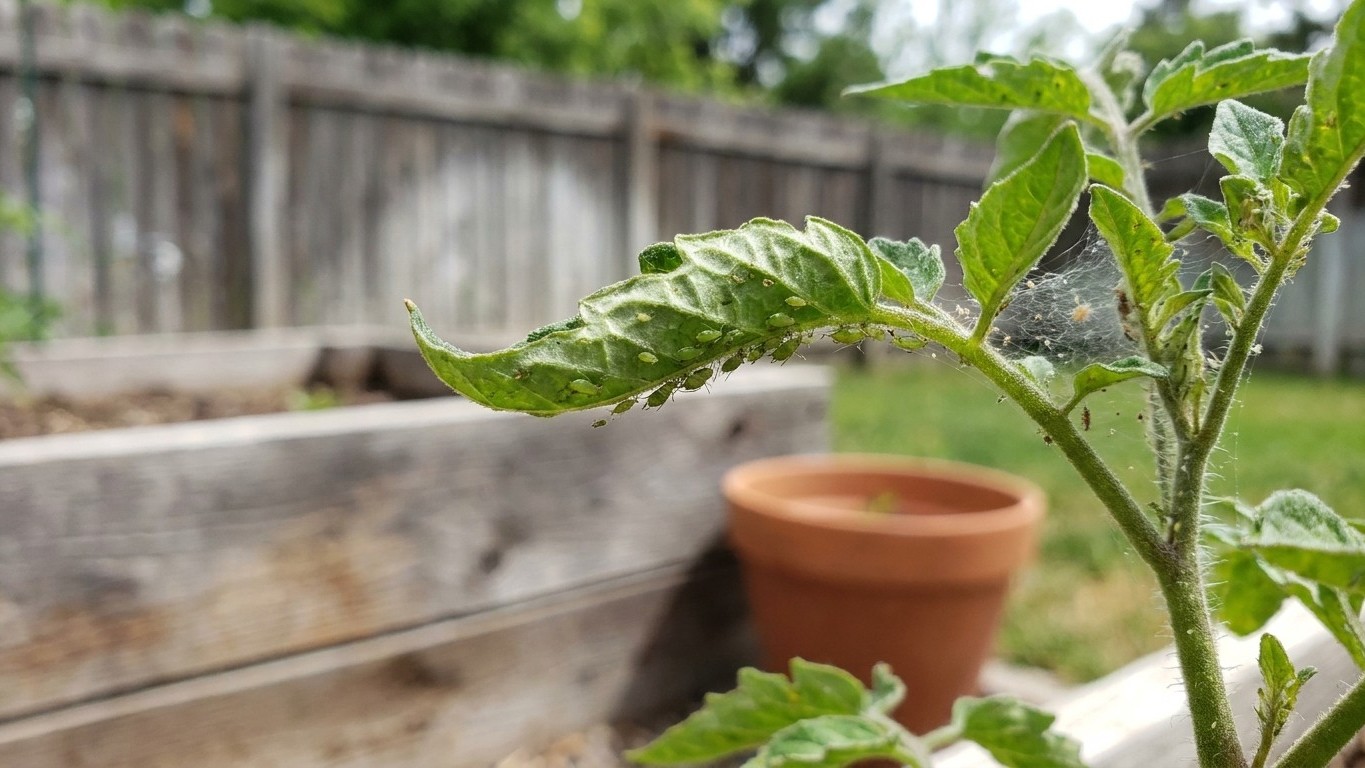
Aphids build up through the middle of the season as temperatures climb. They’re small, soft-bodied, pear-shaped insects, usually pale green but sometimes black, clustered on the undersides of leaves and along new growth. Both nymphs and adults feed by sucking sap, which curls and yellows leaves and leaves behind sticky honeydew that grows sooty mold. A strong jet of water knocks most colonies down, and insecticidal soap handles the rest without touching the pollinators working the same plants.
Colorado Potato Beetle
Colorado potato beetle moves onto tomatoes from nearby potato patches from early summer on. Adults are oval, hard-shelled beetles about 3/8 inch long, yellow-orange with ten black stripes running down the wing covers. The larvae do the worst of the feeding: humpbacked, reddish-orange grubs with a double row of black spots that strip foliage down to bare stems. Hand-picking both stages into a bucket of soapy water works well in a small garden, since the beetle is large and slow enough to catch.
Two-Spotted Spider Mite
Two-spotted spider mites turn up in the hottest, driest stretch of summer, usually on plants already stressed by heat. They’re barely visible without a hand lens, pale yellow-green with two dark spots on the back, and they spin fine webbing across the undersides of leaves when populations build up. Feeding by both nymphs and adults leaves a fine yellow stippling that can bleach whole leaves in a bad outbreak. Regular overhead watering in the morning breaks up the dry, dusty conditions mites prefer.
Tomato Hornworm
Tomato hornworm arrives latest, typically from midsummer into early fall as caterpillars reach full size. It’s hard to miss once grown: a fat green caterpillar up to four inches long with pale diagonal stripes down each side and a curved horn at the tail end. The caterpillar stage eats voraciously, stripping whole branches of foliage and chewing into green fruit overnight. Handpicking works if you catch it early, and Bacillus thuringiensis (Bt) sprays kill young caterpillars without harming a hornworm that already carries the white cocoons of a parasitic wasp on its back.
Working it out for your own garden
Diagnosing a pest from damage alone is mostly a process of elimination, and the fastest way through it is to work backward from three questions: when did the damage appear, what part of the plant is hit, and what’s actually sitting there when you look closely with a hand lens or a flashlight.
- Seedling severed at the soil line overnight: cutworm, check right after transplanting
- Small round holes through young leaves: flea beetle, check the first two weeks after transplant
- Curled, yellowing leaves with sticky residue: aphids, check mid-season on new growth
- Foliage stripped to bare stems by a striped beetle or a spotted grub: Colorado potato beetle
- Fine yellow stippling and webbing in hot, dry weather: two-spotted spider mite
- Large chunks missing from upper foliage and holes in green fruit: tomato hornworm
Why timing does most of the diagnosis for you
The timing column matters more than it looks like it should. Idaho’s compressed season, running from Boise’s April 23-May 7 last frost to its October 7-21 first fall freeze by NOAA’s 1991-2020 normals, means most of these pests get one real window to build a population before cold weather cuts them off. That’s useful information when you’re staring at a damaged plant: a caterpillar chewing fruit in June almost certainly isn’t a hornworm, because hornworms haven’t reached that size yet. A beetle stripping foliage in early May is more likely a flea beetle than a Colorado potato beetle, because the potato beetle hasn’t moved in yet. Cross-check the calendar against the damage before reaching for a spray, and you’ll often rule out three of the six possibilities without touching the plant.
What changes across the state
Boise’s frost dates describe a low, relatively mild valley, and most of Idaho sits higher and colder than that. Elevation is the biggest factor: gardens in the mountain valleys of central Idaho or the higher benches around Idaho Falls have a shorter freeze-free stretch than Boise’s, which compresses the pest calendar even further and can cut a pest like the tomato hornworm off before it does much damage, simply because the caterpillars never reach full size before cold weather ends the season.
The Snake River Plain, with its irrigated farmland running across southern Idaho, tends to carry heavier aphid pressure than drier upland gardens, since irrigation keeps host plants soft and green through the hottest part of summer when aphid reproduction peaks. North Idaho’s panhandle, with more rainfall and cooler summers than the south, generally sees less spider mite pressure, since mites thrive in hot, dry conditions and struggle where humidity stays higher.
Proximity to commercial potato ground is the other local variable worth knowing. Gardens near large-scale potato fields tend to see Colorado potato beetle earlier and in bigger numbers than gardens far from any potato crop, because the beetle overwinters in the soil near its host plants and spreads outward as the season warms. None of this changes which six pests to watch for, but it does shift how early and how hard each one hits in a given yard. Check your own site’s elevation and surroundings before assuming Boise’s timeline applies directly to you.
The mistakes this state punishes

The most common mistake is treating pest control as an afterthought until damage is already visible, which costs more in Idaho than in a longer-season state simply because there’s less time left to recover. A tomato hit hard by flea beetles in the first two weeks after transplant, in a garden already working with a short window between frost dates, may never catch up enough to ripen fruit before the first fall freeze.
Skipping row cover at transplanting because the seedlings look sturdy is the second common error. Flea beetles find new transplants fast, and a plant that’s already lost half its leaf area starts the season behind before it’s even had a chance to settle in. Anyone who has read through the state’s guide to Tomato Planting Dates in Idaho: Counting Back From Your Frost Window already knows how little slack the season allows for lost time, and a pest setback in week one behaves the same as a late planting date.
The third mistake is reaching for a broad-spectrum insecticide the moment aphids appear. That kills off the lady beetles and lacewings that would otherwise keep the aphid population in check on their own, and in a short season there often isn’t time for a second generation of beneficial insects to rebuild before the plant needs the help. A gentler approach, water and insecticidal soap first, keeps that natural control intact. Gardeners who haven’t yet worked through the basics of growing tomatoes in Idaho tend to make this trade without realizing it, since a broad spray looks like the faster fix.
Checking this against your county
Boise’s frost dates and the pest timeline built around them are a starting point, not a guarantee for your own yard. A gardener in a mountain valley or on a higher bench should confirm local pest activity with their county extension office rather than assume Boise’s calendar applies directly. UIdaho Extension, at uidaho.edu/extension, maintains county-level offices across the state and can confirm what’s actually been reported nearby this season. It’s also worth reading the state’s own guide on Tomato Varieties That Ripen in Time in Idaho alongside this page, since a variety with some built-in disease resistance can make pest damage easier to manage even when the insect itself still shows up.
Common questions
Do I need to spray for hornworms every year even if I don’t see them?
No. Hornworm pressure varies a lot year to year, and spraying preventively wastes money and can knock back the parasitic wasps that keep future populations down. Check plants weekly from midsummer on and only treat once you actually find caterpillars or their black, pellet-shaped droppings on the soil below.
Is Colorado potato beetle only a problem if I’m also growing potatoes?
No, it will feed on tomato foliage even without potatoes nearby, though gardens close to potato fields tend to see it arrive earlier and in higher numbers. If you grow both crops, expect the beetle to move between them over the season.
Can I use one spray for all six of these pests?
Not effectively. Bt targets caterpillars like the hornworm but does nothing to aphids or mites, and a broad-spectrum insecticide strong enough to hit a hard-shelled beetle will also kill the beneficial insects controlling your aphids. Match the product to the pest you’ve actually identified rather than reaching for one general option.
I found ladybugs on my aphid-covered plant. Should I still treat it?
Hold off if the ladybug population looks active, since both the adults and their spiky, alligator-shaped larvae eat large numbers of aphids and can bring a colony down without any spray. Give them a week before deciding whether the infestation is still spreading.