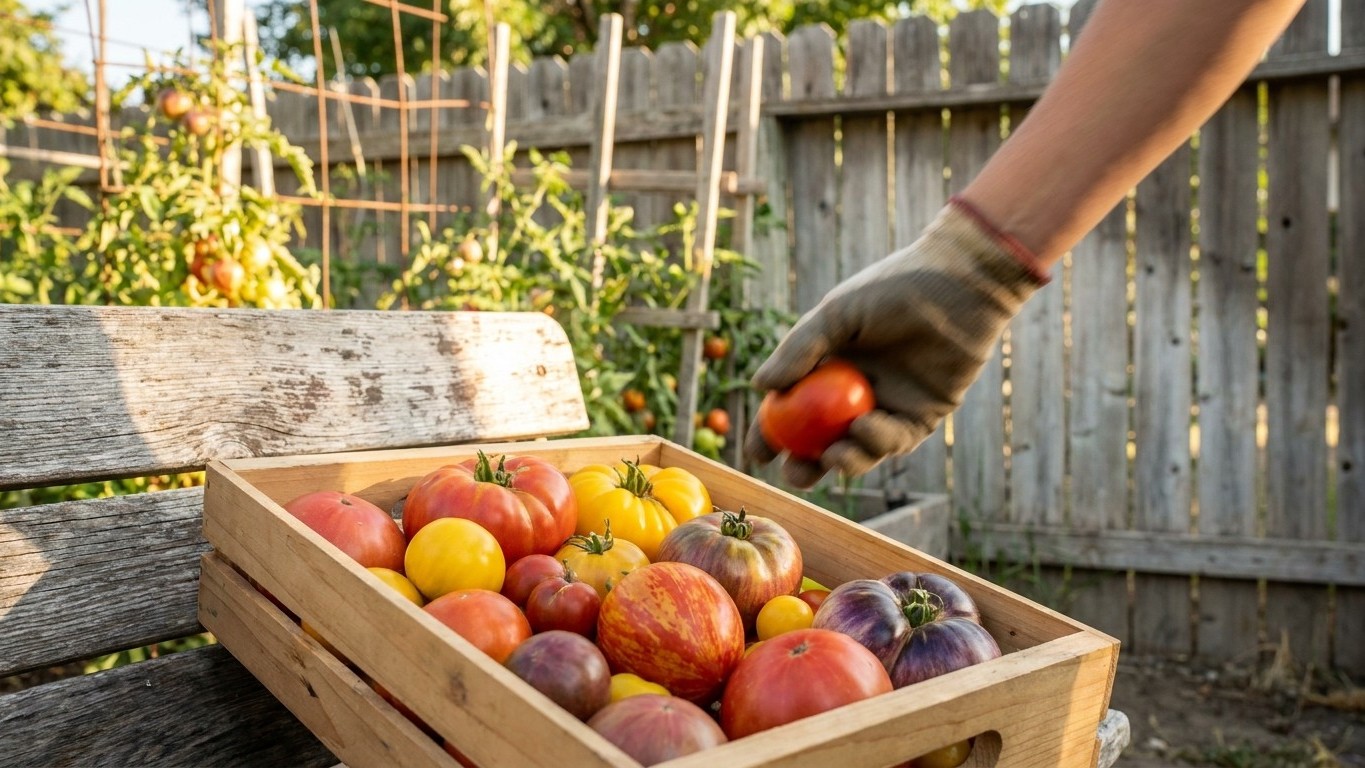

Idaho tomatoes ripen in time when their days-to-maturity number fits inside the frost-free window NOAA’s NCEI 1991-2020 climate normals record for Boise: roughly April 23 to May 7 for the last spring freeze and October 7 to October 21 for the first fall freeze. That gives the valley around five and a half months, though higher parts of the state get much less. Check a variety’s days-to-maturity against that window before you buy the seed packet, not after.
What this comes down to in Idaho

Boise’s fall frost date is the fixed point here, not the seed packet’s days-to-maturity count, which is only ever a guess that shifts a week or two with the season’s heat. Elsewhere gardeners chase the shortest number on the tag; here what matters is how much margin that number leaves before frost actually arrives. Sakura, Sun Gold, and Supersweet 100 all clear that margin from an early-to-late-May transplant, some with far more slack than others.
The varieties below are ordered from shortest season to longest, each one set out early May to late May under the Boise window described above. Where the fruit lands relative to the frost date matters more than the days-to-maturity number by itself, since that number is only ever the seed company’s estimate and shifts by a week or two with a cool or hot season.
Sakura
Sakura reaches first ripe fruit at 55 days from transplant, the shortest of any variety here, and it resists nematodes, tomato mosaic virus, and two races of fusarium wilt. Set out early May to late May, it ripens by mid July with about 84 days of margin left before Boise’s earliest fall frost date, more slack than any other cultivar on this list.
Sun Gold
Sun Gold needs 57 days from transplant and carries high resistance to tobacco mosaic virus and one race of fusarium wilt. It’s a snack tomato, not a canner, and its short season leaves about 82 days of margin before frost at Boise, plenty of room even in a slow summer.
Supersweet 100
At 60 days from transplant, Supersweet 100 resists verticillium wilt and fusarium wilt race 1, and produces heavily right through the season. First ripe fruit lands around mid July with roughly 79 days of margin before the Boise fall frost window opens.
Juliet
Juliet also needs 60 days and adds intermediate resistance to both late blight and early blight, useful in a wet spring. It’s built for sauce and for the lunchbox both, and its margin at Boise runs about 79 days.
Jasper
Jasper matures in 60 days and carries high resistance to late blight along with intermediate resistance to early blight, the strongest disease package of the short-season cherries here. Margin at Boise runs about 79 days, the same as Juliet.
Amalfi
Amalfi needs 68 days from transplant and is determinate, meaning it sets and ripens its crop over a shorter window rather than trickling fruit all season. It carries intermediate resistance to late blight, early blight, and nematodes, and leaves about 71 days of margin before frost at Boise.
Cherokee Purple
Cherokee Purple takes 72 days from transplant with no listed disease resistance, so it depends more on good airflow and clean soil than the hybrids around it. First ripe fruit lands in early August with about 67 days of margin before Boise’s frost window opens, enough for a slicing tomato most seasons but with less room than the shorter varieties above.
Big Beef Plus
Big Beef Plus also runs 72 days but adds intermediate resistance to nematodes and high resistance to gray leaf spot and tomato mosaic virus. It’s the safer bet of the two 72-day beefsteaks on this list if disease pressure is a concern, with the same 67-day margin at Boise.
Tiren
Tiren needs 75 days and resists verticillium wilt, tomato mosaic virus, and fusarium wilt race 1, all rated high. First ripe fruit falls in early August, leaving about 64 days before Boise’s earliest fall frost date.
Granadero
Granadero also takes 75 days, with intermediate resistance to nematodes and high resistance to verticillium wilt and tomato mosaic virus. It’s a paste type, ripening in early August with the same 64-day margin as Tiren.
San Marzano II
San Marzano II needs 78 days from transplant and carries no listed disease resistance, so it wants a spot with good drainage and space between plants. First ripe fruit arrives in early August, leaving about 61 days of margin at Boise.
Celebrity Plus
Celebrity Plus also runs 78 days but is determinate and resists nematodes, gray leaf spot, and tomato mosaic virus. It ripens most of its crop in a shorter window than an indeterminate of the same maturity length, which matters if an early frost cuts the season short. Margin at Boise runs about 61 days.
Brandywine
Brandywine takes 78 days from transplant, carries no listed disease resistance, and grows on a potato-leaf vine rather than the usual serrated tomato foliage. First ripe fruit lands in early August with about 61 days of margin, the same as the other 78-day varieties above, but with less built-in insurance against disease.
Amish Paste
Amish Paste is the longest-season variety on this list at 85 days from transplant, with no listed disease resistance. First ripe fruit doesn’t arrive until mid August, leaving only about 54 days of margin before Boise’s earliest fall frost date, the tightest window of any cultivar named here.
| Variety | Days to maturity | Plant type | Fruit type | Margin before Boise frost |
|---|---|---|---|---|
| Sakura | 55 | Indeterminate | Cherry | ~84 days |
| Sun Gold | 57 | Indeterminate | Cherry | ~82 days |
| Supersweet 100 | 60 | Indeterminate | Cherry | ~79 days |
| Juliet | 60 | Indeterminate | Grape | ~79 days |
| Jasper | 60 | Indeterminate | Cherry | ~79 days |
| Amalfi | 68 | Determinate | Paste | ~71 days |
| Cherokee Purple | 72 | Indeterminate | Beefsteak | ~67 days |
| Big Beef Plus | 72 | Indeterminate | Beefsteak | ~67 days |
| Tiren | 75 | Indeterminate | Slicer | ~64 days |
| Granadero | 75 | Indeterminate | Paste | ~64 days |
| San Marzano II | 78 | Indeterminate | Paste | ~61 days |
| Celebrity Plus | 78 | Determinate | Slicer | ~61 days |
| Brandywine | 78 | Indeterminate | Beefsteak | ~61 days |
| Amish Paste | 85 | Indeterminate | Paste | ~54 days |
Working it out for your own garden
The math is the same for every variety, and it still works if you move to a different address, because it depends only on your own frost dates. Start from Boise’s last spring freeze window, April 23 to May 7 per NOAA’s NCEI 1991-2020 normals, add a couple of weeks for the soil to warm, and you land on the early-May-to-late-May transplant window used for every cultivar above. Add the variety’s days-to-maturity to that transplant range and you get a range for first ripe fruit, never a single date, because the transplant window itself is a range.
Run it for Sakura: transplant early May to late May, add 55 days, and first ripe fruit lands around mid July. Boise’s first fall freeze, per the same NOAA normals, runs October 7 to October 21, leaving roughly 84 days of slack after that first ripe fruit before frost becomes a real risk. That’s wide enough that a cool July or a mild disease season barely touches the outcome.
Now run it for a longer-season cultivar. Amish Paste needs 85 days from transplant, which puts first ripe fruit around mid August and leaves only about 54 days of margin before Boise’s earliest fall freeze date. That margin is still positive at Boise, but it’s the thinnest of any variety named here, and in a higher or more northern part of the state, where the frost-free season runs measurably shorter than Boise’s, that same variety can lose its margin entirely and fail to finish. For the exact arithmetic at your own address, work from Tomato Planting Dates in Idaho: Counting Back From Your Frost Window rather than from Boise’s figures alone.
What changes across the state
Boise sits in a low valley, and NOAA’s frost normals for the city describe conditions there, not the state as a whole. Idaho’s growing regions span from valley floor to well over a mile high, and every meaningful gain in elevation trims the frost-free season, both by delaying the last spring freeze and pulling the first fall freeze earlier. Gardeners farming higher ground in central and eastern Idaho routinely work with a season measured in weeks less than Boise’s.
Latitude adds another layer. The northern Panhandle sits under a different weather pattern than the Snake River Plain around Boise, with cooler summer nights that slow a tomato plant down even before frost becomes the limiting factor. The USDA’s Plant Hardiness Zone Map puts the state across a wide 3b to 7b range, and that spread alone tells you the Boise frost dates above cannot be assumed to hold true even one county over.
Local terrain matters just as much as elevation or latitude. A garden in a low spot that collects cold air overnight sees frost well before a garden on a gentle slope a quarter mile away, and a site near a large reservoir or river often runs a week or two milder than open ground nearby. None of that shows up in a single weather station reading, which is exactly why the Boise figures here are a starting point, not a promise.
The mistakes this state punishes

The most common mistake is setting transplants out on the first warm weekend rather than waiting for the frost window itself to close. A run of warm April days can fool a gardener into planting weeks before Boise’s own last-freeze window of April 23 to May 7 has passed, and a single freeze night afterward kills the whole flat. Cold soil does damage even without a hard freeze, since a transplant set into soil that’s still too cool simply stalls and sits, losing days it never gets back. Signs of a stalled transplant include:
- Leaves that turn dull purple along the veins
- No visible new growth for two weeks or more after transplant
- Seedlings that stay stunted for the rest of the season even after the weather warms
The second mistake is picking a variety for its flavor reputation without checking its days-to-maturity against the season actually available. A gardener at elevation who plants Amish Paste because a neighbor down in the valley grows it well may watch the fruit color up just as the first fall freeze arrives, or not at all. Matching the cultivar to the local window, using the method in the section above, avoids that outcome before a single seed goes in the tray.
The third mistake is ignoring pest pressure until it has already cost part of a harvest. Idaho’s growing season lines up with specific pest arrivals worth watching for, covered separately in Tomato Pests in Idaho: Which Ones Actually Show Up Here, and a gardener who already knows what to expect and when catches a problem while it’s still small enough to manage.
Checking this against your county
Every figure above comes from one NOAA weather station near Boise, and it is a starting point, not an instruction for your own garden. Check your own county’s frost dates before locking in a transplant date, especially if you garden at elevation or in one of the state’s colder valleys. The University of Idaho Extension, at uidaho.edu/extension, publishes county-level guidance and can point you toward local frost data closer to home than Boise’s. For the general steps of raising a tomato crop in this state, from soil prep through staking, see growing tomatoes in Idaho.
Common questions
Will a 90 day tomato still ripen here?
None of the varieties named above run that long, and for good reason: the longest, Amish Paste at 85 days from transplant, already leaves only about 54 days of margin at Boise. Going longer than that leaves almost no room for a cool summer, and in a colder or higher part of the state there may not be enough season left for it to finish at all.
Is days to maturity counted from seed or from transplant?
For every cultivar here, days-to-maturity is counted from the transplant date, not from when the seed was sown. If you direct-seed into the garden instead of setting out started plants, add several weeks to reach the same first-ripe date, since the seed still has to germinate and grow to transplant size first.
Do determinate varieties ripen faster than indeterminate ones?
Not by type alone. Celebrity Plus, a determinate, and San Marzano II, an indeterminate, both list 78 days from transplant. What determinate habit changes is how the crop ripens, setting most of its fruit in a shorter window and then stopping, which matters if an early frost cuts the season short partway through.
What if I already have transplants but missed the recommended window?
A late transplant can still produce a harvest if you lean toward a shorter cultivar like Sakura or Sun Gold rather than a long-season paste tomato. Check the remaining days before your area’s expected fall frost against the variety’s days-to-maturity first, and if the margin looks thin, plan on picking fruit green and ripening it indoors rather than counting on vine-ripe tomatoes.