
Iowa gardens see the same six tomato pests almost every year, and they show up in a predictable order. NOAA’s 1991-2020 climate normals put Des Moines’ last spring freeze between April 12 and April 24, and that same stretch is when cutworms and flea beetles hit new transplants hardest. Check the base of every seedling for cut stems in the first week after you set plants out, since that’s the single window where losing a transplant is most likely.
What this comes down to in Iowa

Cutworms hit Iowa tomato transplants in that narrow April 12 to April 24 window, not the vague “early season” timeline most tomato guides throw around for the whole country. That’s the difference here — Iowa’s pest calendar runs on its own clock, shaped by soil temperatures and planting dates that don’t match what a national gardening article assumes. Six pests actually have a track record in Iowa gardens, and knowing when each one shows up matters more than knowing every pest that could theoretically bother a tomato plant.
The six pests below have a genuine track record in Iowa gardens, listed in the order you’re likely to meet them across a typical season.
Cutworms
Cutworms show up right at transplanting, lining up with that April 12 to April 24 window. They’re dull gray or brown caterpillars, roughly an inch to an inch and a half long, that curl into a tight C shape when you disturb the soil around a plant. They feed at night and chew through stems right at the soil line, dropping a seedling that looked fine the evening before. A cardboard collar pushed an inch into the soil around each stem stops them cold.
Flea Beetles
Flea beetles arrive alongside cutworms but go after leaves instead of stems. They’re tiny, shiny black beetles, barely a sixteenth of an inch long, that jump like fleas when you brush the plant. Their feeding leaves a scatter of small round holes across young leaves, often called shothole damage. Established plants usually outgrow it, but a heavy hit on a fresh transplant can stall growth for a week or more. Floating row cover set over transplants at planting keeps the beetles off until the plants toughen up.
Colorado Potato Beetle
Colorado potato beetle turns up on tomatoes as well as its namesake crop, usually as plants size up in late spring. The adult is oval, about three-eighths of an inch, with cream and black stripes running lengthwise down its wing covers. The larvae are humpbacked, reddish-orange with two rows of black spots, and they do more leaf damage than the adults do. Handpicking both stages off the plant works well on a small planting, since neither one moves fast.
Aphids
Aphids build up through early and midsummer, clustering on the undersides of leaves and along new stem growth. They’re small, soft-bodied, pear-shaped insects, usually pale green or yellowish, and they move in colonies rather than alone. Heavy infestations curl and yellow the leaves and leave a sticky residue called honeydew that draws ants. A strong jet of water knocks most colonies down, and insecticidal soap handles what’s left.
Tomato Hornworm
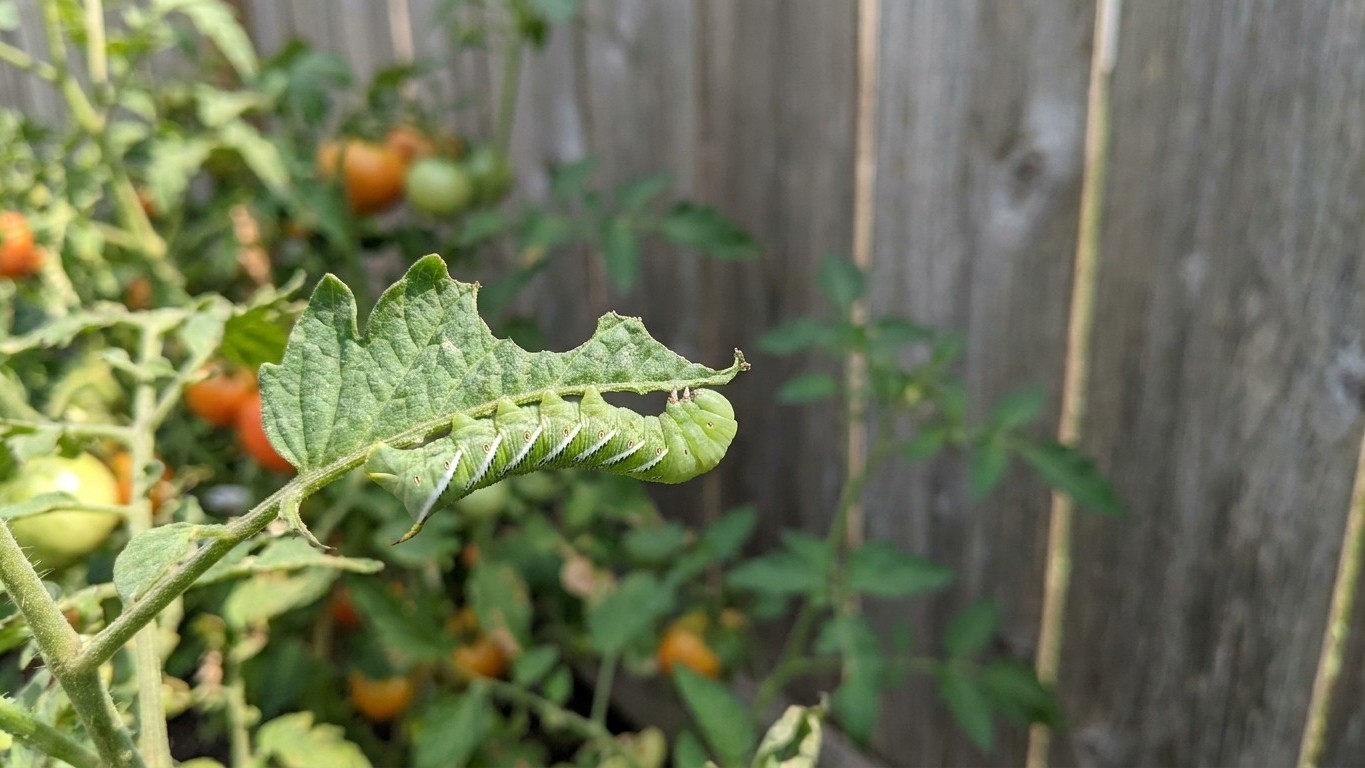
Tomato hornworm is the pest most gardeners actually notice, usually from mid to late summer once plants are full-sized. It’s a big caterpillar, bright green with pale diagonal stripes down each side and a curved horn at the tail end, reaching up to about four inches long before it’s done feeding. A single hornworm can strip a branch of leaves in a couple of days, and dark droppings on the ground below the plant are often the first sign you have one. Handpicking is still the most reliable control, since the caterpillar is large enough to spot once you know where to look.
Stink Bugs
Stink bugs move in as fruit starts to ripen, typically from late summer into the weeks before the first fall freeze. Adults are shield-shaped, roughly half an inch long, and show up in either brown or green depending on the species. They pierce ripening fruit to feed, leaving pale or discolored blotchy spots under the skin that show up clearly once you slice into the tomato. Keeping the area around the tomato bed free of tall weeds removes the cover they use to move in undetected.
Working it out for your own garden
Matching a symptom to a pest starts with what’s damaged, not what’s crawling on the plant when you happen to look. Work through the timeline first: a cut stem right after transplant near the April frost window points to cutworms, while shothole leaf damage at the same stage points to flea beetles. Damage showing up in July or August points somewhere else entirely, since hornworms and stink bugs build their populations through the warm part of the season. For the arithmetic behind exactly when that transplant window falls, Tomato Planting Dates in Iowa: Counting Back From Your Frost Window walks through it in detail.
Reading the damage
A quick table narrows things down faster than guessing from memory:
| Symptom | Likely pest | Stage causing it |
|---|---|---|
| Seedling cut off at soil line | Cutworm | Larva |
| Small round holes in young leaves | Flea beetle | Adult |
| Leaves stripped, humpbacked orange grubs visible | Colorado potato beetle | Larva |
| Sticky residue, curled new growth | Aphid | Nymph and adult |
| Large green caterpillar, branch stripped bare | Tomato hornworm | Larva |
| Blotchy pale spots under fruit skin | Stink bug | Adult and nymph |
Check the plant before you buy a treatment. A product aimed at aphids does nothing to a cutworm problem, and a spray for beetles won’t touch a hornworm.
A seasonal checklist
Because Des Moines’ frost-free stretch runs from the April 12-24 window out to the October 14-25 window NOAA tracks, a tomato plant here can host all six of these pests in sequence over roughly five to six months. A short weekly routine catches most of them before they cause real damage:
- Check stems at the soil line during the first week after transplant
- Turn leaves over to spot aphid colonies before they build up
- Look for dark droppings on the ground under the plant, a sign of a hornworm above
- Slice into a spotted fruit to confirm stink bug feeding rather than blossom end rot
What changes across the state
The frost and pest timelines above are anchored to Des Moines, and the rest of Iowa doesn’t match it exactly. USDA’s Plant Hardiness Zone Map places the state across zones 4b to 6a, a wide enough span that a garden near the state’s northern border works with a noticeably shorter frost-free season than one near the Missouri line. Iowa State Extension’s own county-level data, drawn from records running from 1950 to 2021, comes in about four days later in spring and ten days earlier in fall than the airport-based NOAA figures used above, so treat the Des Moines dates as the early end of what’s possible rather than a number that applies everywhere.
Zones and river corridors
That gap matters for pests because a shorter season compresses everything. Cutworm and flea beetle activity still starts once soil warms enough to transplant, but in the cooler north that point simply arrives later, and hornworms and stink bugs get correspondingly fewer weeks to build up before frost knocks plants back. Southern Iowa, with its longer frost-free stretch, gives late-season pests like stink bugs more time to work on ripening fruit before the season ends.
A garden tucked against a south-facing wall or sitting in a low frost pocket won’t track the airport average either way. One warms faster in spring, the other collects cold air overnight. Elevation and closeness to the Mississippi or Missouri river valleys shift things further, since river corridors tend to moderate overnight lows compared to open cropland a few miles off.
None of this changes which pests show up. Cutworms, flea beetles, aphids, Colorado potato beetle, hornworms and stink bugs are established statewide. What shifts is the calendar each one runs on, and that’s worth checking against your own county’s data before setting a scouting schedule off a Des Moines-based figure alone.
The mistakes this state punishes

The most common misstep in Iowa is transplanting the moment the calendar clears the freeze risk, without checking that the soil itself has caught up. A run of warm days followed by a cool, wet spell right after the April 12 to April 24 window that NOAA tracks for Des Moines leaves seedlings sitting in cold, damp ground exactly where cutworms are most active, and a stressed transplant is easier for them to cut through. Wait for the soil to warm along with the air, not just for the date, before setting plants out.
Four fixes that cost nothing
A second mistake is spraying before confirming which pest is actually responsible. Colorado potato beetle larvae and hornworm caterpillars both strip leaves, but a product aimed at one does little against the other, and a wasted application costs a week you can’t get back once feeding accelerates in midsummer heat.
Gardeners also tend to miss stink bug damage until harvest, mistaking the blotchy spots under the skin for blossom end rot or frost injury. By the time fruit is picked, the bugs have usually been feeding for weeks. Slicing open one suspect fruit as soon as spotting appears, rather than waiting for a full ripening, catches the problem while there’s still time to act on the rest of the crop.
Skipping crop rotation compounds the Colorado potato beetle problem specifically, since adults overwinter in soil and emerge in the same bed if tomatoes, potatoes or eggplant go back in the same spot year after year. Moving nightshade-family crops to a different section of the garden each season breaks that cycle without a single spray. Choosing a variety with some built-in disease resistance, covered on Tomato Varieties That Ripen in Time in Iowa, also reduces how much damage a disease-carrying pest like aphids can do even before you treat for the aphids themselves.
Checking this against your county
Everything above is anchored to Des Moines, and Iowa State Extension’s own county-level records already show a four-day-later spring and ten-day-earlier fall pattern across the state compared to that airport station. Before building a season around these six pests, check your county extension office’s current pest alerts, since outbreak years, and even which pest dominates, shift by region and by the weather a given spring brought. Iowa State University Extension and Outreach publishes both statewide tomato pest updates and county contact information, and that’s the more current word once your own garden’s conditions diverge from an airport average. The basics of growing tomatoes in Iowa are worth reviewing alongside this if you haven’t settled on site and spacing yet, since crowded plants make several of these pests harder to spot early.
Common questions
My tomato leaves have small holes but I never see any bugs on them?
That’s the usual pattern with flea beetles. They’re barely a sixteenth of an inch long, feed mostly at dawn and dusk, and drop off the leaf the moment the plant moves. Check at those times of day, or shake a leaf gently over a white sheet of paper to see what falls off.
Are ladybugs enough to keep aphids off my tomatoes?
They help but rarely handle a heavy infestation on their own. Ladybug larvae eat aphids steadily, but by the time a colony is thick enough to notice, a strong water spray or insecticidal soap will clear it faster than waiting on predators to catch up.
Do marigolds actually keep tomato pests away?
There’s no reliable evidence that marigolds repel the pests covered here. Regular scouting for cut stems, shothole leaves, and caterpillars does far more than any companion planting choice.
Can I still eat a tomato that has stink bug spots on it?
Yes. Cut around the discolored patch and the rest of the fruit is fine to eat, though the texture right under the spot can be a little mealy. It won’t spread once the fruit is off the vine.