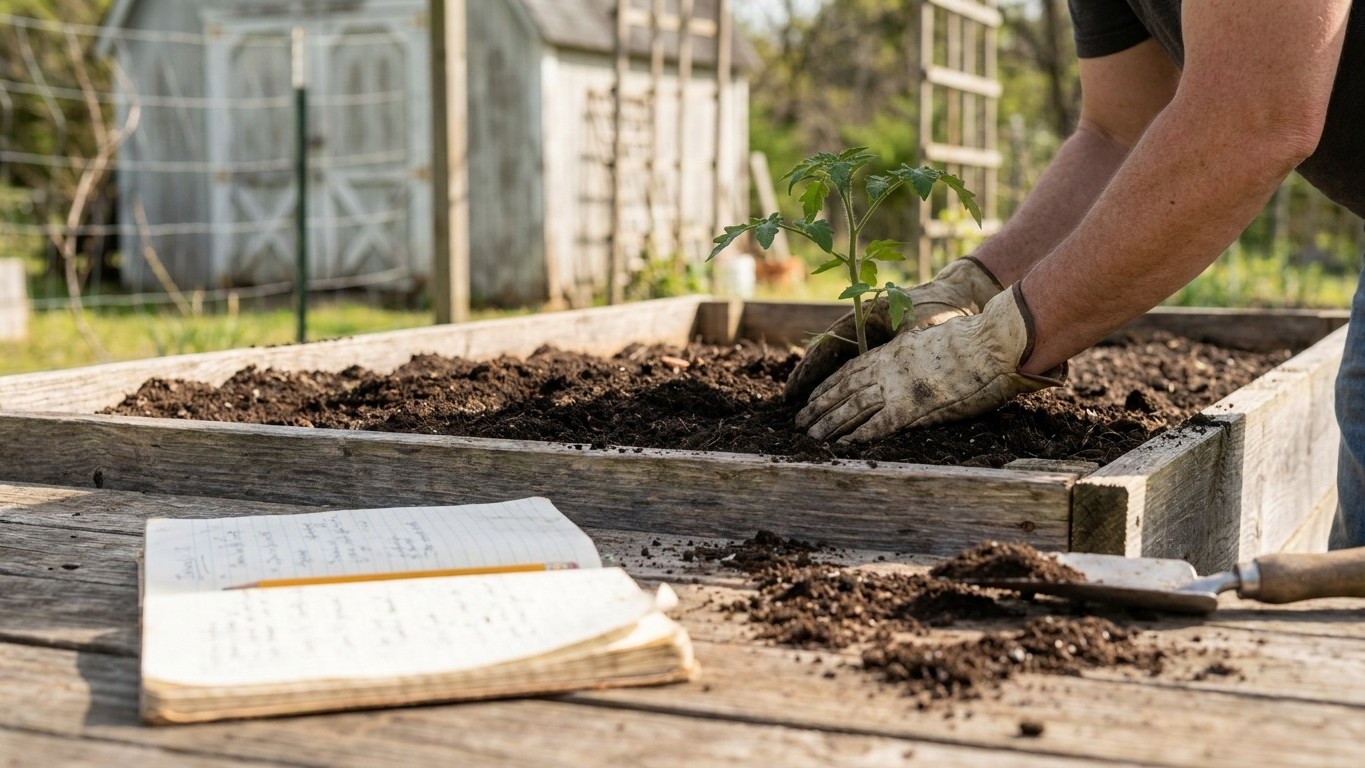

Tennessee tomatoes go into the ground once the risk of frost has passed, and NOAA’s 1991-2020 climate normals put that last spring frost at Nashville between March 31 and April 12. Start seeds indoors about six to eight weeks before that window opens, and hold transplants until the soil itself has warmed, not just the calendar. Check that Nashville-based window against your own county’s frost record before you set a date, since the eastern half of the state runs noticeably later.
What this comes down to in Tennessee

March 31 to April 12 — that’s the window Nashville gardeners work from when they set out tomato transplants, and everything else in this piece bends around those two dates. Middle Tennessee isn’t the whole state, though: a farm up in the eastern highlands is still shaking off frost when the valleys are already warm underfoot. So treat that window as a starting point for your own math, not a statewide calendar. Where you actually sit on the map changes the count more than any seed packet admits.
The USDA’s Plant Hardiness Zone Map, built from 1991-2020 winter minimum temperatures, spreads Tennessee across zones 5b through 8a. That range on its own doesn’t hand you a planting date since hardiness zones measure winter cold, not spring frost timing, but it’s a useful flag: a state that runs from 5b in the highlands to 8a in the lower valleys is not going to share one transplant week, and treating a single figure as statewide is the most common way this goes wrong. The Nashville figure is a reference point, not a rule, and it’s explicitly measured near that city, not averaged across the state.
Tomatoes are also fussier than the frost line implies. A plant can survive a light frost and still stall for two weeks if it goes into cold, wet soil, so growers here often wait past the closing of the frost window for the ground itself to warm before they set transplants out, even though NOAA’s data doesn’t give a soil-temperature figure to pin that to. Watch the forecast for a stretch of settled, mild nights rather than transplanting the day the frost risk statistically clears.
Working it out for your own garden
Counting back for seed starting
Most tomato seed packets call for starting indoors six to eight weeks before the transplant date. Applied to Nashville’s NOAA-derived frost window of March 31 to April 12, that arithmetic doesn’t produce a single day, it produces another range: subtract six weeks from each end and you land near mid to late February, subtract eight weeks and you land near early February. Taken together, the seed-starting window spans roughly early February to early March, and narrowing that further than the data allows is where a lot of planting calendars go wrong.
Counting forward to check the harvest
Once you’ve picked a cultivar, catalogue days-to-maturity figures let you check whether it has time to ripen before the first fall frost, which NOAA’s same normals put at Nashville between October 28 and November 8. Days-to-maturity are counted from transplant, not from seed, and they shift by a week or two with the weather any given season, so use them as an estimate, not a countdown.
| Cultivar | Days to maturity (catalogue) | Estimated first ripe fruit, Nashville transplant window | Margin before fall frost |
|---|---|---|---|
| ‘Early Girl‘ | ~50 days | Late May to early June | Roughly five months |
| ‘Celebrity‘ | ~70 days | Early to mid June | Roughly four and a half months |
| ‘Cherokee Purple‘ | ~80-85 days | Late June to early July | Roughly four months |
Near Nashville, all three finish with weeks to spare, which is one reason the state’s Tomato Varieties That Ripen in Time in Tennessee page can afford to include some long-season heirlooms. The line shows up somewhere else: on the Cumberland Plateau or in the higher parts of East Tennessee, where spring frost lingers later and the growing season is compressed from both ends, that same 85-to-90-day heirloom transplanted at the tail of a cool, delayed spring can still be ripening its later fruit sets when the region’s own first frost arrives, even though the identical plant finishes comfortably at Nashville. That gap between a statewide catalogue number and a specific yard is exactly why the method matters more than any single date.
What changes across the state
Tennessee’s frost timing shifts with elevation more than with anything else. NOAA’s Nashville-area figure of March 31 to April 12 describes the Central Basin, but climb into the Cumberland Plateau or the higher valleys of East Tennessee and cold air settles and lingers longer into spring, pushing the safe transplant date later than that reference window suggests. The same terrain works in reverse come fall, since those cooler, higher spots also tend to see their first frost arrive sooner relative to the calendar than the lower basin does.
Latitude matters less here than the mountains do. Tennessee runs about the same distance north to south along most of its length, but its elevation runs from river bottoms to peaks over a mile high, and that vertical range does more to shift a frost date than a hundred miles of flat latitude would. The USDA’s zone map, spreading the state across 5b to 8a, is really a map of that elevation change as much as anything else.
Local terrain features matter too. A garden in a low frost pocket, a valley bottom, or a spot with poor air drainage will collect cold air on a still night and frost later in spring and earlier in fall than a garden just up the slope from it. None of this shows up on a statewide chart, and it’s the reason two gardens twenty miles apart can need transplant dates a week or more apart even when they sit in the same county.
- Higher elevation (Cumberland Plateau, mountain valleys): later spring frost, earlier fall frost, shorter season overall.
- Low-lying frost pockets: cold air settles and lingers regardless of regional averages.
- Open, elevated sites with good air drainage: often clear frost sooner than the valley floor below them.
The mistakes this state punishes

The costliest mistake is trusting a warm week in March and setting transplants out before the frost window has actually closed. Tennessee spring weather swings hard, and a run of 70-degree days can be followed by a hard freeze within the same NOAA-defined probability window, since March 31 to April 12 is a band of risk, not a hard cutoff. Plant to the closing end of that window, not the opening one, unless you’re set up to cover plants overnight.
The second is picking a variety whose days-to-maturity don’t fit the season actually available where you garden. That risk is smallest near Nashville, where the frost-to-frost season is long enough to carry most catalogue varieties, and largest in the cooler, higher parts of the state discussed above, where a 90-day-plus heirloom leaves little margin. Cross-check any cultivar’s catalogue figure against your own region’s season length rather than assuming the state’s longest growing area applies to your yard; the tomato varieties page walks through more cultivars with that math done for a range of season lengths.
The third is transplanting stressed, cold-shocked seedlings and then blaming the first pest that shows up on them. A tomato set out too early often sits and sulks, and a sulking plant is the one that gets found by early-season insects looking for an easy target. If your seedlings look chewed or wilted shortly after transplant, it’s worth checking Tomato Pests in Tennessee: Which Ones Actually Show Up Here to identify what’s actually on the plant before reaching for a spray, rather than assuming the cold snap alone did the damage.
Checking this against your county
Before you commit to a planting date, call your county’s University of Tennessee Extension office and ask what frost record they use locally, and look for the state’s own tomato planting guide through that same extension system. A five-minute call is cheaper than a flat of transplants lost to a frost the statewide average didn’t predict for your yard.
Common questions
Can I just plant on the same date every year?
No, because NOAA’s frost window itself is a range built from thirty years of data, not a fixed day, and any single season can land early or late within that range. Watch the forecast in the weeks around your local window rather than marking one date on the calendar and treating it as fixed.
What if I already put tomatoes out and a cold snap is coming?
Cover them. Row cover, buckets, or even old sheets thrown over the plants overnight can carry young transplants through a short, light frost, though a hard freeze will still damage or kill uncovered foliage. If the damage is severe, most gardeners are better off replanting than nursing a badly frost-burned seedling back.
Do I count days to maturity from the seed or from the transplant date?
From the transplant date, not from when you sowed the seed indoors. Catalogue days-to-maturity figures assume the plant went into the ground as a young transplant, so add your indoor seed-starting time on top if you’re working backward from a target harvest date.
Is it too late to plant tomatoes if I missed the spring window?
Not necessarily, since many gardeners here still get a full harvest from transplants set out somewhat later than the earliest safe date, especially with shorter-season cultivars. The bigger risk with a late planting is running out of season before the first fall frost recorded by NOAA at Nashville between October 28 and November 8, so lean toward a quicker-maturing variety the later you plant.
Some gardeners also time this by the Moon: when to plant tomatoes by the moon, as almanac tradition rather than fact.