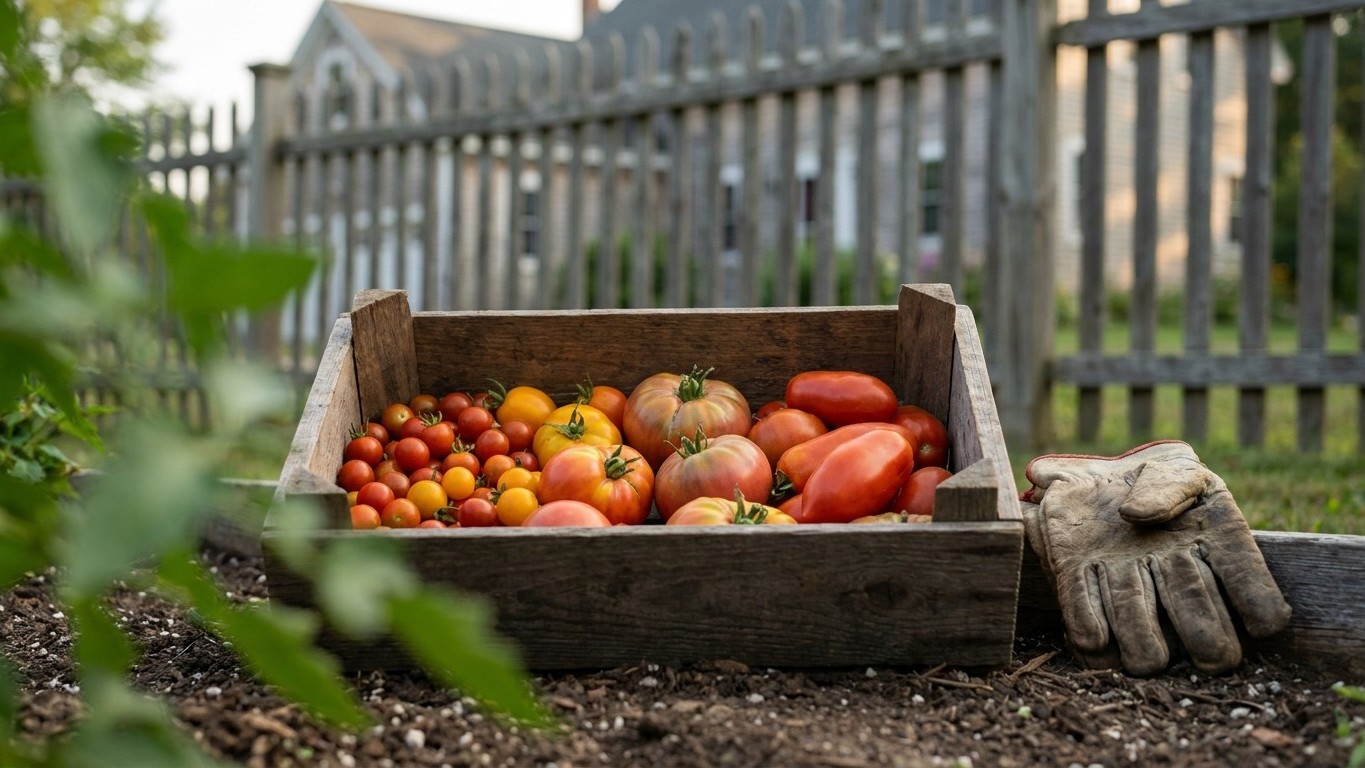

It ripens in time when it colors up before your first hard frost, and for most New Hampshire yards that’s somewhere between October 13 and October 26. That gives you roughly 80 to 100 safe days from a late-April or mid-May transplant, though a low spot or a hillside near you might run shorter. Before you buy seed or start plants, check the days-to-maturity number on the packet against that stretch — that one comparison decides whether you’re eating ripe tomatoes this year or watching green ones sit on the vine while frost warnings pile up.
What this comes down to in New Hampshire

New Hampshire’s growing season is short enough that variety choice decides whether you harvest ripe tomatoes at all, not just how many. NOAA’s 1991-2020 climate normals, recorded at Manchester, put the last spring frost at April 16 to April 27 and the first fall frost at October 13 to October 26. Other parts of the state run colder on both ends, so treat this as a starting point rather than a guarantee, and pair it with the basics laid out in growing tomatoes in New Hampshire before you settle on a variety. Inside that window, the days-to-maturity number on the seed packet is what separates a wide cushion from a finish that depends on a warm September.
The table below lines up nine catalogue varieties against the Manchester frost window, from shortest season to longest, before the details on each one.
| Variety | Days to maturity | Habit | Approx. margin before fall frost* |
|---|---|---|---|
| Sakura | 55 | Indeterminate | 100 days |
| Valentine | 55 | Indeterminate | 100 days |
| Sun Gold | 57 | Indeterminate | 98 days |
| Supersweet 100 | 60 | Indeterminate | 95 days |
| Juliet | 60 | Indeterminate | 95 days |
| Cherokee Purple | 72 | Indeterminate | 83 days |
| Big Beef Plus | 72 | Indeterminate | 83 days |
| Celebrity Plus | 78 | Determinate | 77 days |
| San Marzano II | 78 | Indeterminate | 77 days |
*Margin is calculated from a late April to mid May transplant date to the start of the Manchester-area fall frost window, per NOAA’s 1991-2020 normals. Gardens outside the Manchester area should shorten this figure, sometimes by two weeks or more on each end.
Sakura

Sakura needs about 55 days from transplant to first ripe fruit, which lines up with early July if you set plants out between late April and mid May. It’s a small, glossy red cherry tomato produced in long clusters, better for snacking than sauce. With roughly 100 days of margin before the Manchester-area fall frost, plus resistance to nematodes, tomato mosaic virus, and two races of fusarium wilt, it’s one of the safest bets on this list.
Valentine
Valentine also reaches its first ripe fruit around 55 days from transplant, putting harvest in early July on the same schedule as Sakura. The fruit is a red, oblong grape tomato with a firm skin, carried in long clusters on an indeterminate vine. It carries intermediate resistance to early blight, useful in a wet summer, and leaves about 100 days of margin before frost near Manchester.
Sun Gold

Sun Gold takes about 57 days from transplant to first ripe fruit, close behind the 55-day varieties. The fruit is a small, round, golden-orange cherry tomato with thin skin and a sweet flavor, borne in long trusses on a tall indeterminate vine. It carries high resistance to tobacco mosaic virus and to one race of fusarium wilt, and it still leaves about 98 days of margin before the Manchester-area frost.
Supersweet 100

Supersweet 100 needs about 60 days from transplant, ripening in early July under the same transplant window. It produces small, round, bright red cherry tomatoes in very long clusters on a sprawling indeterminate vine that benefits from a sturdy cage. It carries high resistance to verticillium wilt and to one race of fusarium wilt, with roughly 95 days of margin before frost.
Juliet
Juliet also comes in at about 60 days from transplant, with first fruit in early July. The tomato is a red, oblong grape type with glossy skin, produced in clusters of a dozen or more, useful for roasting as well as fresh eating. It carries intermediate resistance to both late blight and early blight, the two diseases that show up most in a damp New Hampshire August, and it leaves about 95 days of margin before frost.
Cherokee Purple

Cherokee Purple takes about 72 days from transplant, with first ripe fruit expected in late July. It’s a large, slightly flattened beefsteak with dusky pink-purple, almost brownish-red skin and ribbed shoulders, grown for slicing rather than sauce. It carries no listed disease resistance, so it leans on the roughly 83 days of margin before the Manchester-area frost to make up for that, and it’s worth reserving for a warm, sheltered bed.
Big Beef Plus

Big Beef Plus needs about 72 days from transplant as well, also ripening in late July. The fruit is a large, red, round to slightly flattened beefsteak with smooth skin, carried on a tall indeterminate vine. It adds intermediate resistance to nematodes and high resistance to gray leaf spot and tomato mosaic virus on top of Cherokee Purple’s disease profile, with the same roughly 83 days of margin before frost.
Celebrity Plus
Celebrity Plus takes about 78 days from transplant, putting first ripe fruit in late July in a good year. It’s a medium to large, red, uniformly round tomato on a compact determinate bush, useful where space or staking is limited. It carries intermediate resistance to nematodes and high resistance to gray leaf spot and tomato mosaic virus, and its roughly 77 days of margin before frost is the tightest of the varieties on this list that still reliably finish.
San Marzano II
San Marzano II needs about 78 days from transplant, the longest season of any variety here, with first ripe fruit in late July. The fruit is a red, elongated plum tomato with a blunt end, thick meaty flesh, and thin skin, grown specifically for sauce and canning. It carries no listed disease resistance and leaves about 77 days of margin before the Manchester-area frost, enough in most years but the variety most likely to be caught short in a cool, late spring or in a garden well outside Manchester.
Working it out for your own garden
Every date here is arithmetic, not a fact fixed to the calendar. Start with NOAA’s 1991-2020 fall frost window for Manchester, October 13 to October 26, and subtract a variety’s days-to-maturity figure, counted from the transplant date rather than the sowing date. The remainder is your margin, and because both the frost window and the days-to-maturity figure are ranges rather than points, the answer is always a range too. For the arithmetic on your own transplant date, see Tomato Planting Dates in New Hampshire: Counting Back From Your Frost Window.
Take Big Beef Plus as a worked example. Set out between late April and mid May, its 72 days to maturity puts first ripe fruit in late July. Counting forward to the Manchester-area fall frost window leaves roughly 83 days of cushion after that first fruit, which is why it sits comfortably inside the season even allowing for a slow, cool July.
Now take San Marzano II, at 78 days to maturity and the same transplant window. On paper it still leaves about 77 days of margin at Manchester. But NOAA’s normals are measured at the airport, and gardens elsewhere in the state typically see the last spring frost arrive one to two weeks later and the first fall frost arrive one to two weeks earlier, more at elevation. Stack both of those against a paste tomato that already needs the longest season on this list, and that 77-day cushion can shrink to a few weeks, or vanish altogether in a hill town having a cool, late spring. That’s the calculation to run before committing a whole bed to a 78-day variety: not whether it fits at Manchester, but whether it fits where you actually garden.
What changes across the state
The Manchester figures above come from one weather station in the southern part of the state, and New Hampshire’s climate isn’t uniform enough to apply them everywhere. USDA’s Plant Hardiness Zone Map puts the state at a range of zone 3b to zone 6a, which on its own tells you how much the growing season can stretch or shrink depending on where you stand.
Elevation and terrain
Elevation is the biggest factor. Gardens in the White Mountains and the higher parts of the North Country sit at the cold end of that USDA range, with a shorter frost-free season than the Manchester figures suggest, sometimes by several weeks. Low-lying river valleys can trap cold air overnight even at modest elevation, so a garden in a hollow can run colder than one on a slope nearby, whatever the county’s average looks like.
Water, and north versus south
The Seacoast and the shores of larger lakes, including Lake Winnipesaukee, tend to moderate temperature swings in both spring and fall, since a large body of water cools and warms more slowly than open ground. That can push both frost dates later on the immediate shoreline, though it doesn’t change the underlying calculation, only where a given garden sits within the range. South to north is the broadest pattern of all: the Merrimack Valley and towns nearer Manchester generally see a longer season than Coos County and the far north, where the same 78-day tomato that finishes easily in the south is the one most likely to get caught out.
The mistakes this state punishes

The most common mistake here is trusting a warm stretch in April instead of the soil itself.
The second is picking a 78-day variety for a garden that, per the elevation and terrain effects above, effectively runs closer to New Hampshire’s colder USDA zones than to the Manchester reference point. In that situation, a 55 to 60 day variety such as Sakura, Sun Gold, or Juliet is the safer choice, even if it means giving up on paste tomatoes for the year.
The third is missing the point in the season when a particular pest or disease actually shows up, since scouting or treating at the wrong time wastes the one narrow window that works. Tomato Pests in New Hampshire: Which Ones Actually Show Up Here lays out that timing pest by pest, and it’s worth reading alongside variety choice, since resistance codes for nematodes, verticillium, or fusarium only matter if that specific problem is present in your soil to begin with.
- Transplanting into cold soil after a warm stretch, instead of waiting for the soil itself to warm.
- Choosing a 78-day variety for a garden that runs colder than the Manchester reference point.
- Ignoring disease resistance codes on the seed packet when that disease isn’t present in your soil.
- Skipping the pest-timing window covered on the pests page linked above.
Checking this against your county
Every figure here comes from one station near Manchester, and NOAA is explicit that its normals are a station-level product, not a statewide one. Before you commit to a planting date or a variety, check your own county’s numbers against UNH Extension’s tomato guidance at extension.unh.edu, and call your county extension office directly if you garden at elevation, near the coast, or in the North Country, where the Manchester figures are least likely to match what actually happens in your yard.
Common questions
Will Cherokee Purple actually ripen before frost here?
Cherokee Purple’s 72 days to maturity leaves about 83 days of margin against the Manchester-area fall frost window, so in most gardens close to that reference point it ripens with room to spare. It carries no listed disease resistance, though, so a wet or blight-prone summer is more likely to cut its season short than the frost date is.
What does “days to maturity” actually count from?
It counts from the transplant date, not from when you sowed the seed indoors, and catalogue figures shift by a week or two depending on the weather that particular season. A seed packet listing 60 days is telling you about the plant’s own clock, not about your specific spring.
Can I still plant tomatoes if I’m running late into June?
A short-season cherry variety such as Sakura, Valentine, or Sun Gold still has a realistic shot at ripening even from a June transplant in the milder, southern parts of the state, since their 55 to 57 days to maturity leaves room to spare against the Manchester fall frost window. A 78-day variety like San Marzano II is a much bigger risk that late, and probably not worth the bed space.
Do I need disease-resistant varieties in New Hampshire?
Only if the specific disease or pest the resistance code covers is actually present in your garden. New Hampshire’s humid summers make early blight and late blight common enough that the intermediate resistance carried by Valentine and Juliet is a real advantage, but a resistance code for a nematode or wilt you’ve never had does nothing for you either way.