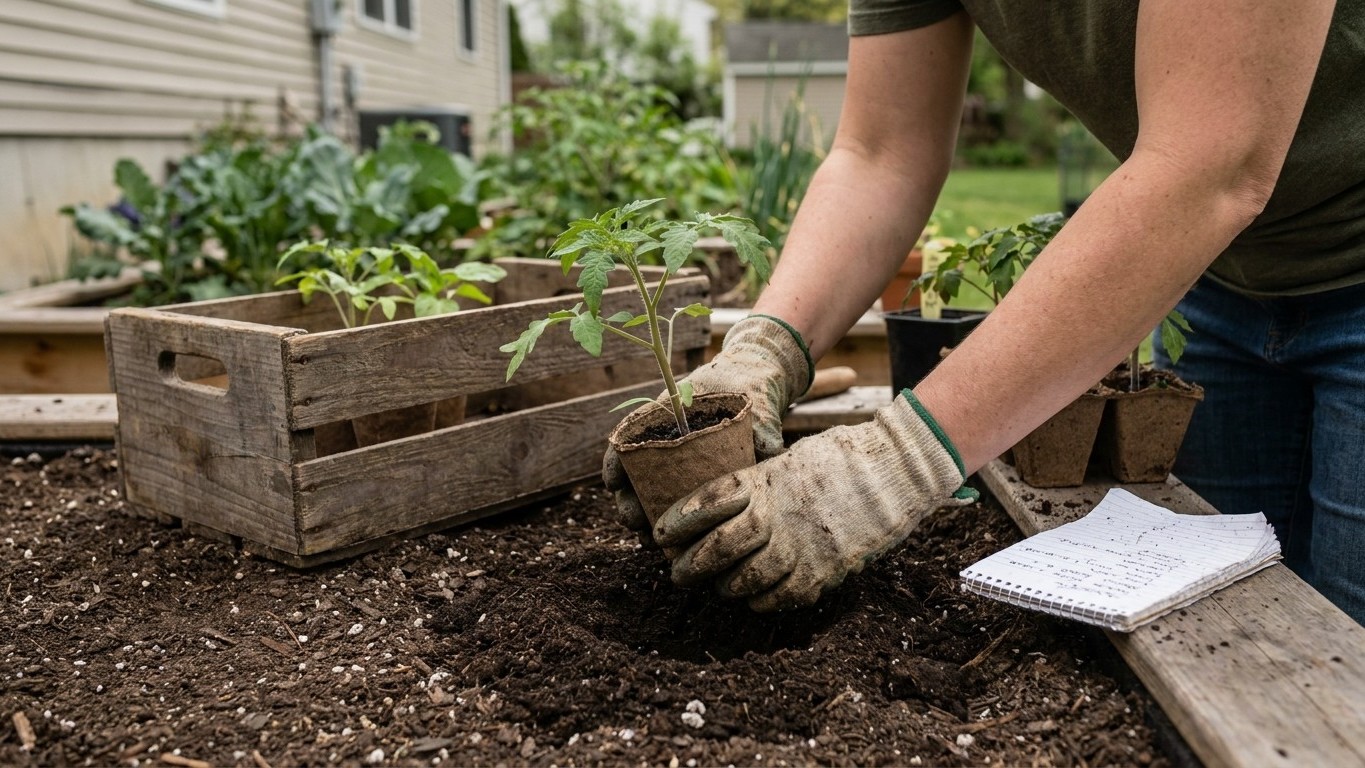

In New Jersey, tomato transplants go into the ground once the last frost risk has largely passed, which near Newark falls between March 29 and April 6. That means seed-starting indoors begins roughly six to eight weeks earlier, putting most kitchens on an early-February timeline. Turn that single reference window into a planting date for your own yard, using the frost window from your area and the days-to-maturity number printed on your seed packet.
What this comes down to in New Jersey

The frost window that matters most for tomatoes here is the one measured at Newark, where NOAA’s 30-year averages put the last spring freeze between March 29 and April 6 and the first fall freeze between November 4 and November 16. Tomatoes are a heat-loving crop with zero frost tolerance, so the safe transplant date sits at or after the spring end of that window, not before it. The basics of growing tomatoes in New Jersey are already covered, so the calendar is what matters here.
That window is a probability band, not a guarantee. NOAA calculates it from the years when a 32-degree freeze had between a 30 and 70 percent chance of happening at that station, which means a frost after April 6 is still plausible in a cold year, and one before March 29 hasn’t been fully ruled out either. Treat the range as a planning tool, not a lock.
Counting back to a seed-starting date
Working backward from that transplant window, seed-starting indoors typically happens six to eight weeks before the plants go outside. Subtracting six to eight weeks from March 29 to April 6 lands most kitchen windowsills on an early-to-mid February start, though the exact week shifts a little depending on which cultivar you’re growing and how warm your indoor setup runs. That single calculation is the backbone of everything else, which is an adjustment layered on top of it for your specific county, cultivar, and season.
If you haven’t settled on which varieties to grow yet, that decision changes how much slack you have on the back end of the season; see Tomato Varieties That Ripen in Time in New Jersey for cultivars sorted by how much of that Newark-length season they actually need.
Working it out for your own garden
The method behind every tomato planting date is the same, whether you garden near Newark or up in the northwest hills: find your own frost window, pick a cultivar’s days-to-maturity number off the seed packet, and run the arithmetic in both directions, spring and fall.
- Find your local frost window from your county extension office or NOAA climate normals, not just the Newark figure above.
- Read the days-to-maturity number off the seed packet or catalog listing, remembering it’s counted from transplant, not from seed.
- Add that number to the spring end of your frost window to estimate when the first ripe fruit should show up.
- Check that estimate against your local fall frost window, leaving a few weeks of margin, not zero.
Running the numbers on a real cultivar
Take a short-season slicer like Early Girl, which most catalogs list at 50 to 59 days to maturity from transplant. Add that to a transplant date somewhere in the March 29 to April 6 window and the first ripe fruit should show up somewhere in the second half of May to early June, well ahead of the November 4 to 16 fall frost window. There’s enough slack in that math to survive a cool, slow spring without losing the crop.
Now run the same math on a longer-season heirloom like Cherokee Purple, typically listed at 80 to 90 days. Transplanted at the same time, its first ripe fruit lands closer to late June through July, which still finishes comfortably before the fall frost window opens. The real risk with a cultivar like this isn’t the catalog number, it’s a late transplant: push that same 80-to-90-day tomato into the ground three or four weeks behind schedule, because of a wet spring or a slow hardening-off period, and the harvest window shifts to bump right up against the November frost dates, leaving no cushion for a cool September that slows ripening before frost even arrives.
For pest timing, the method is different: instead of counting days, match what you’re seeing on the plant, chewed leaves versus stippled foliage versus a wilting stem, against the point in the season when that particular pest typically shows up. That’s worked out pest by pest in Tomato Pests in New Jersey: Which Ones Actually Show Up Here, but the planting-date takeaway is that pushing transplant later to dodge frost risk also tends to push the crop into a heavier pest window later in summer.
What changes across the state
Newark’s frost window is a single data point from one weather station near the coast in the northern part of the state, and New Jersey’s growing conditions vary enough that no single date works everywhere. The state spans USDA zones 6a to 7b, and that two-zone spread alone tells you the season length differs meaningfully between the coldest and warmest corners.
Elevation and inland cold
Elevation is the biggest driver inland. The ridges and valleys of the Skylands region in the northwest sit higher and colder than the Newark station, so gardeners there should generally expect both a later last spring frost and an earlier first fall frost than the Newark figures suggest, sometimes by a week or two on either end. A garden tucked into a valley bottom collects cold air on a still night the way a bowl collects water, while one on a gentle slope drains that cold air away, which is a microclimate effect that can matter as much as which county you’re in.
Coastal moderation
Coastal and southern counties tend to run the opposite direction from the northwest hills: the ocean and the bay moderate temperature swings, so spring often arrives a little earlier and fall frost holds off a little longer than at Newark, though local fog and low-lying frost pockets can still catch a garden by surprise on an otherwise mild night. Treat the Newark window as a starting point, then adjust it based on what your own yard has actually done in past seasons.
The mistakes this state punishes

The single most common mistake is planting into cold soil after a warm spell. New Jersey often gets a stretch of 70-degree days in late March or early April that feels like summer, right in the middle of the Newark frost window, and gardeners plant that week because the air feels ready. The soil underneath is usually still cold from winter, and a tomato transplanted into cold soil doesn’t die, it just stalls, sometimes for weeks, while a plant put in a bit later in warmer soil catches up and passes it.
The second is choosing a variety with more days to maturity than the season comfortably allows, then compounding it with a late transplant. As the arithmetic above shows, most cultivars have enough runway between the spring and fall frost windows here, but that runway shrinks fast if the transplant date slips. A long-season heirloom and a late spring are a bad combination, and it’s the pairing, not either factor alone, that tends to cost gardeners their harvest.
The third is ignoring the probability built into the frost window itself. Because the spring date is a 30-to-70 percent band, a frost is still possible for some time after it closes, just less likely. Gardeners who transplant on the earliest edge of the window without a way to cover plants overnight are betting on the low-probability side of that range, and some years they lose that bet. Keep a frost cloth or an old sheet on hand through at least the first couple of weeks after transplanting, not just on the calendar date the window happens to open.
Checking this against your county
Before you commit a whole flat of seedlings to a date, check it against your county’s extension office and against Rutgers’ statewide guidance at njaes.rutgers.edu.
If you’ve already picked your cultivars and just haven’t confirmed the season handles them, go back to the days-to-maturity numbers on the seed packet and run the same forward-and-back arithmetic against whatever frost window your own county gives you, not the Newark figure alone.
Common questions
Can I plant tomatoes early if I cover them at night?
Covering helps against a light frost but doesn’t fix cold soil, which is usually the bigger problem with an early transplant in New Jersey. If you cover a plant through a frost night but the soil stays cold, the plant may survive but won’t grow much until the ground itself warms up, regardless of what the air temperature does.
How many weeks before transplanting should I start tomato seeds indoors?
Most guidance puts it at six to eight weeks before your transplant date, which for the Newark-area frost window works out to roughly early-to-mid February indoors. Adjust that by a week in either direction depending on how warm and bright your seed-starting setup runs, since a cooler windowsill slows both germination and early growth.
What if I already planted before the frost window closed?
Watch the forecast closely for the rest of the window and keep a frost cover on hand rather than assuming you got lucky. An early transplant isn’t necessarily a mistake if the following weeks stay mild, but it does raise your odds of a cold-soil stall or a frost event, since the window represents a probability, not a hard cutoff.
Do I need to worry about a fall frost cutting my harvest short?
Only if you’re growing an unusually long-season variety or transplanted late. Most tomatoes started within the spring window finish well before the November frost dates near Newark. If you’re pushing a late second planting or a very long-season heirloom, count forward from your actual transplant date using the cultivar’s days-to-maturity number to see how much margin you actually have before frost risk returns in fall.
Some gardeners also time this by the Moon: when to plant tomatoes by the moon, as almanac tradition rather than fact.