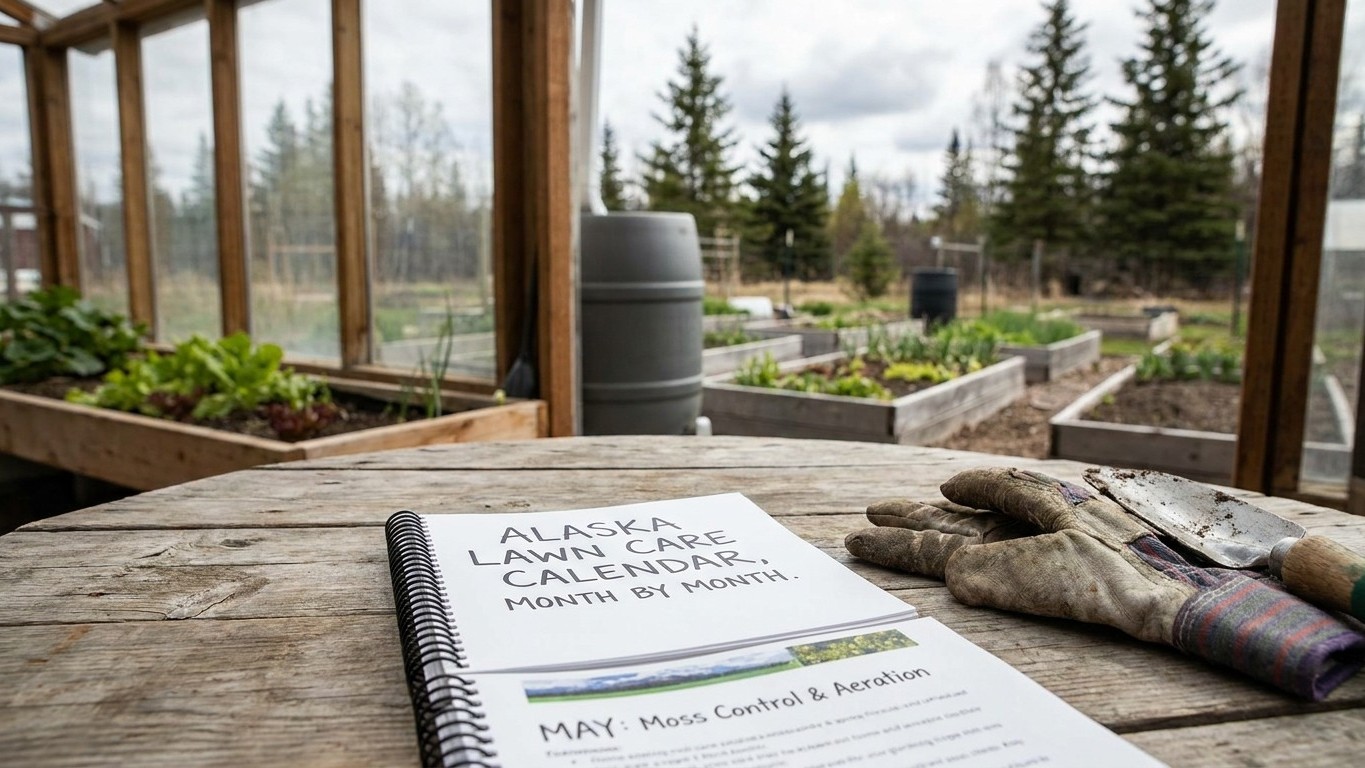

Alaska lawns run on a cool-season calendar, fed mainly in fall and mowed through a short, bright summer. NOAA’s 1991-2020 climate normals put Anchorage’s first fall frost between September 22 and October 1, giving the city roughly 143 frost-free days to work with. Pick a cool-season seed mix, fine fescue or Kentucky bluegrass rather than any warm-season species, and get your main fertilizer application down well before that fall frost window closes.
The short answer for Alaska
Fertilize an Alaska lawn in May the way a Lower 48 calendar tells you to, and you’ll push soft green growth right into a frost that can still bite in early June — then again in September, when that same soft growth gets caught by the first fall freeze instead of hardening off for winter. Get the timing backwards twice in one season and the grass spends its whole 143-day window recovering instead of growing. The fix isn’t a better fertilizer. It’s knowing which month wants what.
For the reference city of Anchorage, NOAA’s NCEI 1991-2020 climate normals put the first fall freeze somewhere between September 22 and October 1, and figure the frost-free stretch at about 143 days. That’s short by Lower 48 standards, but Anchorage is one of the mildest, longest-season parts of inhabited Alaska. The Interior around Fairbanks and the northern coast run considerably shorter, so a reader farther from the coast should treat these dates as the generous end, not a promise for their own yard.
The species list that actually holds up here comes from Clemson’s HGIC 1214 guide to selecting a lawn grass and from Penn State Extension’s cool-season work: Fine Fescues, Kentucky Bluegrass, Perennial Ryegrass, Rough Bluegrass, and Tall Fescue. None of the warm-season turf species sold farther south will survive an Alaska winter, because they have no cold-dormancy mechanism built for a real freeze. They simply die rather than brown off and return.
Which of those five species suits a given yard depends on shade, foot traffic, and how much watering you’re willing to do. Those trade-offs are covered in The Best Grass Seed for Alaska Lawns. What every one of them needs from the calendar is the same: growth concentrated into a short window, feeding weighted toward fall rather than spring, and mowing that respects a plant racing daylight, not heat.
Working through the year

This calendar assumes you’ve already worked through the basics covered in Alaska Lawn Care and settled on a seed mix. Clemson Cooperative Extension’s HGIC 1219 Tall Fescue Maintenance Calendar is the closest published, month-by-month program for the grasses on Alaska’s list, since tall fescue is one of the five and shares its cool-season habit with the fine fescues, bluegrasses, and ryegrass. Clemson wrote it for South Carolina, where the frost-free season runs far longer, so the months it names have to be compressed and shifted to fit Anchorage’s roughly 143-day window. Use it for the order tasks happen in, not for its calendar dates.
Snowmelt to late spring
Alaska’s lawn year starts when snow leaves the ground, not on a fixed date. Counting back the roughly 143 frost-free days NOAA’s normals give Anchorage from its September 22 to October 1 first fall frost puts the calculated last spring freeze at roughly the first half of May, though that is a calculation, not a separately measured date. Rake off matted, wet thatch as soon as the ground firms up enough to walk on without sinking, since that mat is where snow mold survives into the new season. Hold off on the first mow until the grass is dry and actively growing rather than still limp from meltwater. This same narrow window is also when overseeding thin patches makes sense: cool-season seed needs soil that has warmed past the low 50s to germinate reliably, and in Anchorage that point often doesn’t arrive until the frost-free window is already underway.
Summer: mowing through the long daylight
Once growth is underway, cool-season turf in Alaska behaves differently than it does farther south, because the growth driver here is daylight, not heat. Mow often enough that you never remove more than about a third of the blade in one pass, a rule that holds for every cool-season species on the list, and raise the deck rather than lower it if the lawn looks stressed. Water only when the lawn actually shows it. Southcentral Alaska’s summers run cool and often damp enough that supplemental irrigation is the exception rather than the rule. A lawn that’s wilting and turning gray-blue between rains is asking for water. One that’s simply pale usually just needs its fall feeding, not a hose.
Fall: the main feeding window
Cool-season lawns nationwide, tall fescue included, do most of their root-building in fall, and Clemson’s HGIC 1219 calendar puts the heaviest nitrogen application in that season rather than spring. In Alaska, that fall push has to land and be absorbed before growth shuts down for the year, which means getting fertilizer down well ahead of the September 22 to October 1 first-frost window NOAA’s normals name for Anchorage, not after it. A late, heavy feeding that pushes soft new growth right into freeze-up is the single most common way an Alaska lawn goes into winter thin and comes out thinner. Because Alaska’s own Cooperative Extension Service doesn’t publish a species-specific rate calendar the way Clemson does, check the exact pounds-per-1000-square-feet figure and timing on Clemson’s HGIC 1219 page directly and scale the timing back to your own frost date rather than guessing at a number.
Winter: dormant under snow
Once the ground freezes, a cool-season Alaska lawn does essentially nothing until melt, and that’s normal, not a sign of trouble. Snow cover itself insulates the crown. The more consistent the snowpack, the less winterkill you’ll typically see. What determines how the lawn looks under that snow was mostly decided by the fall mowing height and the timing of the last feeding, not by anything you can do once winter has already set in.
What changes across Alaska
Anchorage’s numbers describe Anchorage, and only Anchorage. The Interior, centered on Fairbanks, sits in a river-basin climate cut off from the coast’s moderating effect, so its frost-free season runs considerably shorter than the reference city’s, and winter lows there go a good deal deeper. A calendar built on Anchorage’s September 22 to October 1 first frost window will run a lawn there straight into freeze-up if followed literally. Treat Anchorage’s frost dates as the mild end of the state, not the average.
Coastal Southeast Alaska, around Juneau and Sitka, sits at the opposite end. The Pacific keeps winters milder and summers wetter than Southcentral’s, which stretches the mowing season but raises fungal disease pressure on a lawn that rarely dries out between rains. A cool-season lawn there needs less winter protection and more attention to drainage and airflow than one on the Anchorage bowl.
Elevation matters even within a single town. A yard on a hillside above the Anchorage bowl holds snow later into spring and loses it later in fall than a yard down near sea level a few miles away, which shifts both ends of the mowing season without changing anything about the soil or the seed mix. When in doubt, watch the ground, not the calendar. Mow the first time your own lawn is dry and growing, not on a date copied from a neighbor at a different elevation.
Farther north still, along the Arctic coast, the frost-free season narrows to a few weeks, and a mowed lawn in the conventional sense is uncommon outside a handful of protected town sites. None of the local figures above apply there at all.
The mistakes this climate punishes
Seeding too early is the most common one. Cool-season grass seed put down onto soil still cold and saturated from snowmelt sits without germinating and often rots outright. The failure doesn’t announce itself until early summer, when the seeded patch is still bare dirt while the rest of the yard has filled in.
Trying to run a warm-season lawn here, whether from a leftover bag of Bermuda seed or a sprig taken from a friend’s yard down south, fails for a different reason. Warm-season turf has no true winter dormancy mechanism built for an Alaska freeze. It doesn’t brown off and wait out the cold the way the recommended cool-season species do. It dies outright, and the loss shows the following spring as a patch that never greens up while everything seeded to Fine Fescue or Kentucky Bluegrass around it does.
Mowing too short right before the ground freezes is the mistake that shows up as a gray or pink, matted patch the moment the snow leaves in spring. That’s snow mold, and it takes hold fastest on lawns that went into winter scalped, with too little leaf tissue left to insulate the crown. The fix is to keep the last few cuts of the season at the same height as the rest of summer, not lower.
Feeding late, covered above at the point in the calendar where it actually happens, deserves the plain statement here too. A heavy nitrogen application within a few weeks of the first fall frost buys soft, wet growth the plant has no time to harden before freeze-up, and that soft growth is exactly what snow mold and other fungal pathogens overwinter on.
- Bare patch still visible in early summer: seed sown too early, into cold or waterlogged ground
- Whole area dead and gray the following spring, never greening: wrong species, no winter dormancy
- Gray or pink matted turf right at snowmelt: scalped before freeze-up, or fed too late
- Thin, patchy growth through a damp summer: watered on a schedule instead of by need
Checking this against your county
Anchorage’s frost dates and NOAA’s frost-free count describe one city under one climate normal. Before locking in a seeding date or a fall feeding cutoff based on those figures, check them against your own location through the University of Alaska Fairbanks Cooperative Extension Service, the state’s land-grant extension body, at uaf.edu/ces. District offices there can confirm local frost timing, soil test results, and which of the five cool-season species has actually held up in trial plots near you.
Common questions
When should I plant grass seed in Alaska?
Seed once the ground has thawed and warmed past the mid-50s, which in Anchorage falls somewhere within the window that opens after the calculated last spring freeze, roughly the first half of May, worked back from NOAA’s fall frost data. Wait for soil that crumbles rather than smears, not a date circled on a calendar.
Can I grow a warm-season grass like Bermuda in Alaska?
No. Bermuda, zoysia, and other warm-season turf have no cold-dormancy mechanism built for a real Alaska freeze, so instead of browning off for winter the way the state’s recommended cool-season species do, they die outright and don’t return in spring.
Why does my lawn look gray or pink right after the snow melts?
That’s snow mold, a fungal issue that takes hold on turf that went into winter too tall, too short, or fed too late to harden off before freeze-up. Rake the matted patch gently once it dries, and most cool-season lawns recover through the summer without reseeding.
Do I need to water an Alaska lawn all summer?
Usually not in Southcentral Alaska, where summers stay cool and often damp enough that rainfall covers most of a cool-season lawn’s needs. Watch for a wilted, gray-blue color between rains as the real sign of drought stress, rather than watering on a fixed schedule regardless of weather.