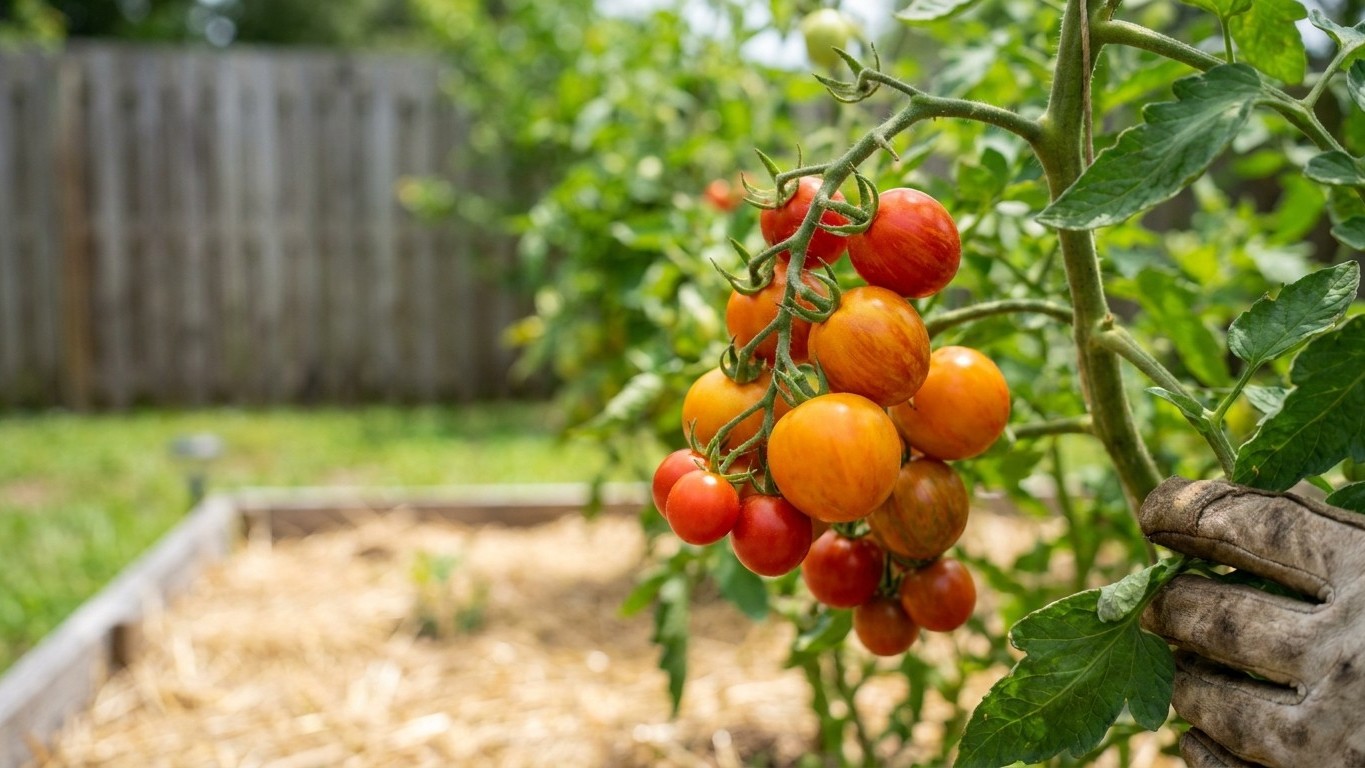

Frost in north Florida arrives so late—November 26 at the earliest, per the Jacksonville area’s own normals—that it was never the real threat these twelve varieties needed to outrun. Set out between early and late March, every one finishes with weeks of margin before that first freeze, the paste tomatoes included. What actually shuts fruit-set down is summer heat and humidity, months before frost ever enters the picture. That’s the race worth watching, and it starts with Sakura.
What this comes down to in Florida

Every variety below was set out early March to late March, the transplant window NOAA’s 1991-2020 normals allow once the Jacksonville area’s last spring frost has passed. Measured against the same station’s first fall frost of November 26 to December 13, all twelve finish with margin to spare, from 165 days for the slowest paste tomato to 195 days for the fastest cherry. The real question in north Florida is almost never whether a variety beats frost. It’s whether it beats the summer heat and humidity that shut fruit-set down long before frost ever becomes a factor. Shorter-season varieties get a jump on that heat, and the cherry types on this list in particular keep setting fruit after the slicers have stalled.
Sakura

Sakura reaches first ripe fruit at about 55 days from transplant, the fastest on this list. Set out early March to late March, it starts ripening by mid May with roughly 195 days of margin before the Jacksonville area’s first fall frost. It carries intermediate nematode resistance plus high resistance to tomato mosaic virus and two races of fusarium wilt.
Sun Gold

Sun Gold needs about 57 days from transplant and ripens by mid May with around 193 days of margin. It carries high resistance to tobacco mosaic virus and to fusarium wilt race 1, useful protection given how fast both diseases move through Florida’s humidity.
Supersweet 100

Supersweet 100 takes about 60 days and also ripens by mid May, with roughly 190 days of margin. It carries high resistance to verticillium wilt and to fusarium wilt race 1, and it fruits in long, heavy clusters through the early part of the season.
Juliet

Juliet matures in about 60 days and ripens by mid May with around 190 days of margin. It carries intermediate resistance to both late blight and early blight, two diseases that build fast whenever a north Florida spring turns wet.
Jasper

Jasper also finishes around 60 days, ripening by mid May with roughly 190 days of margin. It carries high resistance to late blight, the disease most likely to cut a north Florida planting short if a wet spring drags on.
Amalfi

Amalfi takes about 68 days and ripens by late May with around 182 days of margin. It’s a compact, determinate plant, and it carries intermediate resistance to nematodes, late blight, and early blight, a useful combination in sandy Florida soils where root-knot nematodes are common.
Big Beef Plus
Big Beef Plus needs about 72 days and ripens by early June with roughly 178 days of margin. It carries intermediate nematode resistance plus high resistance to gray leaf spot and tomato mosaic virus.
Cherokee Purple
Cherokee Purple also takes about 72 days, ripening by early June with around 178 days of margin. It carries no listed disease resistance, so a plant grown for its flavor needs closer watching through a humid Florida season than the hybrids around it on this list.
Granadero
Granadero takes about 75 days and ripens by early June with roughly 175 days of margin. It carries intermediate nematode resistance plus high resistance to both verticillium wilt and tomato mosaic virus.
Celebrity Plus
Celebrity Plus needs about 78 days and ripens by early June with around 172 days of margin. It’s a compact, determinate bush, and it carries intermediate nematode resistance plus high resistance to gray leaf spot and tomato mosaic virus, a strong option for a shorter staking setup.
Brandywine
Brandywine also takes about 78 days, ripening by early June with roughly 172 days of margin. It carries no listed disease resistance and is grown for flavor on a sprawling vine, which means it needs more attention through the humid stretch of the season than the resistant hybrids nearby on this list.
Amish Paste
Amish Paste is the longest-season variety here at about 85 days, ripening by mid June with roughly 165 days of margin before the Jacksonville area’s first fall frost. That margin is the tightest on this list, so a cool, late spring or a delayed transplant date eats into it fast.
Working it out for your own garden
Start from the frost window, not from a variety you already like. NOAA’s 1991-2020 climate normals put the Jacksonville area’s last spring frost at February 16 to March 7. Add a short buffer for the soil to warm and that produces the early March to late March transplant window. From there, add the catalog’s days-to-maturity to get a first-ripe range, then check that range against the first fall frost of November 26 to December 13 at the same station to see how much room is actually left.
Two cultivars, worked through
Take Sakura first. At 55 days from transplant, an early March to late March planting puts first ripe fruit at mid May. Measured against the November 26 to December 13 frost window, that leaves about 195 days of season still open, more than enough for a full harvest and then some.
Now take Amish Paste, the longest-season cultivar on this list at 85 days. The same transplant window puts first ripe fruit at mid June, and the arithmetic still leaves roughly 165 days before frost. On paper it finishes with room to spare. In practice, the fall frost date is rarely what limits an 85-day tomato in north Florida. Blossom drop starts once night temperatures climb into the heat of a Florida summer, and a plant transplanted at the late end of the window spends more of its flowering period in that heat than a 55-day plant does. That’s the real ceiling a long-season variety runs into here, not the frost line.
Catalog days-to-maturity are counted from the day of transplant under average conditions, and they can shift a week or two either way depending on how warm the spring turns out. The Tomato Planting Dates in Florida: Counting Back From Your Frost Window page walks through this same arithmetic for other frost stations around the state, since the Jacksonville numbers here only apply directly to north Florida. Run the same calculation for any cultivar before you commit a season to it, using your own region’s frost dates rather than a date printed for somewhere else.
What changes across the state
The frost figures in this piece come from one National Weather Service station near Jacksonville, and USDA’s Plant Hardiness Zone Map puts Florida anywhere from zone 8b in the north to 11b in the south, one of the widest spans of any state. A single frost window cannot describe both ends of that range. The Jacksonville numbers hold reasonably well across the inland stretches of north Florida and stop applying once you cross into the central part of the state.
In central and south Florida the tomato calendar flips entirely. Instead of one spring planting racing a fall frost, the main season runs through the cooler months, and summer heat becomes the limiting factor instead of frost. A gardener working from a spring transplant window and frost-margin numbers anywhere south of north Florida would be planting into the wrong season. The days-to-maturity figures for each cultivar still hold everywhere, since those are catalog facts rather than local ones, but the calendar you plug them into has to come from your own region.
Even within north Florida, coastal areas closer to open water tend to run a touch milder in late winter than the inland Jacksonville station, which can push the safe transplant date a little earlier. Inland counties away from that buffering effect run the other way, with a later safe start and an earlier fall frost. Treat the Jacksonville dates as a starting point for the surrounding region, not as a fixed instruction, and confirm against your own county before locking in a transplant date.
The mistakes this state punishes

The first mistake is trusting a warm week in February. NOAA’s 30 to 70 percent freeze-probability band for the Jacksonville area runs February 16 to March 7, which means a freeze is still a real possibility even after several mild days near the front of that window. Wait for the back half of the window, or keep frost cloth ready, rather than trusting a warm spell to hold.
The second is picking a long-season slicer because the frost math says it will finish. It will, technically. Amish Paste at 85 days still leaves roughly 165 days of margin before the Jacksonville area’s fall frost, but that margin is measured against frost, not against the heat that actually shuts tomato flowering down first in a Florida summer. A grower who wants a full harvest before the worst of the heat does better with something in the 55 to 68 day range, such as Sakura, Sun Gold, or Amalfi, set out at the early end of the transplant window.
The third is ignoring the pest calendar that runs alongside this one. North Florida’s tomato pests don’t all arrive at once, and a plant still flowering when a pest peaks loses more yield than one that has already set fruit and started slowing down. Tomato Pests in Florida: Which Ones Actually Show Up Here lays out which ones show up and when, which matters more for a longer-season variety that spends extra weeks exposed in the garden.
Checking this against your county
Every figure is anchored to one weather station near Jacksonville, and Florida is too long a state for one station to speak for all of it. Before you lock in a transplant date or a variety, run the same frost-window check against your own county. The University of Florida’s county extension network keeps local planting guidance and can confirm whether your area matches the north Florida pattern used here or the central or south Florida pattern instead. Your county office is the tie-breaker whenever a seed packet, a national frost map, and your own memory of last spring disagree. For the general steps behind growing a tomato crop start to finish in this state, see growing tomatoes in Florida.
Common questions
Can I plant a tomato that takes 90 days to mature?
Frost margin alone won’t stop you. Even the longest-season variety on this list, Amish Paste at 85 days, leaves roughly 165 days of growing season against the Jacksonville area’s frost dates. What actually limits a 90-day-plus variety here is summer heat shutting down flowering before the plant sets a full crop, not the fall frost line.
Do these transplant dates work for Orlando or Miami?
Check with your county extension office for the window that actually applies south of north Florida.
What happens if my transplants go in later than the window given here?
Each day added at the end pushes flowering further into hot weather, which matters more than the frost margin for most of these varieties. A short-season cherry tomato like Jasper or Juliet tolerates a late transplant better than a long-season slicer like Brandywine, because it finishes its main flush before the heat peaks.
Which variety on this list ripens the fastest?
Sakura, at about 55 days from transplant, reaches first ripe fruit before any other cultivar named here, with fruit ready around mid May from an early to late March transplant. Sun Gold and Supersweet 100 follow close behind at 57 and 60 days.