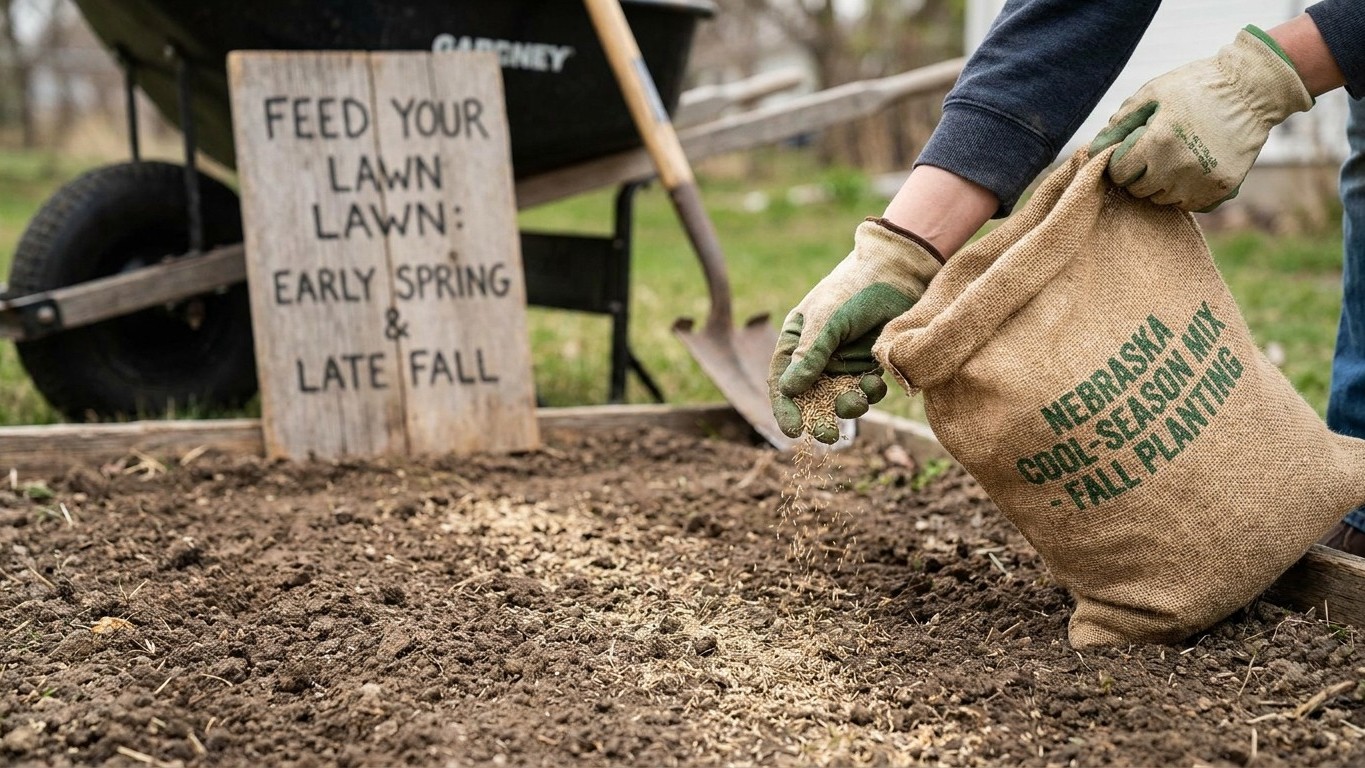

Cold winters here rule out warm-season grass outright, and the summers aren’t hot enough for long enough to make that risk worth taking, so a tall fescue and Kentucky bluegrass blend is what actually holds up in a Nebraska yard. Which of the two carries more weight in your particular lawn comes down to how much sun the spot gets and how well the soil drains. Walk your yard and note where the sun sits by midafternoon and where water pools after a hard rain — that’s what decides the mix, and it’s the first thing to check before you buy seed or sod. For month-by-month guidance once you’ve picked your blend, this Nebraska lawn Calendar lays out the tasks that keep it healthy year-round.
Which grass belongs in Nebraska

The choice comes down to two numbers. NOAA’s NCEI 1991-2020 climate normals, measured at the Omaha reference station, put the coldest month’s mean daily minimum at 13.6°F. That is cold enough to kill bermudagrass, zoysiagrass, and other warm-season species outright most winters, which rules them out anywhere with a similar winter low. The same normals record 28.1 days a year at or above 90°F, a workable but not extreme heat load. Cool-season grass can carry that stretch with the right watering. Warm-season grass needs far more heat than that to justify the winter risk it takes on.
That leaves the cool-season species Clemson Cooperative Extension lists in HGIC 1214, Selecting a Lawn Grass, and the ones Penn State Extension covers for cool-season turf: Kentucky Bluegrass, Tall Fescue, Perennial Ryegrass, Fine Fescues, and Rough Bluegrass. Nebraska lawns, and most of the cool-season belt, are built from these five, mixed to fit the site rather than planted as a single “best” grass. For a closer look at how these species compare and which mix suits your yard, see The Best Grass Seed for Nebraska Lawns.
Kentucky bluegrass spreads by rhizome and fills in bare patches on its own, which makes it the pick for a high-traffic front yard in full sun. It is slower to establish than the others and needs more water to stay green through a dry stretch. Tall fescue roots deeper than bluegrass and holds color longer without irrigation, which is why it dominates so many Midwest lawns. It does not spread by rhizome, so bare spots need reseeding rather than filling in on their own. Perennial ryegrass germinates within days and is often added to a bluegrass or fescue mix for quick cover while the slower species take hold. Fine fescues tolerate shade and poor soil better than the other four but wear out fast under foot traffic. Rough bluegrass is the shade-and-moisture specialist, useful under trees where nothing else holds color.
| Species | Sun/shade | Establishment speed | Traffic tolerance |
|---|---|---|---|
| Kentucky Bluegrass | Full sun | Slow | High, self-repairs |
| Tall Fescue | Sun to part shade | Moderate | High, no self-repair |
| Perennial Ryegrass | Full sun | Fast | Moderate |
| Fine Fescues | Shade | Moderate | Low |
| Rough Bluegrass | Shade, moist soil | Moderate | Low |
Most Nebraska lawns do best on a tall fescue and Kentucky bluegrass blend, or straight tall fescue where shade or drought stress rules out bluegrass on its own. A patch that sits under mature trees, where turf under either of those two thins out year after year, is the one place fine fescue or rough bluegrass earns its keep.
When to seed or sod here
Clemson Cooperative Extension’s HGIC 1203 splits the seeding calendar by grass type: warm-season lawns go in around May, cool-season lawns go in during mid to late September. Nebraska lawns are cool-season, so September is the window that matters here, not May.
Anchor that window on your own frost date rather than the calendar page alone. NOAA’s NCEI 1991-2020 normals put Omaha’s first fall freeze, at the 30 to 70 percent probability band, between October 15 and October 26. Seeding in mid to late September gives cool-season grass several weeks of soil warmth to germinate and root before that freeze risk arrives, enough for the seedling to survive its first winter without pushing so late that a frost catches it too small.
That figure comes from the Omaha airport station. Gardens outside the city, especially at higher elevation or further north in the state, often see their first frost one to two weeks earlier than the reference date, so a rural or suburban planting should move its seeding window earlier by roughly that same margin. Check your own county’s typical first frost against Omaha’s before settling on a date.
Spring seeding is possible for cool-season grass but riskier here. A seedling planted in April or May has to survive summer heat before its root system is established, and Omaha’s normals show 28.1 days a year at or above 90°F for it to get through. Fall seeding skips that gauntlet entirely, which is why extension calendars favor it for cool-season species.
Sod follows the same logic. It can go down in spring if you are prepared to water it through summer, but laying it in September lets the roots knit into the soil during mild weather instead of fighting heat stress from day one. Growers further north, covered in North Dakota Lawn Care: What to Plant and When to Feed It, work with an even narrower fall window for the same reason, since their freeze risk arrives sooner in the year.
The feeding calendar that fits this climate
Nitrogen timing follows the grass’s growing season, not the month on the wall. A cool-season lawn like the tall fescue and Kentucky bluegrass common in Nebraska does most of its root and shoot growth in fall and spring, goes semi-dormant in summer heat, and needs its nitrogen concentrated around September, when growth resumes and the plant is building the root mass it will carry into winter. A warm-season lawn works the opposite calendar, fed as it comes out of dormancy in late spring, but that timing does not apply to any grass recommended for this territory.
How much nitrogen, and when
Clemson Cooperative Extension’s HGIC 1219, the Tall Fescue Maintenance Calendar, lays out application rates in pounds of actual nitrogen per 1,000 square feet by month, and the exact split shifts slightly with the year’s weather. Rather than guess at a number here, check that calendar directly for the current rate and timing, since it is written for the same tall fescue that dominates so many Nebraska lawns.
The pattern that calendar follows is consistent across cool-season turf: a light feeding as growth resumes in early fall, a heavier feeding in mid to late fall once the heat has broken, and no nitrogen at all through the hottest, driest weeks of summer, since pushing new growth while the plant is under heat stress does more harm than good. A single spring application is sometimes added for color, but the bulk of the year’s nitrogen budget goes down after Labor Day, not before it.
Skip nitrogen entirely in July and August on a Nebraska lawn. That is exactly the stretch when Omaha’s normals show the most days at or above 90°F, and a lawn pushed to grow through that heat burns through the stored root reserves it needs to survive the following winter.
Mowing height and watering here
Tall fescue and Kentucky bluegrass, the two species that carry most Nebraska lawns, both do best mowed on the taller end of their range: 3 to 4 inches for tall fescue, and 2.5 to 3.5 inches for Kentucky bluegrass. A taller blade shades the soil, slows weed germination, and holds up better through the heat stretch Omaha’s normals put at 28.1 days a year above 90°F. Whatever the species, follow the one-third rule: never remove more than a third of the blade height in a single cut, which usually means mowing tall fescue before it passes 5 to 6 inches, not after.
Watering through the growing season
An inch of water a week, from rain and irrigation combined, is the standard figure quoted for cool-season turf, applied in one or two sessions rather than a daily sprinkle that only wets the surface. That figure moves in either direction depending on the site. Sandy soil drains fast and may need water split across three sessions instead of one or two, to avoid runoff between waterings. Heavier clay, common across much of eastern Nebraska, holds moisture longer and can go a few extra days between waterings without the lawn showing stress.
The 28.1 days a year Omaha spends at or above 90°F, per NOAA’s NCEI normals, is also the stretch that pushes water need above that baseline inch. On the hottest days, cool-season grass loses moisture faster than it can pull it from the soil, and a lawn that has been getting exactly an inch a week can still show drought stress during that run of heat. Deep, infrequent watering that reaches 6 to 8 inches into the soil builds a deeper root system than frequent light watering, and it is that root depth, not the weekly total, that gets a lawn through the hottest stretch of a Nebraska summer.
What goes wrong on lawns in Nebraska

The failures that show up here follow directly from the two numbers that set the zone. A humid, wet stretch during the growing season pushes brown patch and other fungal disease on tall fescue, since the same warmth that keeps the grass growing also favors the fungus. A hot, dry stretch during those 28.1 days a year above 90°F, per NOAA’s normals, sends cool-season grass into summer dormancy, and a dormant lawn going brown is not a dead lawn. It is a survival response, and it typically greens back up once cooler, wetter weather returns in fall.
Winter brings a different risk. Omaha’s coldest-month minimum of 13.6°F, per NOAA’s NCEI normals, is cold enough that winter desiccation and crown injury show up on turf that went into winter drought-stressed or was cut too short in fall. That is the opposite problem from the mild-winter belt further south, where turf barely stops growing and winter weeds like henbit and chickweed never fully die back, the pattern seen in states covered in Delaware Lawn Care: What to Plant and When to Feed It. Nebraska’s hard freezes generally knock those weeds back on schedule, though a mild winter here can still let them get a head start into spring.
Signs to check for
- Circular tan or straw-colored patches with a darker ring in humid weather: likely brown patch on tall fescue.
- Even, whole-lawn browning with no dead-looking crown at soil level after a dry heat spell: summer dormancy, not death.
- Thin, straw-colored patches that stayed dead into spring green-up: winter desiccation or crown injury from the coldest weeks.
- Broadleaf weeds already flowering in late winter: a mild winter that let them keep growing instead of dying back.
None of these are treated the same way, and guessing wrong wastes a season. Confirm which one you are looking at before reaching for a fungicide, a rake, or a bag of seed.
Local help
A soil test is the fastest way to know what your particular lawn actually needs, since pH and existing nutrient levels vary block to block even within the same city. University of Nebraska-Lincoln Extension runs soil testing and county-level lawn advice across the state, and its county offices know local frost dates and soil types better than any state-wide average can. Start there before buying fertilizer or reseeding a struggling lawn.
Common questions
Can I grow zoysiagrass or bermudagrass in Nebraska?
Not reliably. Both are warm-season species, and Omaha’s coldest-month minimum of 13.6°F, per NOAA’s NCEI 1991-2020 normals, is cold enough to kill them back most winters. A few sheltered pockets in the warmest parts of the state might carry zoysiagrass through a mild winter, but it is a gamble, not a plan.
Why did my lawn turn brown in August?
Most likely summer dormancy, not death. Cool-season grass shuts down growth during the hottest, driest stretch of the year to conserve water, and Omaha’s normals put that stretch at 28.1 days a year above 90°F. Pull back a patch of turf. If the crown at soil level is still white or pale green, it will recover once cooler weather returns.
Should I seed in spring or fall?
Fall, in mid to late September, following Clemson Cooperative Extension’s HGIC 1203 cool-season calendar. Spring seeding is possible but the young grass has to survive a full summer of heat stress before it is established, a harder path than seeding into cooling fall weather ahead of the season’s first freeze.
How short can I cut my lawn before winter?
Don’t scalp it. Gradually lower the mowing height over the last few cuts of the season rather than dropping it all at once, and never take more than a third of the blade in a single pass. Turf cut too short heading into a hard freeze is more prone to the winter desiccation and crown injury that shows up on Nebraska lawns after a cold winter.
Do I need to fertilize in spring at all?
A light spring application is optional, mainly for color, but it is not where most of a cool-season lawn’s yearly nitrogen budget belongs. The bulk of it goes down in fall, once the heat of summer has broken and the grass is building root mass for winter, following the pattern in Clemson’s HGIC 1219 tall fescue calendar.