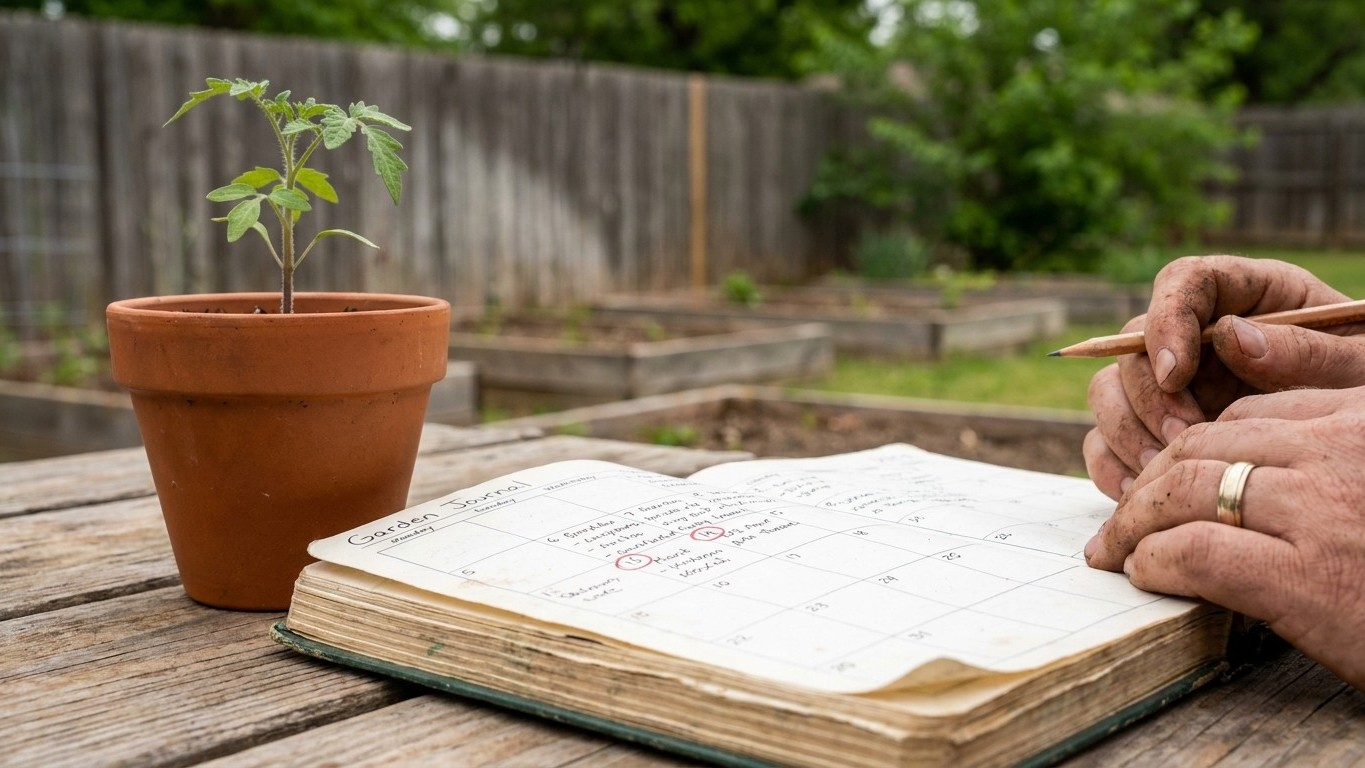

The short answer: you count backward from the frost window, not from a calendar date someone printed. NOAA’s 1991-2020 U.S. Climate Normals put Oklahoma City’s last spring freeze between March 28 and April 10, and its first fall freeze between October 29 and November 8. Pull up your own county’s numbers at OSU Extension before you set a transplant date, since that Oklahoma City figure moves earlier or later depending on where you actually garden.
What this comes down to in Oklahoma

Your last frost isn’t one date, it’s a two-week stretch — and the right move is to plant somewhere inside that stretch, not on the calendar square you circled in January. For most yards that window falls between late March and early April in spring, with the first fall freeze arriving in late October to early November. Check your own county’s frost window before you set a transplant date, since your yard likely runs a little cooler than the nearest airport does.
The state’s USDA Plant Hardiness Zones run from 6a to 8a, per the USDA Plant Hardiness Zone Map’s 2023 release using 1991-2020 normals, which tells you something important before you even get to frost dates: Oklahoma is not one climate. A gardener near the reference city of Oklahoma City is working with a different frost calendar than one in the panhandle or the far southeast, even though both are technically “Oklahoma tomato season.” The Oklahoma City figures above are a starting reference point, not a state-wide guarantee, and the NOAA data itself comes from a single airport station, so your own soil and yard will run on its own schedule, usually a bit later in spring and a bit earlier in fall than the airport reads.
None of this replaces choosing the right cultivar for your season length, which the state’s Tomato Varieties That Ripen in Time in Oklahoma page covers in more depth. Given a frost window instead of a single date, the math is how you land on a planting date that works for your garden.
Working it out for your own garden
Start with the frost window itself, not a date inside it. NOAA’s Oklahoma City normals give a spring window of March 28 to April 10 for the last freeze. That’s not “pick March 28” or “pick April 10,” it’s a fourteen-day band representing a moderate probability of freezing temperatures, and treating either end as a certainty is how gardeners here get burned. If you want a buffer, the whole window shifts later by however much padding you’re comfortable with, but it remains a window.
Counting forward from transplant to harvest
Once you have a transplant window, days-to-maturity figures on a seed packet let you estimate a harvest window, and the arithmetic has to preserve the range. Take ‘Early Girl‘, a compact indeterminate slicer commonly listed at roughly 50 days to maturity from transplant. Add 50 days to each end of the Oklahoma City frost window: March 28 plus 50 days lands in mid-May, and April 10 plus 50 days lands toward the end of May. So a transplant set anywhere across that spring window should start producing ripe fruit sometime in the mid-to-late May range, not on a single predicted day. That’s comfortably ahead of the October 29 to November 8 fall freeze window, with the whole summer still in front of it.
Now push it the other direction with a slower heirloom. ‘Cherokee Purple‘, an indeterminate beefsteak typically listed around 80 to 85 days to maturity, works fine off a spring transplant, since even the slow end of that math lands the harvest by early-to-mid summer. But run the same cultivar as a fall crop, transplanted in early August after a spring crop finishes, and the picture changes: 85 days from early August lands at the very front edge of the October 29 to November 8 fall freeze window. That’s not a comfortable margin, it’s the kind of timing where one early cold snap ends the crop before it ripens. That’s the line: the same cultivar that works easily off a spring frost window can run out of season entirely if the second planting starts too late.
| Cultivar | Days to maturity (from transplant) | Spring harvest estimate (from Mar 28-Apr 10 transplant) |
|---|---|---|
| ‘Early Girl’ | ~50 days | mid-to-late May |
| ‘Celebrity‘ | ~70 days | early-to-mid June |
| ‘Cherokee Purple’ | ~80-85 days | mid-to-late June |
What changes across the state
The Oklahoma City figures above come from a single weather station, and Oklahoma’s USDA Hardiness Zones span 6a to 8a, which by itself tells you the state does not warm up or cool down on one schedule. Latitude matters in the same direction, with the southern tier of the state generally running warmer through the shoulder seasons than the Oklahoma City reference point.
Distance from open water plays a role too, since large reservoirs and lakes moderate nearby temperatures slightly compared to more exposed inland ground, though the effect is local and small enough that it won’t override a genuine cold front. What consistently moves the numbers more than any of these factors, according to the caution built into NOAA’s own station-based data, is simply town versus open country: airport stations tend to sit in cleared, paved ground that holds daytime heat, so surrounding suburban and rural gardens often see their last spring frost run later and their first fall frost run earlier than the airport figure, sometimes by a week or two.
None of this means throwing out the Oklahoma City window. It means treating it as the reference point you adjust from, not the answer itself, and adjusting in the direction your local geography suggests: later in spring, earlier in fall, if you’re outside the immediate metro, at elevation, or well north.
The mistakes this state punishes

- Trusting a warm stretch in March as spring: Oklahoma regularly throws a return freeze after a run of 70-degree days, and the NOAA window (March 28 to April 10 for Oklahoma City) exists precisely because that late-swing risk is real, not theoretical.
- Setting transplants into cold, wet soil right after that warm spell, which stalls root growth for weeks even if the plant technically survives the air temperature.
- Choosing a long-season heirloom for a second, fall planting without running the days-to-maturity math against the fall frost window first, the same arithmetic shown above.
- Ignoring the gap between the airport-based NOAA figure and an actual rural or suburban yard, then being surprised when a frost arrives before the “official” date.
The fix for all four is the same: use the frost window as a range to plan around, not a single line to plant on, and build in a buffer on both ends rather than gambling on the tight edge of the window. If a particular pest tends to arrive on a predictable point in the season here, that’s worth checking against the state’s Tomato Pests in Oklahoma: Which Ones Actually Show Up Here page before you finalize a planting date, since timing a transplant to dodge a pest’s usual arrival is sometimes as useful as timing it around frost.
Checking this against your county
Everything above is built on one reference city’s data. Oklahoma City is a reasonable statewide starting point because it’s the NOAA station named in the U.S. Climate Normals dataset, but it is not your county’s number. Before locking in a planting date, check your local frost data and any tomato-specific guidance through OSU Extension at extension.okstate.edu, and consider calling your county extension office directly, since they often carry finer-grained frost records than the statewide dataset can offer. If you’re still working out which cultivar fits your particular season length, that decision is covered separately on the site’s Tomato Varieties That Ripen in Time in Oklahoma page, and the broader basics of growing tomatoes in Oklahoma are worth reviewing if you haven’t settled soil prep and spacing yet.
Common questions
Can I just plant on the average last frost date and not worry about the range?
You can, but you’re accepting real risk by doing it. NOAA’s window for Oklahoma City runs from March 28 to April 10, and that whole span carries a meaningful chance of a 32F freeze, so planting at the early edge without protection is a bet, not a plan.
How much earlier can I start if I use a wall of water or row cover?
Season-extending covers can let you set transplants ahead of the open-air frost window, but how many days of buffer they actually buy you depends on the product and the severity of the cold snap, which isn’t something a single figure can answer reliably. Treat covers as insurance against a marginal night, not a way to ignore the window entirely.
Do I need to start seeds indoors, or can I just buy transplants?
Either works, and plenty of Oklahoma gardeners buy transplants specifically to skip the indoor seed-starting math. If you do start from seed, count backward from your intended transplant date using the seed packet’s recommended weeks indoors, keeping in mind that transplant date itself is a range, not a single day.
What if my area never got an official last frost date this year and it just stayed warm?
A warm stretch isn’t the same as being past the frost window. Oklahoma’s spring pattern includes real late cold snaps, and the NOAA normals reflect decades of data specifically because single-year warm streaks don’t reliably predict whether a freeze is still coming.
Some gardeners also time this by the Moon: when to plant tomatoes by the moon, as almanac tradition rather than fact.