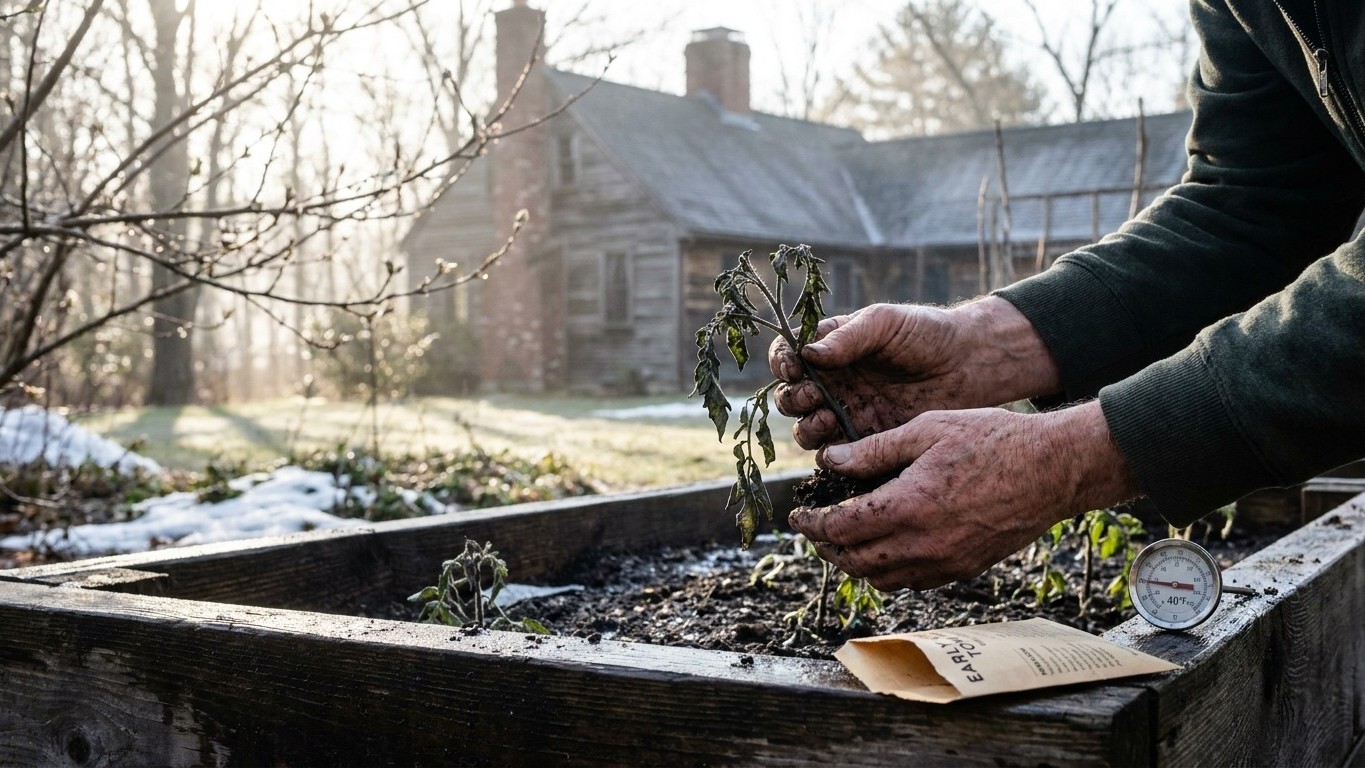

Zone 5a to 7b. Frost gone by early April, back by early November. Ten days a year past 90°F. Those three numbers, more than any seed catalog, decide what actually grows in a Massachusetts yard.
How long your season really is

The USDA Plant Hardiness Zone Map, built from the 1991-2020 climate normals and based on a single measurement (the average annual extreme minimum temperature), places Massachusetts across zones 5a through 7b. That is a wide spread for one state, and it matters here: a Cape Cod garden and a Berkshires garden are not gardening in the same zone, even though both are “Massachusetts.”
The number that does the real work, though, is the frost-free window. At Logan Airport, the reference station NOAA uses for the state’s climate normals, the last spring frost falls between April 1 and April 8, and the first fall frost arrives between November 3 and November 14, a window that also shapes fall traditions like knowing When to Carve a Pumpkin in Massachusetts before that frost sets in. Stretch those two ranges as far as they’ll go and you get a growing season of roughly 209 to 227 days, call it seven months at the outside. That is the entire budget a gardener here has to work with, from seed to harvest.
It rules out more than it allows. Crops that need a long, uninterrupted stretch of warmth and frost-free days to finish (think melons pushed to full ripeness, or okra grown for a heavy yield) are pushing right up against that 209-to-227-day ceiling, especially once you subtract the slow, cool weeks at each end of the season when growth is minimal. That’s not a reason to skip them. It’s a reason to treat them as a stretch goal, not a default plan, unless your yard sits somewhere milder than the state average. Crops built for this exact window, like Growing Potatoes in Massachusetts, Growing Carrots in Massachusetts, Growing Parsnips in Massachusetts, Growing Beets in Massachusetts, Growing Sweet Corn in Massachusetts, and even a longer-season vine crop like Growing Pumpkins in Massachusetts, fit comfortably inside that budget, alongside Growing Spinach in Massachusetts, or the reliably hardy perennial covered in Growing Asparagus in Massachusetts, are a safer bet for gardeners working within the state’s typical frost-free budget.
And here is the part worth saying plainly: those frost dates are averages, not guarantees. NOAA builds them from a 30-70% probability band, which means in roughly half of all years, frost shows up later in spring or earlier in fall than the date on the chart. Planting tender seedlings the week the “average last frost” passes is a bet, not a sure thing. Logan Airport is also a waterfront, urban station, the mildest spot in the state by a wide margin. Inland suburbs and anywhere in the Berkshires will see frost linger later in spring and arrive earlier in fall than these numbers suggest.
What the summer does to a garden here
Massachusetts averages 10.2 days a year at or above 90°F, measured at the Boston reference station. That sounds mild next to states further south, and it is. But heat doesn’t have to be extreme to cause damage, it just has to cross certain thresholds at the wrong moment. Once temperatures push past roughly 90°F, tomato blossoms drop instead of setting fruit, the same heat stress that complicates Growing Peppers in Massachusetts, and cool-season crops like lettuce respond to the heat by bolting, shooting up a flower stalk and turning bitter, sometimes within days.
Ten days a year isn’t a heat wave that lasts all summer. It’s usually a run of hot stretches scattered through July and August, interrupting what would otherwise be a fairly even, temperate stretch. The practical effect is a garden that doesn’t run on one smooth curve from spring to fall. It runs on two productive shoulders, a strong late-spring stretch and a strong early-fall stretch, with a middle patch of summer where certain plants stall out or shut down entirely rather than thriving.
The other number in this section, the coldest month’s average daily minimum of 23.1°F, isn’t about summer at all, but it belongs alongside the heat data because together they define the two edges a plant has to survive here: it needs to tolerate winter lows around 23°F on an average night in the coldest month, and it needs to keep functioning, or at least pause and recover, through short bursts past 90°F in summer. Perennials and shrubs chosen without checking both ends of that range are the ones that struggle here, not because Massachusetts is an extreme climate, but because it asks a plant to handle both edges in the same year.
What tends to go wrong in Massachusetts
UMass Extension’s home garden guidance flags a short list of insects that home gardeners in the state genuinely run into, and it’s worth knowing the timing rather than memorizing a longer list of names.
Winter moth caterpillars are an early-season problem, showing up in spring just as buds open on shade trees, fruit trees, and shrubs, where they chew new leaves and can leave a tree looking skeletonized by late May. Colorado potato beetle follows once the soil has warmed, moving onto potato and eggplant foliage in late spring and early summer and stripping leaves fast enough to set a young planting back significantly. Squash vine borer works differently: it bores directly into the stems of squash and related vine crops in early to midsummer, and the first sign is often a plant that wilts suddenly despite damp soil, the stem already hollowed out from the inside.
Spotted lanternfly is the newer name on the list, an invasive species UMass now tracks as it spreads through the region. It doesn’t target vegetable gardens the way the others do, but its egg masses and feeding damage on trees and vines make it worth knowing on sight.
None of this is a spray schedule, and it shouldn’t be treated as one. Pressure from any of these insects varies block to block, let alone county to county, and a home gardener’s first move on anything that looks like damage should be identification, not a treatment plan pulled from a general list.
Where to check before you plant
Everything above is a state-level average, and Massachusetts is not a small, uniform state climatically. A hardiness range spanning 5a to 7b means the growing conditions in Boston and the growing conditions in the western Berkshires can differ by a full month or more at either end of the season. A planting calendar built around the state capital’s frost dates can be three weeks off for a garden 90 miles west, and three weeks matters when the whole season only runs seven months.
This is exactly what a land-grant extension service is for. UMass Extension maintains the fact sheets, pest alerts, and planting guidance built specifically for Massachusetts conditions, and it’s the source behind the pest list and pest management guidance referenced above. Beyond the state-level site, most Massachusetts counties run their own extension office or Master Gardener program, and that local office is the better place to ask about a specific frost date, a specific pest sighting, or a specific soil condition for your actual town.
Where to Go Next in the Garden
The same cold that shapes a Massachusetts season plays out differently depending on what you’re growing. Bulbs need it, some grasses can’t survive it, and fruiting crops just need it to end on time. If you’re planning fall planting, growing garlic in Massachusetts lays out the planting dates and varieties that actually get a proper winter chill, and what happens to the bulb when they don’t. For the lawn itself, Massachusetts lawn care explains why a warm-season grass like Bermuda can green up fast in summer and still end up dead flat by February, and what to plant and feed instead. And once spring turns the corner, growing tomatoes in Massachusetts walks through the frost dates that decide when it’s safe to put plants in the ground, along with the varieties and pests you’ll be dealing with once they’re in. Each of these pages takes the same climate facts driving this hub and applies them to one specific thing you’re trying to grow, so you’re not guessing at dates or hoping a plant makes it through a winter it was never built for.