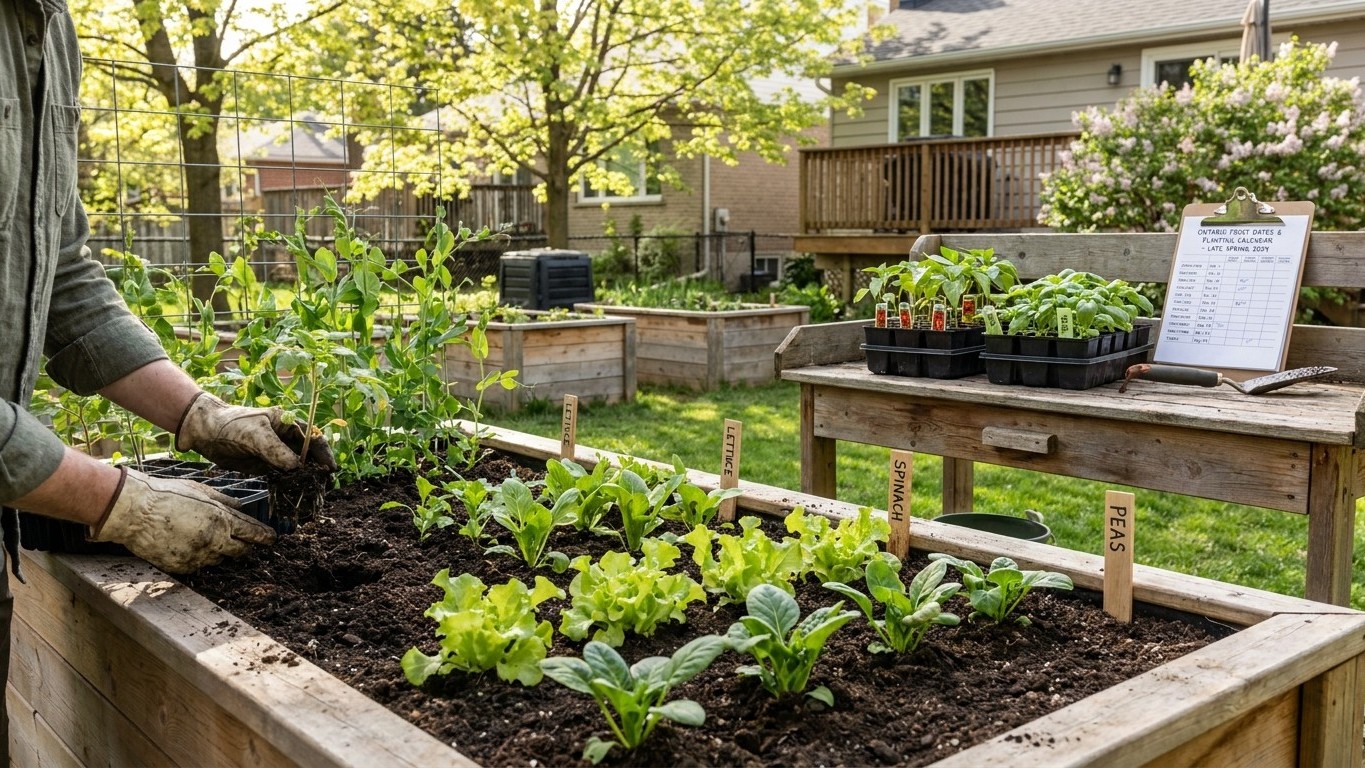

Ontario’s growing conditions come down to three numbers: a hardiness zone of 7a on the Canadian scale, a frost-free window of roughly 169 days, and summers with almost no punishing heat. Together they decide what actually fits in a backyard here, long before soil type or sun exposure enter the picture.
How long your season really is

Three figures set the boundaries of what a garden in Ontario can do. The reference station is Toronto Lester B. Pearson, and the numbers below come from Environment and Climate Change Canada’s normals.
| Measure | Value |
|---|---|
| Hardiness zone (Canadian system) | 7a |
| Average last spring frost | April 30 |
| Average first fall frost | October 16 |
Subtract one date from the other and the frost-free window comes out to about 169 days, a little under six months. That’s the working number. It’s the length of the season a garden actually gets between the point when frost risk fades in spring and the point when it returns in fall.
A window that size rules some things out flatly. Long-season crops that need well over four months of reliably warm ground, the kind of pumpkins or dry beans bred for a longer stretch, or anything started from seed outdoors that needs a slow finish, are pushing their luck here. Growing Pumpkins in Ontario can work, but they need a head start indoors, a warm microclimate, or a variety bred short, and knowing When to Carve a Pumpkin in Ontario depends on getting that timing right from the start. The same logic applies to warmth-loving crops like peppers, and Growing Peppers in Ontario successfully usually means starting seeds indoors well before the last frost date. Sweet corn sits closer to the edge of what the window allows, and Growing Sweet Corn in Ontario generally means choosing an early-maturing variety to make sure the ears finish before fall frost arrives. Cool-season staples fare better within this window, and Growing Potatoes in Ontario fits comfortably into the 169-day stretch without the same fuss. The same holds true for root vegetables, and Growing Beets in Ontario is another reliable option that thrives within this frost-free window, and Growing Carrots in Ontario follows the same pattern, slotting easily into the available season. Growing Parsnips in Ontario is much the same story, needing that same steady stretch of cool weather to develop properly. Perennial crops fit this pattern too, and Growing Asparagus in Ontario rewards patience with a bed that keeps producing for years once established. Leafy greens round out the list nicely, and Growing Spinach in Ontario is one of the easiest ways to make use of the cooler edges of the season, thriving in the spring and fall stretches when other crops are just getting started or winding down. Planting tender crops straight into the garden on the average last-frost date and hoping for the best is a gamble dressed up as a plan.
Averages are not promises
The April 30 and October 16 dates are means, not guarantees. Environment and Climate Change Canada builds them from decades of data, and a mean by definition sits in the middle. Frost arrives later than April 30 in roughly half of all years, and it can show up before October 16 just as often. Treat both dates as the midpoint of a window, not a green light or a red light. Gardeners who plant tender crops right on the average date, without a backup plan for a late cold snap, lose seedlings more often than the calendar suggests they should.
It also matters that these figures come from one station near Toronto. Ontario runs from Lake Erie’s shoreline to the edge of the boreal forest, and a province that size does not share one climate. Northern and upland districts can run two to three weeks behind these dates, sometimes more.
What the summer does to a garden here
The heat side of the equation is almost a non-issue at the reference station: the average is 0.0 days a year above 90F. That’s not a typo, and it’s not the same as saying summers are cool throughout. It means the kind of extreme heat that shuts a garden down, the days that push a tomato plant to abort its flowers or send lettuce bolting to seed, are rare events here rather than a routine part of July.
That absence changes the shape of the gardening year in a specific way. In places where 90-degree days pile up through midsummer, gardeners often split the season in two: a spring planting, a dead middle where cool-season crops simply can’t survive, and a fall planting that picks up once the heat breaks. Ontario’s climate profile doesn’t force that split. With almost no extreme heat days, there’s less reason to expect a midsummer dead zone for crops like lettuce, spinach, or peas, which can otherwise stall out and go bitter or bolt once daytime highs sit in the 90s for a stretch.
The other side of that same coin is the winter minimum. The coldest month here averages a daily minimum of 13.6F. That’s the figure that decides whether a perennial, a shrub, or a fruit tree survives the winter outright, separate from the record cold snap that might hit once a decade. A plant rated hardy only to zone 8 or warmer, on the Canadian scale, is not a safe long-term bet outdoors here even if it survives one mild winter. The 13.6F average is what it has to shrug off most years, not the exception.
What tends to go wrong in Ontario
No provincial extension service in Canada publishes its own home-garden pest list the way land-grant universities do in the US, so the pests below are documented by extension services in neighboring US states, Cornell, Michigan State, Ohio State, and the University of Minnesota among them. The biology crosses the border freely. The calendar sometimes doesn’t, so treat timing as a general guide rather than a fixed date, and check with Ontario’s own agriculture office for local identification.
- Colorado potato beetle, active from late spring through summer, strips potato and eggplant foliage down to the stems and can defoliate a young planting in days if left unchecked.
- Squash vine borer, showing up in early to midsummer, tunnels into squash and zucchini stems from the inside, causing sudden wilting even when the soil is moist and the plant looks otherwise healthy.
- Japanese beetle, most active in midsummer, skeletonizes leaves on a wide range of ornamentals and fruiting plants, leaving a lace-like pattern behind.
- Spotted wing drosophila, a late-summer to fall problem, lays eggs inside ripening soft fruit like raspberries and cherries, so damage often isn’t visible until the fruit is picked.
None of these show up on a fixed schedule tied to the calendar date. They track temperature and plant growth stage, which is exactly why the frost-free window matters here too: a season that starts a week late or ends a week early shifts when each of these pests peaks.
Where to check before you plant
This page works from one reference station and one set of provincial-scale figures. Ontario spans several degrees of latitude, from the milder Lake Erie shoreline to colder inland and northern districts, and a single hardiness zone or frost date can be three weeks off at either edge of that range. A planting calendar built for the Toronto area is not automatically the right one for Sudbury or for the Ottawa Valley.
The starting point for anything more specific is Ontario’s Ministry of Agriculture, Food and Rural Affairs, which publishes provincial guidance on crops, pests, and growing conditions. From there, local agricultural offices and regional advisors can narrow the picture down to a specific county or district, including realistic frost dates for that spot and pest pressure as it’s actually being reported nearby that season.
That local check matters more than it sounds. A gardener working from provincial averages alone might plant two to three weeks too early on a cold clay soil near Georgian Bay, or too late on a sheltered site near the Niagara Peninsula. The numbers on this page are the frame. The details that decide whether a specific planting works come from the ground it’s going into.
Putting the Season to Work in Your Garden
All this frost and cold-hardiness data means little until it’s applied to something actually growing in the yard. If you’re after edible crops, growing garlic in Ontario shows how the deep, sustained winter cold that follows an October frost is exactly what a garlic clove needs to split properly come spring — a case where the province’s harsh winter is doing the gardener a favor rather than working against them. Move to the vegetable bed and the timing gets tighter: growing tomatoes in Ontario lays out the roughly 168-day window between the average last spring frost and the average first fall frost at Toronto Pearson, the stretch you’re actually working with if you want ripe fruit before the cold returns.
And if none of that interests you — if the goal is simply a green lawn rather than a harvest — Ontario lawn care explains why the whole province is cool-season grass territory, not warm-season, given how rarely Toronto sees a day above 90°F and how cold its winter nights run. Each of these pages takes the same climate data from this hub and turns it into planting dates and choices you can actually use.