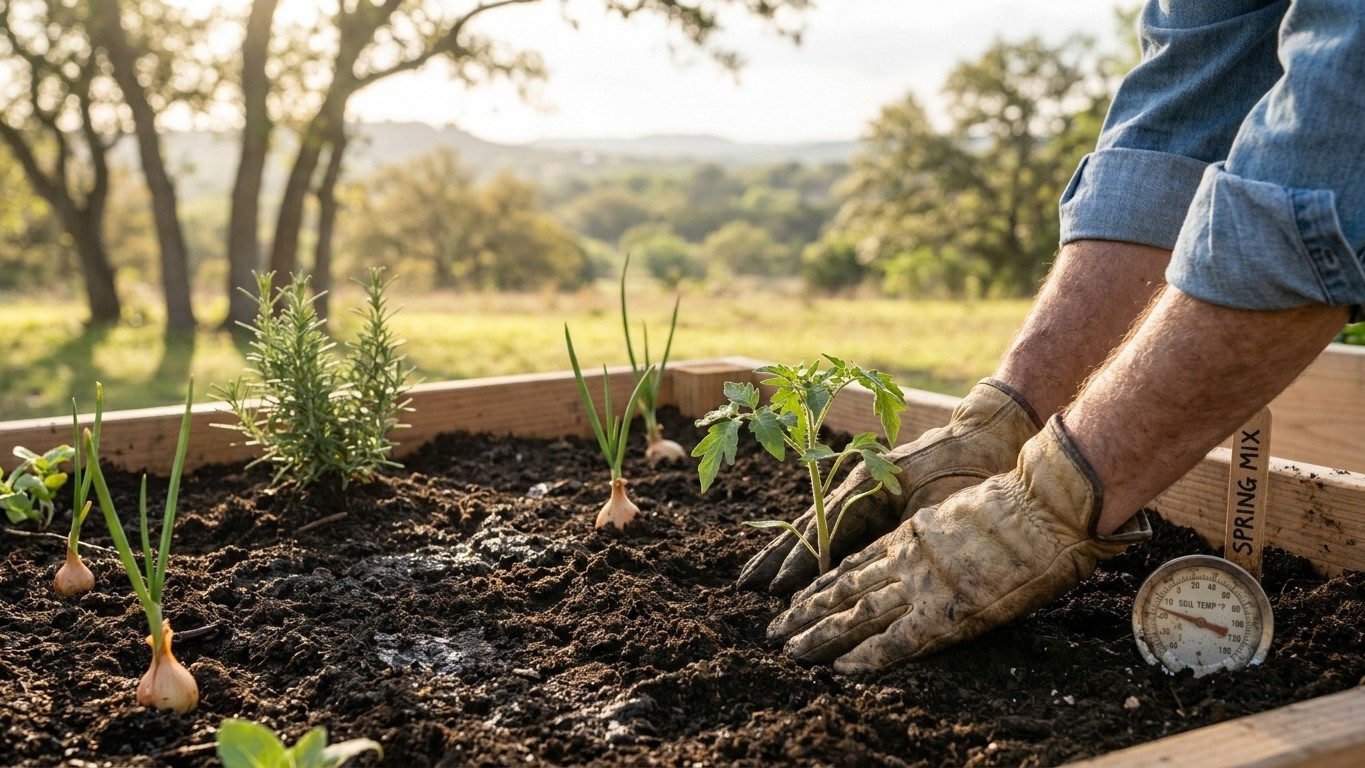

Gardening in Texas means working with one of the longest frost-free windows in the country, but also one of the harshest summer heat loads. In the Houston area, that means a growing season stretching from early February to mid-December, with USDA zones across the state ranging from 6a to 10a. What you can actually plant, and when, depends less on generic advice and more on exactly where you are.
How long your season really is

Three numbers decide almost everything a Texas gardener can attempt in a given year. The USDA Plant Hardiness Zone Map places the state anywhere from zone 6a to zone 10a, a spread wide enough to cover both a Panhandle winter that kills citrus outright and a Gulf Coast winter mild enough to grow it outdoors. For the Houston reference station, the average last spring frost falls between February 4 and March 1, and the average first fall frost arrives between December 1 and December 19.
| Metric | Value |
|---|---|
| USDA Hardiness Zone (statewide range) | 6a to 10a |
| Average last spring frost (Houston/IAH) | Feb 4 – Mar 1 |
| Average first fall frost (Houston/IAH) | Dec 1 – Dec 19 |
Do the subtraction on the Houston dates and the frost-free window runs roughly nine to ten months. That’s long enough for two full rounds of warm-season crops in a single year, including a fall crop of Growing Potatoes in Texas, something gardeners in short-season states can only plan once, and it also leaves room for a second heat-loving crop like Growing Peppers in Texas, or an early spring root crop such as Growing Carrots in Texas, with a second round of Growing Beets in Texas or Growing Parsnips in Texas fitting neatly into the cooler fall stretch, not to mention enough lead time for a long-term perennial bed if you start Growing Asparagus in Texas early in the season, right around the same time you’d be checking When to Carve a Pumpkin in Texas. But “average” is doing a lot of work in that sentence. NOAA’s freeze probabilities are built from three decades of data, which means by definition close to half of all years will bring a frost later in spring or earlier in fall than the average date. Treat these as planning windows, not guarantees.
Why this rules some things out
A long frost-free season sounds like permission to grow almost anything. It isn’t, quite. Crops that need a genuinely cool, mild summer to mature (many northern-bred lettuce varieties, some slow-maturing brassicas) will run into the next section’s problem long before frost becomes relevant again. The frost dates tell you when you can start and stop. They don’t tell you what survives the months in between.
What the summer does to a garden here
Houston averages 102.4 days a year at or above 90F, and even the coldest month only dips to a mean daily minimum of 43.7F. That combination, a heat load most of the country never sees paired with a winter mild enough to barely qualify as one, shapes the entire structure of the gardening year in Texas.
Heat past roughly 90F isn’t just uncomfortable for plants, it’s disqualifying for some of them. Tomato flowers drop and stop setting fruit once nighttime temperatures stay too warm. Lettuce, spinach, and other cool-season greens bolt to seed and turn bitter. That’s not a minor slowdown. With more than 100 days a year crossing that threshold, a big chunk of the calendar is effectively closed to anything that prefers mild conditions.
The practical result: Texas gardening tends to split into two distinct seasons rather than one long, even one. A spring push planted as soon as frost risk clears, harvested before the worst heat arrives, and a fall push planted once temperatures ease back down, timed against that December frost date. The middle of summer becomes a holding pattern for many crops, sometimes a dead zone where only the most heat-tolerant plants keep producing. Gardeners who plan for one continuous growing season, the way a cooler-climate garden works, often find their spring plantings collapse by July with nothing obvious to blame but the thermometer.
What tends to go wrong in Texas
Texas A&M AgriLife Extension’s home garden guidance flags a recurring cast of pests, and knowing roughly when each one shows up saves a lot of guessing later. This isn’t every insect that exists in the state, just the ones a home gardener here is likely to actually meet.
- Squash vine borer: shows up as squash and other cucurbits start vining in late spring, often noticed only after a healthy plant wilts suddenly.
- Squash bug: builds up through the summer on the same cucurbit crops, feeding in groups on leaves and stems.
- Corn earworm: arrives as corn silks in summer, working down into the ear tip.
- Melon aphid and other aphids: cluster on new growth from spring through fall, worst in warm, humid stretches.
- Whiteflies: peak in the heat of summer, especially on tomatoes and other warm-season vegetables.
- Spider mites: thrive in the driest, hottest weeks of summer, often first noticed as stippled or bronzed leaves.
- Fire ants: active essentially year-round in Texas soil, a nuisance to gardeners handling beds at any point in the season.
Pest pressure varies by county, by crop, and by year. The point of naming these is narrower: if a squash plant wilts overnight in June, or tomato leaves turn stippled in August, a Texas gardener now has a short list of usual suspects instead of a blank guess.
Where to check before you plant
Everything above is a state-level average, and Texas is large enough that a state-level average can mislead. The hardiness zone map alone spans 6a to 10a across the state, four full zones between the coldest corner and the warmest. A planting calendar built around Houston’s frost dates might run three weeks late for North Texas and three weeks early for the Rio Grande Valley.
That’s what a land-grant extension service is for. Texas A&M AgriLife Extension publishes county-level guidance built specifically to correct for this spread, and the local county office is the fastest way to get a planting date, a pest identification, or a variety recommendation calibrated to an actual address rather than a statewide range.
Treat the state-level picture as the framework, not the final word. It tells you the shape of the Texas gardening year: a long frost-free window bookended by real frost risk, a heat load that splits the season in two, and a known set of pests to watch for. The county office fills in the three weeks on either side that decide whether a specific planting date actually works where the reader lives.