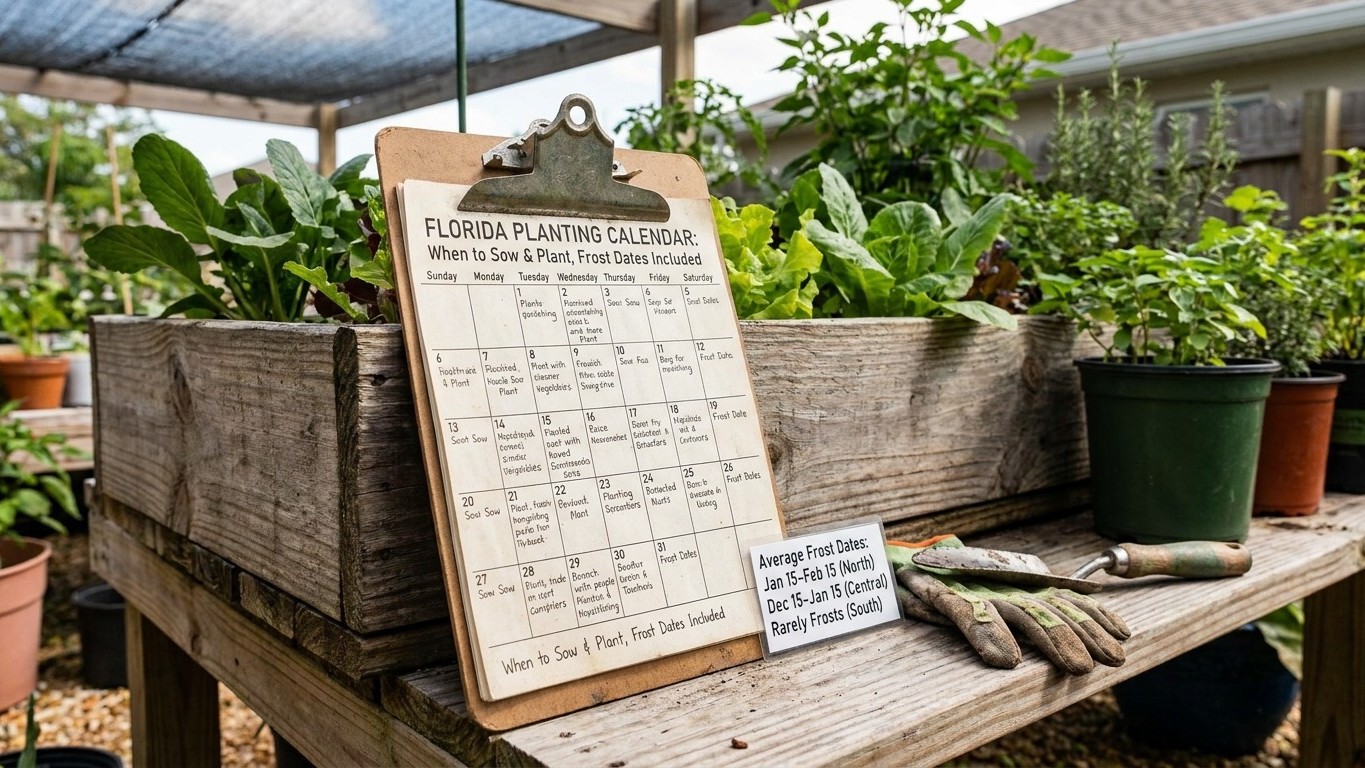

Here’s the thing that trips people up: Florida’s frost dates change dramatically depending on where you’re standing, and using the wrong ones will cost you a whole crop. If you’re near Jacksonville, your last freeze typically falls between February 16 and March 7, with the first fall freeze arriving late November into mid-December. Drop south into Orlando or Miami and that pattern barely applies at all. Before you plant anything, look up which pattern your own county falls under, because a calendar built for Jacksonville will set you up to fail in Tampa.
The frost window in Florida

Start with the numbers that anchor the rest of this page. NOAA’s National Centers for Environmental Information, using the 1991-2020 Climate Normals for station USW00013889 near Jacksonville, place the last spring freeze between February 16 and March 7 and the first fall freeze between November 26 and December 13. Those are not single days. They are the 30 to 70 percent probability band for a 32°F reading, which means a freeze is a real possibility across three full weeks in spring and about two and a half weeks in fall, not a switch that flips on one date.
That range matters more in north Florida than it would in most states, because the same NOAA record shows three of the last thirty years at this station saw no freeze at all. Jacksonville sits close enough to the coast, and the airport site is inland enough, that year-to-year swings are wide. A gardener working from the earlier end of the window, February 16, is playing it safer against a killing frost but risking cold-stunted seedlings. One working from March 7 is trading that risk the other way.
Run the two ends of the range against each other and you get the length of the growing season. Subtract the latest possible last frost, March 7, from the earliest possible first frost, November 26, and the shortest version of the season comes out to roughly 264 days. Take the more generous combination, an early last frost on February 16 and a late first frost on December 13, and the season stretches to about 300 days. Either way, that is somewhere between eight and a half and ten months of open ground, which is long by national standards and gives a lot of room for two or three plantings of the same crop in sequence.
None of this applies once you move south of about the Ocala to Orlando line. Central Florida gets occasional light frost in cold snaps but nothing on the reliable schedule NOAA measures at Jacksonville, and south Florida, from Orlando down through Miami, is functionally frost-free most years. In those regions the calendar built around a spring and fall frost date does not describe the garden at all. If you want a month-by-month breakdown for that part of the state, see What to Plant in Florida in April for the year, see What to Plant in Florida in October, which covers the year, see What to Plant in Florida in May, which covers the year, see What to Plant in Florida in January, which lays out what actually goes in the ground while the north is still watching for frost.he year, see What to Plant in Florida in February for a closer look at what goes in the ground the state, see What to Plant in Florida in July and t, see What to Plant in Florida in March for a closer look at what to get in the ground right now.he year, see What to Plant in Florida in June, which covers the year, see What to Plant in Florida in September, which covers the year, see What to Plant in Florida in November, which lays out what still goes in the ground once frost risk drops out of the picture., check out this guide on What to Plant in Florida in Decemberhe state, see What to Plant in Florida in August. The limiting season there is summer, when heat and humidity, not cold, shut down fruit set on tomatoes and peppers.
Cool-season crops
Cool-season vegetables in north Florida are planted on either side of that last-frost window, not after it, because the crops themselves tolerate light freezing weather that would kill a tomato outright. Spinach, lettuce, peas, and the whole brassica family (broccoli, cabbage, kale, collards) all handle temperatures well below freezing for short stretches once they have a few true leaves, and their growth actually slows down and gets sweeter, not worse, in cold snaps.
Root crops fall into the same category. Carrots, beets, radishes, and turnips are sown directly in the ground weeks before the last frost date arrives, because the seed itself is undamaged by cold soil and the seedlings that emerge shrug off a light freeze. Radishes are the fastest of the group and can go through more than one sowing in the weeks before and after the frost window closes.
Peas are a useful marker crop for this whole group. Snap peas and snow peas germinate in soil too cold for beans, and gardeners in the Jacksonville area typically get seed in the ground while the last-frost window from NOAA is still open, counting on the plant’s own cold tolerance rather than waiting for it to close. The same logic applies to onion sets and to leafy brassica transplants started indoors a few weeks ahead.
What tolerates frost and what does not
- Handles a light frost well: spinach, kale, collards, cabbage, broccoli, carrots, beets, turnips, peas.
- Damaged by any freeze: lettuce hearts left exposed too long, young radish tops, unhardened seedlings of any kind moved outdoors too fast.
- Best flavor after a frost: kale and collards, which convert starch to sugar when temperatures drop.
The practical upshot for a north Florida garden is that the cool season is not a narrow window squeezed between two frost dates. It is the longest and most forgiving planting season of the year, running from before the last frost clear through the mild months and up toward the point where warm-season crops need to take over the same beds.
Warm-season crops

Tomatoes, peppers, squash, beans, and corn are a different story, because soil temperature, not the calendar date of the last frost, decides when they can go in. These crops stop growing, or rot outright, in cold, wet soil even on a day with no frost risk at all. That is why every one of the tomato varieties available for this region carries a transplant window of early March to late March rather than a date tied directly to February 16 or March 7.
That window is a calculation, not a guess. NOAA’s 1991-2020 normals put the Jacksonville-area last freeze between February 16 and March 7, and catalog guidance for warm-season transplants adds enough of a buffer past that date to avoid cold-soil setback, which lands the safe transplant range in early to late March. Here is how that plays out for the tomato varieties available for this territory, each with its published days-to-maturity counted from the transplant date, not from seed.
| Variety | Days to maturity (from transplant) | Habit | Notable resistance |
|---|---|---|---|
| Sakura | 55 | Indeterminate | Nematodes, Tomato Mosaic Virus, Fusarium Wilt races 1-2 |
| Sun Gold | 57 | Indeterminate | Tobacco Mosaic Virus, Fusarium Wilt race 1 |
| Supersweet 100 | 60 | Indeterminate | Verticillium Wilt, Fusarium Wilt race 1 |
| Amalfi | 68 | Determinate | Nematodes, Late Blight, Early Blight |
| Cherokee Purple | 72 | Indeterminate | None listed |
| San Marzano II | 78 | Indeterminate | None listed |
| Celebrity Plus | 78 | Determinate | Nematodes, Gray Leaf Spot, Tomato Mosaic Virus |
Set any of these out in early to late March and the fast group, Sakura, Sun Gold, and Supersweet 100, reaches first ripe fruit by mid May. The longer-season fruit like San Marzano II and Celebrity Plus ripens closer to early June. Both groups still carry well over five months of margin before the first fall freeze arrives, which is why a second planting later in summer is worth considering for anyone who wants tomatoes into autumn.
Work backward from that early-to-late-March transplant date for starting seed indoors. Tomato seed generally needs six to eight weeks under lights before it is sturdy enough to move outside, which puts the indoor sowing date for a Jacksonville-area garden somewhere in mid-January to early February, timed to have transplants ready right as the frost risk from NOAA’s window is closing. Peppers run a week or two slower than tomatoes at that stage and are usually started a little earlier for the same target transplant date. Squash, beans, and corn are different again: all three resent root disturbance, so they are typically sown directly in the ground once the soil has warmed rather than started indoors at all.
The fall planting window
Fall planting in north Florida works the same backward-counting logic as spring, but the target is the first fall freeze, November 26 to December 13 on NOAA’s Jacksonville normals, and the crops on either side of it are different. For a second run of quick tomatoes, the short-season varieties are the ones that make sense here: Sakura, Sun Gold, Valentine, Glacier, and Juliet all reach first ripe fruit in roughly 55 to 60 days from transplant, which leaves enough room to set out a second round in mid to late summer and still finish well ahead of the fall freeze window.
The margin figures published for each of these varieties, when set out in the March window, run from about 172 days for the slower San Marzano II and Celebrity Plus up to 195 days for the fastest, Sakura and Edox. That much slack means a spring-planted vine of one of the faster varieties can be kept producing well past its first flush and still finish long before the first frost closes the season, without needing a second planting at all.
Crops that go in as fall approaches
Cool-season crops make the actual fall planting push, sown so their days-to-maturity, printed on the seed packet, lands them at harvest size before or right around the first freeze. Broccoli and cabbage transplants, carrot and beet seed, and a fresh round of spinach and lettuce all go in during the weeks leading up to that November 26 to December 13 window, counting back from whichever end of the range is more cautious for a given site. Kale and collards are worth planting a little later than the others on purpose, since both improve in flavor after the plant has been through a light freeze, and gardeners in the Jacksonville area often time a portion of the crop to mature right as that first frost risk arrives rather than well ahead of it.
Beans and squash, by contrast, are finished for the year once that fall frost window opens. Neither tolerates any freezing weather, so any fall succession planting of either one needs to be timed to finish well before the earliest date in the range, not the latest.
Reading a planting calendar properly
Every figure on this page is measured at one station near Jacksonville, and a state-wide calendar is a starting point, not an instruction. Florida’s geography works against a single set of dates more than most states. A few hundred feet of elevation change, a large lake nearby, or a location inside an urban heat pocket can each shift a local frost date by a week or more in either direction from what a nearby weather station records.
The inversion between north and central Florida is the biggest version of this problem, but smaller versions of it exist everywhere. A garden near the St. Johns River or one of the state’s larger lakes tends to run a few degrees milder on a cold night than an inland site the same distance north, because open water releases heat slowly overnight. A garden in a low spot where cold air pools, sometimes called a frost pocket, can freeze on a night when a spot a quarter mile away and slightly higher stays clear. A calendar built around a single 32°F freeze threshold, the kind that makes sense in a state like Nebraska where the whole state shares one basic frost pattern, does not translate directly to a state split as sharply between temperate and subtropical zones as Florida is. See the Nebraska Planting Calendar for what a single-frost-window state’s calendar actually looks like by comparison.
The fix is to treat the NOAA range as the outer edge of the risk, then watch your own garden for a season or two. Keep a simple record of the date of the first and last frost you actually observe at your own site, not just the nearest airport reading, and note how it compares to the NOAA window for Jacksonville. Gardeners just across the state line get a similar spread for similar reasons, which is worth checking against the Georgia Planting Calendar if you garden anywhere near that border.
Local help
County-level frost dates, soil testing, and cultivar advice suited to your specific part of the state are worth getting from a source closer to home than a NOAA station average. The University of Florida’s statewide extension network, reachable through the state extension service, publishes county-by-county guidance that accounts for the north-to-south inversion. A soil test through the same office is the other piece worth doing before the first spring planting, since Florida’s sandy soils vary widely in nutrient content from one yard to the next. For other parts of the state, our Florida guides cover the citrus, lawn, and landscape questions that sit alongside the vegetable calendar.
Common questions
Can I use this calendar if I live in Orlando or Miami?
No, not directly. The frost dates in this article come from a NOAA station near Jacksonville and describe north Florida’s climate. Central and south Florida are largely frost-free, and the growing calendar there runs on a different logic, with winter as the main season and summer heat as the limiting factor.
What happens if I plant tomatoes too early, before the frost window closes?
A late freeze inside the February 16 to March 7 window can kill unprotected transplants outright, and even a frost-free cold snap can stall growth for weeks in cold, wet soil. Waiting for the window to close, or covering plants overnight if you push earlier, is cheaper than replacing a flat of seedlings.
Is it too late to plant a fall garden if it’s already October?
It depends on the crop and how many days to maturity it needs before the first fall freeze, which for the Jacksonville area falls between November 26 and December 13. Fast crops like radishes and lettuce can still go in; a full-season broccoli transplant started from seed in October likely will not finish in time and should go in as a transplant instead.
Do I need to worry about frost at all if I garden in south Florida?
Rarely, but not never. Even areas that are effectively frost-free most years can see an occasional hard freeze in an unusual cold snap, and tender crops like citrus or tropical ornamentals can still take damage. It is worth knowing your local extension office’s advice for the rare event even if you do not plan around it every year.
Why do the tomato varieties on this page list a “days of margin before frost” number?
That figure shows how much of the roughly 264 to 300 day growing season is left after the first fruit ripens, calculated from the NOAA frost window and each variety’s published days to maturity. A larger margin means more room for a second harvest flush or a follow-up planting in the same bed.
Some gardeners layer an older custom on top of frost dates: planting by the moon, which we explain as almanac tradition, not fact.
Related guides
- Georgia Planting Calendar: When to Sow and Plant, Frost Dates Included
- Alabama Planting Calendar: When to Sow and Plant, Frost Dates Included
- Kentucky Planting Calendar: When to Sow and Plant, Frost Dates Included