
Six insects account for nearly every tomato problem reported in Quebec gardens, and the short season built around Montreal/St-Hubert A’s average frost window, May 6 to October 5, decides when each one shows up. Some appear the week transplants go into cold soil; others don’t build numbers until August.
What this comes down to in Quebec

Quebec’s tomato pest lineup is short and mostly tied to a growing season that, at the Montreal/St-Hubert A reference station, runs from an average last spring frost on May 6 to an average first fall frost on October 5. That’s roughly five months, cool at both ends, and it filters out several insects that thrive further south while leaving room for a handful that tolerate short summers just fine.
The pests below are listed in the order they typically appear, from the week transplants go into the ground through late summer. Each entry covers what to look for, what stage does the damage, and what actually helps if you find it in your own rows.
Cutworms
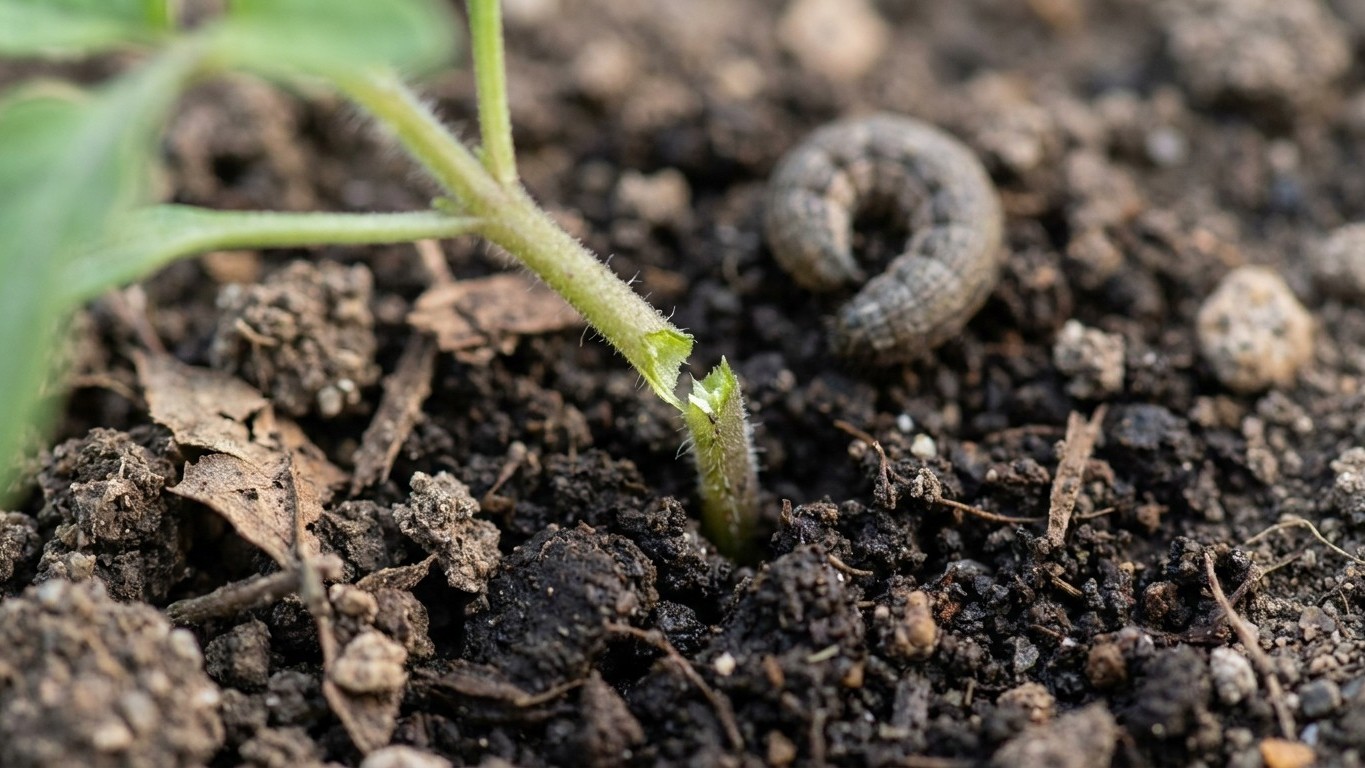
Cutworms are gray-brown caterpillars, roughly an inch long, that curl into a tight C-shape when disturbed. They feed at night, and the damage shows up as young transplants sliced clean through at the soil line, sometimes toppled whole with no leaf damage above. The larva is the only stage that matters here. A cardboard or foil collar pushed an inch into the soil around each stem at transplant time stops them cold.
Flea Beetles
Flea beetles are tiny, shiny black beetles barely a sixteenth of an inch long that jump like fleas when you brush the plant. Adults chew small round holes through leaves, giving young foliage a shotgun-blast look, and they hit hardest on seedlings just after transplant, when a few dozen holes can stunt a plant for weeks. A floating row cover left over transplants until they’ve hardened off keeps adults off the leaves without any spray.
Four-Lined Plant Bug
This one is easy to spot: bright yellow-green body about three-eighths of an inch long with four black stripes running down the back. Nymphs and adults both pierce leaf tissue, leaving small dark, sunken spots that can look like a fungal disease from a distance. They show up in late spring to early summer and produce a single generation a year, so the damage is usually cosmetic rather than plant-threatening. Clearing garden debris in fall reduces overwintering eggs, and insecticidal soap handles nymphs if numbers climb.
Colorado Potato Beetle
Adults are about three-eighths of an inch, yellow-orange with black stripes running the length of the wing covers. Larvae are humpbacked, reddish-orange with two rows of black spots, and they’re the more damaging stage, capable of stripping a plant’s leaves in days once a cluster of orange egg masses hatches. They arrive in early to mid-summer. Hand-picking adults and larvae works on small plantings; a Bt-based or spinosad product targets larvae without harming most beneficial insects.
Aphids
Aphids are small, pear-shaped insects, green or black, that cluster on the undersides of leaves and along stem tips. They don’t chew, they suck sap, and heavy infestations curl and yellow leaves while leaving a sticky honeydew residue that attracts sooty mold. Populations build gradually through summer rather than arriving all at once. A strong water spray knocks most of them off, and lady beetles usually move in on their own if the garden isn’t sprayed with broad insecticides.
Tomato Hornworm
The tomato hornworm is hard to miss once it’s grown: a green caterpillar up to four inches long with white diagonal stripes down its sides and a curved horn at the rear. It’s the larval stage that does the damage, stripping leaves and chewing into green fruit, and it typically shows up in August as the season winds down. Hand-picking is the standard fix, but a hornworm carrying small white oval cocoons on its back is already parasitized by a beneficial wasp. Leave that one in place; it’s on its way out.
Working it out for your own garden
Six different insects can leave six different kinds of damage, but the diagnosis usually comes down to answering three questions in order: when in the season did you notice it, which part of the plant is affected, and what shape does the damage take.
Timing narrows the field fast. A transplant that goes down overnight in late May, right after it went into the ground, points to cutworms working at the stem, not to hornworms, which don’t show up until August. Small round holes chewed through the first true leaves within days of transplanting match flea beetles almost every time, since that’s the only pest on this list that concentrates its damage on seedlings in the first two or three weeks. Dark sunken spots that appear in June, spreading across older leaves without any visible chewing insect nearby, line up with the four-lined plant bug rather than aphids, since aphids leave curling and yellowing rather than discrete spotting.
Plant part matters next. Damage at the base of the stem is almost always a cutworm problem. Damage spread across upper leaves and stem tips, with a sticky residue and possibly ants moving up and down the stem, points to aphids, which farm that honeydew and attract ants as a side effect. Damage to green fruit, with chunks missing and caterpillar droppings visible on nearby leaves, means a hornworm has moved on from leaves to fruit, which usually happens once the plant is well established in late summer.
The shape of the damage settles most remaining questions. Round shot-holes are flea beetles. Skeletonized leaves with only veins left, especially with orange-and-black striped beetles or humpbacked red larvae visible, mean Colorado potato beetle. Curled, yellowing leaves without holes are aphids. A plant cut clean through at the soil line, with no chewing on the leaves above, is a cutworm and nothing else, since none of the other five pests interact with a tomato stem that way.
When two possibilities still overlap, the insect itself usually settles it. Flip a few leaves over and look for the culprit in the act: a jumping black speck is a flea beetle, a slow-moving yellow-green bug with black stripes is a four-lined plant bug, and small green or black clusters are aphids. Finding nothing moving but seeing chewed leaf edges after dark usually means checking again at night with a flashlight, since cutworms and hornworms both feed after sundown and are easy to miss during the day.
What changes across the state
The Montreal/St-Hubert A frost window describes one river-valley station, and pest timing shifts as the climate changes across the province.
Areas close to the St. Lawrence River and at low elevation, much of the Montérégie and the greater Montreal region, warm up earliest in spring and hold heat longest into fall. Pests that depend on a run of warm days, aphids building numbers, Colorado potato beetle completing multiple generations, tend to get a head start and a longer stretch to multiply in these lowland districts.
Move north or up in elevation, toward the Laurentians, the Saguenay, or the Gaspé, and both frost dates shift later in spring and earlier in fall, compressing the window each pest has to establish. Flea beetles and cutworms, which strike early regardless of the exact date, show up on a roughly similar schedule almost everywhere in the province because they respond to soil temperature at transplant rather than to a long stretch of accumulated warmth. Colorado potato beetle and aphids, which need successive generations to become a real problem, tend to build to damaging numbers later, and sometimes not at all, in the coolest, shortest-season districts.
Distance from open water plays a smaller but real role too. Gardens right along the St. Lawrence often see milder nights than gardens a few miles inland at the same latitude, which can extend the window during which aphids and plant bugs stay active into early fall. None of this changes which six pests show up, since the same insects are established across the province’s tomato-growing regions. It changes how early they arrive and how many generations they get through before the first fall frost ends the season.
The mistakes this state punishes
Skipping protection at transplant is the costliest mistake in a five-month season, because flea beetles and cutworms hit exactly when a young plant has the least reserve to recover. A transplant that loses its growing tip to a cutworm in late May doesn’t get replaced in time to still produce a crop before the average October 5 frost; there isn’t a second season to fall back on. A floating row cover or a cutworm collar at planting time costs a few minutes and prevents both problems at once.
Waiting for obvious damage before checking for Colorado potato beetle eggs is the second one. The orange-yellow egg clusters on leaf undersides hatch into the more destructive larval stage within about a week or two, and by the time skeletonized leaves are visible, the plant has already lost a meaningful chunk of the growing season it needs to ripen fruit before frost. Checking leaf undersides weekly starting in June catches the eggs before they hatch.
Reaching for a broad-spectrum insecticide at the first aphid sighting tends to backfire in a short season, since it kills off the lady beetles and other predators that would otherwise keep numbers down for the rest of summer, without enough season left afterward for those predator populations to rebuild. A water spray or insecticidal soap targets aphids directly and leaves the predators to do the rest of the job.
Finally, pulling a plant in a panic over a single tomato hornworm in August often means giving up on fruit that was close to ripening anyway. One or two hornworms rarely cost a Quebec garden its harvest this late in the season; hand-picking them off is usually all that’s needed.
Checking this against your county
The pests, timing, and frost window described here reflect the Montreal/St-Hubert A station and the lowland region around it, not every corner of Quebec. A garden in the Gaspé or the upper Laurentians can see the same six pests on a noticeably later schedule, or in smaller numbers, simply because the season starts later and ends sooner there.
For a check specific to your own area, MAPAQ’s regional offices and their published vegetable guides are the better source, since they track local frost data and pest reports rather than a single reference station. Start with MAPAQ and search for the horticultural resources covering your region.
Common questions
Do tomato hornworms survive winter in Quebec soil?
They pupate underground, and in milder winters or under snow cover some do survive to emerge as moths the following summer. Quebec’s cold reduces survival compared to warmer regions, which is part of why numbers stay manageable most seasons rather than exploding.
Is the Colorado potato beetle only a threat to potatoes?
No. It feeds readily on tomato and eggplant too, and if you grow potatoes and tomatoes in the same garden, treat both as one connected pest problem rather than checking them separately.
Do a few aphids on a tomato plant need treatment right away?
Usually not. Small aphid clusters often get controlled by lady beetles and other predators before they spread. Step in with a water spray or soap only if the colony keeps growing over a week or two.
Can a row cover stay on all season to block flea beetles and cutworms?
No, it needs to come off once flowers form so pollinators can reach them. That timing works out fine here, since both pests do most of their damage on young transplants in the first few weeks, before flowering starts.