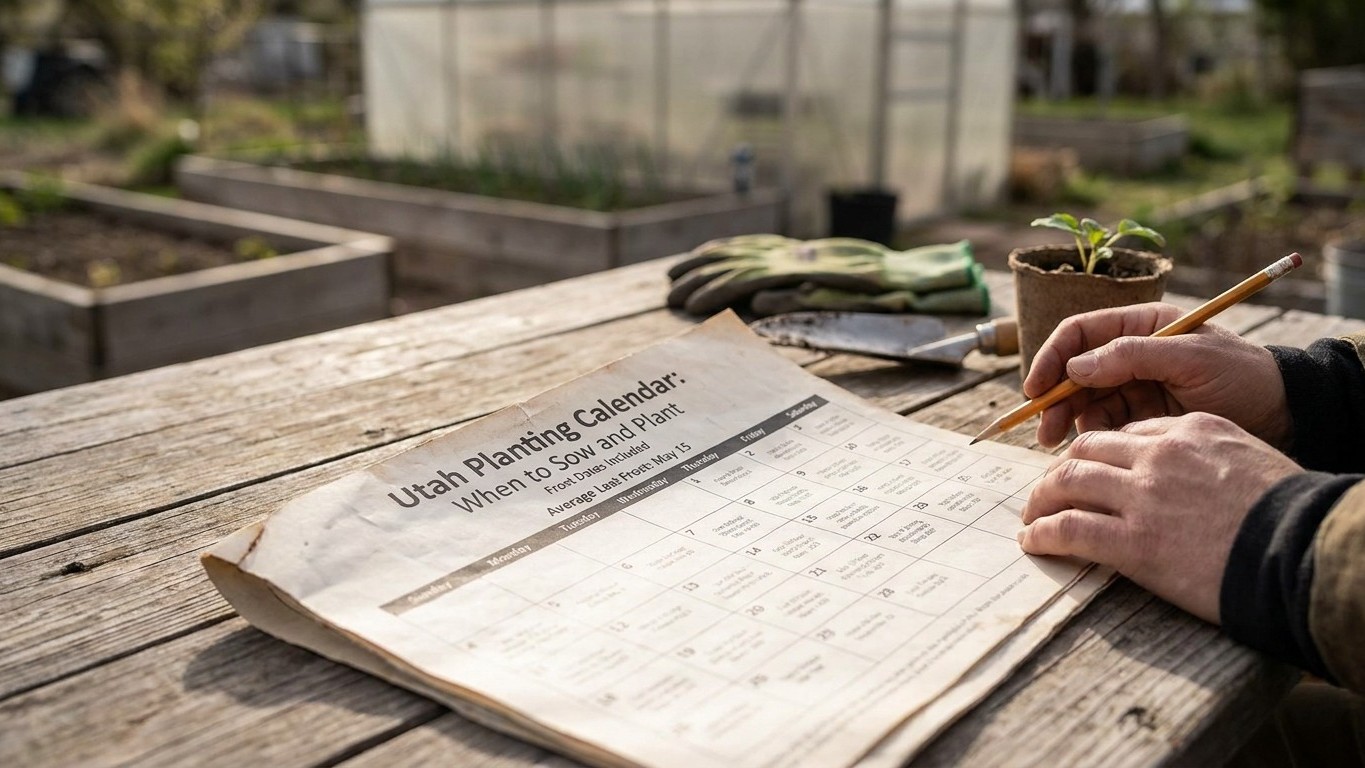

Utah’s growing season isn’t one date, it’s two—and everything you plant depends on the gap between them. In the Salt Lake valley, the ground clears its last hard freeze somewhere between April 12 and April 29, then stays open until mid-to-late October, but a bench, canyon mouth, or mountain valley nearby runs weeks behind that. So before you sow a single seed, walk your own yard and check when the snow actually melts off the beds and when frost has hit your plants in past years—that tells you more than any calendar date will.
The frost window in Utah

Everything in a Utah vegetable garden runs off two dates: the last hard freeze of spring and the first of fall. At the Salt Lake City airport station, NOAA’s NCEI 1991-2020 climate normals put the last spring frost between April 12 and April 29, and the first fall frost between October 18 and October 29 (for a full rundown of what that fall frost date means for your garden, see What to Plant in Utah in October, and for the tail end of the season once frost has settled in, see What to Plant in Utah in November). Those numbers describe a 30 to 70 percent probability of a 32degF freeze on any given day within that window, not a hard switch, so treat both edges as soft rather than absolute.
Do the arithmetic across the widest and narrowest versions of that window and you get a growing season of somewhere between 172 and 200 frost-free days at the reference station: 172 days if spring runs late (April 29) and fall arrives early (October 18), and up to 200 days if spring clears early (April 12) and fall holds off until October 29. That is a wide enough spread that a gardener who plants strictly by the calendar one year and gets caught by a mid-October freeze the next hasn’t done anything wrong—it’s also why knowing What to Plant in Utah in May matters just as much as tracking what comes after in What to Plant in Utah in June, the height of summer covered in What to Plant in Utah in July, the mid-season heat covered in What to Plant in Utah in August, or the fall dates covered in What to Plant in Utah in September. The station’s own numbers say that range exists.
Salt Lake City sits in a mild valley next to a large lake, and that combination buys it a longer season than most of the state gets. Higher elevations and the northern mountain valleys run their last frost weeks later and their first frost weeks earlier, squeezing the season from both ends. Lower, warmer country in Utah’s southwestern corner typically clears its last frost earlier and holds off its first fall frost longer than the Salt Lake figures suggest. If you garden in a mountain valley or anywhere well above the Salt Lake floor, use these dates as a floor for how early it’s safe to plant, not a target to hit.
Utah’s neighbors deal with the same elevation problem on a bigger scale. Gardeners just across the border in Wyoming work with an even tighter window, covered in our Wyoming Planting Calendar, where high-elevation towns can see frost-free stretches well short of what the Salt Lake numbers describe.
Cool-season crops (see What to Plant in Utah in May before checking What to Plant in Utah in June, then What to Plant in Utah in July once summer crops take, and later What to Plant in Utah in November as the season winds down, and What to Plant in Utah in August as the season winds down, and What to Plant in Utah in September as fall approaches, and What to Plant in Utah in October as the season winds down hold, and What to Plant in Utah in August as the season turns) over the beds, and What to Plant in Utah in September as the season winds down) Utah in October when it’s time to wind the season down)
Peas, spinach, lettuce, brassicas and most root crops don’t wait for the frost-free date. See What to Plant in Utah in January for a month-by-month breakdown of which crops to start early, see What to Plant in Utah in February, then keep reading for how these crops go in when, including What to Plant in Utah in December, crops to sow, see What to Plant in Utah in April, and continue reading for what else applies throughout the of these to start early, see What to Plant in Utah in March. They tolerate a light freeze once established, and several germinate better in cold soil than warm. The practical marker isn’t a date on the calendar. It’s whether the ground has thawed and dried out enough to work without turning to mud.
What goes in first
- Peas: sow as soon as the soil can be worked, typically four to six weeks before the close of the last-frost window.
- Spinach and lettuce: direct-sow two to four weeks ahead of the last frost date. Both germinate poorly once the soil warms up.
- Brassicas (broccoli, cabbage, kale): start transplants indoors four to six weeks before the last frost, then set them out two to three weeks ahead of that date.
- Root crops (carrots, beets, radishes): direct-sow from about three weeks before the last frost date through several weeks after it.
Because Salt Lake City’s last frost window runs from April 12 to April 29 per NOAA’s normals, “four to six weeks before” lands the earliest pea and spinach sowings in early to mid-March, sliding later at elevation. Gardeners above the valley floor should push all of these back by however many weeks their own site typically lags Salt Lake, which becomes obvious after a season or two of watching when the snow actually clears from the beds.
Lettuce and spinach bolt once daytime temperatures climb into the 80s, which happens by early summer across most of Utah, so treat the cool-season window as bracketed on both ends. Too early and cold, wet soil rots the seed. Too late and heat bolts the crop before it produces much of a harvest. Succession-sow lettuce every couple of weeks through the cool stretch to keep a supply coming, then start again once nights cool off in early fall.
None of these crops need protection once the frost has passed, but a floating row cover earns its keep in the weeks before that, buffering a surprise freeze that would otherwise blacken young lettuce or brassica transplants overnight.
Warm-season crops

Tomatoes, peppers, squash, beans and corn are killed outright by frost, so the last frost date is a hard floor for them, not a target date. But frost isn’t the only limit on these crops. Soil temperature matters more than the calendar, because seeds and roots stall in cold ground even when the air itself is technically safe. Bean and corn seed rots more than it germinates in soil that hasn’t warmed enough, and pepper and squash transplants sulk for weeks if set out too early even without any visible frost damage.
Matching variety to the season
For transplanted tomatoes, the workable window across most of Utah runs from late April to mid May, calculated by pairing each variety’s days-to-maturity figure against the Salt Lake frost dates with a week or two of margin for a cool spring. That range shifts later at elevation and earlier in the warmer southwestern corner of the state. Wait until nighttime lows are reliably above the mid-50s before setting tomatoes, peppers, or squash outside, even once the calendar clears the frost date. A cold snap that doesn’t kill the plant outright can still stunt it for weeks.
Short-season tomatoes buy the most insurance against a late spring or an early fall. Fast varieties like Sakura and Edox reach maturity in 55 days from transplant, so set out between late April and mid May, they ripen by early July and carry roughly 103 days of margin before the average first fall frost. Longer-season paste and beefsteak types eat into that cushion fast, needing 75 to 78 days from transplant and not ripening until late July, which trims the margin to around 80 to 83 days. The table below shows the full spread.
| Variety | Days from transplant | Type | First ripe (calculated) | Margin before fall frost |
|---|---|---|---|---|
| Sakura | 55 | Indeterminate | Early July | 103 days |
| Edox | 55 | Indeterminate | Early July | 103 days |
| Valentine | 55 | Indeterminate | Early July | 103 days |
| Glacier | 55 | Determinate | Early July | 103 days |
| Sun Gold | 57 | Indeterminate | Early July | 101 days |
| Supersweet 100 | 60 | Indeterminate | Mid July | 98 days |
| Juliet | 60 | Indeterminate | Mid July | 98 days |
| Amalfi | 68 | Determinate | Mid July | 90 days |
| Cherokee Purple | 72 | Indeterminate | Late July | 86 days |
| Big Beef Plus | 72 | Indeterminate | Late July | 86 days |
| Tiren | 75 | Indeterminate | Late July | 83 days |
| Granadero | 75 | Indeterminate | Late July | 83 days |
| San Marzano II | 78 | Indeterminate | Late July | 80 days |
| Celebrity Plus | 78 | Determinate | Late July | 80 days |
All of these figures are counted from the transplant date, not the seed-sowing date, and shift by a week or two either direction depending on how the season actually runs. For indoor seed starting, count back six to eight weeks from the late-April-to-mid-May transplant window. That puts the sowing date at roughly early to mid March for the earliest transplants, sliding to late March for growers targeting the back half of the window. Corn, beans, and squash are usually direct-sown instead, and should go into the ground only once the soil itself, not just the air, has warmed past frost risk, generally a week or two after the last frost date has cleared.
The fall planting window
Fall planting works backward from the first frost instead of forward from the last one. NOAA’s NCEI 1991-2020 normals put the Salt Lake City station’s first fall frost between October 18 and October 29. To find a sowing date for a fall crop, take the days-to-maturity printed on the seed packet, count back from the earlier end of that window to be conservative, then add another one to two weeks on top, because growth slows as daylight shortens and a crop maturing “on time” by the packet’s count often needs longer once nights cool.
That extra margin matters more for fall crops than spring ones. A lettuce packet’s maturity estimate assumes the steady warmth of late spring, not the shortening days of September, so a fall crop sown to hit exactly that number of days before frost can still fall short of full size when the cold arrives. Building in the additional stretch is cheap insurance. Worst case, the crop matures a little early and sits fine in the ground under a light cover.
Crops that improve after a light frost
Not every fall crop is racing the freeze. Kale, Brussels sprouts, carrots, and spinach all convert stored starches to sugars when nights turn cold, and a light frost makes these crops sweeter rather than damaging them. Leaving carrots in the ground through the first few frosts, mulched heavily, is a common practice in short-season Utah gardens rather than a shortcut someone stumbled into by accident. Full-grown cabbage and broccoli tolerate a light frost too, though a hard freeze will still damage an exposed head.
The safest fall crops for most of Utah are the same quick cool-season crops that go in early spring: spinach, lettuce, radishes, and peas, all of which finish fast enough to fit inside even the shorter version of the fall window. Longer-season fall crops like Brussels sprouts need to be started from a summer sowing well before the first-frost countdown even begins, so their timing is set by the summer calendar rather than the fall one. A cold frame or heavy row cover can push the practical harvest window a few weeks past the first frost for cold-hardy greens, though it won’t rescue a warm-season crop still on the vine when the freeze finally arrives.
Reading a planting calendar properly
A state-wide planting calendar, this one included, is built from one weather station and applied to a state that ranges from low desert along its southern border to peaks well above 10,000 feet. Treat every date on this page as a starting point for the Salt Lake valley, not an instruction for your own yard. The gap between a valley floor and a bench a few hundred feet higher can run two or three weeks on both ends of the season.
Utah adds two more wrinkles on top of the station average: the effect of the Great Salt Lake, and the way cities hold heat. Ground close to the lake sees temperature swings moderated in both directions, sometimes delaying the first freeze in fall and the last one in spring compared to drier ground a short drive away. Urban neighborhoods run a few degrees warmer overnight than open farmland at the same elevation, simply because pavement and buildings hold the day’s heat longer. Either effect can shift the practical planting date by a week or more from what a single station reports.
What to track instead
The averages also hide year-to-year swings. A 30 to 70 percent freeze probability window means a late cold snap after the “average” last frost date is not rare. It happens in a meaningful share of years by definition. A gardener who plants tender crops the day the average date arrives is taking a real risk in a noticeable fraction of seasons. The way around that isn’t a better calendar, it’s a local record: keep a simple log of the date of the last hard freeze in your own yard for a few years, and that number will beat any state-wide figure for predicting next year.
The same logic applies anywhere a single station has to stand in for a whole territory. A grower in a maritime climate like Nova Scotia’s, covered in our Nova Scotia Planting Calendar, deals with the same gap between a coastal reporting station and an inland valley that never gets the moderating effect of the water.
Local help
For county-level frost dates, soil testing, and variety trials specific to your bench or valley, Utah State University Extension keeps county offices across the state with staff who track local conditions the NOAA station in Salt Lake can’t capture on its own. A soil test through your county office is worth the small fee before a first garden bed goes in, since Utah’s often alkaline, clay-heavy soils need amendment recommendations specific to your yard rather than a state average. Our broader Utah guides cover soil, pests, and other state-specific gardening questions.
Common questions
When is it actually safe to plant tomatoes outside in Utah?
Not on the calendar date alone. Wait until nighttime lows are reliably above the mid-50s in addition to being past your local last frost date, since a cold but frost-free night still stunts a young tomato plant. In the Salt Lake valley that generally lines up with late April through mid May, later at higher elevation.
Does Utah have one frost date for the whole state?
No. The dates on this page come from the NOAA station at Salt Lake City, and elevation changes them by weeks in either direction. A mountain valley or bench town should expect a later last frost and an earlier first frost than the figures given here.
Can I trust the days-to-maturity number on a seed packet?
Mostly, but treat it as a starting point rather than a guarantee. Packet figures are usually counted from transplant for tomatoes and peppers, and from direct-sowing for most other crops, and they assume average conditions that a particularly cool or hot season won’t match exactly.
What happens if I plant warm-season crops too early?
Cold soil stalls germination and root growth even without a frost, so seeds rot before sprouting and transplants sit without growing for weeks. Waiting an extra week or two after the frost date usually outgrows a plant set out too early into cold ground by midsummer.
Is it worth planting a fall garden in Utah?
Quick cool-season crops like spinach, lettuce, and radishes are worth the extra sowing, since they fit inside the fall window even in its shorter years. Longer-season fall crops need a mid-summer sowing instead, well before the first-frost countdown starts, to have any real margin.
Related guides
- Idaho Planting Calendar: When to Sow and Plant, Frost Dates Included
- Wyoming Planting Calendar: When to Sow and Plant, Frost Dates Included
- Illinois Planting Calendar: When to Sow and Plant, Frost Dates Included