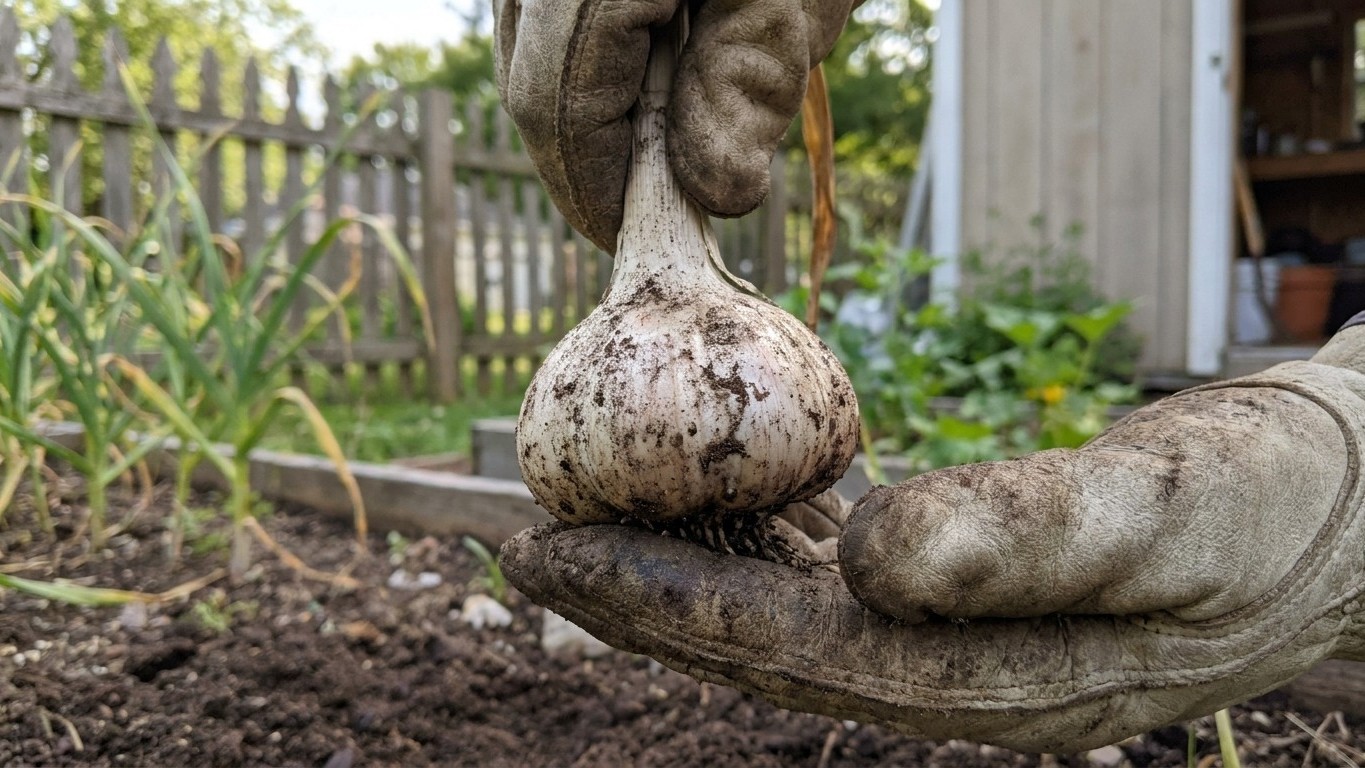

Garlic goes in the ground in Ohio from mid-September to late September, no matter which variety you’re growing. You’re not picking that date off a calendar page — you’re counting back from your own first fall frost, which near Columbus lands around October 5 to October 15, so garden zones elsewhere shift earlier or later. The one thing to do before you commit to a week: pull your county’s frost record and check it against that Columbus window, because the ground stays workable for weeks yet, and you’d rather start with room to move than a single day to hit.
The short answer for Ohio

Plant garlic in Ohio from mid-September to late September. That window comes from Counting Back From the state’s first fall frost, which OSU Extension’s Ohio Gardening Calendar places at October 5 to October 15 near Columbus. The frost date itself isn’t the planting deadline. It’s the anchor point: garlic needs several weeks of root growth in soil that’s still workable before the ground locks up for winter, and that root growth has to happen before, not after, the first hard freeze settles in. With a bed picked and compost worked in, as covered in Growing Garlic in Ohio, what’s left is nailing the date.
Every cultivar on the closed list for this territory, from softnecks like Early Red Italian to hardnecks like Fall Festival and Ivan, shares that same mid-to-late September window. That’s not a coincidence of naming. Garlic planted in fall doesn’t run on a days-to-maturity clock the way a tomato does. It sits in the ground through winter, then bulbs the following summer, so what decides bulb quality isn’t a count of days after transplant. It’s whether the clove had a full stretch of cool soil to grow roots before winter, and then enough cold afterward to split into cloves at all.
On that second point, Ohio has margin to spare. University of Georgia Extension publication C854 puts the chilling garlic needs after planting to differentiate into cloves at six to eight weeks below 40°F. Ohio’s winters run about 21.8 weeks below 40°F, so the chill requirement is never the limiting factor here the way it might be in a warmer state. What decides success in Ohio is timing the planting date, not worrying whether winter will be cold enough.
Working it out for your own garden
The arithmetic behind the mid-September-to-late-September window is straightforward once you see it laid out. OSU Extension’s frost window near Columbus runs October 5 to October 15. The recommended setout window sits roughly two to four weeks ahead of that frost range, the stretch garlic needs to grow roots in soil that’s still workable before the ground turns cold enough to stop root growth. That’s why the planting date is given as a range rather than a single day, and why it’s worth keeping both ranges in mind rather than picking one point out of either.
Applying it to your own address
Start with your own first fall frost date, not Columbus’s. OSU Extension’s Ohio Gardening Calendar is measured at or near Columbus, and a garden fifty miles away in either direction can run a week or more ahead of or behind that figure. Once you have a local frost estimate from your county extension office, apply the same two-to-four-week setback and you’ll land on your own planting window.
Three things move that local frost date around, and by extension move your planting window: elevation, a large lake, and open water generally. Higher ground cools faster after sunset because cold air is dense and drains downhill into low spots, so a garden on a ridge or in a valley bottom can see frost arrive a week or two earlier than a garden on a mid-slope nearby. A large body of water works the opposite way. It holds the day’s heat into the evening and releases it slowly, so a garden close to shoreline can run a week or two behind an inland garden at the same latitude. Neither adjustment has a fixed number attached the way the Columbus figure does. Treat two weeks either way as the outer edge of what’s plausible, and use your own frost history, not a statewide average, to settle on a week within that edge.
The closed list of varieties suited to this territory all share the same fall setout window, whatever the plant’s type:
| Variety | Type | Set-out window (Ohio) |
|---|---|---|
| Inchelium Red | Softneck | Mid to late September |
| Lorz Italian | Softneck | Mid to late September |
| Italian Late | Softneck | Mid to late September |
| German White | Hardneck | Mid to late September |
| Chesnok Red | Hardneck | Mid to late September |
| Duganski | Hardneck | Mid to late September |
For a fuller rundown of how these varieties differ in flavor, storage life, and clove count, see Garlic Varieties That Suit Ohio Winters.
What changes across Ohio
Ohio isn’t one climate, and the frost window OSU Extension measures near Columbus doesn’t hold for the whole state. Three regions consistently run ahead of or behind that figure, and the direction depends on what’s nearby: a large lake, high ground, or a river valley.
The Lake Erie shoreline
Counties along the lake, Ashtabula, Lake, Cuyahoga and the rest of the northern strip, sit downwind of a large, slow-cooling body of water that keeps fall air warmer than the interior at the same latitude. First frost typically arrives later there than it does around Columbus, which pushes the whole planting window later by roughly the same margin.
The Appalachian Plateau in the southeast
Vinton, Athens and Hocking counties sit at higher elevation on hillier ground, and cold air pools in the valleys on clear autumn nights. Frost tends to show up earlier here than on the flatter ground around Columbus, so a garden in this part of the state should plan toward the early side of the mid-September-to-late-September window, or slightly ahead of it.
The Ohio River valley
Along the southern border, lower elevation and the river’s moderating effect on nearby air tend to push first frost later than the state average, similar to the lake counties but for a different physical reason.
None of this changes the underlying method, only the date fed into it. The two-to-four-week setback from your own local first frost still applies wherever you garden in Ohio. What changes is which end of the calendar you’re counting back from, and for a state this long north to south, that difference is real enough to matter for a crop that has to root before the ground freezes.
The mistakes this climate punishes
The most common mistake in Ohio is simple procrastination. Gardeners wait for the first real cold snap to feel motivated, and by then the mid-September-to-late-September window measured against the Columbus frost date has already closed. Cloves planted in October still grow, but they don’t get the root establishment they need before the ground locks up, and a weak root system going into winter means a smaller bulb the following summer.
Skipping mulch on shallow-planted cloves causes the second failure. Ohio’s clay-heavy soils go through repeated freeze-thaw cycles over winter, and a clove sitting just under the surface without a mulch layer can heave partway out of the ground on a freeze-thaw swing, exposing it to drying out and rot. A few inches of straw mulch, applied right after planting, absorbs most of that swing.
Sourcing clean seed garlic
Starting from grocery-store bulbs instead of certified seed garlic creates a third problem, one Ohio’s climate does nothing to protect against. UC IPM’s guidelines for onion and garlic, UC ANR Publication 3453, list white rot, caused by the fungus Sclerotium cepivorum, as active across a published 50 to 75°F range. Columbus’s monthly mean air temperature falls inside that range in five months of the growing season, September, October, April, May and June, with one of those months at the fungus’s published optimum. Fusarium basal rot, caused by Fusarium oxysporum f. sp. cepae, has a published range of 59 to 90°F that Columbus’s monthly means fall inside for four months: September, May, June and July.
Those thresholds are published as soil temperatures, and the figures above compare them to air temperature, which lags soil and swings less. A monthly average sitting inside a range doesn’t mean every day that month stayed there either, and Columbus is one reference station, not a description of the whole state. What the numbers do establish is that Ohio’s growing season spends a meaningful stretch of time within range for both diseases, so the season itself does nothing to stop an infected clove from spreading the pathogen through your bed once it’s planted. Buying certified disease-free seed garlic is the actual control, since neither fungus dies out on its own once it’s established in soil.
Checking this against your county
Every figure in this piece is anchored to Columbus, and OSU Extension is explicit that its Ohio Gardening Calendar is a starting point, not a county-by-county forecast. Before you commit to a planting date, check your own county’s frost history against the records held by OSU Extension, which maintains local offices with data specific to their area. A grower in Ashtabula County and one in Hocking County can both apply the same two-to-four-week setback described above and still land on different weeks within the mid-September-to-late-September range, because they’re starting from two different local frost dates, and that’s the correct outcome, not an error.
Common questions
Can I plant garlic in spring instead of fall in Ohio?
You can, but expect smaller bulbs. Garlic sizes up through a fall-to-spring cold spell that triggers the clove to split, and a spring-planted clove misses most of that window. Treat spring planting as a stopgap for cloves you forgot to get in the ground, not a first choice.
What if I miss the September window entirely?
Plant as soon as you can in October and mulch heavily the same day. The crop will likely come in smaller than a properly timed planting because the roots had less time to establish, but a late-planted clove still beats one held over to spring.
Should I separate the cloves ahead of time or right before planting?
Break the bulb into individual cloves the same day you plant, not weeks ahead. A clove that’s been separated and left sitting starts to dry out at the exposed basal plate, which slows rooting and invites rot once it’s in the ground.
Does it matter which way up the clove goes?
Yes. Plant with the pointed tip up and the flat root scar down. A clove planted upside down or sideways still grows, but it wastes energy correcting its own orientation underground before it can put down real roots.
If you follow the almanac, here is when to plant garlic by the moon. It is a tradition, not a proven method.