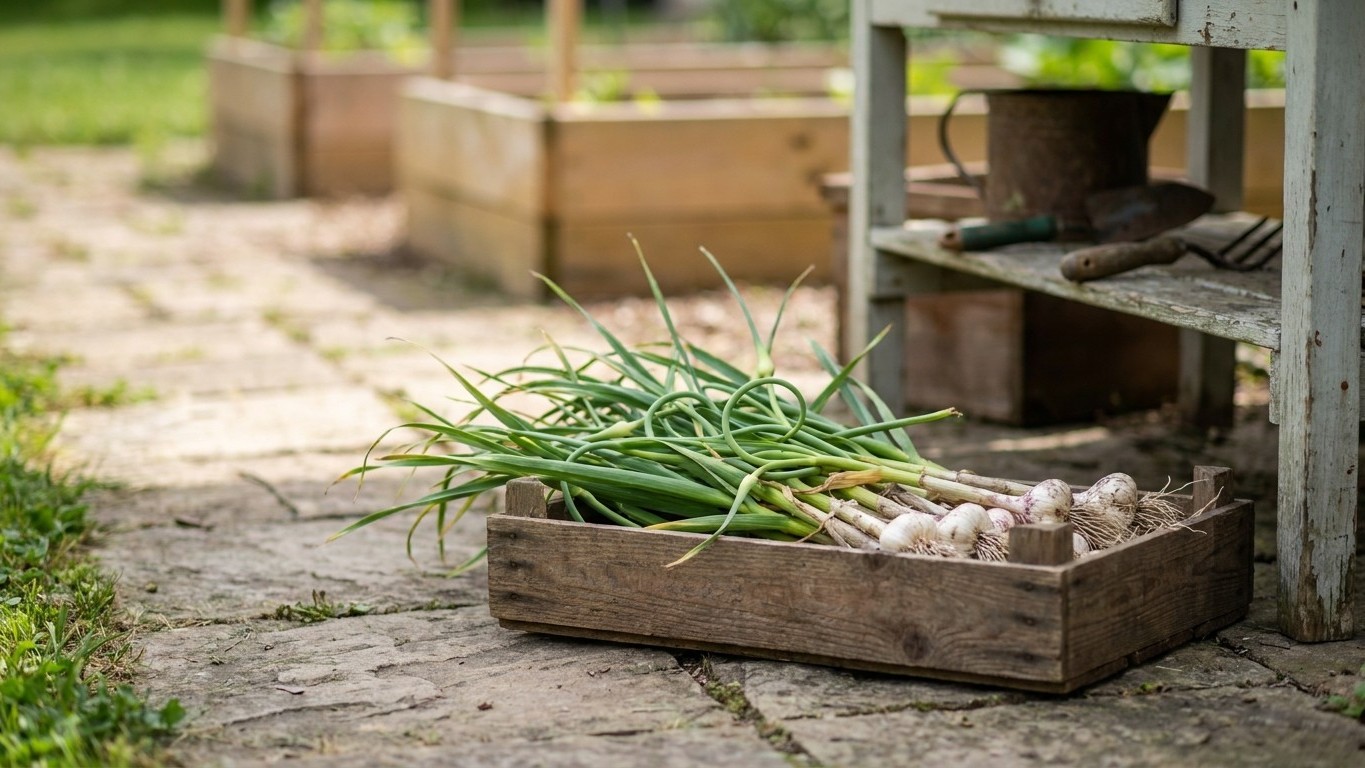

Pennsylvania winters deliver an average of 21.8 weeks below 40°F, according to research cited by University of Georgia Extension (publication C854), far more than the six to eight weeks any garlic clove needs to split into a full bulb. That means the real decision for a Pennsylvania grower is not whether garlic will winter over, it is which type suits your county and whether you get it in the ground on time. Set cloves out mid-October to late October and pick a hardneck cultivar if you garden above the ridgelines or in the state’s colder counties.
The short answer for Pennsylvania

Plant garlic in fall, not spring. Every cultivar worth growing here goes into the ground mid-October to late October and comes out of the ground the following summer, after a full winter of dormancy and a spring of leaf growth. That single planting window covers all fourteen varieties in wide circulation for this state, hardneck and softneck alike, because Pennsylvania’s cold season is long enough to satisfy the chill requirement for either type without pushing the calendar around.
Near Philadelphia, NOAA’s 1991-2020 climate normals put the first fall freeze between November 5 and November 16. That range is a midpoint, not a guarantee: in roughly half of all years the first freeze lands later than this window, and in the other half it arrives earlier. Growers who wait for a hard freeze as their planting cue are already behind. If you haven’t settled your bed yet, the soil prep and site steps belong in our guide to Growing Garlic in Pennsylvania before any of this matters.
The fourteen varieties
All of the following are sold as fall-planted stock for this climate. The set-out window is the same across the list. What differs is neck type, which shapes how each performs under stress, stores after curing, and tolerates a rough winter.
| Variety | Type | Set-out window |
|---|---|---|
| Early Red Italian | Softneck | Mid to late October |
| Inchelium Red | Softneck | Mid to late October |
| Italian Late | Softneck | Mid to late October |
| Lorz Italian | Softneck | Mid to late October |
| Bavarian Purple | Hardneck | Mid to late October |
| Blue Music | Hardneck | Mid to late October |
| Chesnok Red | Hardneck | Mid to late October |
| Duganski | Hardneck | Mid to late October |
| Fall Festival | Hardneck | Mid to late October |
| Georgian Crystal | Hardneck | Mid to late October |
| Georgian Fire | Hardneck | Mid to late October |
| German Red | Hardneck | Mid to late October |
| German White | Hardneck | Mid to late October |
| Ivan | Hardneck | Mid to late October |
Softneck types such as Inchelium Red or Italian Late tend to cure into bulbs that keep longer in storage and generally handle a milder, wetter winter better. Hardneck types such as Duganski or German Red are the ones growers reach for when a winter runs harsher or the ground stays frozen and exposed longer than usual.
Working it out for your own garden
The arithmetic
The mid-October to late-October planting window isn’t arbitrary. It sits roughly three to four weeks ahead of the November 5 to November 16 first-freeze range that NOAA’s 1991-2020 normals record near Philadelphia. That gap gives a clove time to push roots into the soil before the ground turns hard enough to stop root growth, without so much lead time that top growth breaks the surface and gets caught by an early cold snap. You can run the same subtraction for your own county: take your area’s typical first fall freeze and count back three to four weeks to find your planting window.
For the week-by-week version of this countdown, including how to adjust it once frost actually arrives at your address, see When to Plant Garlic in Pennsylvania: Counting Back From the First Frost. That page walks through the same math this section is teaching you to do yourself.
Adjusting for your site
A single frost date drawn from one weather station will never describe a whole state. Elevation, a large lake, and coastal exposure can each shift a local first-freeze date by roughly two weeks in either direction from a valley-floor or coastal reference point. A hilltop planting a few hundred feet above a nearby valley will often see frost land earlier in fall than the valley does, because cold air sinks and pools low. A site close to a large body of water usually sees the opposite effect: the water holds heat into the season and delays the first freeze at the shoreline while inland spots a few miles away have already frozen.
None of this changes the six-to-eight-week chill requirement itself, since Pennsylvania’s cold season clears that bar everywhere in the state with room to spare. What it changes is your personal planting date within the mid-October to late-October range: gardeners on higher, more exposed ground should plant on the early side of that window, and gardeners in a sheltered, lake-moderated pocket can lean toward the later side without much added risk.
What changes across Pennsylvania
Where the window narrows
Philadelphia and the surrounding Delaware Valley sit at the mild end of the state’s climate range. NOAA’s 1991-2020 normals for that station are the reference figures, and the caution that comes with them matters: the northern tier counties (Potter, Tioga, McKean) and the Allegheny high country (Somerset, Cambria and the surrounding plateau) run two to four weeks behind Philadelphia each spring, and the same cold air that delays their spring green-up tends to bring their first fall frost on sooner too. Growers in those counties should treat the early end of mid-October as their target rather than the late end, and lean toward hardneck cultivars over softneck.
The Lake Erie shoreline in the state’s northwest corner behaves differently again. Water this large holds summer heat well into fall, which usually delays the first hard freeze right at the shoreline even while inland spots at similar latitude have already frozen. A grower a mile or two off the lake can often plant later in the window than a grower on a ridge fifteen miles inland, despite sharing a county line.
None of these regional shifts are precise enough to hang a planting date on without local confirmation. They tell you which direction to adjust, not by how many days, and the county-level detail belongs with your local extension office rather than a statewide reference point.
The mistakes this climate punishes
Pennsylvania’s winter is cold enough that under-chilling is rarely the problem. The mistakes that actually cost a crop here are timing and site mistakes, plus a few disease risks that this climate keeps active longer than a grower might expect.
- Planting too late in the window and giving cloves too little time to root before the ground locks up, which leads to heaving and dead plants by spring.
- Planting too shallow, so a hard freeze-thaw cycle pushes the clove partway out of the soil over winter.
- Skipping a mulch layer in the colder counties, where bare soil around a shallow-rooted clove sees wider temperature swings than a mulched bed.
- Choosing a softneck cultivar for a high, exposed, cold-pocket site instead of a hardneck type built for that kind of stress.
- Planting seed stock of unknown origin, which is how soilborne disease gets into a bed in the first place.
Disease pressure to plan around
UC IPM’s Onion and Garlic pest guidelines (UC ANR Publication 3453) publish the soil temperature ranges in which several major garlic diseases are active. Matched against Pennsylvania’s growing-season air temperatures, white rot‘s published 50 to 75°F range overlaps the monthly average air temperature in five months of the growing season, including one month at its published optimum, and fusarium basal rot‘s 59 to 90°F range overlaps four months, also including one month at its optimum. Pink root‘s 75 to 85°F optimum lines up with one month, and southern blight‘s 86 to 95°F optimum doesn’t align with any month’s average here.
Read that carefully rather than as a forecast. These are soil temperature ranges compared against air temperature averages, soil lags and swings less than air does, and a monthly average sitting inside a range does not mean every day that month favors the disease. None of these figures mean a disease cannot occur in Pennsylvania. Southern blight showing no overlapping month means it’s less active here, not absent, and infected planting stock can introduce any of these pathogens regardless of climate. The single most effective mistake to avoid is planting garlic of unknown disease history into a bed that’s grown alliums recently.
Checking this against your county
Every figure is anchored to one reference station near Philadelphia. Your county’s first freeze date, soil type, and elevation will shift the numbers, sometimes by two weeks or more. Penn State Extension maintains county-level offices across Pennsylvania and is the right place to confirm your local frost window before you commit cloves to the ground. A five-minute call to your county office beats guessing from a statewide average, especially if you garden in the northern tier, the Alleghenies, or right along the Lake Erie shore where Philadelphia-based figures are least representative.
Common questions
Can I still plant garlic if I missed the mid-October window?
You can push into November in most years since the first freeze near Philadelphia often doesn’t arrive until the Nov 5 to Nov 16 range, but you’re gambling on the half of years when frost comes early. A late-planted clove that hasn’t rooted before a hard freeze is at real risk of heaving out of the ground over winter.
Do I need to pick a different variety for a raised bed versus in-ground?
Not because of variety, but raised beds freeze and thaw faster than in-ground soil because they’re exposed on more sides. If you’re planting in raised beds in a colder county, add mulch and lean toward a hardneck cultivar rather than switching varieties for the bed type itself.
Is hardneck garlic actually more cold-hardy than softneck, or is that just tradition?
It holds up in practice, not just tradition. Hardneck types are generally the more reliable choice in harsher, more exposed winters, which is why growers in the state’s colder counties lean toward them, though Pennsylvania’s overall winter cold is long enough that softneck types also complete their chill requirement here without trouble.
Will an unusually warm winter mean my garlic doesn’t split into cloves?
Unlikely in this state. Pennsylvania’s cold season runs an average of 21.8 weeks below 40°F according to University of Georgia Extension’s research, well beyond the six to eight weeks garlic needs, so a single mild winter would have to be extreme to fall short of that requirement.