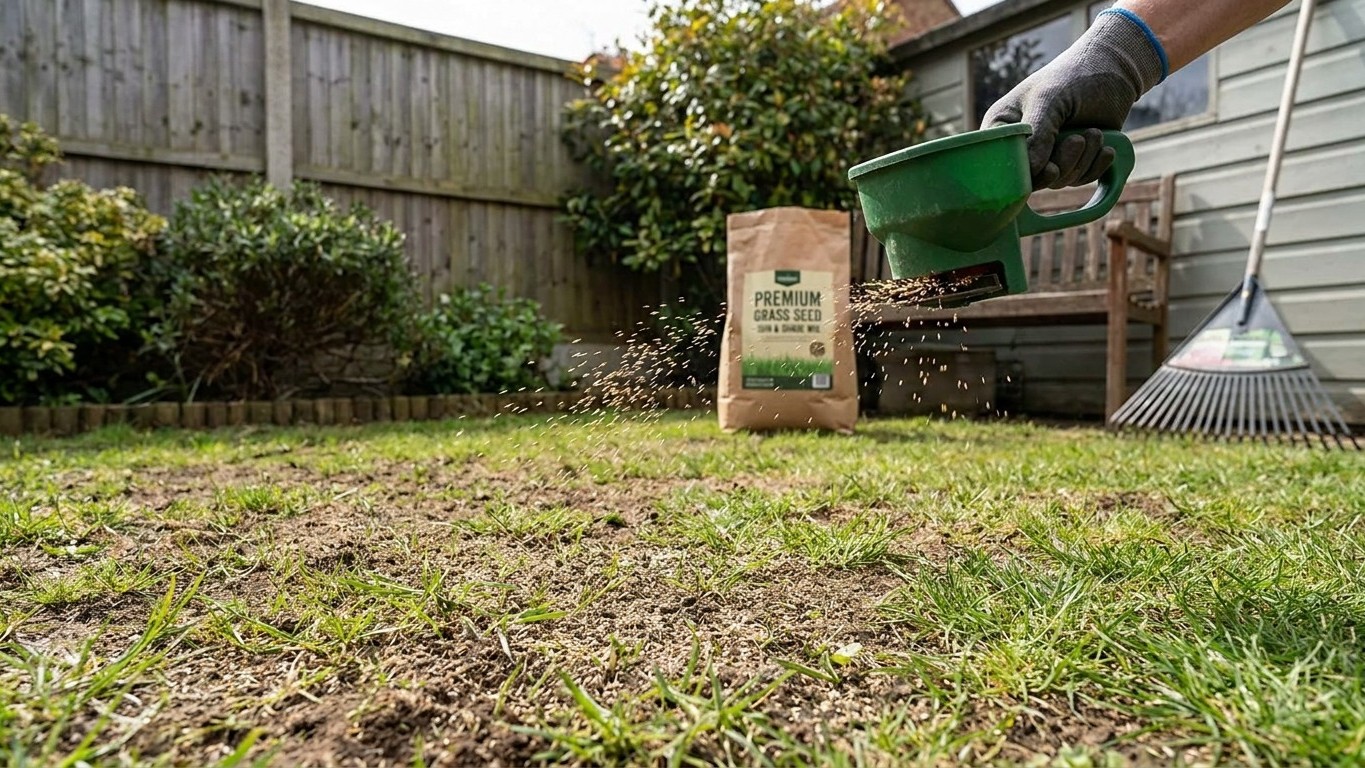

Overseeding thickens a thin lawn by working new seed into the gaps between existing grass plants, rather than killing the whole stand and starting over from bare soil. Match the new seed to what’s already there: Kentucky bluegrass and perennial ryegrass both mow at 2 to 3 inches, but tall fescue wants 2.5 to 3.5 inches, per Penn State Extension and Clemson Cooperative Extension HGIC 1214. Before buying a bag of seed, walk the lawn and identify what’s already growing, because mixing species with different mowing needs sets up a fight every time you cut the grass.
Why this matters
A thin lawn doesn’t announce its own failure the day you skip overseeding. It shows up weeks later, when the bare patches that seemed minor in spring turn to dust in July heat or mud in a wet fall, and by then the window for easy correction has usually closed. Skip overseeding on a cool-season lawn and by the time next summer’s stress arrives, the thin areas are exactly where weeds move in, because bare soil doesn’t compete with anything.
The mistake most homeowners make is treating overseeding as a rescue for a lawn that already looks bad, rather than routine upkeep for a lawn that’s merely thinning. Grass density peaks the year it’s seeded and declines every year after as older plants die off from mowing stress, disease, and age. Overseeding before the thin spots are visible from the street keeps the canopy dense enough that weed seed can’t find the bare soil it needs to germinate.
Getting the species wrong costs differently. A homeowner who overseeds a shaded fescue lawn with Kentucky bluegrass, rated only fair for shade tolerance by Penn State Extension, won’t see the failure until the following summer, when the new grass thins under the trees while the fescue around it holds on. The species choice, not the seeding technique, usually decides whether the lawn thickens or just repeats the same bare patch next year.
When to do it
Two opposite growing seasons
Cool-season grasses (fine fescues, Kentucky bluegrass, perennial ryegrass, rough bluegrass, and tall fescue, per Penn State Extension and Clemson Cooperative Extension HGIC 1214) do almost all of their root and shoot growth in spring and fall, and slow down through summer heat. Warm-season grasses (bermudagrass, zoysiagrass, St. Augustinegrass, centipedegrass, bahiagrass, carpetgrass, and seashore paspalum) do the opposite: they grow hardest through summer heat and go dormant and brown once temperatures drop in fall. Overseed a cool-season lawn in its fall growth window, and a warm-season lawn in late spring once it’s fully out of dormancy, since seeding into a dormant lawn wastes the seed on soil that won’t warm or cool fast enough to support germination.
Find your local window
The exact weeks differ by hundreds of miles of latitude, and the fact sheets cited here are national, not local. Check your own state extension’s maintenance calendar for your species before you buy seed: Clemson publishes one for centipedegrass (HGIC 1215), bermudagrass (HGIC 1216), zoysiagrass (HGIC 1217), St. Augustinegrass (HGIC 1218), and tall fescue (HGIC 1219), and each spells out the seasonal window for that specific grass rather than for lawns in general.
Overseeding often gets paired with core aeration, since core aeration opens the soil and gives new seed somewhere to fall besides the top of existing thatch. If you’re aerating and overseeding on the same visit, do the aeration first so the holes are open when the seed goes down. Fall overseeding on a cool-season lawn often lands around the same time as the last mow and the other end-of-season jobs covered in winterizing a lawn, so plan the two together rather than as separate trips to the yard.
How to do it

Match the new seed to the old
The single biggest decision in overseeding is picking a species that shares the mowing height and site tolerances of the grass already growing, so the two blend instead of competing. A shade-tolerant patch overseeded with a wear-tolerant, sun-loving species just creates a second problem instead of solving the first. The table below lines up the species covered by Penn State Extension (fine fescues, Kentucky bluegrass, perennial ryegrass, rough bluegrass) and Clemson Cooperative Extension HGIC 1214 (tall fescue and every warm-season species) by mowing height and by shade, drought, and wear tolerance.
| Grass | Season | Mowing height | Shade | Drought | Wear |
|---|---|---|---|---|---|
| Kentucky Bluegrass | Cool-season | 2 to 3 in | Fair | Fair | Good |
| Perennial Ryegrass | Cool-season | 2 to 3 in | Fair | Fair | Good |
| Fine Fescues | Cool-season | 2.5 to 3.5 in | Excellent | Good | Poor |
| Rough Bluegrass | Cool-season | 2 to 3 in | Excellent | Poor | Poor |
| Tall Fescue | Cool-season | 2.5 to 3.5 in | Good | Fair | Fair |
| Bermudagrass | Warm-season | 0.75 to 1.5 in | Very poor | Excellent | Excellent |
| Zoysiagrass | Warm-season | 0.75 to 2 in | Excellent | Good | Very good |
| St. Augustinegrass | Warm-season | 2.5 to 4 in | Excellent | Good | Fair |
| Centipedegrass | Warm-season | 1.5 to 2 in | Fair | Fair | Poor |
| Bahiagrass | Warm-season | 3 to 4 in | Poor | Excellent | Good |
| Carpetgrass | Warm-season | 1 to 2 in | Fair | Very poor | Poor |
| Seashore Paspalum | Warm-season | 1 to 1.5 in | Poor to fair | Fair to good | Good |
Prepare the existing turf
Mow the lawn shorter than usual, at the low end of the range for whatever species is growing, before spreading any seed. Cutting Kentucky bluegrass or perennial ryegrass down near 2 inches, or tall fescue near 2.5 inches, opens light to the soil surface so new seedlings aren’t shaded out by the existing canopy before they’ve even germinated. Bag the clippings on this one mow, since leaving them behind just buries the seed under a mat of cut grass. This step assumes the rest of the lawn care routine, mowing, watering, and fertilizing, is already keeping the existing turf healthy. Overseeding thickens what’s already alive. It doesn’t fix a lawn failing for other reasons.
Get seed to soil contact
Seed sitting on top of thatch or mowed clippings won’t germinate at any useful rate, no matter how good the seed is. Seed-to-soil contact matters more than the seeding rate itself. Core aeration, a slit seeder, or a hard raking to scratch open the thatch layer all accomplish the same goal: bare soil exposed in enough spots that falling seed has somewhere to land besides a dead leaf. Clemson HGIC 1203, Lawn Establishment, covers this same soil preparation for a lawn started from scratch, and the same principle applies to thickening an existing one.
How much seed, and how deep
Exact seeding rates in pounds per 1000 square feet differ by species, and by whether you’re overseeding thin turf or establishing bare soil from nothing, with figures published per species in Clemson HGIC 1203. Buy seed labeled for overseeding rather than new-lawn establishment, since bags are usually marked both ways, and follow the rate printed on that bag or in your state extension’s guide rather than guessing at one. As a general rule, seed pressed into loosened soil no deeper than about its own width germinates faster than seed buried too deep to reach the surface, which is why a light raking or rolling after spreading beats tilling seed in.
Keep the top layer of soil consistently damp with light, frequent watering until the new grass is up, then taper toward less frequent, deeper watering once it’s established, matching the rest of the lawn’s pattern. Wait until the seedlings have grown tall enough to need mowing at the same height as the established lawn before running a mower over them.
What goes wrong
Mowing too soon or too low
Running the mower over new seedlings before they’ve rooted pulls them right out of loosened soil, and the tell is a lawn that looks patchy in exactly the pattern of the mower’s wheel tracks about two weeks after that first cut. Wait until seedlings have grown tall enough to need mowing at the established height, not before, and raise the deck rather than guess low.
Watering wrong
Overseeded patches that dry out between waterings during germination simply die before they’re visible as anything but bare dirt, and by the time the gap is still bare a month later, the seed is gone and the window has closed. On the other end, waterlogged soil rots seed and invites damping-off fungus, which shows up as seedlings collapsing at the base within days of emerging rather than growing on.
Wrong species for the site
Seed chosen for looks rather than site conditions fails on a delay. A shade-tolerant fine fescue overseeded into full sun thins out the following summer once heat and drought stress arrive, not right away, which is why the mistake often gets blamed on bad seed a year later instead of a bad match. Rough bluegrass, rated poor for both drought and wear by Penn State Extension, is a common case: it looks fine in a shaded, low-traffic spot the first season and fails wherever foot traffic or a dry summer shows up next.
Skipping soil contact
Seed broadcast over thatch without raking, aerating, or slitting germinates at a fraction of the rate of seed with real soil contact, and the tell is a stand that looks thin and spotty rather than uniformly thickened, visible as soon as the new grass is tall enough to compare against the old.
How this changes across the country
A homeowner following Penn State Extension’s guidance, in Pennsylvania’s cool-season climate, overseeds fine fescue, Kentucky bluegrass, perennial ryegrass, or rough bluegrass lawns in that species’ fall growth window, since all four are classified cool-season by Penn State Extension. A homeowner following Clemson Cooperative Extension’s guidance, in South Carolina, is working with warm-season species instead: bermudagrass, zoysiagrass, St. Augustinegrass, centipedegrass, bahiagrass, carpetgrass, or seashore paspalum, all listed warm-season by Clemson HGIC 1214, and overseeded in that grass’s active growing season rather than in fall.
The complication is that Clemson’s own list, covering South Carolina, includes both tall fescue, a cool-season grass, and the warm-season species above, because South Carolina sits in a transition zone where neither the cool-season nor the warm-season answer applies everywhere in the state. A lawn on the same street can reasonably run either grass, depending on sun exposure, elevation, and what was planted when the house was built. There’s no single overseeding calendar for a transition-zone lawn. The right window depends on which of the two categories the existing grass falls into, not on the state line.
This is also why matching species to season matters more in a transition zone than anywhere else. Overseeding a transition-zone tall fescue lawn on a warm-season calendar, or a bermudagrass lawn on a cool-season one, wastes the whole planting, since the seed goes into the ground while its own species is dormant rather than growing.
Common questions
Can I overseed and put down crabgrass preventer in the same weekend?
No, and this is the mistake that wastes the most seed. Most pre-emergent herbicides work by stopping any seed from germinating, not just weed seed, so applying one before or after overseeding kills the new grass seed along with the crabgrass. Check the label on whatever pre-emergent is already in the garage, since some carry a waiting period before it’s safe to seed.
Why did my overseeded patch come up patchy instead of even?
Uneven germination almost always traces back to uneven soil contact rather than bad seed. Spots where seed landed on thatch, mulch, or compacted soil skip germination entirely, while spots that got raked or aerated fill in. Walk the patchy area and check whether it lines up with where the soil surface actually got broken before seeding.
Do I need to fertilize when I overseed?
New seedlings need a different feeding schedule than an established lawn, and Clemson Cooperative Extension’s HGIC 1201, Fertilizing Lawns, covers the rates and timing for both situations separately. Follow that guidance rather than the fertilizer schedule already running on the rest of the lawn, since the two aren’t the same job.
Can I overseed a warm-season lawn with ryegrass for winter color?
That’s a different job than thickening a permanent stand, sometimes called winter overseeding: a cool-season grass like perennial ryegrass gets seeded into a warm-season lawn purely for green color while the warm-season grass is dormant and brown, not dead. It can slow the warm-season grass’s spring recovery if the ryegrass isn’t mowed out or allowed to die back in time, so treat it as a separate decision from the thickening covered here.