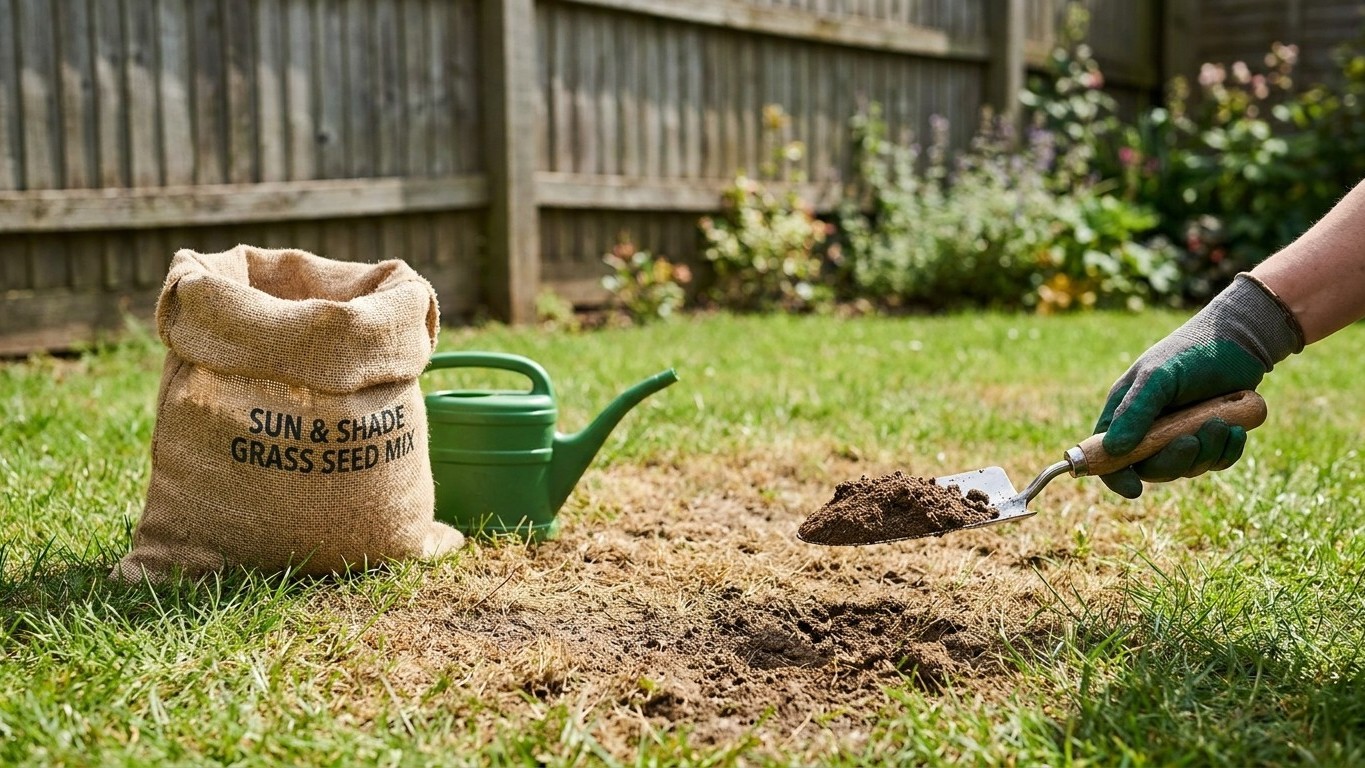

A bare spot is soil showing through where grass has died back or never filled in, and its shape is the fastest clue to why. A tight circle usually means dog urine or a fungal disease. A straight line means equipment, a buried pipe, or a hose dragged too many times. A ragged, spreading drift means grubs, compaction, or shade. Pull a handful of grass from the spot’s edge before you do anything else: if it lifts free like a strip of carpet, you are dealing with grubs, and the fix below starts differently than it does for a mowing or watering problem.
What you are looking at

Start with the outline of the spot, not the grass inside it. A perfect circle a few inches across, with a dark green ring around a dead center, is the classic look of dog urine: the nitrogen concentration kills the crown in the middle while feeding a green flush at the edge. A circle several feet wide with a smoke-colored or bleached band running through the grass, sometimes with mushrooms at the margin, points to a fungal disease rather than urine.
Straight-edged bare strips almost always trace back to something mechanical: a mower turning in the same spot, a trailer or hose dragged repeatedly, a buried utility line, or herbicide overspray along a walkway. These edges are sharp because the cause was sudden and localized, not something that spread through the soil.
Irregular, drifting patches with soft, feathered edges are the harder case. The grass often thins gradually rather than dying all at once, and the edge is not a clean line but a gradient from healthy green to bare soil. This shape shows up with grub damage, soil compaction along traffic paths, root competition under trees, and drought stress on high or sandy spots that dry out before the rest of the lawn.
- Perfect circle, dead center, green ring: dog urine
- Wide circle or ring, smoky band, possible mushrooms: fungal disease
- Straight line, sharp edge: mower, hose, buried line, or spray drift
- Irregular drift, feathered edge: grubs, compaction, shade, or drought
Color matters as much as shape. Straw brown that still has some flexibility in the blade is different from soil showing through with no plant tissue left at all. The first is often stress the plant can recover from. The second means the crown is gone and something has to be replanted.
What it is not
The most common false alarm is confusing a thinning, pale lawn with an actual bare spot. If you can still see grass blades, even yellowed or flattened ones, and no soil is visible between them, you are looking at a nutrient, watering, or dormancy issue rather than a dead patch. That distinction, and the ways to sort out hunger from drowning from ordinary seasonal dormancy, is covered on Yellow Lawn: Hunger, Drowning, or Simply Dormant.
A second look-alike is a fungal fruiting event. Mushrooms popping up overnight in a ring or cluster can look like the start of a dead patch, but the grass underneath is often untouched, because the fungus is breaking down buried wood or old roots rather than attacking the living turf. What that fungus is actually feeding on is explained on Mushrooms in a Lawn: What They Are Feeding On.
The test that separates most of these cases takes thirty seconds. Grab a clump of grass at the margin of the spot and pull firmly. If the sod lifts away in a loose mat with the roots barely attached, and you find C-shaped white larvae underneath, you have a grub problem, and treatment is a different job than reseeding a scalped patch. If the roots hold and resist your pull, the cause is above ground, in the mowing, watering, or disease category, not below it.
What actually causes it
Bare spots almost never appear the day the damage happens. The grass shows the injury days to weeks later, once the crown has actually died and stops producing new blades. That lag is why so many people blame the wrong week: the mower pass or dry spell that caused it is usually long past by the time the spot turns brown.
Cool-season causes
Kentucky Bluegrass and Perennial Ryegrass carry a good wear rating according to Penn State Extension’s Lawn Establishment guide, which is why they hold up under a backyard path or a dog’s regular route better than Fine Fescues or Rough Bluegrass, both rated poor for wear by the same source. Put any of those fine-textured grasses on a route the kids run every day and the blades wear through before the crown can recover. Heat is the other major driver: cool-season lawns are already stressed by midsummer temperatures, and a dry stretch on top of that pushes the crown past recovery, with the bare patch showing up well after the heat wave has broken.
Warm-season causes
Warm-season grasses go dormant and brown every winter, and that is not damage, it is the plant’s normal survival state. True winterkill is different: it shows up the following spring as a patch that never greens up while the rest of the lawn does. Bermudagrass carries a very poor shade rating from Clemson Cooperative Extension’s HGIC 1214, so bare patches under trees on a bermudagrass lawn are shade thinning, not disease. Centipedegrass and Carpetgrass rate poor and very poor for drought tolerance in the same fact sheet, so on those species the first bare spots in a dry summer tend to appear on the highest, fastest-draining ground.
Mowing height plays into both groups. Cutting Bermudagrass below its recommended 0.75 to 1.5 inch range, or St. Augustinegrass below 2.5 inches, scalps the crown and exposes bare stolons, according to Clemson’s HGIC 1214 mowing figures for those species. The same happens to Kentucky Bluegrass or Tall Fescue mowed under their listed 2 to 3.5 inch ranges from Penn State and Clemson respectively.
Fixing it
Confirm the cause before you buy anything
Run the pull test from the section above, check whether the lawn is warm-season and simply dormant, and look at the shape of the spot again now that you know what to look for. If the lawn is warm-season and it is winter or early spring, the honest answer is often to wait. A dormant lawn that greens up unevenly in a few weeks is recovering on its own, not dying, and treating it during that window wastes money and can stress it further.
Repair what is actually dead
For a confirmed dead patch on a cool-season lawn, rake out the dead material, loosen the top inch of soil, and reseed with a species suited to how that spot is used. The table below uses the published mowing height, shade, drought, and wear ratings from Penn State Extension and Clemson Cooperative Extension’s HGIC 1214 to compare options.
| Grass | Season | Mowing height | Shade | Drought | Wear |
|---|---|---|---|---|---|
| Kentucky Bluegrass | Cool | 2 to 3 in | Fair | Fair | Good |
| Perennial Ryegrass | Cool | 2 to 3 in | Fair | Fair | Good |
| Tall Fescue | Cool | 2.5 to 3.5 in | Good | Fair | Fair |
| Fine Fescues | Cool | 2.5 to 3.5 in | Excellent | Good | Poor |
| Zoysiagrass | Warm | 0.75 to 2 in | Excellent | Good | Very good |
| Bermudagrass | Warm | 0.75 to 1.5 in | Very poor | Excellent | Excellent |
A spot that sees daily foot traffic does better patched with Kentucky Bluegrass or Perennial Ryegrass on a cool-season lawn, or Zoysiagrass or Bermudagrass on a warm-season one, given their good to excellent wear ratings above. A shaded spot on a cool-season lawn favors Fine Fescues instead, given their excellent shade rating from the same source.
What it costs
Patching a small area with seed, starter fertilizer, and straw mulch is a low-cost weekend job, typically the cheapest fix on this list. Warm-season repairs more often use sod plugs or sprigs rather than seed, which costs more per square foot but establishes faster. Core aeration or dethatching to fix a compaction-driven drift adds rental or contractor cost but addresses the actual cause rather than just the symptom, which matters if the lawn as a whole, covered in more detail at Lawn Problems, has been struggling in more than one spot. Chemical grub or fungicide treatments should be the last step, not the first: several fungicide active ingredients carry state-specific restrictions, so check the product label and your state’s extension service before buying one, and only after the pull test or a soil sample has actually confirmed the pest or disease.
Keeping it from coming back
Most repeat bare spots trace back to one of three habits: mowing shorter than the species tolerates, watering on a schedule too shallow and too frequent to build deep roots, or fertilizing at a time that pushes weak growth instead of recovery. Of the three, mowing height is the easiest to get wrong without noticing, since a mower deck set a notch too low shaves off the same eighth of an inch every single pass.
Check your mower’s actual cutting height against the range for your species rather than trusting the dial. Clemson’s HGIC 1205 mowing fact sheet and the species figures above give the range to aim for. If the spot that keeps failing is a traffic route, changing the route with a stepping-stone path or reseeding with a higher-wear species from the table solves the recurring problem instead of patching the same ground every year.
Timing for reseeding, fertilizing, and dethatching differs by species and by climate, and cool-season and warm-season lawns are often on opposite calendars for the same task. Clemson publishes separate maintenance calendars for Centipedegrass, Bermudagrass, Zoysiagrass, St. Augustinegrass, and Tall Fescue (HGIC 1215 through 1219) that lay out the sequence for each. Confirm which calendar applies to your lawn before scheduling repair work, and treat any local sowing date or frost timing as a question for your own state extension service.
Common questions
Why does the bare spot keep coming back in the exact same place every year?
That usually means the underlying cause was never fixed, only the symptom. A recurring spot in the same footprint points to compaction, a drainage low point, shade from a tree that has grown larger, or a traffic route that has not changed, not a random or one-time event.
Is it worth reseeding a bare spot in the middle of summer?
For cool-season grasses, summer heat works against new seedlings, so a patch reseeded then often fails again before it ever fills in. Warm-season grasses handle summer seeding better since that is their active growth period, but either way, matching the repair timing to the species calendar matters more than rushing to cover bare soil.
My lawn is warm-season and the whole thing is brown right now, not just one spot. Is that the same problem?
No. Uniform, lawn-wide browning on a warm-season grass in the cool months is ordinary dormancy, not patchy, isolated dieback. A true bare spot stands out against lawn that is otherwise green or evenly dormant, and if you are unsure which you are seeing, the dormancy-versus-damage distinction is walked through on the yellow lawn page linked above.
Can I just throw grass seed on top of the bare spot without doing anything else?
Seed scattered on undisturbed soil or over dead thatch rarely germinates in useful numbers, because it needs soil contact to take root. Rake or scratch the surface first, and if the original cause was grubs, compaction, or a buried line, address that before reseeding or the new grass will fail the same way the old grass did.