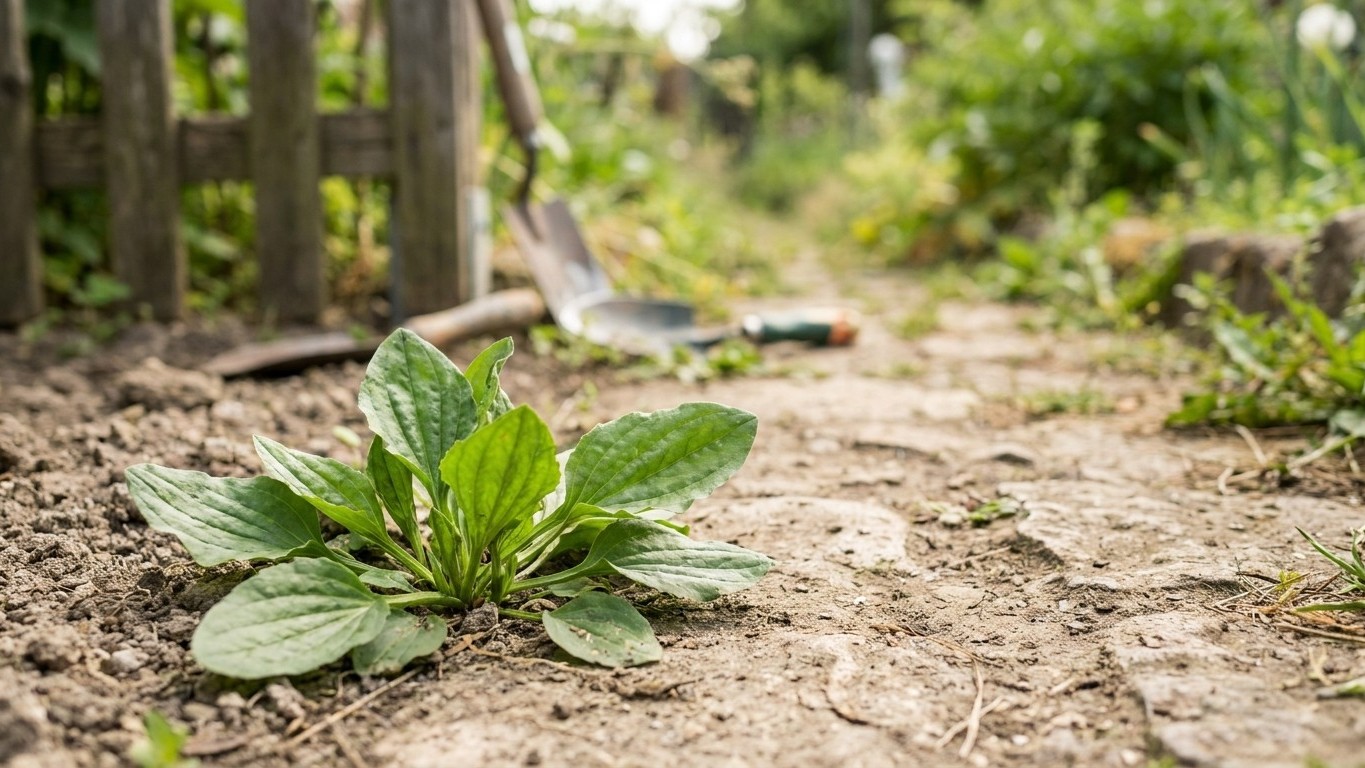

Broadleaf plantain is a low, ground-hugging rosette with wide oval leaves that shows up wherever soil has been packed too tight for grass roots to breathe. It does not cause compaction. It simply tolerates the conditions that kill off thin turf around it. The single most useful thing you can do before reaching for a spray bottle is check whether the spot is a path, a gate, a low corner that puddles, or an area you mow too close.
How to be sure that is what you have

Broadleaf plantain (Plantago major) grows as a flat rosette pressed close to the ground, with no upright stem carrying the leaves. Each leaf is broad and egg-shaped to oval, wider than it is long in mature plants, with five to seven parallel veins running from the base to the tip like the ribs of a fan. The margins are smooth or gently wavy, never toothed or lobed. When it flowers, a thin, leafless spike rises four to six inches from the center of the rosette, packed with tiny greenish flowers that mature into a bristly seed head. That spike is the fastest way to confirm identification once summer arrives, but the rosette is present and identifiable long before it flowers.
Look for it in the places turf struggles most: worn paths across the yard, the strip beside a driveway, gate openings, the base of a swing set, tire ruts. It stays green through most of the growing season and often persists later into fall than the turf around it, since its shallow taproot and rosette habit let it keep photosynthesizing below where a mower blade reaches.
Two plants get mistaken for it. The first is buckhorn plantain (Plantago lanceolata), a close relative with long, narrow, lance-shaped leaves and typically three prominent veins rather than five to seven. It stands more upright and the leaves are noticeably narrower than broadleaf plantain’s. The second is a dandelion rosette before it flowers. The discriminating detail is the leaf margin: a dandelion’s leaf is deeply toothed or lobed along its edge, while a broadleaf plantain’s is smooth. If you are ever unsure and the plant has not yet flowered, run a finger along the leaf edge. Jagged means dandelion, described in more detail on our page about Dandelions in a Lawn: Pulling, Spraying, and What Comes Back. Smooth with parallel ribs means plantain.
Why it is in your lawn
A weed this specific to hard ground is telling you something about the soil before it is telling you anything about the plant. Compacted soil squeezes out the air pockets that grass roots need, and most turfgrass simply cannot push roots down through it. Broadleaf plantain’s taproot and rosette habit are built for exactly that stress. It does not need loose, aerated soil to establish, so it moves into the bare or thinning patches where turf has already given up.
Mowing height plays a direct role too. Scalped turf, cut well below the range a species tolerates, thins out and opens bare soil to weed seed. That thinning is rarely a single event. It is usually foot traffic across the same line week after week, a mower set too low for the grass species growing there, or a low spot that stays soggy and gets walked on while wet, packing it down further. Thin, weak turf is the opening, and broadleaf plantain is simply quick to take it. A lawn that has one weed problem rarely has only one, and it helps to look at the whole picture of Lawn Weeds showing up in the same worn areas before treating any single species in isolation.
Poor drainage compounds the problem in low corners of a yard, where water sits after rain and compresses the soil structure further each time it is walked on while saturated. None of this means the lawn is unhealthy overall. It means one specific area is under a specific stress, and the plantain growing there is a marker, not the cause.
The window that decides everything
Two different weeds, two different timings
Broadleaf plantain is a perennial that also spreads by seed, which means it gets attacked on two separate schedules depending on which stage you are targeting. A pre-emergent herbicide works only on germinating seeds still below the soil surface. It does nothing to an established rosette that is already growing, because there is no seed left to stop. A post-emergent broadleaf herbicide works the opposite way: it needs enough leaf surface on an actively growing plant to absorb and translocate the spray, so it is far more effective on existing rosettes than pre-emergents ever will be.
Clemson Cooperative Extension’s HGIC 1219 Tall Fescue Maintenance Calendar times the pre-emergent window to a visual cue rather than a calendar date, tying application to forsythia and dogwood bloom as the trigger. That phenological marker exists because soil temperature, not the date on a calendar, is what actually triggers weed seed germination, and bloom timing tracks soil temperature closely enough to be useful. The same bloom event happens weeks apart depending on where you garden, arriving far earlier in the Southeast than in the northern half of the country, so a date printed in a national guide will always be wrong for someone. Watch the forsythia and dogwood in your own yard rather than a date on a bag.
For an established rosette already growing, the practical window is simpler: treat it while it is actively putting on new leaf growth, since a plant under drought stress or heading into dormancy will not take up enough herbicide to matter. Clemson’s species-specific maintenance calendars (HGIC 1215 through HGIC 1219, one per grass species) lay out a full season of mowing, feeding and weed-control timing for the lawn types they cover, and checking the calendar for whichever grass is actually growing in your yard will do more for timing than any generic weed-control schedule.
Getting rid of it
Pulling it
Hand-pulling works well on broadleaf plantain specifically because of how its root is built. It carries a single, fairly thick taproot rather than the network of rhizome fragments that let a weed like Quackgrass: Why It Regrows From Every Piece You Leave resprout from every piece left behind. If you get the crown and most of the taproot out in one motion, the plant typically does not come back from what remains in the soil. Pull after rain or watering, when the ground is soft, and use a narrow weeding knife to loosen the soil alongside the root before you pull, rather than gripping the leaves and yanking, which snaps the taproot short and leaves enough behind to regrow.
Chemical control
Where hand-pulling is not practical across a large patch, selective post-emergent herbicides built around 2,4-D, dicamba, triclopyr or mecoprop (MCPP) are the standard active ingredients, usually sold combined as a three-way broadleaf weed killer for lawns. These work by disrupting growth in broadleaf plants specifically and, at labeled rates, leave most cool-season and warm-season turfgrasses alone. They will also kill clover, violets and any other broadleaf plant the spray drifts onto, ornamental beds included, so treat spot applications carefully near anything you want to keep.
Warm-season lawns vary widely in which actives they tolerate well, so check the product label’s list of grasses it is approved for before spraying, rather than assuming a broadleaf herbicide safe on one warm-season species is safe on all of them. Several of these active ingredients are restricted or banned outright in some states, particularly near waterways, so check your state department of agriculture’s current list before buying rather than assuming a product sold at a national retailer is legal to use everywhere.
Keeping it out
Thick turf is the actual fix
Every control method above treats the plant that is already there. The lasting fix is turf dense enough that bare soil never opens up for a seed to land on in the first place, and that starts with mowing height matched to the species actually growing in the lawn.
| Grass | Type | Mow height | Wear tolerance | Drought tolerance |
|---|---|---|---|---|
| Kentucky Bluegrass | Cool-season | 2–3 in | Good | Fair |
| Perennial Ryegrass | Cool-season | 2–3 in | Good | Fair |
| Tall Fescue | Cool-season | 2.5–3.5 in | Fair | Fair |
| Fine Fescues | Cool-season | 2.5–3.5 in | Poor | Good |
| Bermudagrass | Warm-season | 0.75–1.5 in | Excellent | Excellent |
| Zoysiagrass | Warm-season | 0.75–2 in | Very good | Good |
| St. Augustinegrass | Warm-season | 2.5–4 in | Fair | Good |
| Centipedegrass | Warm-season | 1.5–2 in | Poor | Fair |
Cool-season figures come from Penn State Extension’s Lawn Establishment guidance, and warm-season figures come from Clemson Cooperative Extension’s HGIC 1214, Selecting a Lawn Grass. A lawn cut at the low end of its species range on the paths and gate openings it takes the most traffic will thin faster than the rest of the yard, which is exactly where a rosette like broadleaf plantain gets its opening.
Feeding on the schedule Clemson’s HGIC 1201, Fertilizing Lawns, lays out for the species growing in your yard builds the root and leaf density that closes those gaps over a season, and overseeding thin cool-season lawns in the appropriate window for that species fills bare soil with grass before a weed seed gets the chance. Aerating high-traffic strips relieves the compaction that invited the plantain in the first place, which does more for keeping it out long-term than any single herbicide application.
Common questions
Can I just mow it instead of pulling it?
Mowing removes the flower spike before it sets seed, which slows how fast the patch spreads, but it does not kill the plant. The rosette sits low enough to survive under a mower blade and keeps growing back from the crown.
Is broadleaf plantain harmful to pets or kids?
No. It is not a toxic plant, and young leaves are eaten in some traditional foraging and herbal use. That has no bearing on how to manage it in a lawn, where the goal is usually a uniform stand of turf rather than an edible patch.
Will the bare spot fill in on its own after I pull it?
Sometimes, if the surrounding turf is dense and healthy enough to spread into the gap. If the spot is compacted or the turf around it is already thin, overseed it or lay a small patch of sod rather than waiting, since bare soil left open is exactly what invited the plantain in the first place.
Does vinegar kill the roots?
Household vinegar burns the leaves on contact but rarely reaches the taproot, so the rosette usually regrows from the crown within a few weeks. Stronger horticultural vinegar sold at higher acetic acid concentrations burns more thoroughly but still acts mainly on contact rather than moving down into the root system the way a systemic herbicide does.