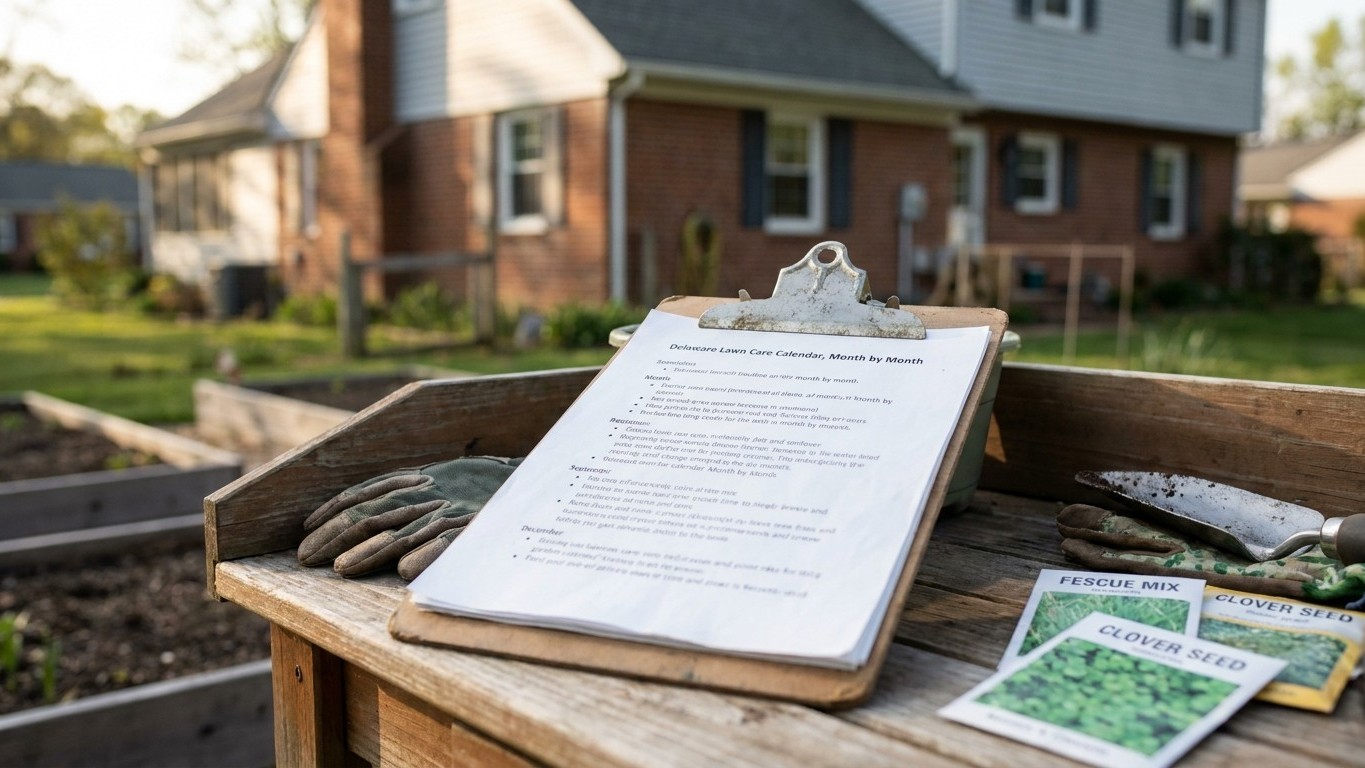

Seed spread in early September, three weeks before Delaware’s first frost window opens, comes up thin and rarely survives the winter — it never gets the cool-weather root growth it needs before the ground locks. The same clock punishes a late feeding or a final mow cut too long. Fescue and bluegrass lawns here do their real growing in spring and fall, not July, and every date on this calendar counts backward from that first frost near Wilmington, which lands anywhere between October 26 and November 7.
The short answer for Delaware
Delaware sits in what turf literature calls a cool-season zone, and near Wilmington that means the lawn is built on tall fescue, Kentucky bluegrass, fine fescue, perennial ryegrass or rough bluegrass, the five species Clemson Cooperative Extension (HGIC 1214) and Penn State Extension list as the cool-season lineup for this climate. These grasses grow hardest in spring and fall and slow down or brown off in summer heat, so the whole calendar puts the heavy work at the two ends of the year, not in the middle of July. For help weighing those five against each other on shade and wear tolerance, see The Best Grass Seed for Delaware Lawns.
The date that anchors everything else is the first fall frost. NOAA’s 1991-2020 climate normals place that date, measured at the Wilmington airport station, between October 26 and November 7. That is a range, not a single day, and it comes from one station, so a lawn further inland, at higher ground, or closer to the coast can turn colder earlier or later than that window. The last safe seeding date, the final mow of the year, and the closing feeding all get counted backward from wherever your own ground actually sits inside or outside that range.
Working through the year

Delaware doesn’t have its own published turf calendar, so the closest working reference for a tall fescue lawn is Clemson Cooperative Extension’s HGIC 1219, the Tall Fescue Maintenance Calendar. It’s built for a cool-season lawn, which is exactly what most Delaware yards are, and the practices in it translate directly even though the specific calendar dates in that publication are written for South Carolina. Anchor the same practices to the frost window near Wilmington instead of Clemson’s dates, and the sequence holds.
Late winter into early spring
This is when a thin, tired lawn gets its first light feeding of the year and a pre-emergent herbicide goes down, timed for before soil warms enough to trigger crabgrass germination. Mowing starts back up at a fairly low pass to clear winter debris, then climbs toward the season’s working height as growth picks up.
Late spring into summer
Growth peaks in late spring, then cool-season turf slows hard once summer heat sets in. Raise the mower to the top of tall fescue’s usual cutting range through the hot months. This is also the season to hold off on seeding entirely. New seedlings can’t establish roots deep enough to survive a stretch of heat and dry soil, and HGIC 1219 treats summer as a maintenance-only stretch: mow, water if you’re irrigating, and skip the nitrogen.
Late summer into fall
Fall is the main event on a cool-season calendar. Core aeration and overseeding both belong here, done while the soil is still warm enough for germination but early enough to give new grass several weeks of growing weather before the ground cools past use. Near Wilmington, that means getting seed down well ahead of the October 26 to November 7 frost window NOAA reports for that station, since seedlings need time to root before the first hard freeze. Most of the nitrogen for the year goes down in this stretch too, per HGIC 1219’s split, with a lighter application in spring and none through summer.
Winter
Once growth stops for the season, mowing stops with it. A lawn that went into winter with a full fall feeding and a fresh overseed carries that density through to spring instead of losing it to bare, thin patches.
| Season | Primary task | Mowing | Why |
|---|---|---|---|
| Late winter to early spring | Light feeding, pre-emergent | Low pass, rising through season | Wake the lawn without forcing growth ahead of summer stress |
| Late spring to summer | Maintenance only, no seeding | Top of tall fescue’s range | Taller blades shade roots and cut water loss in heat |
| Late summer to fall | Aerate, overseed, main feeding | Normal working height | Warm soil plus cooling air gives seed its best shot before frost |
| Winter | Dormant, no mowing | N/A | Grass has stopped growing for the season |
What changes across Delaware
Delaware is a small state, but it isn’t a uniform one. The rolling Piedmont ground around New Castle County, where Wilmington sits, runs slightly higher and cooler than the flat coastal plain that covers most of the rest of the state, which means the frost dates NOAA reports for the Wilmington station are already on the earlier side of what much of Delaware sees.
Move south and the picture flips. Coastal Sussex County, warmed by its proximity to the Atlantic Ocean and Delaware Bay, tends to hold heat later into fall and see its own first frost arrive later than the Wilmington figure suggests. A lawn there can often carry a fall overseed a week or two past what the Wilmington window would allow.
Kent County, in the middle of the state, sits between those two patterns without a station of its own in this data set. Treat the Wilmington range as a starting point there, not a fixed date, and watch your own lawn’s response to the first cold nights each year to calibrate.
None of this changes which grasses grow here. Warm-season species like bermudagrass or zoysia are built for hot, humid summers and go dormant far earlier than Delaware’s growing season would suggest is normal, so they don’t hold up as a lawn anywhere in the state regardless of these local differences. The five cool-season species named above are the workable list statewide, even as the calendar dates around them shift by a county or two.
The mistakes this climate punishes
Seeding in the wrong window
Cool-season seed put down in May or June germinates into a seedling with no time to build roots before summer heat arrives. It shows up as a spotty, thin stand by July, and often as bare dirt by August once the young grass gives out. Fall, timed against the frost window near your own ground, is the window that actually works for tall fescue, bluegrass, fine fescue, perennial ryegrass and rough bluegrass alike.
Scalping through summer
Cutting a cool-season lawn short right as summer heat sets in removes the leaf area the grass needs to shade its own roots and hold soil moisture. The damage doesn’t show immediately. It shows up two to three weeks later as a lawn that browns off faster and recovers slower than a neighbor’s lawn cut taller through the same stretch. Raising the mower deck before the first hot week, not after the lawn already looks stressed, is what actually prevents it.
Feeding heavy in summer
Nitrogen pushed onto a cool-season lawn in July feeds top growth the grass can’t support while its roots are already working against heat and drought stress. It also feeds brown patch and other fungal diseases that favor warm, humid conditions. Save the heavier feeding for fall, when HGIC 1219’s split puts most of the year’s nitrogen anyway.
Skipping fall aeration
A lawn that goes into winter compacted and thin doesn’t get denser on its own. Skipping the fall aeration and overseed shows its cost the following spring, when crabgrass and other weeds move into the bare ground a fuller stand of turf would have crowded out.
Checking this against your county
Every figure above is measured at or near Wilmington, and Delaware runs from the Pennsylvania line to the Maryland coast, so a lawn in Sussex or Kent County can be running on a different clock. The University of Delaware Cooperative Extension is the source to check for anything specific to your county, including local pest pressure and soil test recommendations that this calendar doesn’t cover. If you’re building out a full Delaware Lawn Care routine rather than just this year’s calendar, that’s the office to start with before you buy seed or fertilizer.
Common questions
Can I plant zoysia or bermuda grass in Delaware?
Not successfully as a lawn grass. Delaware falls in the cool-season zone by the climate thresholds used to classify it, and warm-season grasses like zoysia and bermuda go dormant far earlier here than they would further south, leaving a brown lawn for a large part of the growing season.
Why is my lawn brown in July even though I’m watering it?
Cool-season grasses like tall fescue and Kentucky bluegrass go semi-dormant in summer heat as a survival response, and browning during a hot, dry stretch doesn’t mean the grass is dead. It typically greens back up once temperatures drop and rain returns in early fall.
What’s the latest I can seed in fall before it’s too late?
Count backward from the first fall frost, which NOAA’s 1991-2020 normals put between October 26 and November 7 near Wilmington, and give the seed several weeks of growing weather before that window arrives. A lawn further inland or at higher ground should treat that window as arriving earlier, not later.
Do I need to dethatch every year?
Not automatically. Dethatch when the thatch layer feels thick and spongy underfoot rather than on a fixed yearly schedule, and check it before assuming aeration alone will fix a lawn that still feels dense after a season of core aeration.