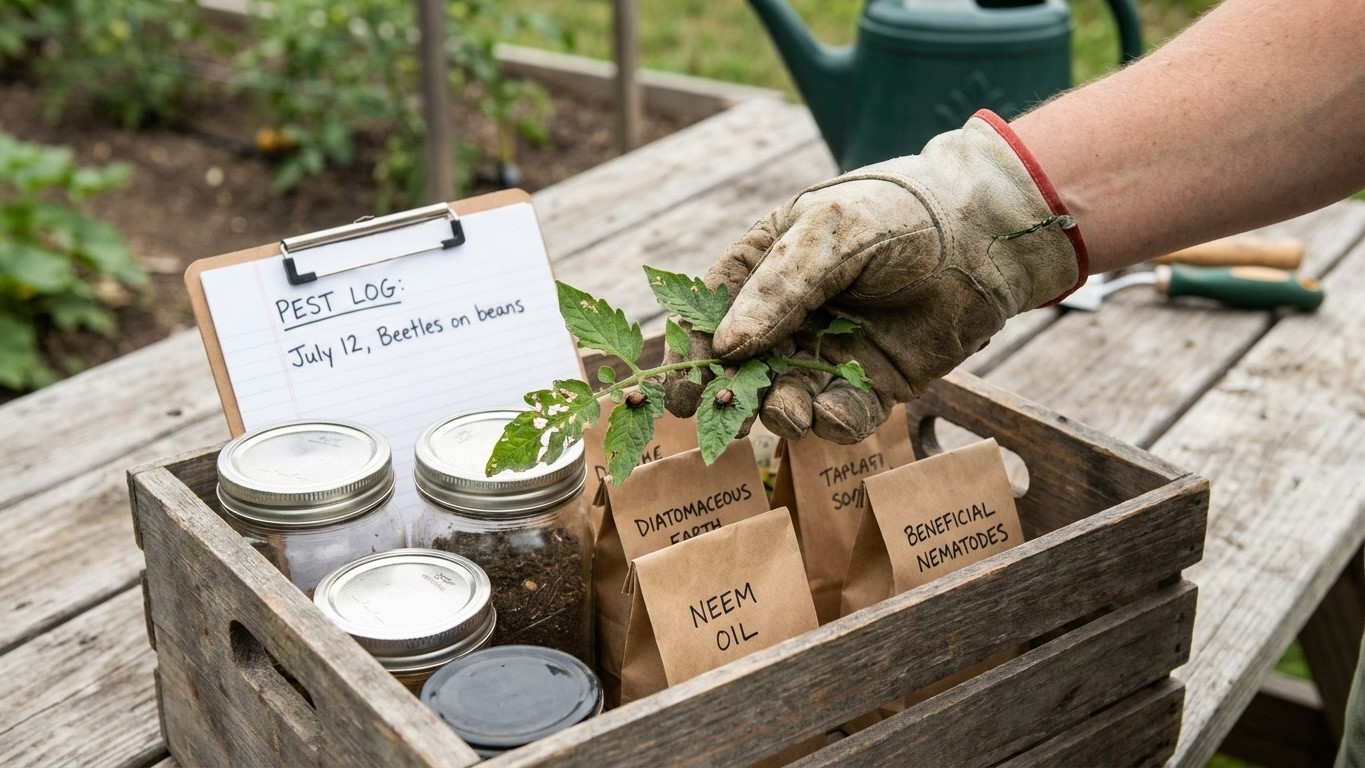

Why is your garden suddenly getting chewed up in June and July? Most likely, Japanese beetle — the insect Iowa considers the most destructive one in home landscapes here, running mid-June through July and peaking around mid-July. Start walking your cucurbits, roses and raspberries once a week beginning in early June, checking leaf undersides and stem bases before you ever see real damage, not after.
What Iowa gardens actually deal with

Iowa’s combination of humid summers, generous rainfall and a long list of backyard staples, squash, cucumbers, tomatoes, roses, irises, lilies, gives several insect groups exactly the conditions they need to build up fast. Iowa State University Extension identifies a specific set of insects as the ones that consistently cause the most damage in home gardens and landscapes here: Japanese beetle, squash bug, squash vine borer, striped and spotted cucumber beetle, common stalk borer, Grasshoppers Iowa, iris borer, and Lily leaf beetle Iowa. That list isn’t exhaustive, and pressure differs from one county to the next, but these are the names worth knowing on sight.
ISU is explicit that Japanese beetle populations in Iowa deserve top billing. It was first found in Iowa in 1994 and has spread since, feeding on hundreds of plant species from roses to linden trees to raspberries. Right behind it in destructive potential is the Squash vine borer in Iowa, which gardeners often overlook until their squash plants suddenly wilt, while the Squash bug in Iowa, which growers know for its foul-smelling defense, can be just as damaging once it establishes on cucurbits, and the Striped cucumber beetle in Iowa, found on cucurbit seedlings, can spread bacterial wilt before the plants ever get established, a threat shared by its close relative, the Spotted cucumber beetle in Iowa, which also feeds on the same seedlings. Interestingly, ISU also notes that tomato hornworm, a pest that dominates garden anxiety in many other states, is more a curiosity than a real problem here, which is one reason it doesn’t appear on this list.
This is the earliest damage you’ll spot, showing up on foliage in May and June. Look for ragged notches along leaf edges and vertical streaks where the caterpillar has tunneled down inside the leaf. By midsummer the same larva moves into the rhizome itself, hollowing it out and often inviting soft rot behind it. Cutting back and destroying old iris foliage in fall, before the moth lays eggs, is the single most effective step.
Striped cucumber beetle

These show up as soon as cucumber, squash and melon seedlings emerge, feeding on leaves, stems and blossoms and leaving small round holes and ragged edges. The real damage isn’t the chewing, it’s bacterial wilt, a disease these beetles carry and transmit as they feed. Floating row cover over young seedlings until bloom is the most reliable defense, since it keeps the beetle off the plant during the window when infection risk is highest.
Spotted cucumber beetle

Similar in size and habit to its striped cousin, this beetle feeds on the same cucurbit crops plus corn seedlings and beans, chewing leaves and occasionally clipping young stems at soil level. It’s a weaker vector of bacterial wilt than the striped beetle but still worth controlling with the same row cover approach.
Squash vine borer

Moths fly early to mid-June, laying eggs at the base of squash and zucchini stems. You rarely see the moth. What you see is a plant that was thriving one week and collapsing the next, with a hole near the stem base often surrounded by a sawdust-like frass. By the time wilting shows, the larva is already inside feeding, so the useful window for prevention is before symptoms appear, not after.
Squash bug

Adults show up once vines start running, with egg-laying beginning in late June. Eggs are laid in tidy bronze clusters on leaf undersides, easy to crush by hand before they hatch. Feeding causes leaves to develop yellow speckling that turns brown and crisp, and heavy infestations can collapse a whole squash plant by late summer.
Japanese beetle

Adults are active from mid-June through July, peaking by mid-July, and they feed in groups, which is why damage seems to appear overnight. They skeletonize leaves, eating the tissue between veins and leaving a lace-like pattern behind, and they’ll also chew flowers and soft fruit. Roses, linden, and raspberries take the worst of it. Hand-picking into a bucket of soapy water in the morning, when beetles are sluggish, is genuinely effective if you keep at it daily through the peak.
Common stalk borer
Larvae are active earlier in the season in weedy grasses and move into garden plants, especially corn, tomatoes and dahlias, mid to late June as those stems get large enough to tunnel into. A wilting stem with a small entry hole near the base and a hollowed-out center is the giveaway. Keeping grassy weeds mowed along garden edges before late June cuts down on the population moving in.
Grasshoppers
Present through the general growing season from May into September, grasshoppers chew ragged holes in leaves and can strip seedlings entirely in bad years, especially along garden edges next to unmown grass or pasture. Numbers build gradually over summer as nymphs mature into adults, so damage tends to worsen as the season goes on rather than arriving suddenly.
Lily leaf beetle
Both the adult beetle and its sludge-covered larvae feed on lily foliage, buds and flowers, and a bad infestation can strip a lily bed down to bare stems within weeks. The larvae are easy to miss because they coat themselves in their own dark excrement, which looks more like a smear of dirt than an insect. Hand-picking adults and checking leaf undersides for the excrement-covered larvae works, but it has to be done regularly once you find the first one.
Telling damage apart

Reading the pattern
The shape of the damage tells you more than the plant does. Ragged holes with chewed, uneven edges point to a chewing insect like a beetle or grasshopper. Fine yellow or white speckling across a leaf surface, without visible holes, usually points to something piercing and sucking sap rather than biting chunks out. A sudden, whole-plant wilt on an otherwise healthy-looking squash or zucchini, especially with a hole near the stem base, is the calling card of squash vine borer, not disease.
Insect, disease, or water stress
Sticky residue on leaves, sometimes with a sooty black coating underneath, signals a sap-feeding insect leaving behind honeydew, not a fungus. That distinction matters because a fungicide does nothing for it. A plant that wilts evenly across the whole canopy in the heat of the afternoon and recovers by morning is showing normal water stress, while a plant that wilts and stays wilted, especially one leaf or one side at a time, is more likely dealing with vascular disease or borer damage inside the stem.
| What you see | Most likely cause | Category |
|---|---|---|
| Skeletonized leaves, tissue eaten between veins | Japanese beetle feeding | Insect |
| Sudden stem-base wilt with a hole and frass | Squash vine borer larva | Insect |
| Yellow leaf speckling turning brown and crisp | Squash bug feeding | Insect |
| Sticky film with black sooty coating | Sap-feeder honeydew | Insect |
| Whole-canopy wilt that recovers overnight | Heat and water stress | Environmental |
| Hollow rhizome with soft, foul-smelling rot | Iris borer plus bacterial rot | Insect and disease |
When each one shows up
Iowa’s pest season, measured near Des Moines by Iowa State University Extension, runs May through September and peaks between mid-June and August. Other parts of the state run slightly earlier or later depending on local weather, so treat this as a window to watch rather than a fixed calendar. Rely on plant stage and temperature, not the date on the wall, to decide when to start checking.
- Early season (seedling emergence): cucumber beetles arrive as soon as cucurbit seedlings break the soil.
- May into June: iris borer damage shows up on foliage before moving into the rhizome by July or early August.
- Early to mid-June: squash vine borer moths are flying and laying eggs at stem bases.
- Mid-June through July, peaking mid-July: Japanese beetle adults are active and feeding in groups.
- Mid to late June: common stalk borer larvae move from weedy grasses into larger garden stems.
- Late June onward: squash bug adults appear as vines start running, with egg-laying beginning.
- Through summer into September: grasshopper numbers build as nymphs mature into adults.
The pattern that matters most is that most of these pests overlap. By the second half of June you can have cucumber beetles, squash vine borer larvae, squash bug eggs and Japanese beetle adults all active in the same yard at once. That’s the stretch to check plants two or three times a week rather than once. Gardeners further south, in a state like Georgia, deal with a similar cast of cucurbit pests but on a longer, earlier season, as covered in our Georgia pests guide.
What actually works
Prevention comes first
Crop rotation matters most for soil-dwelling and stem-boring pests like squash vine borer and common stalk borer, since moving cucurbits and corn to a different bed each year breaks the cycle of larvae emerging near last year’s host plants. Floating row cover, put on at planting and removed once flowers need pollinating, keeps cucumber beetles and vine borer moths off young plants during the exact window they do the most damage. Mowing grassy field edges before late June removes the weedy habitat where stalk borer larvae start out before moving into the garden.
Encouraging natural predators helps more than most gardeners expect. Ground beetles, birds and parasitic wasps all take a share of beetle and caterpillar populations if you avoid broad-spectrum insecticides that kill the predators along with the pest.
Targeted intervention
Hand-picking is genuinely effective for Japanese beetle, lily leaf beetle and squash bug, especially early in an infestation, and it costs nothing but time. Crushing squash bug egg clusters before they hatch in late June prevents an entire generation in one pass. For squash vine borer, once a larva is inside a stem, spraying the leaves does nothing. The only real recovery option is slitting the stem lengthwise to remove the larva and mounding soil over the wound so the plant can root along the buried section.
A few popular home remedies do little: garlic and pepper sprays repel some feeding but rinse off in rain and need daily reapplication to matter, and dish soap sprays only affect soft-bodied insects on direct contact, so they’re useless against beetle adults and stem-boring larvae. Gardeners in Kansas contend with much of the same Japanese beetle pressure moving north through the plains, and our Kansas pests guide covers the same trade-offs between hand control and sprays.
What control costs
Cost here is mostly a question of time rather than money, and the cheapest options for a home garden are also the most labor-intensive. Hand-picking costs nothing but a few minutes a day through the peak weeks, but it has to be done daily or every other day to keep numbers down, since skipping a week lets an infestation rebuild. Row cover is a one-time material cost each season, reusable for several years if stored dry, and needs almost no ongoing labor beyond checking that edges stay sealed against the soil.
| Method | Money cost | Time cost | Repeat frequency |
|---|---|---|---|
| Hand-picking | None | Low per session, adds up over weeks | Daily to every other day during peak |
| Row cover / barriers | One-time, reusable | Low, mainly install and removal | Once per season, checked periodically |
| Biological controls (predatory insects, encouraging birds) | Low to none | Indirect, mostly habitat management | Ongoing, not a quick fix |
| Sprays (insecticidal soap, other targeted products) | Moderate, repeat purchases | Moderate, application plus reapplication | Every 5 to 10 days through the pest window |
Biological controls, meaning predators you encourage rather than buy, cost almost nothing directly but take longer to show results and won’t stop an infestation already underway. Sprays cost the most over a season once you count repeat purchases and the labor of reapplying after rain, and they still miss pests like squash vine borer that feed inside the stem where no spray reaches. For a typical home garden, hand-picking combined with row cover beats spraying on both cost and effectiveness for most of the pests on this list.
Local help
For identification of an insect you can’t place, or to check on outbreak reports for your county, Iowa State University Extension is the reference source. Its Yard and Garden Encyclopedia and county offices, reachable through the main Iowa State University Extension site, can confirm a specimen from a photo or sample. For more on growing conditions and other tasks specific to this state, see our Iowa guides.
Two More Pests Worth Watching For
Not every Iowa garden problem fits neatly into the categories above, and a couple of specific pests deserve their own rundown. If your yard backs up to a field or you’ve noticed chewed leaves showing up in waves during the hottest part of summer, check out grasshoppers in Iowa, which covers when they ramp up in late June, peak through July and August, and finally taper off after the first hard frost. Populations aren’t consistent year to year either, so it helps to know what drives the swings.
If you grow true lilies, there’s a separate threat to watch for starting much earlier in the season. The page on lily leaf beetle walks through why it shows up in mid-to-late April, right as lily shoots first break the soil, and why it doesn’t really let up until new adults settle in for winter. It’s a pest that’s been spreading into more Iowa gardens, so it’s worth a look even if you haven’t spotted it yet.
Common questions
Why are there so many Japanese beetles on my roses all of a sudden?
Japanese beetles feed in groups and are drawn to plants already showing beetle damage, since the chewed leaf tissue releases scent compounds that attract more beetles. A rose that looked fine on Monday can be covered by Thursday simply because the first few beetles called in the rest.
Can I just till the garden to get rid of borers?
Tilling in fall can expose some overwintering stalk borer larvae and pupae to cold and predators, but it won’t reach a squash vine borer larva that’s already inside a living stem during the growing season. Tilling is a between-season measure, not a fix for an active infestation.
Do marigolds actually keep pests away?
There’s no reliable evidence that marigolds repel the pests on this list, including cucumber beetles or squash bugs, despite the popular claim. They’re a fine companion plant for other reasons, just not a substitute for row cover or hand-picking.
My squash plant wilted overnight, is it too late to save it?
If the wilt is sudden and the plant was otherwise healthy, check the stem base for a hole and soft, sawdust-like frass, the signs of a squash vine borer larva already inside. It’s often not too late. Slitting the stem to remove the larva and mounding soil over the wound gives the plant a real chance to keep growing.