
Tennessee gardens deal with a defined roster of insect pests, twelve groups in all — from root maggots and cutworms to the Imported cabbageworm in Tennessee that gardeners spot on cabbage and other cole crops, the Harlequin bug in Tennessee that gardeners often find on brassicas, the Cabbage looper in Tennessee that growers battle on the same cole crops, the Squash vine borer in Tennessee that gardeners watch for once squash and pumpkin vines start to run, and the Mexican bean beetle in Tennessee that growers find skeletonizing leaves on snap beans and other legumes — that the University of Tennessee Extension flags in its publication PB 595 as the ones most likely to cause real damage in a home plot. The extension service notes that many of these run through three to seven generations across a single growing season, so pressure builds steadily rather than arriving all at once. Start walking your rows once a week from the day you plant, checking stems and leaf undersides before any damage becomes obvious.
What Tennessee gardens actually deal with

A row of seedlings that looked fine on Tuesday is flat and yellowing by Friday, and nothing above the soil explains why. Pull one up and you’ll likely find the culprit: small, legless, cream-white maggots tunneling through the roots, or a gray-brown caterpillar curled at the base where a stem used to stand. Tennessee gardens run through a predictable cast of these underground and after-dark feeders all season, and each one gives itself away differently once you know where to look.
Root maggots

The damage happens underground, where small, legless, cream-white maggots tunnel through seeds and roots, killing seedlings before they emerge or leaving surviving plants stunted and pale. The adults are small gray flies, easy to mistake for houseflies at a glance. Floating row cover laid down at planting keeps the flies from reaching the soil in the first place, which matters more than any treatment applied after the fact.
Flea beetles and cutworms

Flea beetles are tiny, shiny beetles that jump like fleas when you brush a leaf, leaving foliage peppered with small round holes. Cutworms are thick gray-brown to black caterpillars that feed at night and often sever a young stem right at the soil line, so a plant that stood fine the evening before is lying flat by morning — a season that also tends to bring on vine crop pests like the Squash bug in Tennessee, which growers watch for on their squash and pumpkins, plus the Corn earworm in Tennessee that growers watch for once ears start to form, and the Colorado potato beetle in Tennessee, which gardeners watch for on potato and tomato foliage. A cardboard collar pushed into the soil around each transplant stem stops cutworms without any spray.
Aphids


The adult is oval, about 3/8 inch, yellow-orange with ten black stripes running down its back. Its humpbacked, reddish-orange larvae do most of the real damage, capable of stripping potato or eggplant foliage down to bare stems within a matter of days once numbers build. Hand picking both stages off the plant before that happens is the most reliable control for a small garden.
Cucumber beetles

The striped form is yellow with three black stripes running the length of its back, while the spotted form is yellow-green with about a dozen black spots scattered across the wing covers. Both chew ragged holes in leaves and blossoms, and both can carry bacterial wilt from plant to plant as they feed, which can take down a healthy vine within a week of the first wilting leaf.
Squash bug

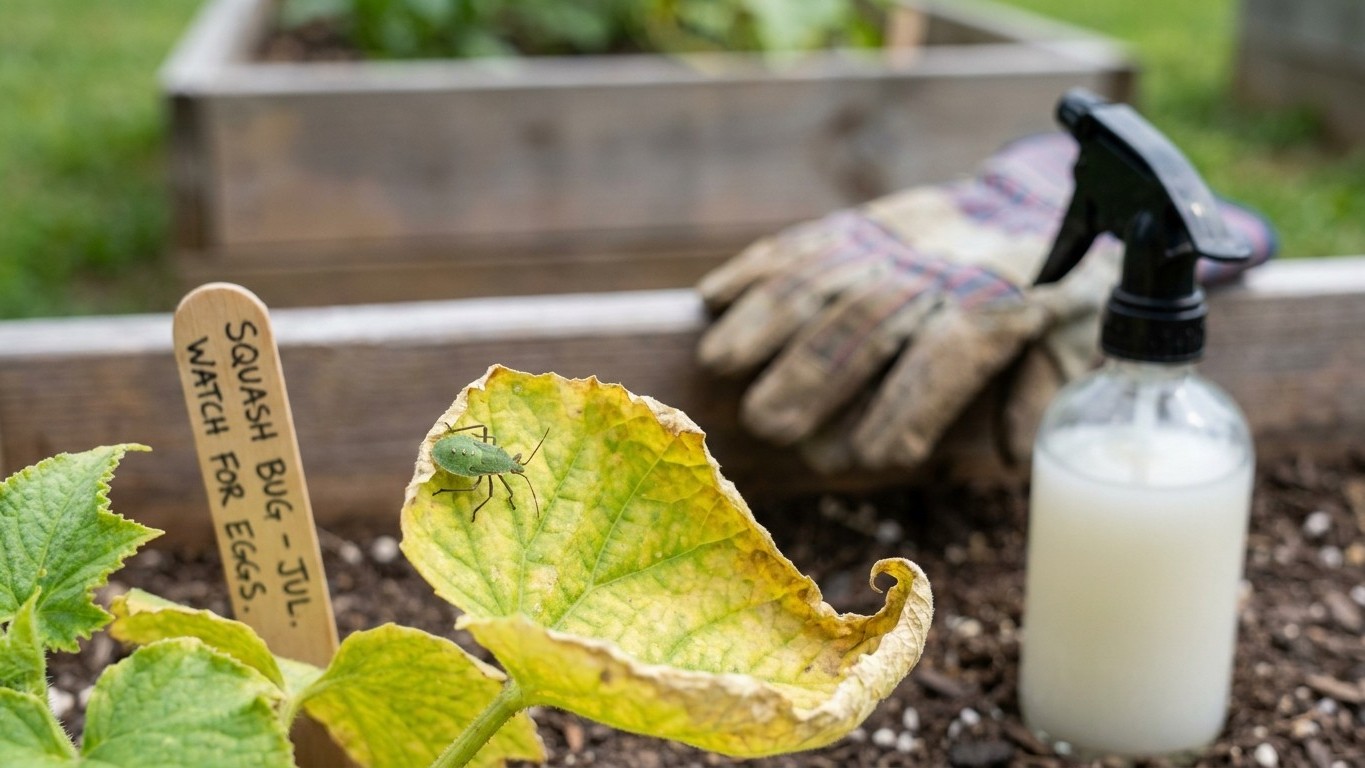
Adults are flat-backed, grayish-brown, and roughly the size of a fingernail, often found in pairs along stems. Gray nymphs cluster in groups on leaf undersides near bronze-colored egg clusters, and feeding causes leaves to wilt and blacken outward from the puncture point. Left unchecked through a season, squash bugs can collapse an entire plant.
Squash vine borer
The moth responsible has an orange abdomen ringed in black and olive-brown wings, closer in appearance to a wasp than to a typical moth. The damage comes from its larva, a cream-white, wrinkled caterpillar that tunnels inside the stem, causing sudden wilting even though the base of the plant still looks intact. Catching it early enough to slit the stem and remove the borer by hand can still save the vine.
Harlequin bug
This shield-shaped stink bug is boldly marked in red or orange and black, hard to overlook against green cabbage-family foliage. It sucks sap from leaves, leaving pale, blotchy patches that dry brown and papery over time. Its black-and-white striped egg masses sit in neat rows on the undersides of leaves, and removing them before they hatch keeps the next generation from getting started.
Cabbageworms and loopers
The imported cabbageworm is a velvety green caterpillar with a faint yellow stripe down its back, while the cabbage looper is pale green and arches into a distinctive loop as it moves, lacking a full set of middle legs. Both, along with the smaller diamondback moth larva, leave ragged holes and dark green droppings on cabbage-family leaves. Bacillus thuringiensis (Bt) sprays control all three while leaving most beneficial insects alone.
Mexican bean beetle
Adults look like copper-colored ladybugs, oval, about 1/4 inch, with sixteen black spots spread across the wing covers. Yellow, spiny larvae feed alongside the adults on leaf undersides, skeletonizing tissue between the veins until the leaf looks lace-thin. Checking the undersides of bean leaves weekly once plants start to flower catches the problem before it spreads.
Hornworms
These are large green caterpillars, up to four inches long, marked with white diagonal stripes and a horn-like spike at the rear. A single hornworm can strip tomato, pepper or tobacco foliage overnight, and the damage often shows up before the caterpillar itself is spotted, since its color blends in almost perfectly with the leaves. Hand picking is worth the search once you see chewed stems with no obvious culprit nearby.
Corn earworm and tomato fruitworm
The same species does double duty under two names, showing up as a green, pink or brown striped caterpillar tunneling into corn ear tips or boring straight into a ripening tomato. Damage on corn shows as chewed kernels at the tip, while on tomato it’s a clean hole leading into rotting flesh inside. Timing any treatment to egg-laying, before the larva burrows in, is the only window that actually works.
Telling damage apart

Reading the damage before you go looking for the insect saves a lot of wasted time. Chewed leaf edges with visible bite marks point to something with jaws, a beetle or caterpillar working the margins inward. Stippling, a fine pale speckling across the leaf surface, usually means a sap-sucking insect feeding from underneath rather than chewing through. Round, evenly spaced holes across a leaf are the calling card of flea beetles, while skeletonized foliage with only the veins left intact points toward Mexican bean beetle larvae or a heavy caterpillar infestation.
- Sticky, shiny leaves with a black film: aphid honeydew and the sooty mold that grows on it, not a fungal disease on its own
- Sudden wilting of one vine with no other symptoms: check the stem base for a small hole and sawdust-like frass before assuming disease
- Pale blotches turning brown and papery: sap-feeding insects like harlequin bug, not a nutrient problem
- Bacterial wilt following cucumber beetle feeding: vines collapse fast once the disease takes hold, faster than simple drought stress would explain
Reading a wilt correctly
If a wilted plant perks back up again in the evening, suspect water or a root disease before you suspect insects. A plant that stays wilted around the clock, especially one that was otherwise healthy the day before, is more likely dealing with a borer inside the stem or a vascular disease cutting off water flow entirely. Pull a struggling plant and check the roots for rot, cut into a wilted stem near the soil line to look for tunneling and frass, and check actual soil moisture with a finger before reaching for any spray. Watering faults show up gradually and evenly across a bed, while insect and disease damage tends to hit individual plants first and spread from there.
When each one shows up
The University of Tennessee Extension ties its pest timeline to plant growth stages and rising temperatures rather than fixed calendar dates, and that’s the more useful way to think about it. Soil insects like root maggots and cutworms are active right at planting, before seedlings have any size to spare. As those seedlings establish, the early wave moves in: flea beetles, aphids, thrips, and more cutworm activity, all capable of setting a young plant back badly if they go unnoticed for even a week or two.
Once plants flower and start setting fruit, the foliage and fruit feeders take over. Cucumber beetles, squash bugs, squash vine borers, Colorado potato beetles, harlequin bugs, cabbageworms and Mexican bean beetles all build through the middle of the season, often overlapping on the same plants. Corn earworm and tomato fruitworm activity tends to run later still, tracking corn silking and tomato ripening rather than any single date.
Don’t stop scouting once you’ve dealt with the first wave. The extension service’s note that many of these pests run three to seven generations in a season means a problem that seemed to clear up in June can return as a fresh generation in August, feeding on the same plants or the next crop planted after them. Gardeners just across the state line, dealing with a similar overlap of generations on a slightly different schedule, can compare notes in Garden Pests in Virginia: What Shows Up, When, and How to Stop It.
What actually works
Prevention does more work over a season than any spray applied after the fact. Rotating where you plant related crops each year keeps soil-dwelling pests like root maggots and cutworms from building up in the same bed year after year, since many of them can’t travel far to find next year’s crop. Timing plantings to slip past a pest’s peak activity, using floating row cover over young seedlings, and setting out cardboard collars around transplants all reduce pressure before it starts. Leaving some flowering plants nearby also brings in predators and parasitic wasps that do a portion of the work for free.
When intervention is worth it
Once a pest is established, match the response to the insect rather than reaching for the same product every time. Hand picking works well for large, slow insects like hornworms and Colorado potato beetle adults and larvae. Bacillus thuringiensis (Bt) controls caterpillars, cabbageworms, loopers and hornworms included, without harming most beneficial insects, but it does nothing against beetles or sap-sucking insects like aphids and harlequin bugs. Insecticidal soap works on soft-bodied sap feeders but needs direct contact and repeat application after rain.
- Bt sprays: effective on caterpillars only, no effect on beetles or true bugs
- Insecticidal soap: effective on aphids and similar soft-bodied insects, needs direct contact
- Row cover and collars: prevent egg-laying and stem access, useless once the insect is already established
- Hand picking: effective on large, visible insects, does little against fast-cycling pests like aphids
Some popular home remedies do little. Garlic or hot pepper sprays and ultrasonic pest repellers have not held up as reliable controls, and neither has the idea that marigolds alone will keep a bed pest-free. Crop rotation matters just as much for a Tennessee garden as it does further north, an idea covered in more depth in Garden Pests in Ohio: What Shows Up, When, and How to Stop It, since the same soil-dwelling pests behave the same way regardless of climate zone.
What control costs
Cost here is mostly a question of time rather than money, and the two trade off against each other depending on the method. Hand picking costs nothing but time, and for a small home garden it beats every other method on that measure alone. Barriers and row cover cost more up front but pay that back over several seasons since the material is reusable. Biological controls and sprays sit in between, with sprays needing the most frequent repeat applications simply because of how many generations these pests run through a season.
| Method | Money cost | Time cost | How often repeated |
|---|---|---|---|
| Hand picking | None | Short daily or every-other-day checks during peak activity | Continuous through the affected weeks |
| Row cover and collars | One-time material cost, reusable across seasons | Low once installed, but must come off for pollination on some crops | Once per crop cycle, replace fabric as it wears |
| Biological controls (Bt, insecticidal soap) | Moderate, priced per application | Mixing and spraying time, plus reapplication after rain | Repeated through the caterpillar or aphid generation it targets |
| Broad-spectrum sprays | Moderate to higher, depending on product and coverage | Application time plus a schedule to maintain | Most frequent, since it has to track each new generation |
Sprays that don’t target the right life stage are money spent for no result. A product timed to adult beetles does nothing to eggs already laid, and one timed to young larvae does little once a caterpillar has grown large enough to shrug it off. For most home gardens, a combination of barriers early and hand picking through the season costs the least overall, with targeted biological controls reserved for the pests that genuinely outrun hand picking, like aphids.
Local help
For anything that doesn’t match a description here with confidence, the University of Tennessee Extension identifies specimens and tracks outbreaks county by county through its statewide network of local offices. Bring in an actual sample, not just a photo, since several of these insects look nearly identical in a phone picture and differ only under closer inspection. Find your nearest office and more on identifying what’s in your garden through the University of Tennessee Extension directory, and browse more state-specific growing advice in our Tennessee guides.
Get the Details on Specific Pests
Knowing that Tennessee gardens face pest pressure from early spring through late fall is one thing, but it helps to zoom in on the bugs that actually show up on your plants. Take a closer look at how aphids behave in Tennessee, where you’ll find that these pests start appearing as early as mid-March in the western part of the state and keep going strong all the way into late October. That long stretch matters because it means aphids aren’t just a spring nuisance you can forget about once summer heat arrives — they linger into the cooler fall months too, taking advantage of the mild temperatures that show up on both ends of the growing season. If you’ve noticed sticky leaves, curling new growth, or clusters of small insects on your tomatoes, peppers, or ornamentals, that page walks through the timing patterns specific to Tennessee’s climate zones, from the western lowlands to the eastern mountains, so you can figure out when to start watching your own garden and when the risk finally tapers off for the year.
Common questions
Do I have to identify the exact pest before I treat it?
Not always, but it changes what you reach for. Bt sprays only work on caterpillars, insecticidal soap only works well on soft-bodied insects like aphids, and neither does anything against a beetle or a true bug like the squash bug or harlequin bug, so treating the wrong category wastes both the product and the week you spent waiting to see results.
Will planting marigolds or garlic keep pests out of my garden?
Not reliably on their own. Neither has held up as a standalone barrier against the pests covered here, though a diverse planting with flowering companions can still help by drawing in predatory and parasitic insects that feed on pest eggs and larvae.
Is it too late to save a plant once a squash vine borer is already inside the stem?
It depends on how far the damage has progressed. If the plant is still standing and only partly wilted, slitting the stem lengthwise near the entry hole, removing the larva, and mounding moist soil over the injured section to encourage new roots can sometimes save it. A plant already collapsed flat with a hollowed-out stem usually isn’t worth the effort to revive.
Do container and raised bed gardens get these pests too?
Most of them, yes. Flying insects like squash vine borer moths, aphids and cucumber beetles don’t distinguish between a container and open ground, so those pests show up just the same. Soil-dwelling pests like root maggots are somewhat less likely in fresh, purchased potting mix, but they can still arrive in soil reused from a previous season or in transplants brought in from elsewhere.