
Something’s chewing, wilting, or riddling holes in your plants, and the fix starts with figuring out exactly what’s out there before you do anything else. West Virginia gardens see the same rotating cast of trouble from April through August — beetles, Cabbage worms in West Virginia, aphids, slugs — and each one leaves its own calling card if you know where to look. So walk out now, while it’s still early, and check the undersides of your leaves and the base of your stems. That one look tells you more than any bottle on the shelf will.
What West Virginia gardens actually deal with

West Virginia’s mix of humid summers, wooded edges near many home gardens, and a long frost-free stretch gives insects and slugs plenty of cover and plenty of time to build numbers. WVU Extension’s list of garden pests reflects what actually shows up on home vegetable plots across the state, not a worst-case inventory, so treat it as the baseline to watch for rather than the full universe of what might appear — including the metallic-green Japanese beetle in West Virginia, a common summer visitor to gardens statewide, the Corn earworm in West Virginia, which tunnels straight into ripening ears of sweet corn, Cucumber beetles in West Virginia, which can spread bacterial wilt through cucurbit vines, Asparagus beetles in West Virginia, which chew notches into spears and fronds early in the season, and Flea beetles in West Virginia, which riddle young seedling leaves with tiny shot-hole pits. Identification before treatment matters more than any product on the shelf, because a chewed leaf can mean six different things.
Slugs and snails

Slugs leave ragged, irregular holes in leaves and a telltale slime trail, and they feed at night or on overcast days when foliage stays damp. For more on identifying and managing Slugs in West Virginia, hand removal after dark, shallow traps, and reducing mulch right against stems cut numbers fast.
Colorado potato beetle

Both the striped adult and the humpbacked orange larvae strip potato and eggplant foliage down to bare stems. For more on identifying and managing Colorado potato beetle in West Virginia, know that larvae do most of the damage, so check leaf undersides for clusters of orange eggs and crush them before they hatch.
Flea beetles

These small jumping beetles riddle young leaves with tiny round shot holes, especially on seedlings. Floating row cover over transplants keeps adults off until plants outgrow the damage threshold.
Asparagus beetles

Adults and larvae chew spears and fern foliage, leaving scarred, discolored patches. Cutting back and cleaning up old fern growth each fall removes overwintering sites.
Cucumber beetles

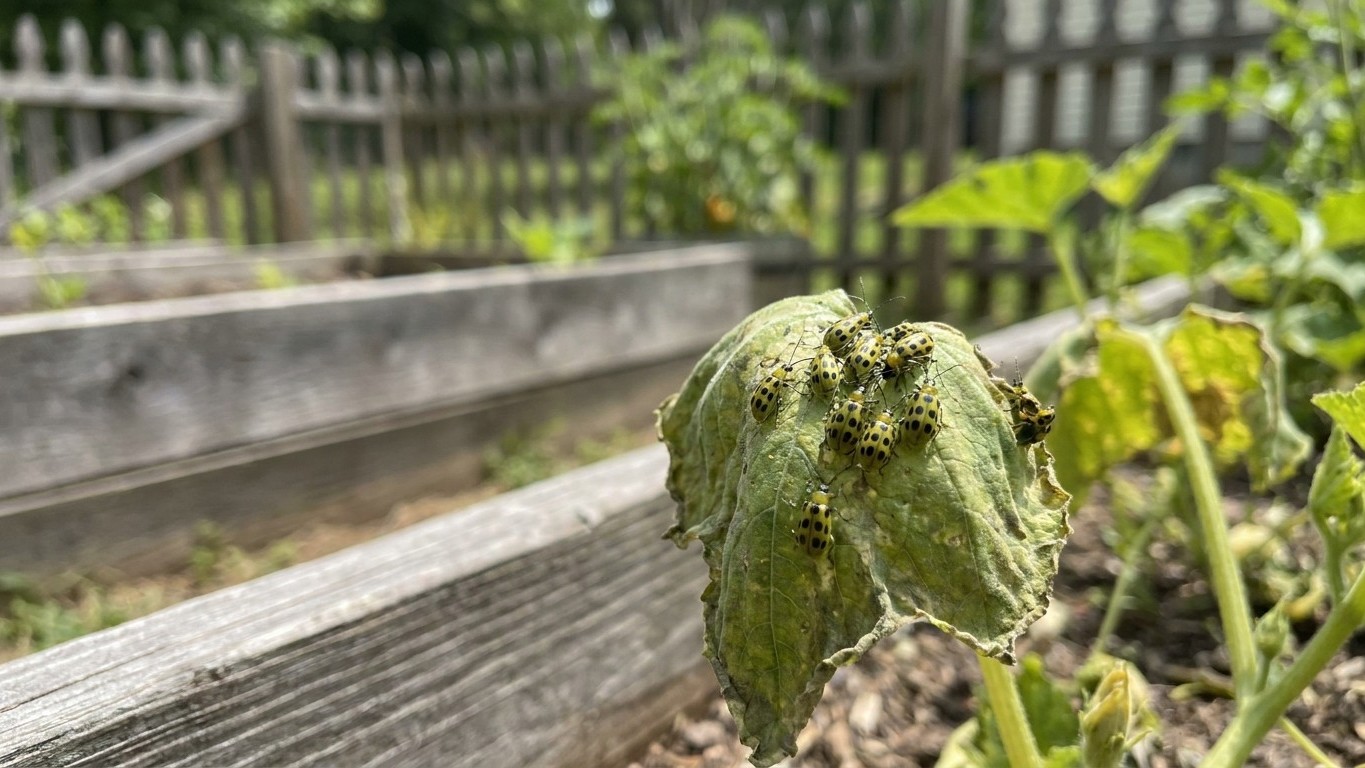
Beyond the chewed leaves and scarred fruit, this is one of the most serious pests of cucurbits because it spreads bacterial wilt as it feeds. Wilted vines with no other explanation point straight at this beetle.
Cabbage worms

Cabbage worms chew irregular holes through leaves and bore into heads, leaving behind small dark green droppings. Row cover from transplant onward keeps the egg-laying butterflies off entirely.
Harlequin bug
These brightly marked bugs suck sap from cabbage-family leaves, leaving pale blotchy patches that eventually turn brown and papery. Handpicking adults and destroying the barrel-shaped egg masses on leaf undersides works well in a small planting.
Japanese beetle
Adults skeletonize leaves between the veins, leaving a lace-like pattern, and they favor beans, roses, and grapevines. Shaking beetles into a bucket of soapy water in early morning, when they’re sluggish, beats most sprays for a home garden.
Aphids and whiteflies
Aphids leave sticky honeydew and curled, distorted new growth, while whiteflies scatter in a small cloud when a leaf is disturbed. A strong water spray or insecticidal soap knocks both back without harming the beneficial insects that eat them.
Tobacco hornworm
This caterpillar strips tomato foliage fast and leaves large dark droppings on leaves below the damage. It’s large enough to hand-pick once you spot it, though its green color makes it easy to miss until damage is already extensive.
Corn earworm
As the primary economic pest of sweet corn in West Virginia, this caterpillar feeds down inside the ear tip, ruining kernels before it’s ever seen. A few drops of mineral oil applied to the silk channel after pollination helps block later arrivals.
Brown marmorated stink bug and spotted wing drosophila
Stink bugs pierce fruit and leave pale, sunken pockmarks, while spotted wing drosophila lays eggs inside soft ripening fruit like berries, so damage shows up as mushy spots after picking. Netting fine enough to exclude the fly, and picking fruit as soon as it ripens, limits both.
Telling damage apart

Chewed leaf edges and round or irregular holes almost always mean a chewing insect: beetles, caterpillars, or slugs. Stippling, a fine pale speckling across the leaf surface, points to something sucking rather than chewing, like aphids, whiteflies, or harlequin bugs working from the underside. Sticky, shiny residue on leaves and any fruit below them is honeydew, a sign of aphids or whiteflies feeding above, not a disease symptom on its own.
Wilting and rot
Sudden wilting in cucumbers and squash with no drought behind it is the classic sign of bacterial wilt spread by cucumber beetles, and by the time it’s visible the vine is usually not recoverable. Slow, general wilting across a whole bed, by contrast, usually traces back to a watering problem, root damage, or a soil-borne disease rather than an insect. Splitting a wilted stem open lengthwise helps sort the two out: a sticky, stringy ooze from the cut points to bacterial wilt, while a clean dry stem points elsewhere.
Holes with clean, straight edges and a caterpillar or its droppings nearby are chewing damage. Holes that look scorched, papery, or start as small water-soaked spots that spread are almost always fungal or bacterial disease, not an insect at all, and no amount of picking bugs off the plant will fix it.
When each one shows up
The rhythm follows the plants more than the calendar, but WVU Extension’s tracking, measured near Charleston, gives a useful sequence for the rest of the state to expect with some local variation. April is when slugs become active in damp beds, Colorado potato beetle adults emerge, and flea beetles are worth trap-cropping around early transplants. From May, asparagus beetles, cucumber beetles, and the first Colorado potato beetle egg clusters appear, so this is the window for checking leaf undersides before populations build.
Early to late summer
By June, cabbage worms, Japanese beetles, and aphids move in as warm-season crops fill out, and this is usually the point where a garden that looked clean in May suddenly shows visible damage. July brings tobacco hornworms on tomatoes, corn earworm as ears form, and the arrival of brown marmorated stink bug and spotted wing drosophila, according to WVU Extension. Gardeners in cooler, higher-elevation parts of the state should expect this whole sequence to run a bit later than it does near Charleston, while warmer valley locations may see early stages sooner.
Checking plants twice a week from bud set through fruiting catches most problems before they become infestations. The habit matters more than any single date, since a beetle that arrives on schedule one year can show up two weeks early or late the next depending on the spring’s temperatures.
What actually works
Prevention
Rotating nightshades, cucurbits, and cabbage-family crops to a different bed each year breaks the life cycle of pests that overwinter in soil near their host plants, including Colorado potato beetle and cabbage worms. Floating row cover installed at transplant, before adults find the bed, keeps flea beetles, cabbage worms, and cucumber beetles off entirely, but it has to come off once flowers need pollinating on crops like squash and cucumbers. Cleaning up old fern growth, vines, and crop debris in fall removes the overwintering sites that asparagus beetles and several others depend on.
Encouraging predators pays off over a season even if it does nothing the first week: lady beetles and lacewings eat aphids by the hundreds, and a border of flowering herbs like dill or fennel draws them in. Trap crops, a few sacrificial squash or radish plants set out slightly earlier than the main planting, pull cucumber beetles and flea beetles away from the crop that matters.
Intervention
Hand-picking, whether it’s Japanese beetles into soapy water or hornworms off tomato stems, remains the most reliable tool for anything large enough to see and slow enough to catch. Insecticidal soap and horticultural oil work against soft-bodied aphids and whiteflies but do nothing against hard-shelled beetles. Products marketed as all-purpose “bug killer” sprays often knock out the pest and the predator eating that pest in the same pass, which is why a targeted approach beats a blanket one almost every time. Home remedies like garlic spray or diatomaceous earth applied wet have little evidence behind them against most of the pests on this list, and repeated dish-soap sprays can burn leaves in hot weather.
What control costs
Hand-picking costs nothing but time, and for slugs, Japanese beetles, and hornworms it’s genuinely the cheapest control available, though it has to be repeated every few days through the peak of the season. Floating row cover and other barriers cost more upfront, since the material and hoops need buying once, but a single set reused for several seasons brings the per-year cost down close to nothing, and it needs almost no repeat labor beyond removing it for pollination and putting it back.
| Method | Relative cost | Repeat effort over a season |
|---|---|---|
| Hand-picking | Lowest, time only | Every 2-3 days in peak months |
| Row cover / barriers | Moderate upfront, low per year if reused | Install once, reopen for pollination |
| Biological controls (predator habitat, beneficial insects) | Low to moderate | One-time planting, ongoing but passive |
| Sprays (soap, oil, targeted insecticide) | Moderate, recurring purchase | Every 7-10 days while pest is active |
Biological controls, mostly the cost of a few flowering plants to draw in predators, pay for themselves over more than one season and need almost no repeat attention once established. Sprays are the most expensive option over a full season once the repeat purchases and reapplication after rain are added up, and they’re also the option most likely to hurt the predator insects doing free work in the same bed. For a typical home garden, a mix of barriers early and hand-picking through the season covers most of what’s on this list without much cash outlay at all.
Local help
The WVU Extension Service tracks pest outbreaks across the state and will identify a specimen or a damage pattern a home gardener can’t place, through the county office network. Their extension service site is the starting point for reaching a county agent, and their pest management page carries the seasonal list. For other West Virginia growing questions, the West Virginia guides section covers frost dates, soil, and crop timing for the state.
Gardeners who’ve moved from a different climate sometimes bring expectations that don’t match here. Someone used to the dry-heat pest pressure covered in Arizona’s pest guide will find West Virginia’s humidity brings on slugs and fungal-adjacent problems that barely register out west, while someone coming from Wisconsin’s garden pest patterns will recognize cabbage worms and Japanese beetles but should expect them to arrive earlier here given the longer, warmer season.
Pest-by-Pest Guides for West Virginia Gardens
Once you’ve got a sense of the season, it helps to look at what’s actually chewing on your plants. If your asparagus spears are marred right as they push through the soil in spring, check asparagus beetles, which run two generations a season. Brassica growers face two look-alike threats in the same window: cabbage worms, which the state extension service ties to a June arrival alongside Japanese beetles and aphids, and harlequin bug, an easy-to-spot insect that moves in as seedlings go into the ground. Sweet corn and tomatoes take a hit from corn earworm, whose moths ride storm fronts up from the Gulf Coast. Vine crops need watching for cucumber beetles, active once soil temperatures climb past 65°F, while nearly every crop can show the small shot-hole damage of flea beetles. Lawns and ornamentals answer to the Japanese beetle, peaking in midsummer, and tomato foliage stripped bare in July and August points to the tobacco hornworm.
Common questions
What’s eating my tomato leaves overnight?
A large green caterpillar with white diagonal stripes, the tobacco hornworm, is the usual overnight culprit on tomatoes, and it leaves dark droppings on leaves below the feeding site. Check with a flashlight after dark if you can’t find it during the day, since its coloring makes it hard to spot against green foliage even up close.
Do I need to spray if I only see a few beetles?
Not usually. A handful of Japanese beetles or Colorado potato beetles rarely justifies a spray, since hand removal handles small numbers just as well without harming the predator insects that keep other pests in check. Reach for a targeted treatment only once damage is spreading fast or the population is clearly building week over week.
Why do my squash vines wilt even though I’m watering them?
Sudden wilting in cucurbits with no drought behind it usually means bacterial wilt carried by cucumber beetles, not a watering problem at all. Cutting the stem and checking for a sticky ooze confirms it, and once a vine is that far gone there’s no treatment that reverses it.
Are the bugs on my cabbage harlequin bugs or stink bugs?
Harlequin bugs are smaller, shield-shaped, and boldly marked with bright red-orange on black, while brown marmorated stink bugs are larger and mottled grayish-brown with none of that bright color. If you’re not sure which one you’re looking at, a photo sent to a county extension office settles it faster than guessing from a description.