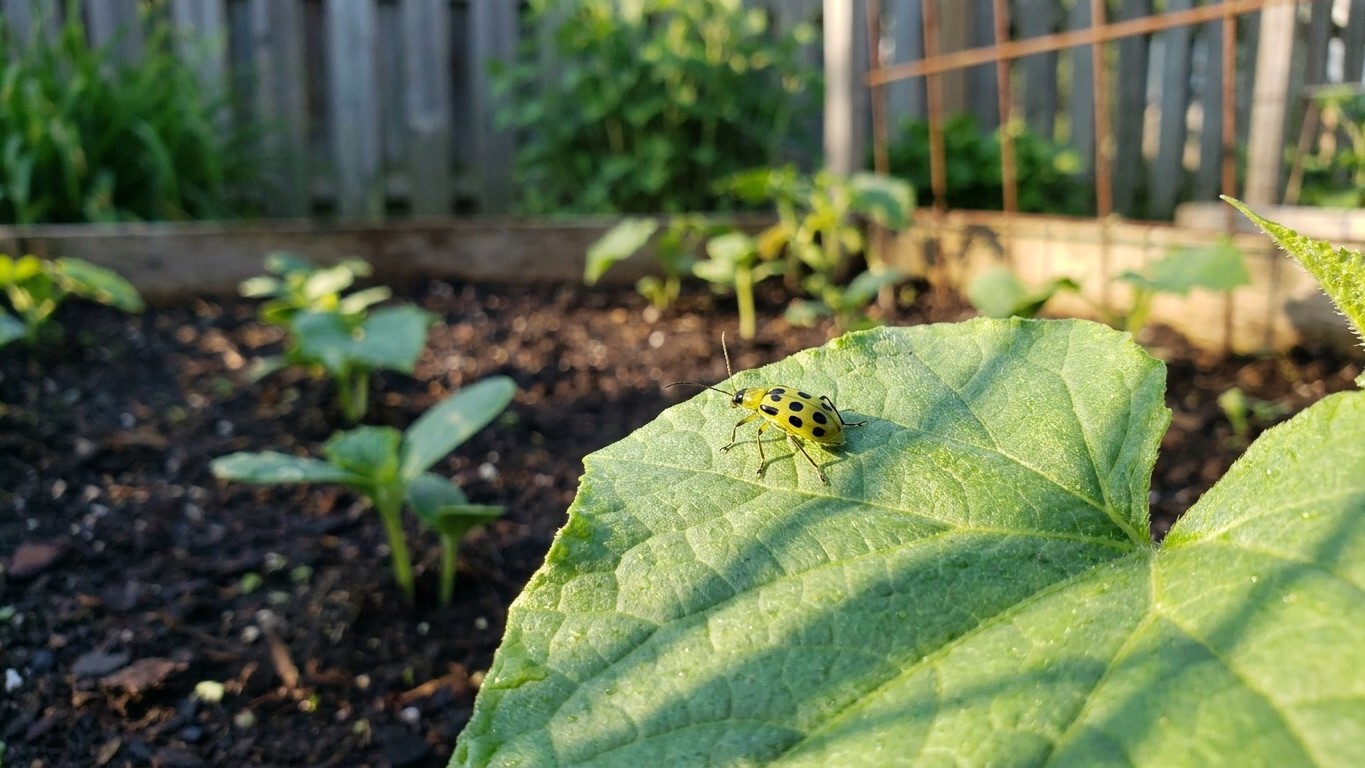

Adult spotted cucumber beetles emerge across Michigan between mid-May and early June, right as cucurbit seedlings push through the soil. They overwinter as adults in leaf litter and field edges, so the first warm stretch above 55°F wakes them up hungry. Row covers installed at planting, removed only for pollination, block the first wave entirely. Combine that with resistant varieties and a tight harvest schedule, and most Michigan gardeners never see the worst of it.
The insect itself, Diabrotica undecimpunctata howardi, is easy to spot: a quarter-inch, yellow-green body with twelve black spots and a habit of dropping to the ground the second you lean in close. That defensive drop is why hand-picking rarely works past the seedling stage. But the beetle’s real threat isn’t the chewing. It’s what rides along in its gut.
When Spotted Cucumber Beetles Show Up in Michigan

Michigan sits mostly in USDA hardiness zones 5a through 6b, with the southern Lower Peninsula warming faster in spring than the Upper Peninsula or the Thumb region. That temperature gradient matters because spotted cucumber beetle activity tracks soil warmth almost exactly. Growers in Berrien or Kent County typically see adults a week or two before those farming near Marquette or Alpena.
A second generation follows in July and August in the warmer southern counties, feeding on later plantings of squash, melon, and cucumber. Michigan’s shorter growing season generally limits the pest to two generations a year, compared to three or more in states like Georgia or Louisiana. That’s a small mercy, but it also means the pressure concentrates hard during two narrow windows rather than spreading thin all summer.
What the Damage Actually Looks Like
Seedlings hit hardest show ragged holes in cotyledons and stunted growth within days. On mature plants, adults chew on leaves, blossoms, and the surface of fruit, leaving scarring that lowers market value even when the plant survives. Larvae, which live in the soil, gnaw on roots and can girdle stems at the base, something easy to miss until a plant wilts for no obvious reason on a day that wasn’t even that hot.
The bigger issue is bacterial wilt, caused by Erwinia tracheiphila, which the beetle carries in its digestive tract and deposits through feeding wounds. Cucumbers and muskmelons are especially vulnerable. Once a plant is infected, there’s no cure. Vines collapse within one to three weeks, and a simple test confirms it: cut a wilted stem and press the cut ends together, then slowly pull apart. Sticky, stringy sap that forms a thread means bacterial wilt, not just drought stress or root damage.
What Actually Stops It
Row covers remain the single most effective tool for home gardeners, and the timing is everything. Covers need to go on at planting or transplant, sealed tight at the edges with soil or landscape staples, and left in place until flowering begins. Once blossoms open, pollinators need access, so covers come off, and that’s usually when the first wave of beetles has already aged past its most destructive feeding window.
Trap cropping works as a supporting strategy rather than a standalone fix. Blue Hubbard squash draws spotted and striped cucumber beetles away from cash crops with striking reliability. Planting a border of Blue Hubbard around the perimeter of a cucumber or melon patch, then treating just that border with an insecticide if numbers spike, protects the main crop while using far less product overall.
Resistant and tolerant varieties reduce pressure without any extra labor. Cucumber cultivars bred with resistance to bacterial wilt cut down the consequences of beetle feeding even when the insects themselves show up in normal numbers. Michigan State University Extension recommends checking seed catalogs for wilt-tolerant cucumber and muskmelon lines before planting, since resistance varies significantly between varieties even within the same species.
Timing the Planting Calendar Around the Pest
Delaying transplant by even one to two weeks past the earliest safe date can shift a crop’s most vulnerable seedling stage past the first beetle emergence peak. It’s a tradeoff, since Michigan’s growing season is already short, but for gardeners who’ve lost a bed to bacterial wilt before, the lost week often costs less than the lost crop.
Crop rotation matters more than most gardeners assume. Adults overwinter in plant debris near where cucurbits grew the previous year, so moving cucumber, squash, and melon beds to a different part of the yard or garden each season reduces the local population that greets seedlings in spring. A three-year rotation cycle, moving cucurbits through three separate garden zones before returning to the first, breaks the overwintering cycle far more effectively than a one-year shift.
Chemical and Organic Options, and When Each Makes Sense
For serious infestations, especially in the seedling stage when bacterial wilt transmission risk peaks, targeted insecticide application still has a role. Products containing spinosad offer an organic-approved option that’s effective against beetle larvae and adults while being less disruptive to pollinators than broad-spectrum options, provided application happens in the evening after bees have finished foraging for the day.
Kaolin clay, sprayed as a fine white coating over foliage, works as a physical deterrent rather than a poison. Beetles dislike landing on the gritty film, and it needs reapplication after rain, but it’s one of the few options safe to use right up to flowering without harming beneficial insects. Neem oil offers similar low-impact protection, though its effect on established adult populations is modest compared to its impact on larvae and eggs.
Beneficial nematodes, applied to soil in spring, target the larval stage before it ever reaches adulthood. Heterorhabditis bacteriophora is the species most commonly recommended for cucumber beetle larvae, and it needs moist soil and soil temperatures above 60°F to establish, which lines up reasonably well with late May conditions across most of Michigan’s growing regions.
Why Michigan’s Climate Shapes the Whole Strategy
Lake Michigan and Lake Huron moderate temperatures along the coastlines, delaying both bud break and beetle emergence by several days compared to inland counties at the same latitude. Growers in a lakeshore county like Ottawa or Berrien often get a slightly later, more compressed emergence window than someone farming forty miles inland in Kent or Ionia County, which changes when row covers need to go on and come off.
Soil temperature, not calendar date, is the more reliable marker for beetle activity than the standard planting guides in seed packets. A soil thermometer pushed two inches into a garden bed telling you 55°F or above is a better signal than the date on a calendar, particularly in a state where a warm April can be followed by a cold, wet May without much warning.
Michigan’s humid summers also create ideal conditions for the bacterial wilt pathogen once beetles introduce it, since Erwinia tracheiphila spreads faster through plant tissue in warm, moist conditions than in dry heat. That’s part of why prevention through timing and physical barriers matters more here than in drier climates where the beetle itself causes cosmetic damage but rarely triggers the wilt collapse that ends a harvest early.
A Realistic Season Plan
Gardeners who’ve dealt with repeat infestations tend to layer three or four tactics rather than relying on one. Row covers handle the seedling window. A Blue Hubbard trap crop border catches stragglers once covers come off. Wilt-resistant varieties reduce the stakes if a beetle does slip through. Crop rotation lowers the baseline population each following spring.
None of these tactics alone eliminates the pest completely, and that’s worth accepting up front rather than chasing a zero-beetle garden that doesn’t really exist outside of a greenhouse. What they do together is keep the population below the threshold where bacterial wilt becomes a real threat to the harvest, which for most home gardens in Michigan is the actual goal worth working toward.
Commercial growers monitoring larger acreage often set an action threshold around one beetle per plant at the seedling stage, a benchmark drawn from extension research across the Midwest corn belt states where cucumber beetles also damage field crops. Below that number, the risk of triggering a spray decision usually outweighs the modest feeding damage the beetles cause on their own.
Related guides
- Spotted cucumber beetle in Ohio: When It Shows Up and What Stops It
- Spotted cucumber beetle in Indiana: When It Shows Up and What Stops It
- Spotted cucumber beetle in New Jersey: When It Shows Up and What Stops It
- Spotted cucumber beetle in New Mexico: When It Shows Up and What Stops It
- Spotted cucumber beetle in Iowa: When It Shows Up and What Stops It
- Spotted cucumber beetle in Alabama: When It Shows Up and What Stops It