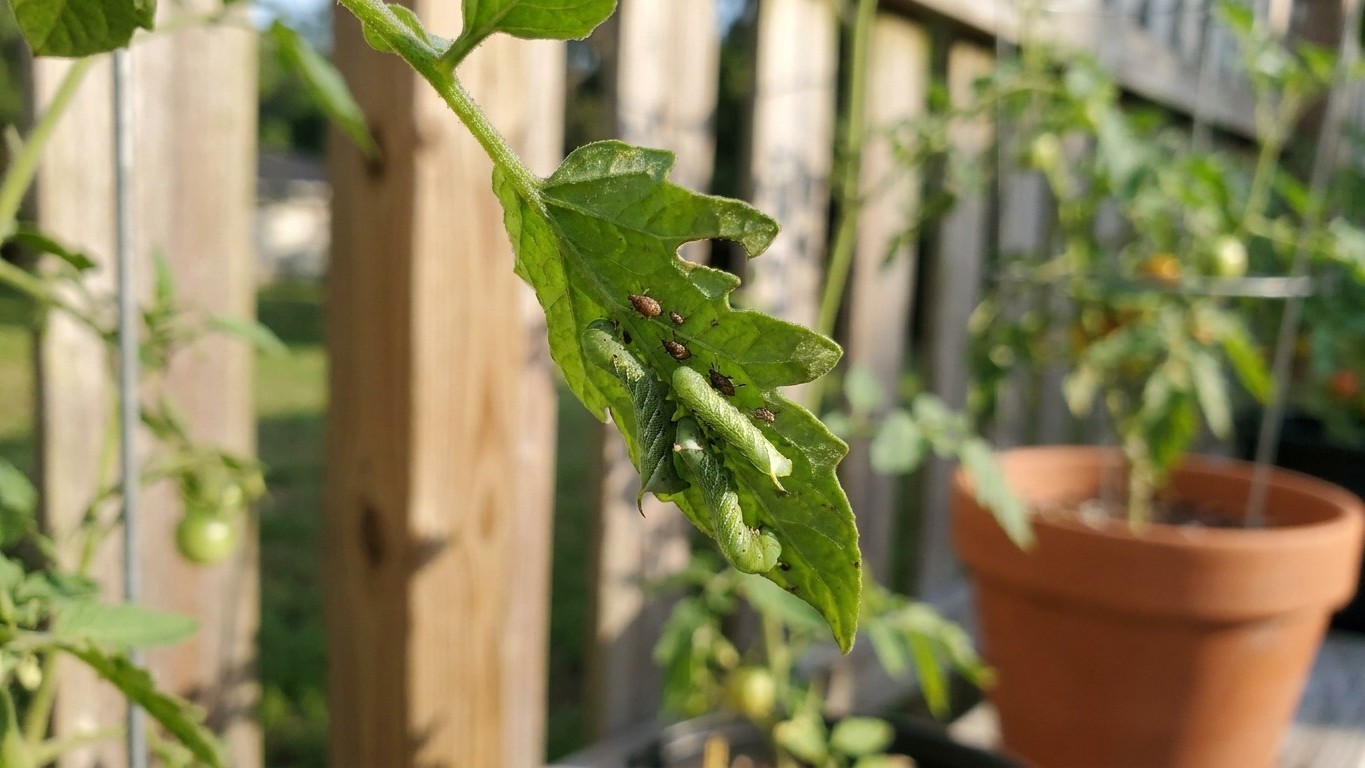

Florida’s warm, humid season brings a specific lineup of tomato pests: aphids and thrips early, whitefly and hornworms as the weather turns hot, then fruitworm, stink bugs and root-knot nematodes through the fruiting stretch. Around Jacksonville, NOAA’s 1991-2020 climate normals put the last spring freeze between February 16 and March 7, so plants are already in the ground and vulnerable well before most of these insects build up numbers. Start scouting the undersides of leaves twice a week the week after transplant, before you see any obvious damage.
What this comes down to in Florida

New leaves unfurl a week or two after transplant, and that’s when aphids cluster on the undersides, sticky and small as a period at the end of this sentence. Thrips slip into the same blossoms not long after, invisible until the silvery streaks show up on the petals. By the time the Florida heat settles in for late spring, whiteflies are rising off the foliage in a pale cloud every time a leaf gets brushed. Each one leaves its own signature, and knowing which is which changes what you spray and when.
Aphids
Aphids show up first, as soon as the plants put on new growth after transplant. They are tiny, pear-shaped insects about the size of a period, green, yellow or black, clustered on the undersides of young leaves and stem tips where they suck sap and leave behind a sticky residue that draws ants. A hard spray of water knocks small colonies down, and insecticidal soap or horticultural oil handles the rest without harming pollinators once flowers open.
Thrips
Thrips arrive around the same time, slipping deep into the flower where a spray never reaches. They are slender, barely 1/16 inch, pale yellow to dark brown, and their feeding leaves silvery streaks and black flecks of waste on leaves and petals. The bigger worry is what they carry: thrips can transmit Tomato Spotted Wilt Virus, so a plant with ringed, mottled fruit and stunted new growth is worth pulling before it exposes neighboring plants. Spinosad applied to open blooms is the most reliable control.
Silverleaf whitefly
Whitefly numbers build as the weather warms into late spring. Adults are pure white, moth-like, about 1/16 inch, and rise in a visible cloud when a leaf is brushed, while the flat, pale yellow nymphs stay glued to the underside of the leaf where they feed. Heavy infestations coat the foliage in sticky honeydew and sooty mold. Reflective mulch under young plants and rotating between horticultural oil and a labeled insect growth regulator keep populations from exploding.
Tomato hornworm
By the time plants are waist high and setting fruit, hornworm is the pest most gardeners actually see, because there is nothing subtle about it. The caterpillar grows to four inches, bright green with white diagonal stripes and a curved horn at the tail, and it can strip a branch of leaves overnight despite its near-perfect camouflage against tomato foliage. Hand-picking works fine on a small planting, and Bacillus thuringiensis (Bt) sprays kill young caterpillars without touching bees or the wasps that parasitize hornworm naturally.
Tomato fruitworm
Fruitworm, the same species known elsewhere as corn earworm, moves in once fruit starts sizing up. The caterpillar is variable in color, green, brown or striped, up to an inch and a half long, and it bores a single hole straight into the fruit near the stem, hollowing it out from the inside. Once a worm is inside, no spray reaches it, so timing matters more than the product: Bt or spinosad applied while eggs are hatching on the foliage is the only window that works.
Southern green stink bug
Stink bugs follow the same fruiting stretch as fruitworm. The adult is shield-shaped, about 5/8 inch, solid bright green, and it feeds by piercing the fruit wall, leaving hard, pale, cloudy spots under the skin that show up once the tomato ripens. They are strong fliers that move in from surrounding weeds and field edges, so mowing or clearing tall grass near the tomato bed removes their staging ground before they find the fruit.
Root-knot nematodes
Nematodes are the pest a gardener never actually sees, since they are microscopic worms living in the soil around the roots. The tell is a wilted, stunted plant that looks like it needs water even after a good rain. Pulling it up shows knotty, swollen galls along the roots instead of the normal thin white strands. There is no rescue spray once a plant is infected. Sandy Florida soil favors nematodes, which is why cultivars bred with intermediate nematode resistance, including Sakura, Celebrity Plus, Big Beef Plus and Amalfi, are worth checking against the Tomato Varieties That Ripen in Time in Florida guide before ordering next year’s transplants.
Working it out for your own garden
Identifying which pest you’re looking at starts with where the damage is, not what the bug looks like from across the yard. Check three things in order: which part of the plant is damaged, whether you can find the insect itself or only the damage it left, and how big the culprit is next to a grain of rice.
Leaf damage with no visible insect at rest usually means something that flies off the moment you get close, like whitefly. Leaf damage with a fat caterpillar still sitting on the stem is straightforward: that’s hornworm, and picking it off ends the problem for that plant. A hole bored straight into the fruit, with no entry marks anywhere else on the plant, points to fruitworm working from the inside, while cloudy pale spots on the fruit skin with no hole at all is stink bug feeding. A wilted plant that looks thirsty despite wet soil is the one case where the culprit is never on the plant at all: pull it and check the roots for galls before assuming a watering problem.
A quick reference table
| Pest | Where you find it | Damage it leaves | Peak season |
|---|---|---|---|
| Aphids | Underside of new leaves, stem tips | Curled leaves, sticky residue | Early, right after transplant |
| Thrips | Inside open blossoms | Silvery streaks, virus symptoms | Early to mid season |
| Silverleaf whitefly | Underside of mature leaves | Sooty mold, sticky honeydew | Late spring onward as it warms |
| Tomato hornworm | On stems, camouflaged in foliage | Stripped branches overnight | Once plants are waist high |
| Tomato fruitworm | Boring into green or ripening fruit | Single hole near the stem end | Once fruit is sizing up |
| Southern green stink bug | On fruit clusters | Cloudy pale spots under the skin | Through the fruiting stretch |
| Root-knot nematodes | On the roots, not visible above ground | Wilting, stunting, root galls | Builds all season in sandy soil |
That timeline lines up with when transplants actually go into the ground. Counting from the frost window that NOAA’s 1991-2020 normals set for Jacksonville, a transplant going in early March to late March is six to ten weeks old by the time hornworm and fruitworm typically appear, which lines up with the fruit-set stage described in the Tomato Planting Dates in Florida: Counting Back From Your Frost Window guide.
What changes across the state
The pest lineup above is timed to Jacksonville’s spring transplant window, and that timing does not travel to the rest of the state.
North versus south
North Florida, where NOAA’s 1991-2020 normals for the Jacksonville area put the last freeze between February 16 and March 7, runs on the same spring-to-summer calendar as most of the country: plants go in as the ground warms, and pest pressure builds through the growing season. South and central Florida do not follow that pattern. USDA’s hardiness zone map puts the state’s range from zone 8b in the north to 11b at the southern tip, and in the warmer zones the growing season inverts, running through the cooler months while summer becomes too hot and wet for a reliable crop. A grower near Jacksonville meets aphids and thrips on a spring transplant and hornworm by early summer. A grower further south, planting into a mild winter instead, meets whitefly and thrips pressure that never really drops off, because the insects overwinter successfully where a hard freeze rarely happens.
Coastal and soil differences
Coastal gardens anywhere in the state tend to carry heavier whitefly numbers than inland ones a similar distance north or south, since the insect favors the same humid, breeze-buffered air that makes coastal summers feel muggier. Soil matters too. Nematode pressure tracks with the sandy soils that dominate most of the Florida peninsula, and it shows up regardless of which half of the state a garden sits in. A gardener on heavier, clay-influenced soil in the panhandle typically sees less of it than one on the deep sand common further south and along the coast.
The mistakes this state punishes

The most common mistake is transplanting into soil that is still cold from a late cold snap, then blaming the pest trouble that follows on bad luck instead of a stressed plant. A tomato set into cold soil grows slowly and sits exposed to aphids and thrips for weeks longer than one that gets moving right away. Wait for the soil itself to warm, not just for the calendar to clear the frost window that NOAA’s 1991-2020 normals give for Jacksonville.
Timing and variety choice
The second mistake is treating thrips as a cosmetic problem. The insect itself does little damage, but the virus it can carry, Tomato Spotted Wilt Virus, ends the plant, and by the time mottled fruit and ringed leaf spots show up the infection has already spread to whatever is nearby. Scout blossoms for thrips before symptoms appear, not after.
The third mistake is choosing a long-season cultivar without weighing the extra exposure that comes with it. San Marzano II, Amish Paste and Brandywine all run past 75 days from transplant, and while Jacksonville’s fall frost, set by NOAA’s 1991-2020 normals at November 26 to December 13, leaves calendar room even for those, a longer stretch on the plant is also a longer stretch for whitefly, hornworm and stink bug to build up numbers on it. A shorter-season cultivar like Sun Gold or Sakura, both around 55 to 60 days, spends less time exposed before harvest is in.
The fourth is skipping the fall cleanup. Leaving spent tomato plants and volunteer seedlings in the ground over winter gives whitefly, thrips and nematodes a place to carry over into next year’s crop instead of starting fresh.
Checking this against your county
Everything above is anchored to Jacksonville, because that is where the NOAA 1991-2020 climate normals used in this guide are measured, and pest timing shifts with local climate more than most gardeners expect. Before planning a spray schedule around it, check it against your own county extension office, since a few weeks of difference in frost timing or a few degrees of average humidity changes when whitefly and thrips actually build up. The University of Florida’s IFAS Extension, through its county offices listed at sfyl.ifas.ufl.edu, keeps current pest alerts that a state-wide page like this one cannot.
Common questions
Do I need to spray every time I see a hornworm?
No. If you only find one or two, hand-picking them off the plant is enough, and it keeps the parasitic wasps that naturally control hornworm populations alive to work on the rest. Save a spray for a plant that’s losing leaves faster than you can pick worms off it.
If I plant a nematode-resistant variety, am I done with nematodes for good?
No, and that’s a common misunderstanding of what the resistance label means. Varieties like Sakura, Celebrity Plus, Big Beef Plus and Amalfi carry intermediate resistance, which slows nematode buildup in the roots but does not eliminate it, so continuous tomato plantings in the same bed still let numbers climb over several seasons. Rotating tomatoes with a non-host crop matters even with a resistant variety in the ground.
How do I tell whitefly from aphids on the underside of a leaf?
Whitefly adults fly up in a visible white cloud the moment you touch the leaf, while aphids stay put and just cluster tighter together. If nothing flies off but you still see tiny pale bumps stuck flat to the leaf, those are likely whitefly nymphs rather than aphids, which are always plump and pear-shaped rather than flat.
Are these pests as bad on a few container plants as in a full garden bed?
Usually less so, simply because there’s less plant tissue to find and fewer neighboring tomatoes for a pest to spread between. Whitefly and aphids still find container plants without much trouble, but stink bug and fruitworm pressure tends to run lower away from a large planting, since both are drawn in from surrounding vegetation and field edges.