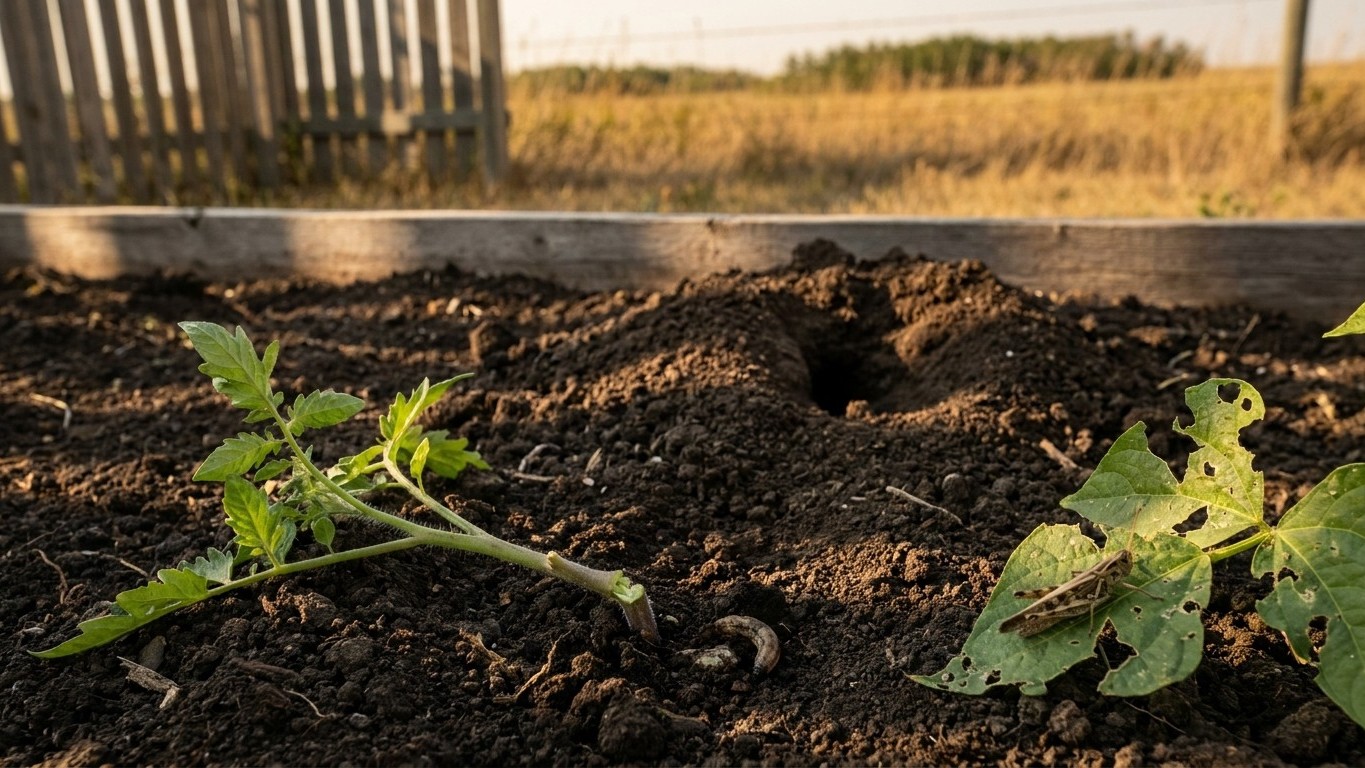

If you garden in Saskatchewan, three things shape what crawls, chews, or burrows into your beds: a short growing season, big temperature swings between May and September, and a prairie landscape that gives ground squirrels and grasshoppers plenty of room to move in from field edges. The pests that matter most here aren’t the same ones a gardener in Ontario or coastal British Columbia deals with. Cutworms show up before you’ve even planted your tomatoes, and once potato plants are in the ground, the Colorado potato beetle in Saskatchewan is often not far behind, chewing through foliage just as the plants start to establish, while tiny but destructive Thrips in Saskatchewan can quietly stunt and scar leaves on onions and other crops before most gardeners even notice they’re there. Grasshoppers peak in dry years, sometimes stripping a row of beans in an afternoon, and by midsummer the Corn earworm in Saskatchewan becomes a familiar headache for anyone growing sweet corn on the prairies. Richardson’s ground squirrels, known locally as gophers, can undo a season of work in a weekend, and come fall, the Boxelder bug in Saskatchewan that gardeners deal with tends to cluster by the thousands on sun-warmed walls and fences, often alongside the Brown marmorated stink bug in Saskatchewan that homeowners are increasingly spotting on the same surfaces, while late-season nests of Social wasps in Saskatchewan add another layer of aggravation for gardeners right as harvest work picks up.
Below is a season-by-season breakdown of what actually shows up in Saskatchewan yards and market gardens, plus the control methods that hold up against prairie conditions rather than generic advice written for a milder climate. Tree owners should also keep an eye out for the Emerald ash borer in Saskatchewan, a pest that can quietly devastate ash trees before symptoms become obvious, while those with spruce on their property will want to watch for the Yellowheaded spruce sawfly in Saskatchewan, whose larvae can defoliate a tree’s new growth in a matter of days. Anyone growing apple trees should also watch for Apple maggot in Saskatchewan, whose larvae tunnel through ripening fruit and can ruin much of a harvest if left unchecked.
Why Saskatchewan’s Climate Changes the Pest Calendar

Saskatchewan sits in a continental climate zone with cold, snowy winters and hot, often dry summers. The frost-free window typically runs from late May to early September, depending on the region, which compresses both plant growth and pest activity into a tight span. Insects that would spread their damage over several months elsewhere in North America instead hit hard and fast here, often in a two-to-three-week burst tied to a specific growth stage of your plants.
Drought years change the equation too. Grasshopper populations in Saskatchewan build over consecutive dry seasons because dry soil favors egg survival, while a wet spring can knock hatching rates down substantially. Saskatchewan Agriculture tracks grasshopper risk by region each year, and gardeners in the southern and west-central parts of the province, where dry conditions are more frequent, tend to see the heaviest pressure.
Spring Pests: What Hits First
Cutworms
Cutworms are the caterpillar stage of several moth species that overwinter as larvae in the soil, including the Miller moths in Saskatchewan that gardeners often notice fluttering around porch lights in late spring. They wake up hungry in early spring, right around the time you’re setting out transplants, and they feed at night by chewing through stems at soil level. A seedling that was standing fine at dusk can be lying flat by morning, severed cleanly near the base.
Cardboard collars pushed an inch into the soil around each transplant stop cutworms cold, since the larvae can’t climb over a barrier or burrow deep enough to go under it. Toilet paper tubes or cut sections of yogurt containers work just as well as anything sold for the purpose. Tilling beds in fall also exposes overwintering larvae to birds and freezing temperatures, cutting down next spring’s population.
Flea Beetles
Flea beetles are tiny, dark, jumping insects that riddle the leaves of canola-family plants, which includes garden staples like radishes, arugula, kale, and bok choy, with small round holes. Seedlings are especially vulnerable because a beetle population that a mature plant shrugs off can kill a young transplant outright.
Floating row covers laid down at planting time and sealed at the edges with soil keep adult beetles from ever reaching the leaves. This matters more in Saskatchewan than in warmer provinces because the plants have less time to outgrow the damage before the short season ends.
Wireworms
Wireworms, the larval stage of click beetles, live in the soil for up to four years before pupating, feeding on roots, seeds, and tubers the whole time. Potato and carrot growers on the prairies deal with them more than most, since these crops sit underground exactly where wireworms feed. There’s no fast organic fix once wireworms are established in a bed; crop rotation away from grasses and cereals, which wireworms favor, is the main long-term strategy home gardeners have.
Summer Pests: The Main Event
Grasshoppers
Grasshoppers are the pest Saskatchewan gardeners talk about most, and for good reason. In outbreak years, which tend to follow two or three consecutive dry summers, grasshoppers move from field margins into yards and gardens in large numbers, feeding on nearly anything green including vegetables, flowers, and even young tree leaves.
Row covers help protect smaller plantings, but they’re not practical for larger vegetable patches once grasshoppers are already established nearby. Keeping the grass and weeds at field edges mowed short removes egg-laying habitat, and tilling soil in fall exposes egg pods to winter cold. In severe outbreak years, some gardeners turn to insecticidal baits labeled for grasshopper control, applied early in the season while nymphs are still small and less mobile.
Aphids
Aphids cluster on new growth and the undersides of leaves, sucking plant sap and excreting a sticky residue called honeydew that can lead to sooty mold. Saskatchewan’s warm, dry summer stretches let populations build quickly, particularly on peas, beans, and roses.
A strong jet of water from a hose knocks most aphids off without chemicals, and repeating this every few days during an outbreak keeps numbers manageable. Ladybugs and lacewings, both common on the prairies, can clear a moderate infestation on their own if you avoid broad-spectrum insecticides that would kill them along with the aphids.
Imported Cabbageworm and Cabbage Loopers
The white butterflies fluttering around your brassicas in July are laying eggs that hatch into green caterpillars capable of skeletonizing cabbage, broccoli, and kale leaves within days. Because these butterflies are active through most of the Saskatchewan summer, a single planting can face two or three waves of caterpillars before harvest.
Row covers again do the heaviest lifting here, since they physically block the adult butterflies from laying eggs on the leaves. Hand-picking caterpillars off plants every few days works for smaller gardens and avoids any spray at all.
Colorado Potato Beetle
This striped beetle and its reddish, humpbacked larvae feed almost exclusively on potato foliage, though they’ll also hit tomatoes and eggplant in a pinch. Saskatchewan’s potato-growing regions, particularly around the Outlook and Elrose areas, see consistent pressure from this pest most summers.
Hand-picking adults and crushing egg clusters on the undersides of leaves early in the season prevents the larger, more damaging larval outbreaks later. Rotating potatoes to a different bed each year, ideally with at least 100 yards of separation from the previous year’s plot, also reduces how easily beetles find the new planting.
Ground-Dwelling and Vertebrate Pests
Insects aren’t the only problem on the prairies. Richardson’s ground squirrels, the animal most Saskatchewan residents simply call gophers, dig extensive burrow systems and feed on a wide range of garden vegetables, often targeting the same rows repeatedly once they find a reliable food source. They’re most active from early spring through mid-summer before entering an extended period of dormancy that can begin as early as July for adult males.
Fencing buried at least 12 inches deep around vegetable beds limits access, since ground squirrels are diggers rather than climbers. Live trapping is legal in Saskatchewan but relocating the animals is restricted under provincial wildlife regulations, so check current rules with Saskatchewan’s Ministry of Environment before choosing that route.
Cottontail rabbits and, in some regions, white-tailed deer add a second layer of pressure, particularly on newly planted seedlings and any leafy greens left unprotected. A simple 2-foot fence of chicken wire stops most rabbit damage, while deer require taller barriers, generally at least 6 to 8 feet, or repellent sprays reapplied after rain.
An Integrated Approach That Works on the Prairies
No single method handles every pest Saskatchewan throws at a garden over a season. What works consistently is layering several low-cost strategies rather than relying on one fix.
- Rotate crop families each year to break the life cycle of soil-dwelling pests like wireworms and root maggots
- Use row covers on brassicas and young transplants during peak flea beetle, cabbageworm, and cutworm activity
- Till exposed beds in fall to expose overwintering grasshopper eggs and cutworm larvae to cold and predators
- Encourage ladybugs and lacewings by planting dill, yarrow, or alyssum near vegetable rows
- Inspect plants twice a week during July and August, when most insect populations peak on the prairies
Saskatchewan Agriculture and the University of Saskatchewan’s horticulture extension programs update pest forecasts each spring based on winter soil conditions and early-season trapping data, and checking those forecasts before planting gives a reasonable heads-up on whether it’s shaping up as a heavy grasshopper year or a quieter one. That single piece of information often shapes which control method is worth the effort, and which one can wait.
Six More Pests Worth Watching
The pests above don’t cover everything gardeners in this province run into, or worry about. Some questions are really about what’s absent: whether apple maggot can even survive here, given how the short summers and cold winter soils work against the fly completing a yearly cycle, or whether emerald ash borer has moved in yet, since the nearest confirmed infestation is still roughly 350 miles away in Winnipeg. Others are about timing and damage control once the pest is confirmed and active. That’s the case with the Colorado potato beetle, which typically emerges once soil temperatures climb past 50°F, and with the yellowheaded spruce sawfly, whose larvae start feeding on spruce needles in late May with a narrow window for low-toxicity control. Then there are the pests that blow in from elsewhere and never overwinter, like corn earworm, which arrives entirely on weather systems from the south, and the ones that spike with hot, dry weather, like thrips, which favor onions, garlic, and canola once humidity drops below 50 percent.