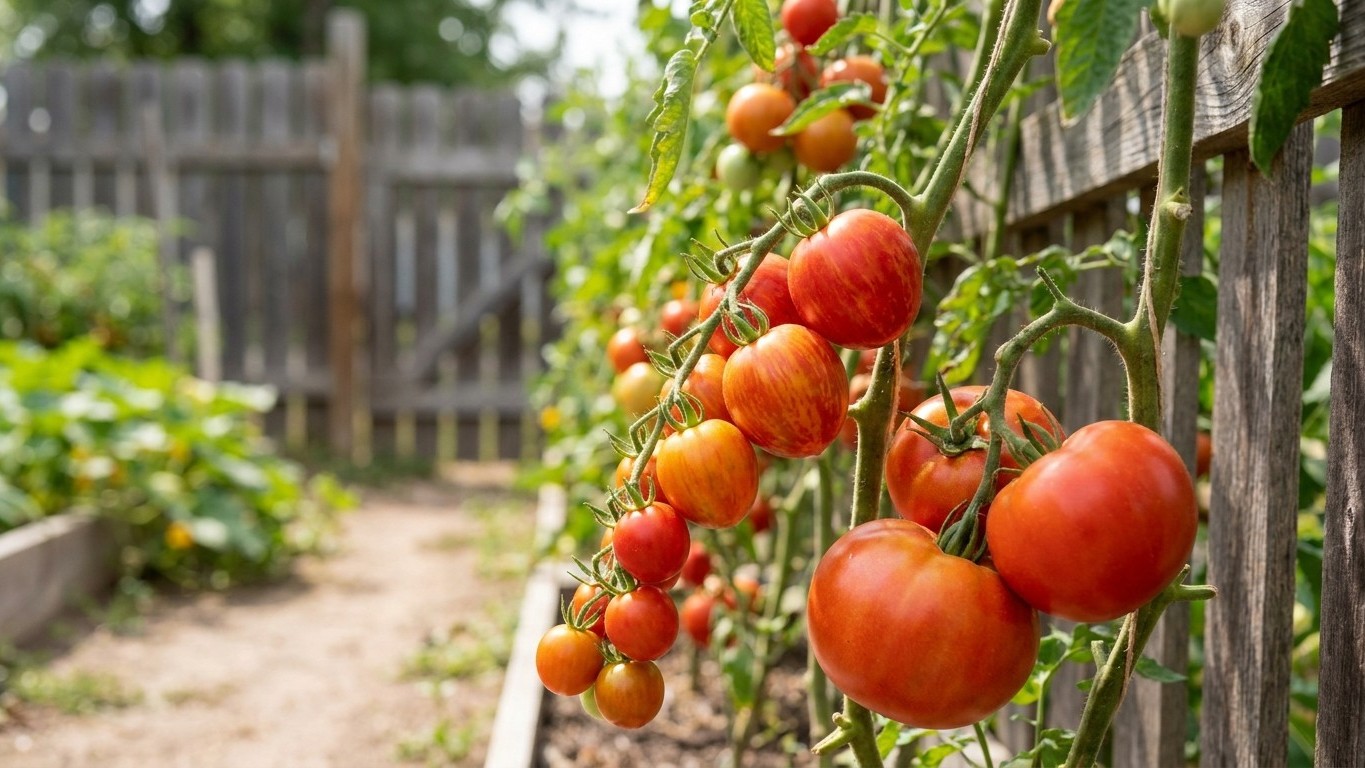

Four and a half months — that’s the frost-free window most South Dakota gardeners get, running from a late-April or early-May last freeze to a first freeze somewhere in late September or early October. It’s enough time for tomatoes, but only if the varieties in the ground actually fit that stretch. A 78-day paste tomato planted hoping for August sun is a gamble; a 55-day cherry alongside it is the safer bet.
What this comes down to in South Dakota

At the Sioux Falls reference station, NOAA’s 1991-2020 normals put the frost-free season at roughly four and a half months, from the late-April to early-May last freeze to the late-September to early-October first freeze. That’s a workable window for Growing Tomatoes in South Dakota generally, but it rewards picking varieties that match it rather than whatever looked good in the catalog.
The safest approach is to plant a spread rather than one variety: a couple of 55-day types for an early, reliable harvest, a mid-season fruit or two for volume, and, only if you have room to gamble a little, one longer-season paste or beefsteak. Days to maturity is always counted from the transplant date, not from seed, and the figure printed on any seed packet can run a week or two either way depending on how the season actually unfolds.
Sakura

Sakura reaches its first ripe fruit in about 55 days from transplant, producing small, round, glossy red cherry tomatoes in long clusters on a vigorous vine. Set out mid May to late May, it typically starts ripening by mid July, leaving roughly 69 days of margin before the Sioux Falls fall frost window opens. It resists nematodes, tomato mosaic virus, and both common races of fusarium wilt, useful if either has shown up in your soil before.
Edox

Edox matures at the same 55 days and carries the identical resistance package: nematodes, tomato mosaic virus, and fusarium wilt races 1 and 2. Its fruit are small, oval red grape tomatoes in heavy clusters, and with the same mid-July first ripening and 69-day margin as Sakura, it works well as a second grape-tomato planting to spread the harvest across the season.
Valentine

Valentine is another 55-day tomato, grown for its oblong, glossy red grape-shaped fruit rather than a round cherry, with intermediate resistance to early blight. It shares the mid-May to late-May transplant window, the mid-July first ripening, and the 69-day margin of the other early types here, and it’s a good pick if blight has cut a harvest short in past years.
Glacier

Glacier is the one determinate plant in this early group, compact enough for a container, ripening small red-orange, round fruit at about 55 days. It shares the mid-July first ripening and 69-day margin of the indeterminate 55-day varieties, and because a determinate plant sets most of its crop in a shorter window, it suits a gardener who wants one concentrated early harvest rather than a long trickle.
Sun Gold

Sun Gold needs 57 days from transplant for its small, round, bright orange cherry tomatoes, borne on a sprawling indeterminate vine and known for very sweet flavor. It resists tobacco mosaic virus and one race of fusarium wilt, and with a mid-July first ripening it still carries 67 days of margin before the Sioux Falls fall frost window.
Supersweet 100
Supersweet 100 takes 60 days from transplant to its first small, round red cherry tomatoes, produced in long clusters on a vine that keeps bearing right up to frost. It resists verticillium wilt and fusarium wilt race 1, ripens in late July, and still holds 64 days of margin before the first fall freeze.
Juliet

Juliet also needs 60 days, yielding small, oblong red grape-plum fruit in heavy clusters on an indeterminate vine, with intermediate resistance to both late blight and early blight. Ripening in late July with 64 days of margin, it’s a solid mid-season choice anywhere foliar disease pressure has been a recurring problem.
Amalfi
Amalfi is a determinate paste tomato needing 68 days from transplant, producing elongated, tapered red fruit suited to sauce and canning. It resists nematodes and carries intermediate resistance to both late blight and early blight, ripens late July, and keeps 56 days of margin before frost, comfortable but noticeably tighter than the 55- to 60-day group above it.
Cherokee Purple
Cherokee Purple is a 72-day indeterminate heirloom, producing large, dusky pink-purple beefsteak fruit with darker shoulders, grown for slicing flavor rather than disease resistance since it carries none of the resistance codes on this list. Ripening in early August, it has 52 days of margin before the Sioux Falls fall frost window, workable in most years but with less cushion for a cool, late spring.
Big Beef Plus
Big Beef Plus matches Cherokee Purple’s 72 days but adds resistance to nematodes, gray leaf spot, and tomato mosaic virus, producing large, round red beefsteak fruit on an indeterminate vine. It shares the same early-August ripening and 52-day margin, and it’s the sturdier choice where any of those three problems have shown up before.
Tiren
Tiren needs 75 days from transplant for its medium, round red fruit on a vigorous vine, with resistance to verticillium wilt, tomato mosaic virus, and fusarium wilt race 1. Ripening in early August, it carries 49 days of margin before frost, tight enough that a late, cool spring could push the last fruit right up against the season’s end.
Granadero
Granadero is a 75-day roma type, bearing elongated red plum fruit for paste and canning, with resistance to nematodes, verticillium wilt, and tomato mosaic virus. Its early-August ripening and 49-day margin put it in the same tighter category as Tiren, best reserved for a garden that gets transplants in right at the start of the mid-May window.
San Marzano II
San Marzano II is the longest-season paste tomato here, needing 78 days from transplant for its long, tapered red fruit. Ripening in early August, it has only 46 days of margin before the Sioux Falls first fall freeze, which means a cool spring or a late transplant can leave the last fruit unripe outdoors.
Celebrity Plus
Celebrity Plus is the longest-season variety on this list at 78 days, a determinate plant producing medium-large, round red fruit, with resistance to nematodes, gray leaf spot, and tomato mosaic virus. It shares San Marzano II’s 46-day margin, so treat it as a variety to start on time indoors and be ready to harvest green if a hard frost threatens before it colors up.
Working it out for your own garden
The reliable way to check any variety, in South Dakota or anywhere else, is to work backward from the local frost window instead of trusting a seed packet’s suggested date. Start with NOAA’s 1991-2020 last spring freeze window for Sioux Falls, April 29 to May 9, and hold off on transplanting until that risk has actually passed in your own county. Then add the variety’s days to maturity, counted from transplant rather than from seed, to get a first-ripe range. Finally check that range against NOAA’s first fall freeze window for Sioux Falls, September 24 to October 4, and see how many days of margin remain. For the week-by-week version of this arithmetic, including when to start seed indoors, see Tomato Planting Dates in South Dakota: Counting Back From Your Frost Window.
The arithmetic in practice
Take Sakura, a 55-day tomato. Transplant mid May to late May, add 55 days, and the first ripe fruit lands in mid July, roughly 69 days ahead of the Sioux Falls fall frost window. That’s wide enough margin that a cool June or a slightly delayed transplant barely matters.
Now take Celebrity Plus, a 78-day tomato from the same transplant window. Adding 78 days pushes the first ripe fruit into early August, only 46 days ahead of the same frost window. A stretch of cool weather that delays flowering by even a week, or a transplant set out at the tail end of the window instead of the start, can eat most of that margin before the plant finishes its last fruit.
| Variety | Days to maturity | Transplant window | First ripe | Margin before frost |
|---|---|---|---|---|
| Sakura | 55 | Mid May to late May | Mid July | 69 days |
| Amalfi | 68 | Mid May to late May | Late July | 56 days |
| Celebrity Plus | 78 | Mid May to late May | Early August | 46 days |
What changes across the state
Sioux Falls sits in the southeast corner of the state at a relatively low elevation, which gives it frost windows about as favorable as South Dakota offers. Move northwest toward the James River valley or up onto higher ground near the Black Hills, and both ends of the season shift against you: the last spring freeze tends to linger later into the calendar and the first fall freeze tends to arrive earlier, which can trim two or three weeks off the growing season that NOAA’s Sioux Falls normals describe.
Elevation, latitude and local topography
The USDA’s Plant Hardiness Zone Map, based on 1991-2020 winter minimum temperatures, spans zone 3b to 5b across South Dakota. That scale measures winter cold rather than the frost-free window a tomato needs, but the same geography drives both figures: the higher and more northerly parts of the state run colder in winter and colder in the shoulder seasons alike. A gardener near the Black Hills or in the north-central counties should treat every date in this article as optimistic and lean toward the earliest, shortest-season cultivars on this list. A gardener in the far southeast, closer to the Sioux Falls station itself, has better odds with the longer-season varieties.
Local site conditions add another layer on top of the regional pattern. A low-lying garden that collects cold air on a still night, or a yard with no windbreak, will often see frost a week or more earlier than a nearby elevated or sheltered site, regardless of what the regional map suggests.
The mistakes this state punishes

The costliest mistake is trusting a warm stretch in early May and setting transplants out before the frost risk has actually passed. NOAA’s Sioux Falls normals put the last spring freeze in the April 29 to May 9 window, and that’s a probability band, not a deadline. A warm few days inside that window can be followed by a freeze that kills unprotected transplants outright, and a tomato set back that way rarely makes up the lost time even if it survives.
Long-season picks and pest timing
The second mistake is choosing a fruit for its size or flavor without checking its days to maturity against the season. A 78-day variety like San Marzano II or Celebrity Plus leaves only about 46 days of margin before the Sioux Falls fall frost window, and any delay in transplanting, or a cool stretch in June, can push the last tomatoes past the point where they ripen outdoors. Pair a variety like that with an earlier one instead of planting it alone, so a rough year still leaves you a harvest.
The third is missing the point in the season when pest pressure builds, since a plant already stressed by an insect problem ripens fruit more slowly than the days-to-maturity number promises. Tomato Pests in South Dakota: Which Ones Actually Show Up Here lays out when each one typically arrives, which matters more for a long-season variety with little margin to spare than for an early cherry tomato that’s already ripening before pressure usually peaks.
The fourth is skipping hardening off just because the transplant date has finally arrived. A tomato moved straight from a warm windowsill into a South Dakota May wind and cool night can set flowering back by more than the week it takes to acclimate a plant properly, time none of the tighter-margin varieties on this list can spare.
Checking this against your county
Every date and margin in this article is calculated from NOAA’s 1991-2020 climate normals for the Sioux Falls airport station, and it’s a starting point, not a guarantee for your own yard. Check your county’s own frost history with South Dakota State University Extension (extension.sdstate.edu) before committing a whole row to a longer-season variety, and ask whether your county has run any tomato variety trials of its own.
SDSU Extension can also tell you whether your area typically runs frost-free days ahead of, or behind, the Sioux Falls window, which is the single number that changes every recommendation.
Common questions
Is a 78-day tomato even worth planting in South Dakota?
It can work, but the margin is thin. At the Sioux Falls reference dates, a 78-day variety like San Marzano II or Celebrity Plus finishes with only about 46 days of margin before the first fall freeze, so plant it alongside an earlier variety and be ready to pull green fruit indoors if frost threatens before it colors.
What’s the earliest tomato I can grow here?
Among the varieties covered here, Sakura, Edox, Valentine and Glacier all reach their first ripe fruit at about 55 days from transplant, the shortest on this list. That leaves roughly 69 days of margin before the Sioux Falls fall frost window, the widest cushion any variety here offers.
Does days to maturity include the time the seed spends in the tray?
No. Catalog days-to-maturity figures are always counted from the transplant date, not from when you sow the seed indoors. That’s why the arithmetic in this article starts from the mid-May to late-May transplant window rather than an earlier seed-starting date.
Should I start my own seed indoors or just buy transplants?
Either works, since the days-to-maturity clock starts at transplant either way. What matters more is getting a healthy, properly hardened-off plant into the ground within the mid-May to late-May window this article assumes, which the planting calendar guide walks through in more detail.