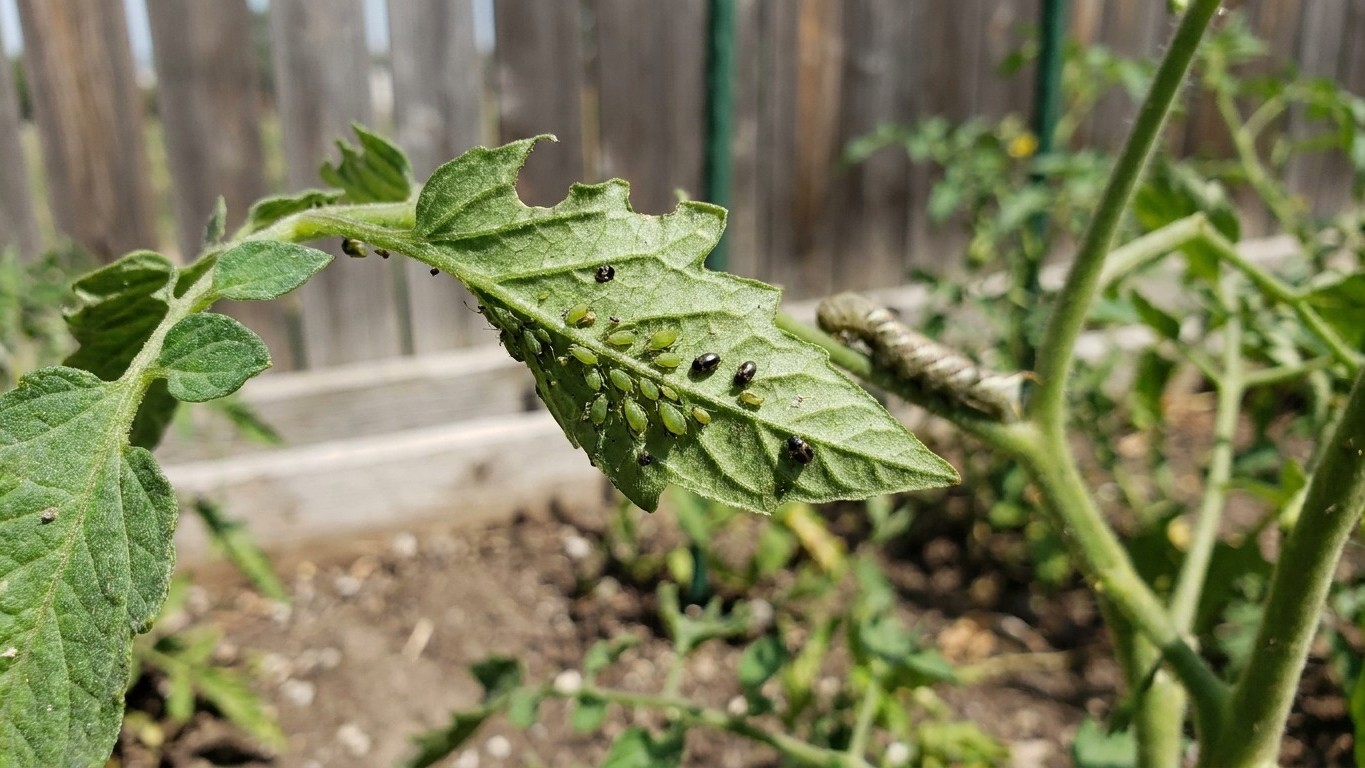

Montana’s tomato pests are a short list: cutworms and flea beetles at transplant, aphids and Colorado potato beetle through early summer, then tomato hornworm and two-spotted spider mite as the season heats up. NOAA’s 1991-2020 climate normals put Billings’ last spring freeze between April 29 and May 10, and pest pressure tracks that same warm-up. Check the soil surface around new transplants for a curled gray larva before blaming anything else on a seedling that fell over overnight.
What this comes down to in Montana

Montana’s short growing season cuts most tomato-pest lists down to size. The hornworms, whiteflies, and aphid swarms that dominate guides written for warmer, wetter states rarely build up here before frost ends the game. What actually shows up is smaller and sneakier: cutworms that sever a transplant at the soil line overnight, and flea beetles that riddle young leaves with pinholes within days of planting. Two pests, not twenty — and each one has a fix that actually fits a Montana garden.
Cutworms

Cutworms are the moth larvae nobody sees until a transplant is already down: plump gray or brown grubs, about an inch long, that curl into a tight C shape when the soil around them is disturbed. They feed at night and sever stems right at the soil line, so a seedling standing fine at dusk is lying flat by morning with the top untouched. A cardboard collar pushed an inch into the soil around each transplant stops them, since the larvae travel along the surface and cannot climb over it.
Flea Beetles

Flea beetles show up within days of setting transplants out: tiny, shiny black beetles about a sixteenth of an inch long that jump like fleas when a leaf is touched. They chew a scatter of pinhead-sized holes across young leaves, and a bad infestation can shred a transplant before it puts on any real growth. Row cover left on until the plants have a few true leaves keeps the beetles off during the only stage where they do real harm.
Aphids

Aphids are small, soft-bodied, pear-shaped insects, usually pale green though sometimes darker, that cluster on leaf undersides and along new stem tips. They do not chew holes. They suck sap, curl new growth, and leave a sticky residue that draws sooty mold. A strong jet of water knocks most colonies down, and ladybird beetles usually finish the job if nothing has already killed them off with a broad insecticide.
Colorado Potato Beetle

Colorado potato beetle is the striped one: adults carry ten black stripes down a rounded yellow-orange wing cover, and the larvae are humpbacked, orange-red, with two rows of black spots along the side. Both stages chew ragged holes from the leaf edge inward, and a heavy infestation can defoliate a plant in under a week. Hand-picking works if caught early, since the beetle moves slowly and its color makes it easy to spot against green foliage.
Tomato Hornworm

Tomato hornworm is hard to miss once it is full grown: a green caterpillar up to four inches long, with pale white diagonal stripes down each side and a curved black horn at the rear end. It feeds on foliage and green fruit, and because it matches leaf color so closely, gardeners usually find the damage, stripped stems and black droppings on the leaves below, before they find the caterpillar itself. Hand-picking at dusk, when the caterpillars are out feeding, is still the most reliable control in a home garden.
Two-Spotted Spider Mite

Two-spotted spider mite is the pest of hot, dry stretches late in the season: barely visible without a hand lens, pale yellow-green, with two dark spots on the back, and it spins fine webbing across leaf undersides and between stems. Leaves stippled with tiny pale dots and a dusty look underneath are the first sign, well before the webbing is obvious. Mites build up fastest on drought-stressed plants, so steady watering does more to prevent an outbreak than any spray applied after the fact.
Working it out for your own garden
The fastest way to identify a pest problem is to work backward from the damage, not forward from a list of names. Start with where the damage sits on the plant, what shape it takes, and how far into the season you are.
- Stem severed at the soil line on a young transplant: cutworms
- Small round holes scattered across young leaves: flea beetles
- Curled new growth, no holes, sticky residue on the leaf: aphids
- Ragged holes from the leaf edge inward, striped beetle visible: Colorado potato beetle
- Stripped stems, missing fruit, black droppings on leaves below: tomato hornworm
- Stippled, dusty leaf undersides in hot, dry weather: two-spotted spider mite
A severed stem at the soil line on a transplant set out during the mid-May to late-May window covered in Tomato Planting Dates in Montana: Counting Back From Your Frost Window points straight to cutworms, since nothing else attacks that low or that early. Scattered pinhole damage on the same young plant a week or two later is flea beetles rather than anything chewing from the leaf edge inward.
A stippled, dusty look on the underside of leaves during a hot, dry stretch in mid to late summer is spider mites, not disease. A hand lens, or even a hard squint, usually shows the tiny moving specks. The single most useful habit is checking leaf undersides, not just the tops, since aphids, mites, and hornworm frass all show there first. Pests do not discriminate by the cultivar planted, from a fast-finishing type through a full-season slicer covered in Tomato Varieties That Ripen in Time in Montana. What changes is how much of the season is left to recover once one gets ahead of you.
What changes across the state
The pest calendar above is built on Billings, and Billings sits in one of Montana’s milder river valleys. NOAA’s 1991-2020 climate normals put its last spring freeze at roughly April 29 to May 10 and its first fall freeze at October 1 to October 14, but the mountain valleys that make up much of the rest of the state can see frost in any month. That difference matters for pests because insect development runs on accumulated warmth, not the calendar date. A colder valley pushes every pest on this list back by weeks, not days.
Elevation does most of the work. A garden at higher elevation warms later in spring, so cutworms and flea beetles emerge later relative to a Billings calendar, and the whole pest sequence compresses into a shorter window before fall arrives. Distance from a large water body also matters. Valleys near larger lakes tend to hold more humidity into the evening, which favors aphids and slows the kind of hot, dry stress that lets spider mite populations explode. Drier, more exposed sites, common across the eastern plains, run hotter through midsummer and see mites show up earlier and heavier.
North-facing slopes and the shadier canyon bottoms scattered through the mountain west warm slowly and stay cooler through the pest season, which can delay Colorado potato beetle and hornworm activity by a meaningful stretch compared to an open, south-facing garden at the same elevation. None of this changes which six pests to watch for. It changes when each one becomes a real threat and how much overlap builds between two of them showing up at once.
The mistakes this state punishes

The most common mistake is treating pest damage as frost damage, or the reverse, and losing a week figuring out which one it actually was. A transplant flattened at the soil line after a warm spell is not a late freeze, since Billings’ last freeze runs April 29 to May 10 by NOAA’s normals and a warm stretch inside that window does not mean the risk has passed. It is almost always cutworms, and the fix is a stem collar at planting, not a row cover added later.
The second mistake is spraying broadly for aphids or mites early in the season, before natural predators have had a chance to establish. A broad insecticide applied in June kills the ladybird beetles and predatory mites that would otherwise keep both pests in check through the hot part of summer, and the pest population that returns weeks later often comes back worse with nothing left to eat it. Spot-treat or hand-pick before reaching for anything broader.
The third is skipping the daily check on new transplants during the two or three weeks right after the mid-May to late-May setting-out window that Tomato Planting Dates in Montana: Counting Back From Your Frost Window covers. Cutworms and flea beetles do the most damage in exactly that stretch, on plants too small to shrug off any loss, and a few minutes each morning catches both before they cost a whole transplant.
Checking this against your county
Everything above is measured at or near Billings, and Montana’s other valleys and elevations shift both the frost window and the pest calendar that follows it. Before assuming any of these sequences apply exactly to your own garden, check with your county’s extension office through the directory at Montana State University Extension, part of the USDA’s land-grant extension network. Your county agent has pest reports specific to your elevation, which is the only way to know if a pest on this list arrives earlier or later where you actually garden. The general framework for the crop, covered in growing tomatoes in Montana, is the right starting point if you have not already worked through it.
Common questions
Do cutworms come back after I put up a collar?
Not on the same plant, since the collar blocks the larva from reaching the stem, but new cutworms hatching in the soil nearby can still target an unprotected transplant a few feet away. Collars need to go around every transplant, not just the ones already hit.
Will hand-picking hornworms actually keep up with them?
Yes, in most home gardens only a few plants get one or two hornworms at a time, and a daily check at dusk catches them before real damage builds up. Leave any hornworm covered in small white cocoons alone, since a parasitic wasp has already laid eggs in it and it will stop feeding on its own within a day or two.
Do I need to buy ladybugs for aphids?
Usually not. Wild ladybird beetles and other predators tend to find an aphid colony on their own within a couple of weeks, and a strong spray of water in the meantime knocks the population down enough to prevent real damage. Store-bought ladybugs often fly off within a day or two of release anyway.
Can flea beetles kill a full-grown tomato plant?
Rarely. Flea beetles do most of their damage to seedlings and young transplants that have not yet built a full canopy, and a mature plant with several sets of true leaves usually outgrows the damage without any control needed. The exception is a heavy infestation hitting a transplant already stressed by cold soil or transplant shock.