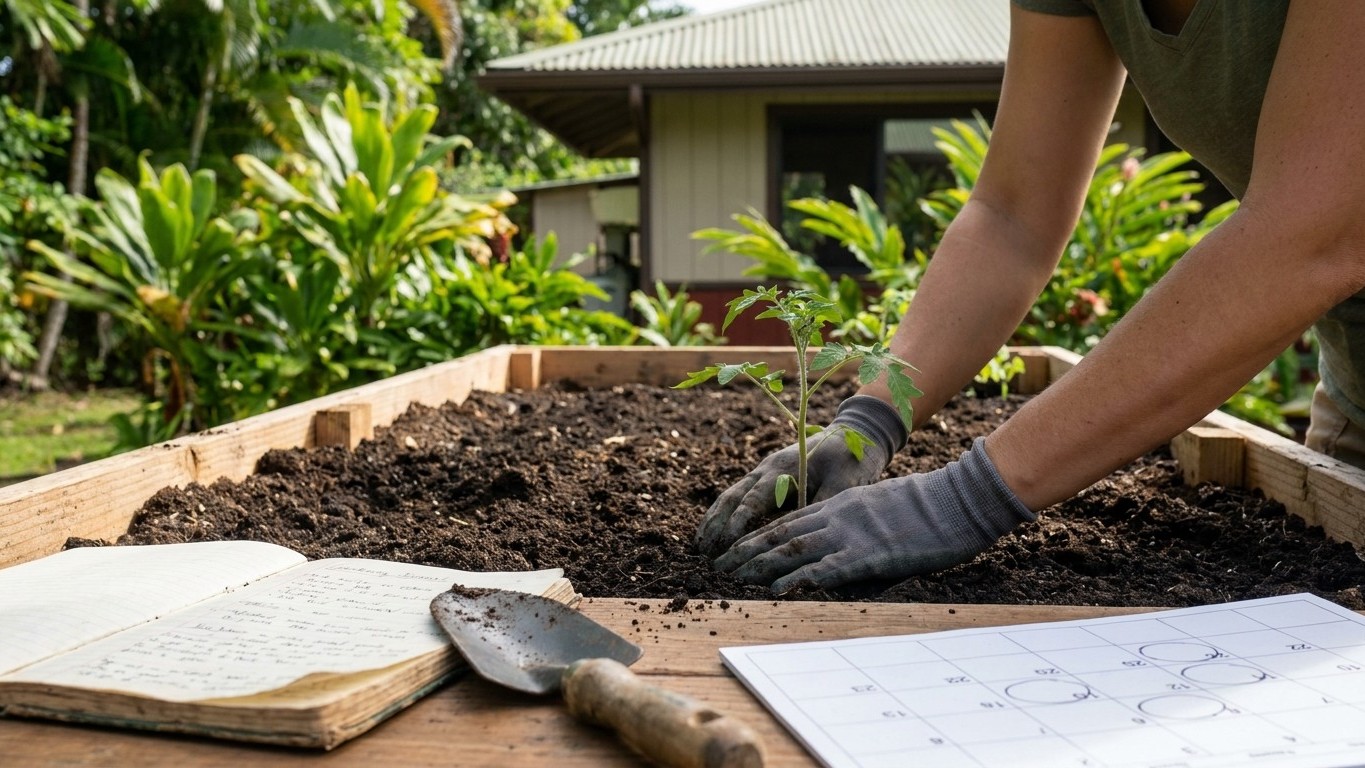

Mauna Kea’s summit frost is about as close as this state gets to the mainland’s killing freeze, and it sits thousands of feet above the nearest tomato patch. That single fact breaks the “count back six to eight weeks from last frost” rule before you can even use it. Down where you’re actually gardening, elevation slows growth the way cold normally would, and a badly timed wet spell can wipe out a planting the way frost never will. Your real calendar runs on those two things instead.
What this comes down to in Hawaii

NOAA’s data for the Honolulu station rules out a frost-based planting calendar for lowland Hawaii entirely. Frost exists in this state, but only on the summits of Mauna Kea, Mauna Loa and Haleakala, thousands of feet above any vegetable garden. For the tomato patch, that means the mainland method of “count back six to eight weeks from last frost” has nothing to attach to here.
What replaces it is a combination of elevation, rainfall and which side of an island you’re on. Elevation does the job frost normally does on the mainland: it slows growth and stretches out days to maturity even though it never kills the plant outright. Rainfall does the job a killing frost does in a different climate, in that a wet stretch at the wrong time can end a planting through fungal disease rather than cold. Windward slopes, the sides that face the prevailing trade winds, run wetter and slightly cooler than leeward slopes on the same island, and that split matters more to your planting date than any date on a calendar.
The practical result is that most of lowland Hawaii can support tomatoes across a much longer stretch of the year than a mainland grower is used to, but “longer” is not the same as “any time works equally well.” A full walkthrough of the crop itself, including soil prep and support, lives on growing tomatoes in Hawaii. The answer is: plant whenever your elevation and the local rain pattern allow steady growth, not on a fixed date drawn from a frost table that doesn’t apply to you.
Working it out for your own garden
Start with days to maturity, not a frost date
Since there is no frost date to subtract from, the arithmetic runs the other direction: pick a transplant window based on your elevation and rainfall pattern, then count forward using the cultivar’s published days to maturity to see when fruit should start ripening and whether that lands in a wetter or drier stretch. Catalogue day counts are measured from transplant, under close-to-ideal warmth, and they run a week or two longer once a plant is dealing with cooler nights at higher elevation.
Take Sun Gold, an indeterminate cherry tomato rated at 57 days from transplant. That’s roughly eight weeks. Near sea level, where nights stay warm year-round, a transplant set out in reasonably dry weather should be dropping ripe fruit close to that eight-week mark, and because it’s a short cultivar, a second planting can often follow in the same season if the first one finishes clean.
Now take Amish Paste, an indeterminate paste tomato rated at 85 days, roughly twelve weeks. At the same low elevation that number might hold, but push the same plant up into a cooler upland zone and those twelve weeks stretch further, because the cooler nights that come with elevation slow ripening below what the seed packet assumes. A longer cultivar sitting on the vine for extra weeks in an upland, wetter zone is also exposed to fungal pressure for longer, which is where a slow-finishing paste tomato can lose the race it would have won at sea level. For the fuller list of cultivars and which finish reliably at which elevation, see Tomato Varieties That Ripen in Time in Hawaii.
| Cultivar | Days to maturity | Habit | Where it fits |
|---|---|---|---|
| Sun Gold | 57 | Indeterminate | Fast enough for repeat plantings at any elevation |
| Sakura | 55 | Indeterminate | Shortest on this list, good for a quick first crop |
| Celebrity Plus | 78 | Determinate | Mid-length, holds up better where rain pressure is higher |
| Amish Paste | 85 | Indeterminate | Best kept to lower, drier elevations where extra weeks on the vine are safer |
What changes across the state
Hawaii is not one climate, and the USDA’s 2023 hardiness map reflects that by spreading the state across zones 9a through 13a, based on the 1991-2020 normals. Honolulu, sitting near sea level, falls toward the warm end of that range. Upland districts on the same island, and cooler pockets on Maui and the Big Island, sit toward the cool end, and that gap changes both how fast a tomato ripens and how long it stays healthy once it does.
Windward versus leeward exposure moves the numbers again, separately from elevation. A windward slope, facing into the trade winds, tends to run wetter, and extra moisture on the leaves is what drives early blight and other fungal problems in this state rather than cold ever entering the picture. A leeward slope on the same island can be drier and warmer at the same elevation, which often makes it the easier spot for a longer-season cultivar to finish clean.
None of this state-wide description should be read as a fixed number for your yard. The 9a-13a range and the Honolulu station data are reference points, not a substitute for what your own elevation and slope are doing. A garden five minutes up the road can sit in a different pocket of that range.
The mistakes this state punishes

The most common error is importing a mainland planting calendar wholesale, choosing a transplant date because “that’s when you plant tomatoes” rather than because the local elevation and rainfall support it. Without a frost date forcing a hard stop, it’s easy to assume the season is unlimited and to ignore the wet stretch that will do the same job a freeze does elsewhere.
The second mistake is picking a long-season cultivar for an upland plot without accounting for the extra weeks elevation adds to the catalogue figure. An 85-day tomato that would finish comfortably near the coast can end up needing considerably longer upslope, and every extra week on the vine in a wetter zone is another week of exposure to disease. Match the cultivar’s length to the elevation, not just to the flavor or size you want.
- Treating the whole state as one growing zone instead of checking elevation and slope for your specific plot
- Choosing a cultivar by days-to-maturity alone without weighing whether it also carries resistance to the fungal pressure common on wetter slopes
- Assuming a fast finish means no disease risk, when a slow-ripening fruit left on a damp vine is what actually invites problems
Watching for those pest and disease pressures matters as much as timing does. The rundown of what actually shows up on tomatoes in this state, and when, is on Tomato Pests in Hawaii: Which Ones Actually Show Up Here.
Checking this against your county
Everything above is a state-wide starting point built on one Honolulu-area station and one state-wide hardiness map. Your own county sits somewhere inside that range, and the only way to pin it down is to ask locally. The University of Hawaii’s College of Tropical Agriculture and Human Resources runs the state’s extension service, and its office is the place to check for guidance specific to your island and elevation, reachable through CTAHR’s extension directory. A county extension agent can tell you what a state-wide figure never will: how your particular slope and rainfall pattern actually behave.
Some gardeners also time this by the Moon: when to plant tomatoes by the moon, as almanac tradition rather than fact.
Common questions
Do I need to protect my tomatoes from frost in Hawaii?
No. NOAA’s climate data for the Honolulu station show no measurable freeze risk in inhabited areas, and that holds true across the state’s lowland gardens. Frost only occurs on the high summits, far above where tomatoes are grown.
Can I plant tomatoes in Hawaii any time of year?
Close to it, at low elevation, but “any time” still runs into the local rainy stretch, which drives fungal disease the way cold drives frost damage elsewhere. Check with your county extension office for the rainfall pattern specific to your side of the island before settling on a date.
Why is my tomato taking longer to ripen than the seed packet says?
Elevation is the usual reason. Catalogue days-to-maturity are counted under warm, close-to-ideal conditions, and cooler nights at higher elevation stretch that timeline, sometimes by a couple of weeks or more.
Does it matter which side of the island I garden on?
Yes. Windward slopes tend to run wetter, which raises disease pressure, while leeward slopes at the same elevation are usually drier and give a longer-season cultivar an easier path to finishing clean.