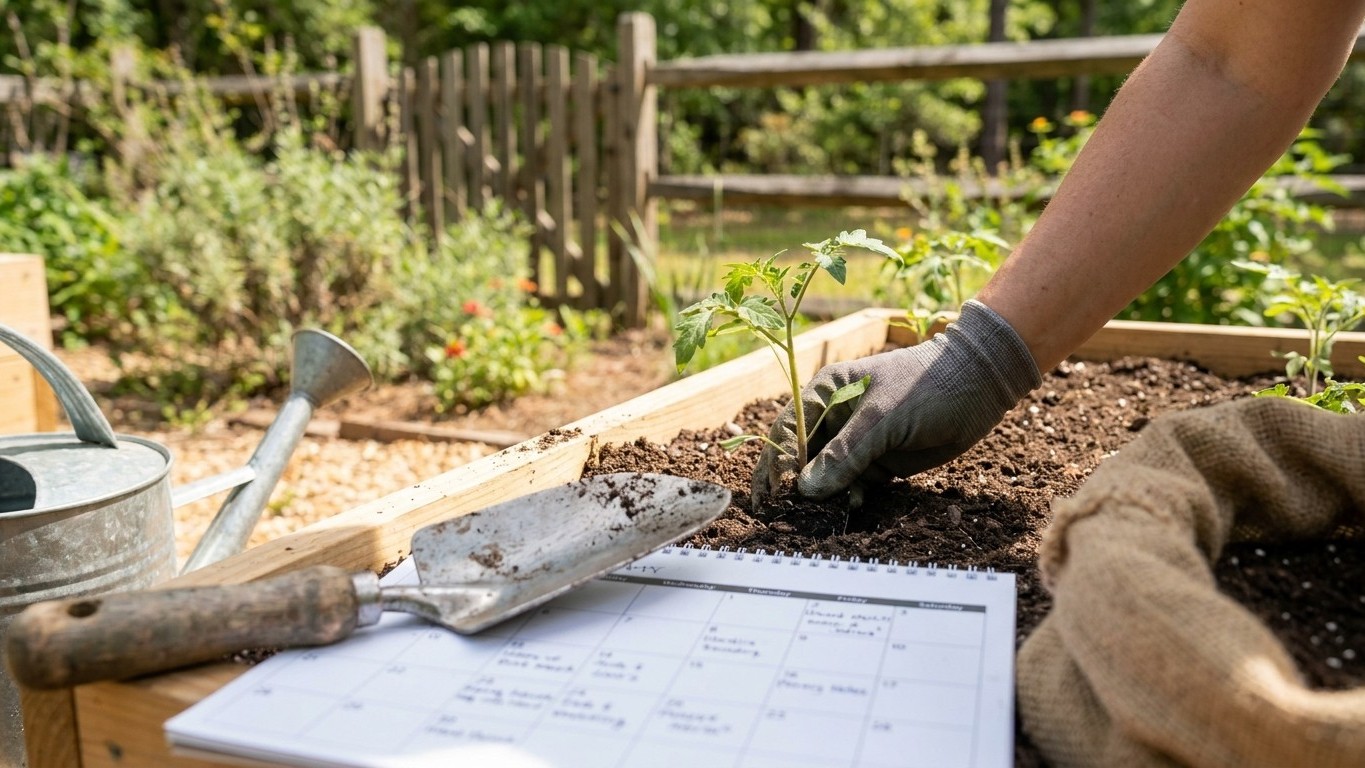

South Carolina’s tomato planting window runs off the last spring frost, which NOAA’s 1991-2020 climate normals put at February 28 to March 17 for the Charleston airport station. That’s a two-and-a-half-week range, not a date, and it shifts earlier or later depending on where in the state you garden. The one thing to do before you transplant: pull up NOAA’s freeze probability data for the station nearest you, not just Charleston, and use that range as your starting point.
What this comes down to in South Carolina

Charleston’s frost window, February 28 to March 17, gets quoted across the state as if it were South Carolina’s planting date. It isn’t. That range belongs to the coast, where zone 9a winters barely bite, while the Upstate sits in 7a and works on a different clock entirely. Copying Charleston’s dates into an Upstate garden means transplanting into cold soil weeks too early. The number worth carrying with you instead is the one printed on your seed packet — days to maturity — because that figure travels intact from Charleston to Greenville, even when the calendar dates don’t.
None of that means one date works for the whole state. Charleston sits at the mild end of South Carolina’s range, and the USDA zone spread from 7a to 9a alone tells you the Upstate and the coastal plain are not the same garden. Treat the Charleston figures as an anchor point you adjust from, not as your planting calendar. The days-to-maturity number printed on any seed packet or in any catalog is the same in every state because it’s a fixed catalog fact, not a local one.
Working it out for your own garden
The method is simple arithmetic, but it only works if you do it with ranges instead of single dates. Start from NOAA’s frost window for your reference station, add or subtract the days-to-maturity figure for the cultivar you’re growing, and you get another range, not a day. Rounding that range down to one date is where most planting calendars go wrong, because it pretends a level of precision the weather data doesn’t actually have.
Spring transplant math
Take ‘Celebrity‘, a widely grown determinate slicer that catalogs list at around 70 days to maturity from transplant. Set it out anywhere inside Charleston’s NOAA-derived window of February 28 to March 17, and counting 70 days forward from each end of that window lands first ripe fruit somewhere between early May and the back half of May. Measured against the first fall frost window of November 20 to December 5, that leaves several months of harvest before cold ends the season. This is why a mid-season slicer is such an easy fit for the Charleston area, and why Tomato Varieties That Ripen in Time in South Carolina is worth a look before you commit to a longer-season pick.
Fall crop math
The arithmetic changes once you’re planning a second, fall crop instead of the spring one. Take ‘Brandywine‘, a long-season indeterminate heirloom that catalogs list at roughly 90 to 100 days to maturity. If you transplant a fall round of it in September, as some gardeners try, 90 to 100 days out lands maturity somewhere between late November and mid-December, which runs right into or past the November 20 to December 5 first fall frost window from NOAA. That’s the line: a short or mid-season cultivar has margin to spare on a fall planting, but a 90-to-100-day heirloom set out too late does not, and the fruit may not finish ripening before the first hard freeze ends the plant.
What changes across the state
South Carolina runs from sea-level barrier islands to Blue Ridge foothills, and that elevation change is the single biggest reason the Charleston figures don’t travel. The USDA hardiness map spans zones 7a to 9a across the state, and that four-zone spread reflects real differences in how early the ground warms and how late the first hard freeze arrives.
The coast itself is not uniform either. NOAA’s caution on the Charleston airport data specifically notes that peninsular Charleston, surrounded by tidal water, runs milder than the airport station a few miles inland, so even gardeners in the same metro area see different results. Distance from the coast matters generally, since large bodies of water buffer temperature swings, and low-lying river bottoms tend to collect cold air on clear nights in a way that hillside or upland ground does not.
The Upstate is the other end of the spread. NOAA’s data notes that Upstate South Carolina runs several weeks tighter at both ends of the frost-free season compared to the coastal station, meaning a later last frost in spring and an earlier first frost in fall. That tighter window is exactly why a planting method that counts backward from your own local frost data matters more than a single statewide date ever could. A gardener in the foothills working from Charleston’s numbers alone would risk transplanting weeks too early.
The mistakes this state punishes

The most common error in South Carolina is transplanting into cold soil after a warm early stretch. A run of warm days in late February can feel like spring has arrived, but NOAA’s normals show freeze risk continuing into mid-March at the Charleston reference station, and soil temperature lags air temperature by days. Tomatoes set into cold, wet soil stall and often never fully recover their growth rate, even if they survive.
The second is picking a long-season cultivar without checking it against the actual frost window available. As the fall crop arithmetic above shows, a 90-to-100-day heirloom has very little room to spare once you’re past the spring planting window, and choosing one for a fall planting without doing that math is a common way to lose a crop to the first freeze.
The third is missing the point in the season when a pest predictably shows up and treating too late to matter. Timing your scouting to the parts of the season when a given insect actually appears matters more than reacting after the damage is visible; Tomato Pests in South Carolina: Which Ones Actually Show Up Here lays out that timing pest by pest. Skipping that step and only checking plants once a problem is obvious tends to cost a much bigger share of the harvest than catching it early would have.
Checking this against your county
A single reference station near Charleston is a starting point, not an instruction for your own yard. Your county extension office can tell you how local conditions differ from that reference point, and Clemson Cooperative Extension, South Carolina’s land-grant extension service, publishes tomato-specific guidance you can check your plan against before you buy transplants. Start at Clemson Extension and search for tomato production guidance, or call your county office directly and ask what they see locally for both frost timing and pest pressure.
Common questions
Can I just plant on the same date every year?
No, because the frost window NOAA publishes is a range built from thirty years of data, and any single year can fall early, late, or right in the middle of it. Watch the extended forecast for your own area as the range approaches rather than marking one calendar date and transplanting regardless of conditions.
What if I already put my transplants out and a late frost is coming?
Cover them. A sheet, frost cloth, or overturned bucket held off the foliage will usually get young transplants through a light, short freeze, though nothing guarantees survival in a hard freeze. If you’re inside NOAA’s stated frost window for your area, keep some form of cover on hand until the range has fully passed.
Does the days-to-maturity number on the seed packet include the time to grow the seedling?
No, catalog days-to-maturity is counted from the transplant date, not from seed. If you’re starting seed indoors yourself, add the seedling’s growing time on top of the maturity figure before you count forward to an expected harvest date.
Is it too late to plant tomatoes if I missed the spring window?
Not necessarily, since South Carolina’s frost-free season is long enough at the coast to still get a harvest from many cultivars planted well after the earliest safe date. Check a shorter-season cultivar’s days-to-maturity against your local first fall frost date before you decide, using the same backward-counting method covered above.
The Moon calendar is a separate, older custom: see when to plant tomatoes by the moon, written as tradition rather than fact.