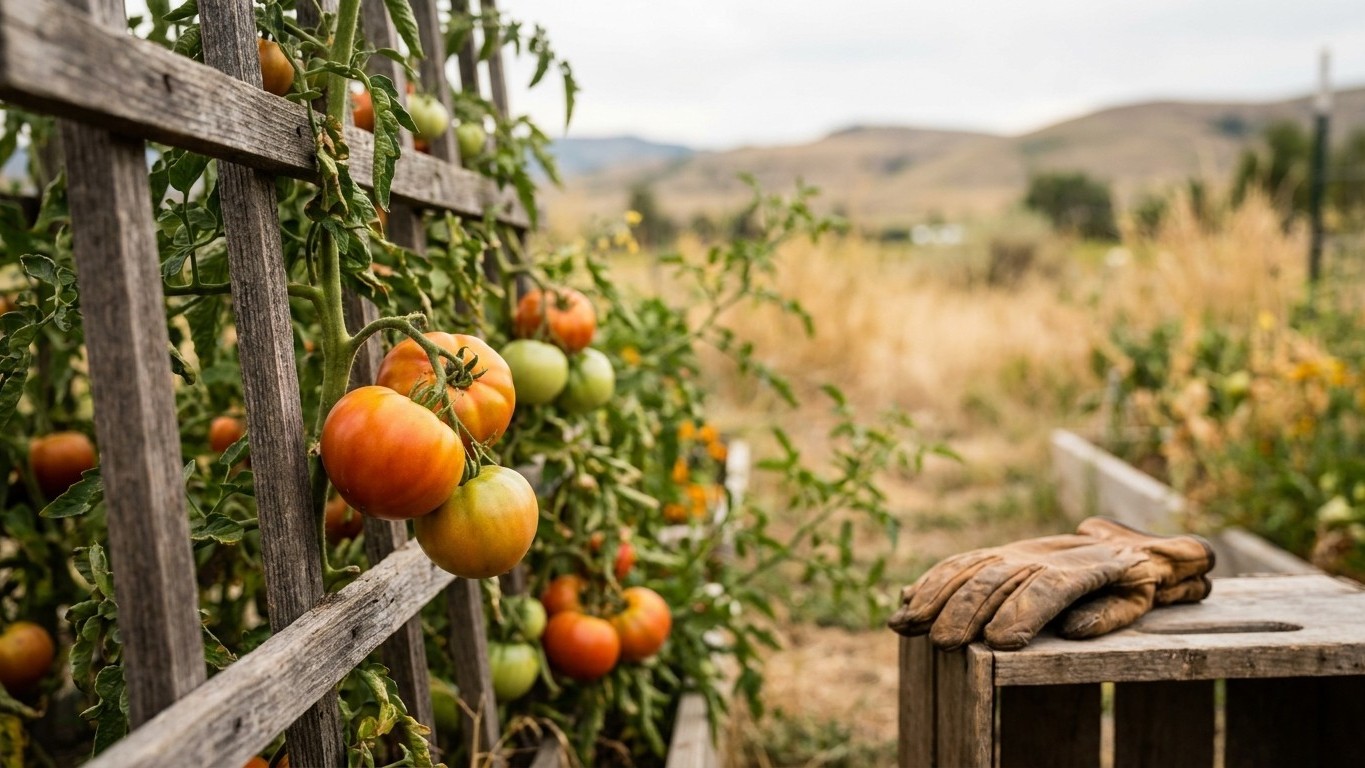

Wyoming tomatoes have to finish inside a frost-free window that runs, near Cheyenne, from a last spring freeze of May 7 to May 18 to a first fall freeze of September 24 to October 5, according to NOAA’s 1991-2020 climate normals. That gives roughly 130 frost-free days at that elevation, and less the higher you go. Check the days-to-maturity number on the seed packet against that window before you order, because in this state that single number decides more than flavor or size ever will.
What this comes down to in Wyoming

Days to maturity is the number that decides everything here. Set transplants out late May to early June, once soil near Cheyenne has cleared the last frost risk, and you’re already spending most of a short season before the first tomato even forms. A Sakura at 55 days carries roughly 60 days of margin into fall’s first freeze; a Cherokee Purple at 72 carries barely 43. That gap is the whole story — smaller numbers aren’t a preference here, they’re the difference between a full harvest and green tomatoes on the vine when frost hits.
The cultivars below are ordered from shortest to longest days to maturity so you can see exactly where the line falls for your own garden. All of them are set out at the same point in the calendar, late May to early June, because that is the stretch when soil near Cheyenne has warmed past the danger of a late freeze without giving up too much of the growing season waiting for it. The shorter the days-to-maturity number, the more margin carries into an early fall freeze, and in a state this short on season, that margin is worth more than almost any other trait on the seed packet.
| Variety | Days to maturity | Type | Margin before frost* |
|---|---|---|---|
| Sakura | 55 | Cherry, indeterminate | about 60 days |
| Sun Gold | 57 | Cherry, indeterminate | about 58 days |
| Juliet | 60 | Grape, indeterminate | about 55 days |
| Amalfi | 68 | Paste, determinate | about 47 days |
| Cherokee Purple | 72 | Slicer, indeterminate | about 43 days |
| Big Beef Plus | 72 | Slicer, indeterminate | about 43 days |
| Tiren | 75 | Paste, indeterminate | about 40 days |
| San Marzano II | 78 | Paste, indeterminate | about 37 days |
*Margin measured against Cheyenne’s first fall frost window of September 24 to October 5, from NOAA’s 1991-2020 climate normals. Other parts of the state will see less margin.
Sakura

Sakura needs about 55 days from transplant to first ripe fruit, producing small, glossy red cherry tomatoes good for snacking and salads. It carries resistance to nematodes, tomato mosaic virus and both common races of fusarium wilt, useful in soil that has grown tomatoes before. Set out late May to early June, it ripens by late July with roughly 60 days of margin before Cheyenne’s typical first fall frost, the widest cushion of any variety on this list.
Sun Gold

Sun Gold matures in about 57 days from transplant and produces small, golden-orange cherry tomatoes sweeter than most red cherry types. It resists tobacco mosaic virus and fusarium wilt race 1. Transplanted in the same late May to early June window, it ripens by late July with about 58 days of margin left before frost, close enough to Sakura’s timing that the choice between them comes down to fruit color and flavor rather than season length.
Juliet

Juliet is a grape-type tomato, its small oblong red fruit holding firm on the vine longer than a round cherry will, and it matures in about 60 days from transplant. It resists both late blight and early blight, two diseases that turn up in wet years. Set out at the standard late May to early June date, it ripens late July with about 55 days of margin before the first fall frost.
Amalfi

Amalfi is a determinate plant, more compact than the others on this list, bearing oblong red paste tomatoes suited to sauce rather than slicing. It matures in about 68 days from transplant and carries intermediate resistance to nematodes, late blight and early blight. Set out late May to early June, it ripens in early August with about 47 days of margin before frost, a reasonable pick if you want a paste tomato without waiting out San Marzano II’s full season.
Cherokee Purple

Cherokee Purple is an heirloom slicer with dusky pink-purple skin and darker shoulders, grown for flavor rather than yield, and it takes about 72 days from transplant to first ripe fruit. It carries no listed disease resistance, so it depends more than the others here on crop rotation and clean soil. Set out late May to early June, it ripens in mid August with about 43 days of margin before Cheyenne’s first fall frost, workable but with less room for a cool, slow summer than the shorter-season picks above it.
Big Beef Plus

Big Beef Plus is a large red beefsteak tomato bred for slicing, maturing in about 72 days from transplant, the same timeline as Cherokee Purple but with a disease-resistance package that covers nematodes, gray leaf spot and tomato mosaic virus. That resistance makes it the steadier choice where soil-borne disease has caused problems in past seasons. It ripens in mid August with about 43 days of margin before frost.
Tiren
Tiren is a plum-shaped paste tomato, glossy and deep red, built along San Marzano lines, and it needs about 75 days from transplant to ripen. It resists verticillium wilt, tomato mosaic virus and fusarium wilt race 1. Set out late May to early June, it ripens mid August with about 40 days of margin before frost, enough in most years but worth watching closely in a cool one.
San Marzano II
San Marzano II is the classic canning paste tomato, long and narrow with a pointed tip, and it takes about 78 days from transplant, the longest of any variety on this list. It carries no listed disease resistance and ripens in mid August, leaving about 37 days of margin before Cheyenne’s first fall frost window of September 24 to October 5. That margin holds in an average year at Cheyenne’s elevation, but it is the one variety here where a cold, late spring or an early frost at higher ground could cut the harvest short, so gardeners further from the reference station, or higher up, should treat it as the outer edge of what the season allows.
Working it out for your own garden
The dates above come from working forward across the frost window, and the same math applies to any variety not listed here. Start with NOAA’s last spring freeze range for Cheyenne, May 7 to May 18, and add the week or two most gardeners wait for the soil to warm before setting out transplants. That lands in the late May to early June window used throughout this page. From there, add the variety’s days to maturity, a figure counted from transplant, not from seed, and always described by the catalog as approximate since it shifts by a week or so with a hot or cool summer.
A cultivar that finishes with room to spare
Take Sakura as the worked example. Transplant lands in late May to early June, and 55 days from the start of that range puts first ripe fruit in the second half of July, matching the catalog’s own estimate. Measured against Cheyenne’s first fall frost window of September 24 to October 5, from NOAA’s 1991-2020 normals, that leaves roughly 60 days of slack. Even a slow, cool summer that pushes ripening back two or three weeks still finishes well ahead of frost.
A cultivar that does not
Now run the same math on a hypothetical 110-day heirloom slicer, a days-to-maturity figure common among the biggest beefsteak types in most catalogs. Transplanted at the same late May to early June date, it would not ripen until mid to late September, landing right inside Cheyenne’s typical first fall frost window instead of well ahead of it. Any variety whose calculated ripening date overlaps the frost window itself, rather than sitting weeks before it, is too long a season for this state unless you plan to run row cover or another season-extension method into the fall. For the planting-date arithmetic this section leans on, see Tomato Planting Dates in Wyoming: Counting Back From Your Frost Window, which works through the spring side of the calendar in more detail than fits here.
What changes across the state
Cheyenne sits at a high elevation, and the frost dates above come from a single NOAA reporting station there, so they describe the southeastern edge of the state better than they describe the Bighorn Basin or the mountain valleys further west. Elevation is the biggest single factor: gardens sitting a couple thousand feet higher than Cheyenne typically see frost linger later into spring and arrive earlier in fall, shrinking the frost-free window from both ends, while lower valleys along the state’s eastern and southern edges tend to run a bit milder than the Cheyenne normals suggest.
Distance from Cheyenne matters almost as much as elevation. The USDA’s Plant Hardiness Zone Map puts the state anywhere from zone 3a in the coldest mountain valleys to zone 6a in the warmest low-elevation pockets, a wider spread than most states carry, which means a variety with 60 days of margin at Cheyenne’s elevation could have half that, or less, in a colder pocket of the state. North-facing slopes, low spots where cold air pools overnight, and anywhere well above Cheyenne’s elevation should all be treated as running colder and shorter-season, sometimes by several weeks on each end of the season.
None of this means the cultivar list above stops applying. It means the margin numbers shrink the further a garden sits from Cheyenne’s elevation and latitude, and a gardener in a colder pocket of the state should lean toward the shorter end of that list, Sakura, Sun Gold or Juliet, rather than assuming San Marzano II’s 37 days of margin holds everywhere the way it does near the reference station.
The mistakes this state punishes

The most common mistake is planting into cold soil right after a warm spell, which happens often enough in Wyoming that it deserves its own warning. A string of warm days in May does not mean the frost risk has passed, since NOAA’s last spring freeze window for Cheyenne runs all the way to May 18, and higher elevations run later still. Wait for the calendar, not the thermometer, and hold transplants back until the standard late May to early June window even if the weather turns warm early.
The second mistake is choosing a long-season variety because it tastes better or yields more, without checking whether the season allows it. A 78-day paste tomato like San Marzano II works at Cheyenne’s elevation with room to spare, but stack a colder pocket of the state on top of a cool summer and that margin can vanish. If a garden already runs colder than the state average, treat the longer end of the list as an experiment, not a certainty, and keep at least one shorter-season variety in the ground as a backup.
- Cold soil after a warm spell: wait for the late May to early June window regardless of the weather
- A long-season variety in a short-season yard: pair it with a shorter-season backup
- Pest timing borrowed from another state: track this state’s own seasonal pattern instead
The third mistake is timing pest control to a calendar borrowed from somewhere else, which does not work because Wyoming’s pests arrive on their own schedule tied to this state’s own temperatures. Knowing which pests actually show up here, and when, matters as much as the variety planted. That is covered in full in Tomato Pests in Wyoming: Which Ones Actually Show Up Here, but the short version is that missing the early window on an aphid or flea beetle problem costs more time here than it would in a state with a longer season to recover in.
Checking this against your county
Every number on this page is anchored to one NOAA weather station near Cheyenne, and Wyoming’s elevation and terrain change enough from county to county that these figures are a starting point, not a final answer for a given yard. The University of Wyoming Extension, the state’s land-grant extension service, keeps county-level guidance and can compare local frost dates and elevation against the Cheyenne normals used throughout this page. Check with your county extension office before locking in a planting date, especially above 6,000 feet or in a valley known for pooling cold air, and use the general guide to growing tomatoes in Wyoming for season-long care once the varieties are picked.
Common questions
Can I start seeds indoors earlier to grow a longer-season variety here?
Starting seed indoors earlier does not move the transplant date, which is set by soil temperature and frost risk, not by seed age. A transplant held indoors too long past its normal size often stalls for a week or two after it goes in the ground, which erases most of whatever head start it seemed to have.
What if my county’s frost dates are different from Cheyenne’s?
They probably are, since Cheyenne’s figures come from one reporting station and elevation shifts the frost dates a lot across Wyoming. Call your county extension office for the local range, then run the same days-to-maturity math against that range instead of the Cheyenne one.
Do cherry tomatoes ripen faster just because the fruit is smaller?
Not really, it is mostly genetics rather than fruit size. Some paste and slicer types on this list mature faster than others of the same fruit size, so the days-to-maturity number on the packet is a better guide than fruit type alone.
Is it worth trying a variety that isn’t on this list?
It can be, as long as the days-to-maturity number on the seed packet gets run through the same math shown above against Cheyenne’s frost window, or your own county’s numbers if they differ. A variety with a days-to-maturity figure well under 70 has the best odds almost anywhere in the state.