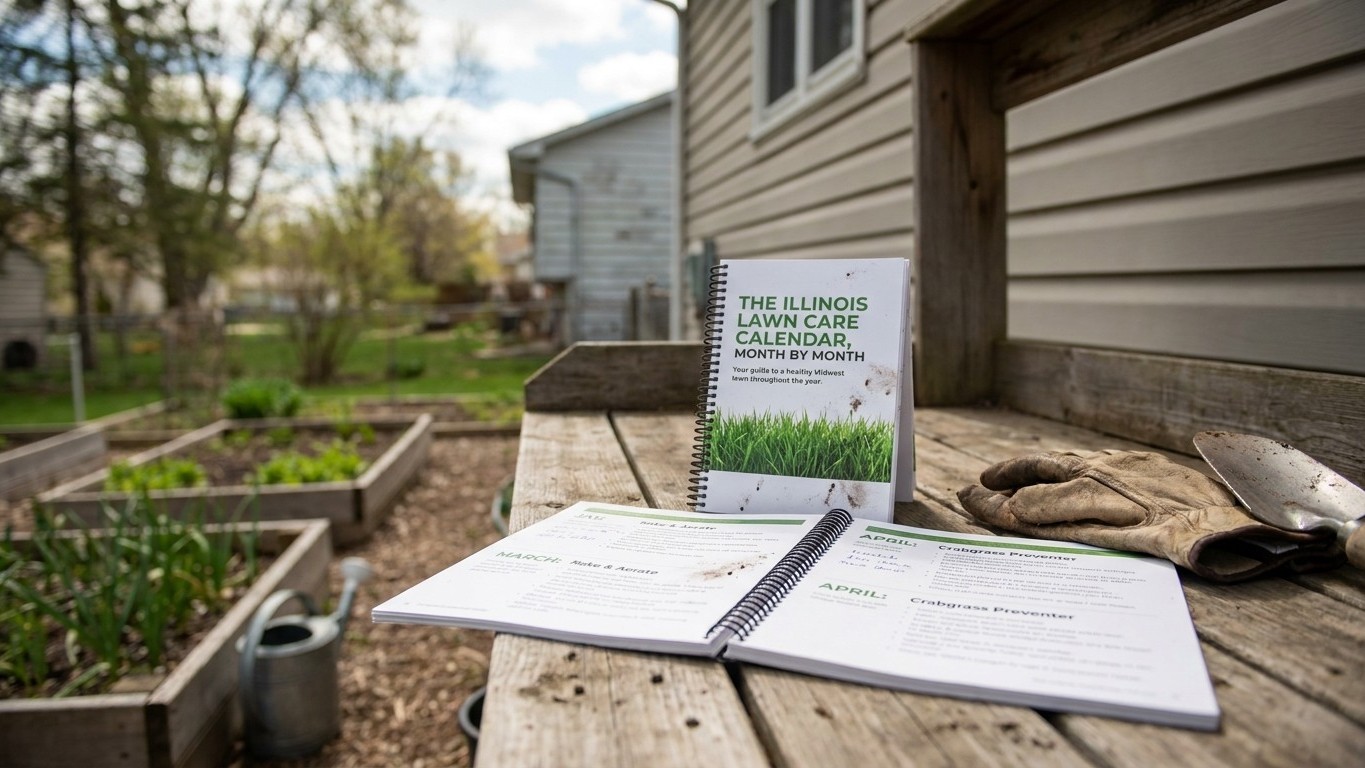

Illinois grows a cool-season lawn, full stop. NOAA’s 1991-2020 climate normals put the first fall freeze near Chicago at October 24 to November 3, and that window anchors the whole calendar, from the last safe seeding date to the final mow of the year. Check your own county’s frost record before scheduling any fall task, since the Chicago figure comes from one weather station and the rest of the state runs earlier or later than that date.
The short answer for Illinois
What can you actually do to your lawn right now, this month, in Illinois? It depends on the season, but the whole year runs backward from one date: the first fall freeze, which lands somewhere between October 24 and November 3 depending on where in the state you’re standing. Go find your county’s frost date before you plan a single seeding day, feeding, or mow — everything else in this calendar, spring cleanup through winter dormancy, gets timed off that number.
| Grass | Strength | Trade-off |
|---|---|---|
| Tall Fescue | Best drought and light-shade tolerance of the five | Coarser blade texture than the others |
| Kentucky Bluegrass | Spreads by rhizome and self-repairs bare patches | Needs more water once established |
| Perennial Ryegrass | Germinates fastest, good for quick patch repair | Rarely carries a whole lawn on its own |
| Fine Fescues | Tolerates shade a bluegrass lawn cannot handle | Lower wear tolerance under foot traffic |
| Rough Bluegrass | Handles shade and steady moisture well | Struggles in open sun or dry spots |
Which of the five you actually have changes the details that follow, including mowing height, feeding month, and how the lawn behaves in a dry August. If you have not settled on a species yet, The Best Grass Seed for Illinois Lawns walks through which one fits a given yard before you build a calendar around it.
Everything below assumes you already know which species you are working with. What stays constant across all five is the backstop date: the first fall freeze near Chicago, October 24 to November 3 per NOAA’s 1991-2020 normals, is the point every fall task in this calendar works backward from.
Working through the year

Clemson Cooperative Extension’s Tall Fescue Maintenance Calendar (HGIC 1219) lays out the tall fescue year task by task, and because tall fescue is one of the five cool-season species that hold up in Illinois, the sequence of tasks transfers even though the calendar itself was written for South Carolina timing. The principle worth borrowing is the order of operations: crabgrass control before the soil warms, the lightest feeding of the year in spring, the heaviest feeding and the only real seeding window in fall, and a mowing height that rises rather than falls once summer heat sets in. The actual dates in HGIC 1219 will shift earlier here than they run in the Carolina piedmont, so treat it as a sequence to follow, not a set of Illinois dates to copy directly.
Spring
Spring is for cleanup and restraint, not the year’s main feeding. Rake out matted debris once growth resumes, get a pre-emergent down before soil temperatures push crabgrass to germinate, and mow at whatever height suits the species you have rather than scalping it low for a tidy look. A single light nitrogen feeding early in spring is enough for tall fescue and bluegrass alike, following the sequence in HGIC 1219. Spring is also the wrong season to seed a bare patch of cool-season grass. Seedlings sown now run straight into summer heat before they have built a root system deep enough to survive it.
Summer
Summer is a holding pattern. Raise the mower a notch, cut nitrogen back almost entirely, and water for depth rather than frequency so roots follow moisture down instead of staying shallow near the surface. A cool-season lawn that browns during a dry Illinois summer is not dead. It has gone dormant to protect its crown, and it greens back up once temperatures drop and rain returns. Mowing that lawn short while it is under drought stress, or forcing green color with a heavy feeding during a heat wave, does more damage than the brown ever did.
Fall
Fall carries the workload the other three seasons skipped. This is the season for the heaviest nitrogen application of the year, for core aeration once growth resumes with cooler weather, and for the only reliable seeding window a cool-season lawn gets. Seed and feed early enough that new grass has real growing weeks ahead of it before the ground goes dormant. Near Chicago, NOAA’s 1991-2020 normals put the first fall freeze at October 24 to November 3, so work fall tasks backward from whichever end of that window your county tends toward, and confirm the date locally before committing to a seeding day.
Winter
Once hard frost arrives, cool-season grass stops growing above ground and mowing stops with it. There is little to do beyond keeping the lawn clear of heavy leaf cover that can mat and smother turf under snow, and staying off frozen or saturated ground, which compacts easily and shows the damage as thin or bare patches the following spring.
What changes across Illinois
The Chicago figures used above come from a single NOAA weather station, and Illinois runs roughly 380 miles from its northern border to Cairo at the southern tip, so no single frost date describes the whole state. The Chicago-area first fall freeze of October 24 to November 3 is a reference point for the northeastern counties around Cook, DuPage and Lake, not a state-wide deadline.
Lake Michigan pushes the counties nearest its shore later on both ends of the season than land-locked counties at the same latitude, because open water holds heat into fall and delays the first freeze along the immediate shoreline. Move inland even a county or two and that effect fades quickly, so a suburb twenty miles from the water can freeze noticeably earlier than the lakefront itself.
Southern Illinois, around Cairo and the counties bordering Kentucky, sits far enough south that its growing season likely runs longer on both ends than the Chicago figure suggests. A lawn in that part of the state can usually mow later into fall and start earlier in spring, though it also carries more summer heat stress on cool-season turf, since the species tolerances that make tall fescue and bluegrass workable in Illinois get pushed harder the farther south you go.
Illinois has relatively little elevation change compared to a mountain state, so altitude is not the driver of local variation here that it would be in Colorado or western North Carolina. Latitude and the lake are. Whatever county you garden in, confirm against your own county’s frost record before locking in a fall seeding date built on the Chicago figure.
The mistakes this climate punishes
Seeding cool-season grass in late spring or early summer is the most common mistake in this climate, and it fails almost every time. Seed put down after the soil has already warmed germinates fine, but the young grass hits summer heat and drought stress before its roots go deep enough to handle it, and most of the stand dies out by August. The damage shows up as thin, weedy turf by mid-summer, not as an obvious failure at planting.
Feeding heavily in late spring or early summer is the second version of the same error. A cool-season lawn pushed with nitrogen right before hot weather puts on soft, fast top growth with no reserves to handle heat or drought, and it becomes more prone to fungal disease in humid Illinois summers. The heaviest feeding of the year belongs in fall, when the grass is building roots and storing energy rather than racing to put out blades.
Cutting a cool-season lawn short going into summer is the third. Scalping tall fescue or bluegrass right before a heat wave removes the leaf tissue the plant needs to shade its own crown and soil, and a lawn that looked tidy in June turns patchy and brown by July, then struggles to recover until temperatures drop in fall. Raise the mower rather than lower it once real heat arrives.
Planting or feeding for a warm-season species is a mistake specific to a cool-season state. Grasses like bermudagrass and zoysia are built to grow hard through summer heat and go dormant at the first frost, which is the opposite rhythm of Fine Fescues, Kentucky Bluegrass, Perennial Ryegrass, Rough Bluegrass and Tall Fescue. A warm-season lawn seeded or heavily fed here spends its short growing window fighting a climate that shuts it down early, and its dormancy through the long Illinois winter looks like dead turf for months, not the brief brown patch a cool-season lawn shows under summer drought.
None of these mistakes show up the day they happen. The seeding failure shows in August, the scalping damage in July, and the wrong-season feeding shows as disease weeks after the fertilizer went down. That delay is exactly what makes each one easy to repeat the following year.
Checking this against your county
Everything above is built from Chicago-area and national figures, and a lawn in Rockford, Springfield or Cairo runs on a different schedule than the Chicago data suggests. Illinois Extension maintains county offices across the state and is the source to check before locking in a mowing schedule, a fertilizing date or a fall seeding window for your specific location. If you have not yet worked through the basics of building a lawn in this climate, Illinois Lawn Care covers the ground this calendar assumes you have already walked.
A county office can also tell you which of the five recommended species performs best on your particular soil, since drainage and soil pH shift species performance more than the statewide calendar does on its own.
Common questions
Can I seed my lawn in spring in Illinois?
You can, but fall is the more reliable window for the five cool-season species recommended for Illinois: Fine Fescues, Kentucky Bluegrass, Perennial Ryegrass, Rough Bluegrass and Tall Fescue. Spring-seeded grass has to survive a full summer of heat and drought stress on a root system that is only weeks old, and a lot of it thins out or dies by August.
Why is my lawn brown in July even though I’m watering it?
Cool-season turf goes dormant under heat and drought stress even with some irrigation, and browning is the plant protecting its crown rather than dying outright. Watering deeply but less often, and raising the mower height, helps it hold color longer, but some summer browning is normal for this climate and the lawn typically recovers once temperatures drop in fall.
Should I plant a warm-season grass like zoysia in Illinois?
Zoysia and other warm-season grasses are not on the list Clemson Cooperative Extension and Penn State Extension recommend for a cool-season climate like Illinois’s, and they go dormant and brown for most of the long Illinois winter rather than the brief summer browning a cool-season lawn shows. Stick with Fine Fescues, Kentucky Bluegrass, Perennial Ryegrass, Rough Bluegrass or Tall Fescue instead.
How do I know the frost dates for my specific county?
The October 24 to November 3 window cited in this calendar comes from NOAA’s 1991-2020 normals for the Chicago area specifically, and other parts of Illinois run earlier or later depending on latitude and distance from Lake Michigan. Illinois Extension’s county offices, and NOAA’s own station data for a location closer to you, are the places to confirm a local figure before planning fall work around it.