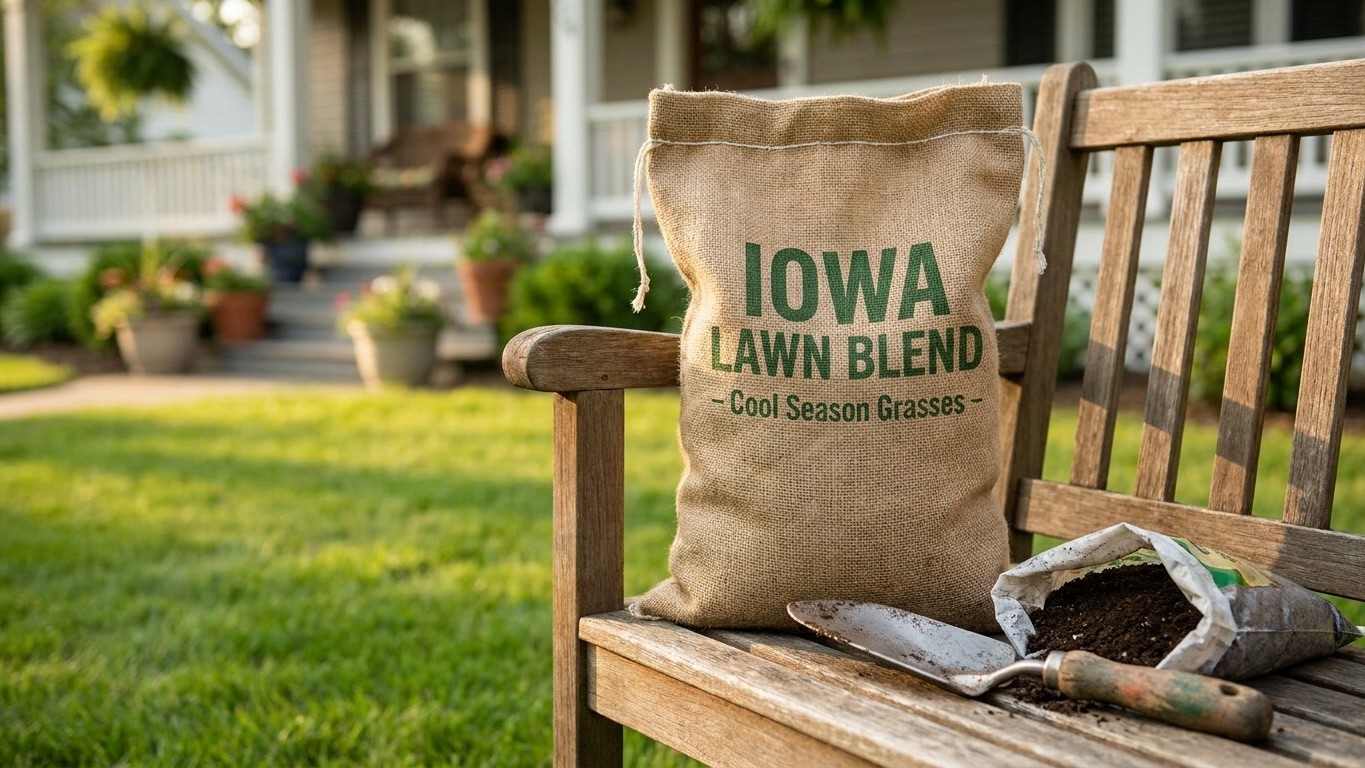

Iowa’s climate calls for cool-season turf, not warm-season grass. Kentucky bluegrass, tall fescue, perennial ryegrass, fine fescue and rough bluegrass are the five species Clemson Cooperative Extension’s HGIC 1214 and Penn State Extension list as suited to this kind of winter. The Homestead Post classifies the Des Moines area as a cool-season zone, based on NOAA’s summer heat and winter cold normals. Match the species to how the lawn actually gets used, then plan to seed or overseed in fall, since spring seeding of these grasses struggles once summer heat arrives.
The short answer for Iowa
Iowa sits square in the cool-season belt, not the warm-season South, which already rules out half of what a national seed rack tries to sell you. That narrows things to five real options: Kentucky bluegrass, tall fescue, perennial ryegrass, fine fescue, and rough bluegrass. The general advice stops there and calls it done. Here it doesn’t, because a shaded side yard, a well-worn play area, and a fast-draining slope each want a different one of those five — and the bag rarely tells you which.
Within that zone, the five workable species are Kentucky bluegrass, tall fescue, perennial ryegrass, fine fescue and rough bluegrass, the list Clemson and Penn State Extension both give for cool-season turf. None of them is automatically “the best.” A shaded side yard, a play area that takes constant foot traffic, and a slope that dries out fast each call for a different one of the five. The right call depends on how the lawn gets used before it depends on the seed bag.
If the yard is unestablished or the basics of soil prep and mowing height haven’t been settled yet, that groundwork belongs in Iowa Lawn Care before seed selection matters much. Seed dropped on compacted, unamended soil underperforms no matter which of the five species is in the bag.
Working through the year

Ranking the species
For most Iowa yards, a blend built around Kentucky bluegrass is the standard starting point. It spreads by rhizome, so it fills in bare patches and foot-traffic wear on its own over a season or two, but it is slow to establish from bare seed and needs more water than the alternatives during a dry stretch. Tall fescue trades that self-repair for a deep, coarse root system that shrugs off drought and heat better than any other cool-season option here, at the cost of a clumping habit that does not fill bare spots without reseeding. Perennial ryegrass germinates fast, often within a week or two, which makes it useful as a nurse grass mixed with slower species, but it wears out under heavy traffic faster than bluegrass or tall fescue. Fine fescue tolerates shade better than the other four and needs less nitrogen, but it dislikes summer humidity and heavy wear. Rough bluegrass handles wet, shaded ground where little else survives, but it thins out fast in full sun or drought.
| Species | Establishment speed | Drought tolerance | Shade tolerance | Wear tolerance |
|---|---|---|---|---|
| Kentucky bluegrass | Slow | Moderate | Low | High (self-repairs) |
| Tall fescue | Moderate | High | Moderate | High |
| Perennial ryegrass | Fast | Low | Low | Moderate |
| Fine fescue | Moderate | Moderate | High | Low |
| Rough bluegrass | Moderate | Low | High | Low |
When to seed
Cool-season grass here goes down in fall, not spring. NOAA’s 1991-2020 climate normals put the first fall freeze at Des Moines between October 14 and October 25. Counting back the roughly six weeks a seedling needs to root before frost puts that window at approximately early to mid September, the arithmetic being six weeks subtracted from each end of the frost range. Iowa State Extension’s county-level data, drawn from 1950-2021 records, run about ten days earlier than the Des Moines airport figure in fall, so a county away from Des Moines may need seed in the ground closer to late August to hit the same six-week margin. Treat the airport date as the late end of the window, not the target. For the sequence of tasks around that seeding date, fertilizing, mowing, and pre-emergent timing, Clemson’s HGIC 1219 tall fescue maintenance calendar lays out the order of operations for this species, though it is written for South Carolina’s longer season and its dates need to be shifted earlier for Iowa’s shorter one. The full month-by-month version of that shift for this state is worked out in The Iowa Lawn Care Calendar, Month by Month.
Spring seeding is possible but works against the clock. A cool-season seedling planted in April has only a few weeks of favorable soil temperature before summer heat arrives, and a root system that thin rarely survives its first hot, dry stretch without heavy irrigation.
What changes across Iowa
Every figure above is measured at or near Des Moines. The rest of the state does not match it evenly. Northern Iowa, closer to the Minnesota border, sits in a colder pocket where frost arrives sooner and the growing season for a new seeding is shorter than the Des Moines numbers suggest. The driftless area in the northeast, with its steeper, higher ground, tends to hold cooler, damper microclimates than the flatter cropland around Des Moines, which favors rough bluegrass and fine fescue in the shaded ravines but slows establishment everywhere else. Southern Iowa, nearer the Missouri line, runs milder and gives a longer window before the first freeze.
Never treat the Des Moines frost window as a fixed date for the whole state. Iowa State Extension’s own county-level figures, built from 1950-2021 records rather than a single airport, already run about four days later in spring and ten days earlier in fall than the NOAA airport data used above. That gap alone is a warning: a county-specific check, not a single statewide number, is what should set the actual seeding date on a given property.
Elevation plays a smaller but real role too. Low ground that holds frost pockets on calm, clear nights will freeze before the surrounding higher fields, and a lawn sitting in one of those pockets should be seeded and mowed on the earlier, more cautious end of any range given here.
The mistakes this climate punishes
Iowa’s climate is unforgiving of a few specific habits, and each one shows its damage on a different schedule.
- Seeding cool-season grass in late spring or early summer: the seedling roots fail once heat arrives, and the bare patches show by midsummer.
- Mowing too short during a hot, dry stretch: scalped turf loses the shade its own canopy provided the soil, and browning accelerates within days.
- Heavy spring nitrogen instead of fall feeding: it pushes soft top growth right before summer stress and disease pressure, with damage showing in July and August.
- Skipping the fall aeration and overseeding window entirely: thin spots from the previous summer’s stress never fill back in and just widen the following year.
- Planting a warm-season species hoping it survives the winter: it will not persist through a cool-season zone’s cold, and the failure shows the following spring as bare, dead turf rather than a slow decline.
One distinction worth holding onto through all of this: brown is not the same as dead. A cool-season lawn that browns in a July dry spell is usually dormant, not dying, and it greens back up once fall rain and cooler temperatures return. The failures above are the ones that do not recover on their own.
Checking this against your county
Iowa State University Extension maintains the county-by-county offices best positioned to confirm a local frost date, soil test recommendation, or species performance for a specific address. Its directory and county office finder are available at Iowa State University Extension, and a quick call before a fall seeding project is worth more than any statewide range.
Common questions
Can I plant grass seed in the spring instead of fall in Iowa?
Spring seeding is possible but the odds are worse. Cool-season seedlings planted in spring have only a short window before summer heat arrives, and a root system that young rarely survives a hot, dry stretch without frequent watering.
Is Kentucky bluegrass or tall fescue better for my yard?
It depends on the trade-off you’d rather live with. Kentucky bluegrass self-repairs from wear and thin spots because it spreads by rhizome, but it needs more water in a dry summer. Tall fescue tolerates drought and heat better but grows in clumps and will not fill a bare patch on its own.
My lawn turned brown in July, is it dead?
Probably not. Cool-season turf goes dormant and browns during summer heat and drought as a survival response, and it typically greens back up once fall rains and cooler weather return. A patch that stays brown and dead-looking well into fall is a different problem, worth checking with a county extension office.
How long does grass seed take to fill in?
It depends on the species. Perennial ryegrass germinates fastest, often within a week or two under good conditions, while Kentucky bluegrass is the slowest of the five, sometimes taking several weeks. Soil temperature and moisture at seeding time affect all of these times more than the calendar date does.