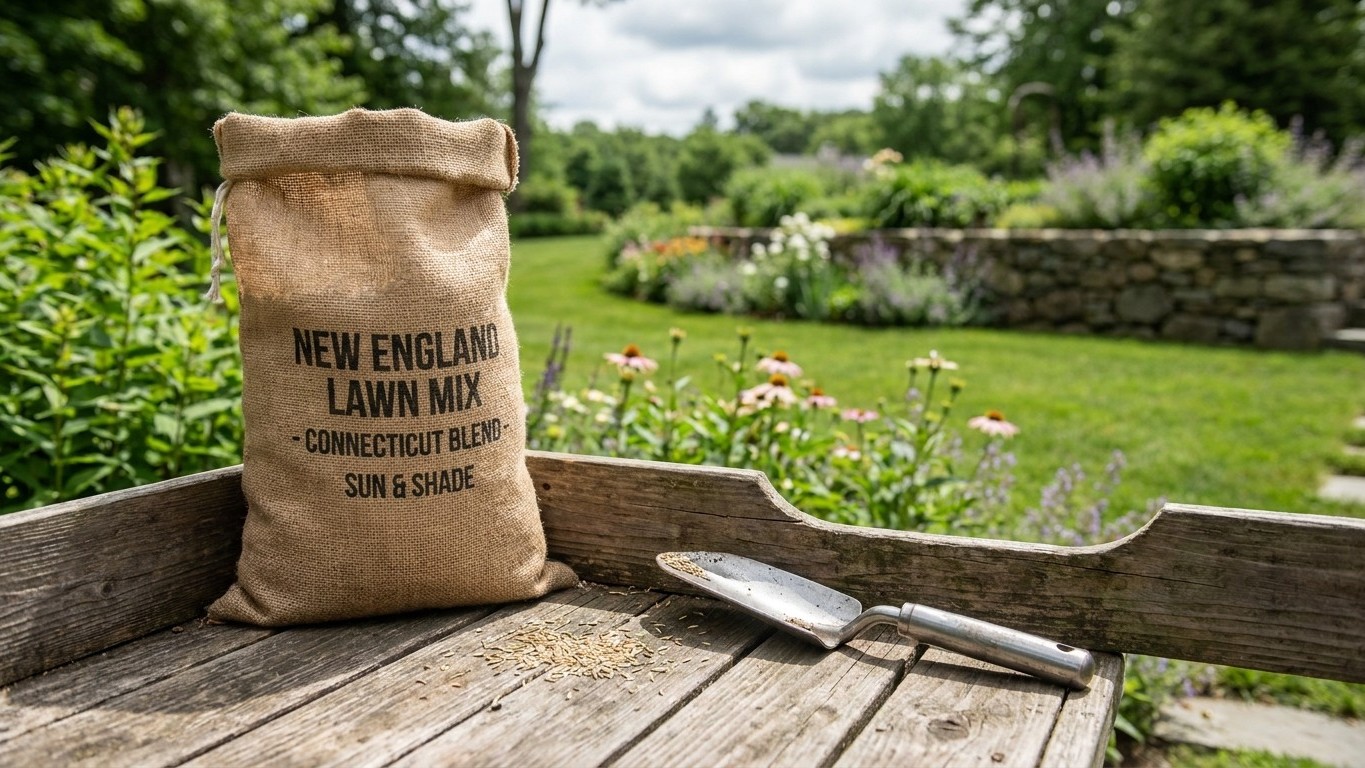

Connecticut sits squarely in cool-season turf territory, which settles the seed question before you even walk into the store: think Kentucky bluegrass, tall fescue, fine fescue, perennial ryegrass, or rough bluegrass, not bermudagrass or zoysia — those warm-season types die back hard here and rarely wake up green the next spring. Among the cool-season five, the right pick depends on your sun, your traffic, and how often you’re out there with a hose. Kentucky bluegrass rewards the sunny, well-watered yard; tall fescue shrugs off drought and shade; fine fescue holds the deep-shade corners no one else will grow in.
The short answer for Connecticut
Connecticut falls in the cool-season turf zone, a designation The Homestead Post assigns from Bridgeport’s climate normals read against the season tolerances published by Clemson Cooperative Extension (HGIC 1214). That means the grasses that survive a Connecticut winter and summer are Kentucky bluegrass, tall fescue, perennial ryegrass, fine fescues, and rough bluegrass, the five species Clemson Cooperative Extension (HGIC 1214) and Penn State Extension group as cool-season turf. A warm-season grass like bermudagrass or zoysia will not overwinter reliably this far north. It goes dormant at the first hard freeze and often fails to green back up the following spring in a climate this cold.
Which of the five wins for your lawn comes down to three things: how much sun the area gets, how much foot traffic it takes, and how much you’re willing to water. Kentucky bluegrass gives the densest, most classic lawn but wants full sun and steady moisture. Tall fescue tolerates drought and light shade better and recovers faster from wear, at the cost of a coarser blade. Fine fescue is the real option for dense shade, though it thins under heavy use. Perennial ryegrass germinates fast and is more often blended in as a nurse grass than grown alone. Rough bluegrass is a shade and wet-soil specialist most homeowners only see in a blend bag.
Most Connecticut lawns end up as a mix rather than a single species, because most yards have more than one light condition across the lot. A blend built around Kentucky bluegrass and fine fescue suits a lot with both sun and shade, while a mix weighted toward tall fescue suits a yard that takes a beating from kids, dogs, or a steep slope.
Working through the year

Cool-season grass makes its two hardest growth pushes in spring and fall, and goes semi-dormant in the heat of summer. That rhythm should set your calendar, not the month by itself.
Spring: repair, don’t seed a whole lawn
Spring is for patching bare spots, spot-feeding, and starting the mowing season at a taller cut. Seeding an entire lawn in spring is riskier than it looks. Seedlings compete with crabgrass germinating at the same time, and rarely root deeply enough before summer heat arrives to stress them. Save the big seeding push for fall.
Summer: mow high, water deep, and don’t seed
This is the stress season for cool-season turf. Raise the mower deck instead of lowering it. A taller blade shades the soil and slows moisture loss. Do not lay new cool-season seed in June, July, or August. It will germinate straight into heat it has no chance of surviving.
Fall: the real seeding window
Fall is when cool-season grass actually establishes, because the soil is still warm enough for root growth while air temperatures ease and disease pressure drops. That window closes at the first hard freeze. NOAA’s 1991-2020 climate normals put the first fall freeze at Bridgeport, the mildest station in the state, at October 28 to November 10. Seed generally needs six to eight weeks of growing time before that freeze to root deeply enough for winter, which works out to a seeding window running from early September to late September for the Bridgeport area, and earlier than that if you garden inland or at elevation. The Connecticut Lawn Care Calendar, Month by Month breaks that window down by task if you want the week-by-week version.
Clemson Cooperative Extension’s Tall Fescue Maintenance Calendar (HGIC 1219) lays out the same fall-first logic for tall fescue specifically: mowing, feeding, and aeration all cluster around that same pre-frost window, with a lighter repeat pass in spring. That pattern holds whichever cool-season species is in your lawn, tall fescue or otherwise. Treat summer as maintenance only, not planting season.
What each species costs you
| Species | Sun needs | Wear tolerance | Drought tolerance | Trade-off |
|---|---|---|---|---|
| Kentucky bluegrass | Full sun | Good, self-repairs by rhizome | Low, needs regular water | Slow to establish from seed |
| Tall fescue | Full sun to light shade | Very good | Good, deep roots | Coarser blade texture |
| Fine fescue | Shade specialist | Low | Good once established | Thins under foot traffic |
| Perennial ryegrass | Full sun | Moderate | Low | Rarely grown alone, mainly a blend component |
| Rough bluegrass | Shade, wet soil | Low | Poor | Niche use in low, damp spots |
What changes across Connecticut
The frost dates above come from Bridgeport, a Long Island Sound station and the mildest ground in the state. NOAA’s climate normals describe that coastal strip specifically, not Connecticut as a whole. Inland and northwest Connecticut freeze earlier in fall and thaw later in spring than the shoreline does, which shortens the fall seeding window and pushes spring mowing back too.
Elevation is the main driver. The Litchfield Hills and the higher ground along the state’s northwest corner sit several hundred feet above the coastal towns, and cold air pools in those valleys on clear autumn nights well before Bridgeport records its first freeze. A lawn in Norfolk or Salisbury should treat the coastal seeding window as a guide to shift earlier, not a date to copy directly.
The Connecticut River valley cuts against that pattern in places. Its wide floodplain and lower elevation hold heat a little longer into fall than the surrounding hill towns, though not as long as the immediate shoreline does. Long Island Sound is the other moderating force: towns within a mile or two of the water get a longer, milder fall and a later last spring freeze than towns at the same latitude just ten miles inland.
None of this changes which species belong on a Connecticut lawn. Cool-season grass is the right call from the shoreline to the northwest corner. It changes when you do the work, not what you plant. If you garden away from the coast, treat every date in this piece as a range to move earlier, and check your own town’s frost history against NOAA’s station network if you want a tighter window than the state-level guidance here gives you.
The mistakes this climate punishes
Seeding cool-season grass in late spring or early summer is the most common mistake homeowners make here, and it shows up by midsummer as thin, wilted seedlings that never fill in. The seed germinates fine in mild spring soil, then hits Connecticut’s hot, often dry summer stretch before its roots go deep enough to survive it. Wait for the fall window instead, timed off local frost dates rather than a seed bag’s printed planting map.
Cutting the lawn short going into summer is the second big one. A close summer cut exposes soil to direct sun, drives up moisture loss, and opens bare patches that crabgrass moves into. The damage does not show the day you mow. It shows up three or four weeks later as brown, stressed turf that looks like drought damage even where the sprinkler ran on schedule. Raise the deck before the heat arrives, not after the lawn already looks tired.
Feeding heavily in the heat of summer is a related error. Cool-season grass is not building leaf tissue in July and August the way it does in spring and fall, so a midsummer nitrogen application pushes growth the plant can’t support under heat and drought stress, and can scorch turf that’s already struggling. Save the feeding for the fall window, when the grass is building roots for winter instead of fighting the weather.
Skipping the fall feeding and overseeding pass entirely is the quieter mistake, the one that doesn’t show damage this year but shows up as a thinning, weed-prone lawn two or three seasons out. Fall is the one season cool-season turf in Connecticut can’t afford to skip. A lawn that only gets attention in spring is running on whatever density survived the previous winter, and that density only goes down over time without a fall reseeding to rebuild it.
Checking this against your county
Your own town’s frost dates, soil, and shade pattern will nudge the timing earlier or later, sometimes by two or three weeks if you garden well inland or at elevation. UConn Extension keeps county-level guidance and a soil testing service that will tell you more about your specific lot than any statewide average can. Check their site before you buy seed by the pallet, and lean on Connecticut Lawn Care for the groundwork, like grading and soil prep.
Common questions
Can I overseed with Kentucky bluegrass in a shady yard?
Not successfully on its own. Kentucky bluegrass needs close to full sun to form a dense stand and thins out fast under trees. Fine fescue is the species Clemson Cooperative Extension (HGIC 1214) lists for shade, so blend it in or switch entirely for the shaded parts of the yard.
What happens if I miss the fall seeding window?
Wait for the following fall rather than seeding late into a Connecticut winter. Spring seeding is possible but competes with weed germination and gives roots less time before summer heat arrives, so it usually produces a thinner stand than a fall seeding does.
Will zoysia or bermudagrass survive here?
Not reliably. Both are warm-season grasses built for a climate that stays warm most of the year, and Connecticut’s winters fall outside what they tolerate. A warm-season lawn planted this far north typically thins badly or dies out over a winter or two, rather than simply browning and recovering the way it would farther south.
Why does my lawn look brown in August even though I’m watering it?
Cool-season grass goes semi-dormant in summer heat and browns as a survival response, which is different from the grass dying outright. It usually greens back up once temperatures drop and fall rain returns, as long as it wasn’t scalped by a too-short mower cut on top of the drought stress.