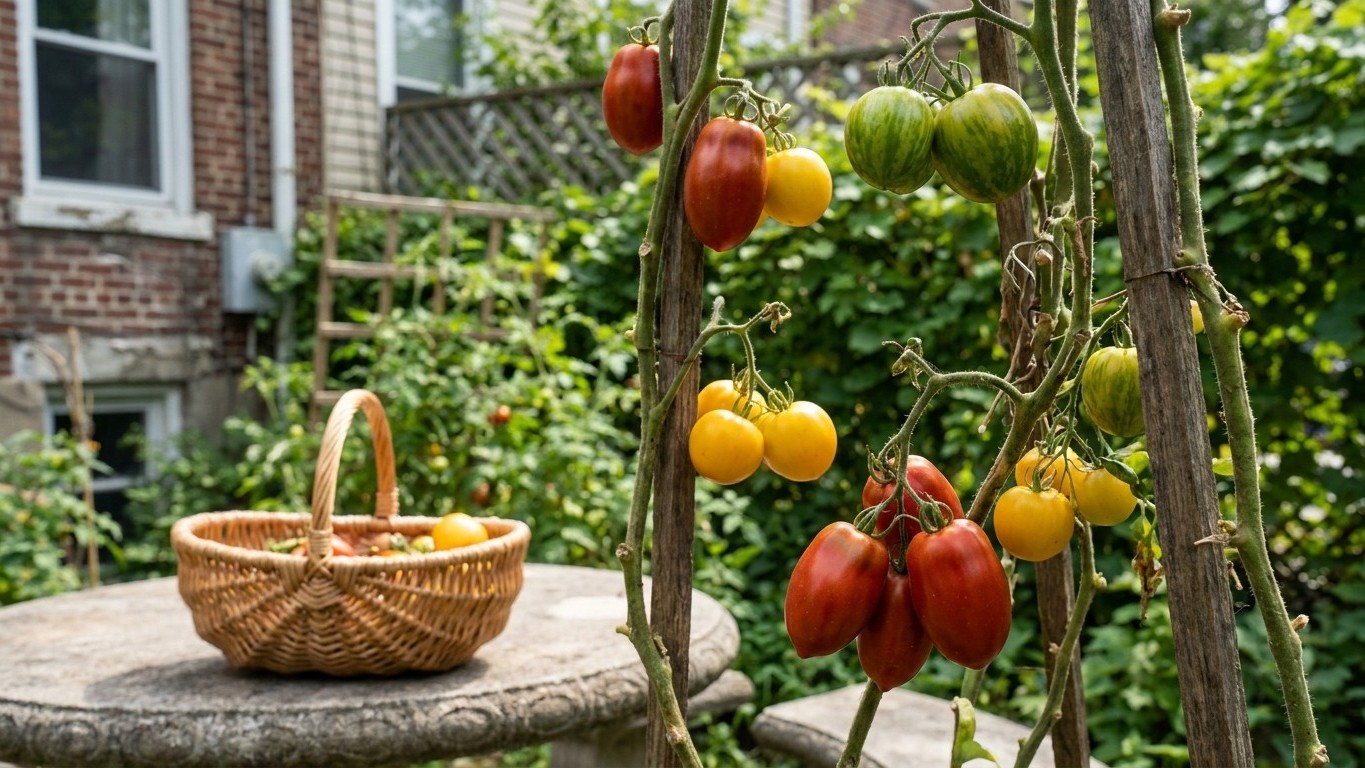

New York City’s growing season, per NOAA’s 1991-2020 climate normals, runs from a last spring frost of March 23 to April 3 to a first fall frost of November 14 to November 27, a frost-free window of well over seven months. Pick a tomato whose catalogue days-to-maturity clears whichever end of that window applies to your yard, and the rest is bed prep. The one thing to do before buying seed: count the cultivar’s days-to-maturity against your own frost dates, not against the calendar page of a seed catalogue grown somewhere else.
What this comes down to in New York

Fourth of July, the tomato variety, needs about forty-nine days to ripen — Brandywine wants up to a hundred. That gap is the whole story of a New York garden, where the first frost can land anywhere from late September in the Hudson Valley to early October on Long Island. Count backward from your frost date and a lot of beloved heirlooms simply run out of runway. The list below sorts real varieties by days to maturity, so you can see which ones actually fit your season.
| Variety | Days to maturity | Plant type | Fruit |
|---|---|---|---|
| Fourth of July | about 49 days | Indeterminate | Small-medium red slicer |
| Early Girl | 50-57 days | Indeterminate | Medium red slicer |
| Stupice | 52-65 days | Indeterminate, potato-leaf | Small red |
| Sun Gold | about 57 days | Indeterminate | Orange cherry |
| Celebrity | about 70 days | Semi-determinate | Medium-large red |
| Cherokee Purple | 80-85 days | Indeterminate | Large purple-pink beefsteak |
| Brandywine | 80-100 days | Indeterminate, potato-leaf | Large to very large pink-red beefsteak |
Upstate and at elevation the same rule applies, but the window is shorter, so the margin for a long-season heirloom shrinks or disappears – more on that below. The varieties below are ordered from shortest to longest season so you can see exactly where your own risk starts to climb.
Fourth of July
Fourth of July ripens in about 49 days from transplant, the fastest red slicer widely sold in catalogues. Indeterminate vines keep setting modest 4- to 6-ounce fruit through summer once they start, which makes it a reasonable choice for a New York gardener who wants an early slicer or just wants insurance against a short season upstate.
Early Girl
Early Girl needs about 50 to 57 days to first ripe fruit, still fast enough to clear any frost date in the state with room to spare. It’s an indeterminate vine with smooth, medium 4- to 6-ounce red globes, bred as an all-purpose slicer rather than for size, and it has been a reliable early producer in home gardens for decades.
Stupice
Stupice is a Czech heirloom that ripens in roughly 52 to 65 days depending on the catalogue, with small 1- to 2-ounce red fruit on a sprawling indeterminate vine with smooth-edged, potato-leaf foliage rather than the usual serrated tomato leaf. Its main selling point for New York is cold tolerance: it sets fruit in cooler soil and air than most varieties, which matters most in the weeks right after transplant.
Sun Gold
Sun Gold is a cherry tomato at about 57 days, producing small, bright orange, round fruit in long clusters on a vigorous indeterminate vine. It’s grown for flavor rather than size, and its short season means it starts filling the kitchen with ripe fruit well before the slicers do.
Celebrity
Celebrity takes about 70 days and grows as a compact, semi-determinate bush rather than a sprawling vine, setting medium-to-large 7- to 8-ounce red fruit with smooth skin. It was bred for reliability rather than size or unusual color, and its season length fits comfortably inside the frost-free window at either end of the state.
Cherokee Purple
Cherokee Purple needs roughly 80 to 85 days, longer than anything above it on this list, for a large 10- to 12-ounce beefsteak with dusky purple-pink skin and darker shoulders on an indeterminate vine. It’s grown for flavor, not speed, and in New York it needs a prompt transplant and a full season to color up before fall frost closes things out.
Brandywine
Brandywine runs 80 to 100 days depending on the strain, the longest season on this list, for a large to very large pink-red beefsteak on an indeterminate vine with potato-leaf foliage. Fruit can top a pound, but that size and flavor come at the cost of a season long enough that it only reliably finishes where the frost-free window is generous, worth checking against your own numbers before you commit a whole bed to it.
Working it out for your own garden
Start from the two ends of your local frost window and work inward, the same method used on Tomato Planting Dates in New York: Counting Back From Your Frost Window. In New York City, NOAA’s 1991-2020 normals put the last spring freeze at March 23 to April 3 and the first fall freeze at November 14 to November 27. Stretch the earliest pair of dates and you get roughly 235 days of frost-free ground. Stretch the latest pair and it’s roughly 238 days. Either way, call it about seven and a half to eight months for a garden near the city, a wide target that most catalogue tomatoes can hit if they go in on time.
Running the numbers on two varieties
Take Celebrity, at about 70 days to maturity from transplant. Set it out anywhere in the March 23 to April 3 window and it ripens by roughly early to mid-June, leaving nearly five months of slack before the earliest fall freeze date in mid-November. That’s the kind of margin that forgives a slow, cool spring or a transplant that sat in its pot an extra week.
Now take Brandywine, at 80 to 100 days. Transplanted on the same New York City schedule it still ripens with room to spare, because the city’s frost-free season is unusually long for the state. The math changes where the season is shorter: in the colder interior and higher elevations, where the USDA’s hardiness map places conditions well below the mild end of the state’s 3b-7b range, the frost-free window can run considerably shorter than New York City’s, and a 90- to 100-day count from a late, cool spring transplant can push ripening dangerously close to the first fall freeze. The lesson isn’t that Brandywine fails everywhere in New York, it’s that the same catalogue number means a comfortable margin in one part of the state and a real gamble in another.
Do this arithmetic with your own dates before you buy seed, not after: count the catalogue days-to-maturity forward from the earliest and latest days you’d realistically transplant, and see where that lands relative to your local fall frost window.
What changes across the state
The frost dates above come from Central Park, a dense, heat-retaining site close to the ocean, and NOAA is explicit that this is a New York City figure, not a state-wide one. Move away from the city and several things push those dates around at once.
Elevation is the biggest single factor. The Adirondacks, the Catskills, and the higher ground of the Southern Tier sit well above sea level and cool faster in fall and warm slower in spring than the coastal lowlands, so both frost dates move inward from the two ends and the frost-free season shortens. The USDA’s hardiness map reflects this directly: the state spans zone 3b in its coldest interior and mountain pockets up to zone 7b in its mildest areas, a six-zone spread that is unusually wide for one state.
Proximity to open water works the other way. Land close to Lake Erie, Lake Ontario, and the Atlantic coast holds heat longer into fall and releases it more slowly than inland ground at the same latitude, which is part of why some of the state’s most productive fruit and vegetable country sits in a narrow band near those lakeshores. The effect fades quickly moving inland, so a county touching Lake Ontario can behave very differently from a county thirty miles south of it.
North versus south matters too, but less predictably than most gardeners assume. A sheltered, south-facing slope in the northern part of the state can outrun an exposed, low-lying spot much further south, because cold air pools in valleys and low ground regardless of latitude. Frost settles into the lowest point in a landscape on a still, clear night, so a garden’s own position relative to its surroundings can matter as much as its position on the map.
The mistakes this state punishes

The most common mistake is trusting a warm stretch in late March or early April as the season’s real start. NOAA’s frost window for New York City, March 23 to April 3, is built from a 30 to 70 percent freeze probability band, not a guarantee, so a run of warm days inside or even after that window doesn’t mean the last freeze has actually passed. Soil temperature lags air temperature by days, and tomato roots set into cold, wet soil stall rather than grow, erasing any head start a gardener thought they’d bought by planting early.
The second mistake is choosing fruit size and flavor over season length. A 90- to 100-day Brandywine planted in a short-season pocket of the state can still be carrying green fruit when the first fall freeze arrives, while a 70-day Celebrity planted on the same day would already be finished. Decide on days-to-maturity before you decide on flavor, especially outside the city’s unusually long frost-free window.
The third is skipping hardening off because the transplant looks sturdy. A tomato raised indoors or bought from a heated greenhouse has never felt real wind, direct sun, or a cold night, and setting it straight into the ground invites transplant shock that can cost a week or more of growth, which matters far more in a short season than a long one.
The fourth is timing everything around frost and forgetting the insects that show up on a separate schedule. Early-season pests can hit transplants before they’ve hardened into the ground, and Tomato Pests in New York: Which Ones Actually Show Up Here covers which ones actually turn up and when, worth checking alongside your planting date rather than after damage appears.
Checking this against your county
Every figure above is anchored to Central Park in New York City. It’s a fine starting point for the five boroughs and nearby suburbs, but it is not your county’s number if you garden upstate, on Long Island’s East End, or anywhere at elevation. Cornell Cooperative Extension keeps county-level offices across the state, and its extension service is the right place to ask for a frost window specific to your own location before you lock in a variety list.
Common questions
Can I still grow a 90-day tomato if I’m upstate or near the Adirondacks?
Maybe, but check your local frost window before you commit a bed to it. The frost-free season shrinks considerably in the colder interior and at elevation compared with New York City’s figures above, and a long-season beefsteak like Brandywine leaves little margin for a cool spring or a late transplant in those areas. A county extension office can tell you where your own window actually falls.
Does starting seeds indoors earlier let me grow a longer-season variety?
No, not by itself. Catalogue days-to-maturity are counted from the transplant date, not from the seed-starting date, so starting seeds indoors earlier just gives you a bigger transplant on the same calendar. It doesn’t shorten how long the plant needs in the ground once it’s out there.
Are determinate tomatoes faster to ripen than indeterminate ones?
Not necessarily. Plant habit and days-to-maturity are two separate things: Celebrity is semi-determinate at about 70 days, while Early Girl is indeterminate and ripens even faster, at 50 to 57 days. Check the days-to-maturity number specifically rather than assuming a bushy, determinate plant is automatically the quicker one.
Is it worth buying a tomato transplant that’s already flowering at the garden center?
Generally no. A transplant that’s flowering before it’s even in the ground has usually been stressed or pot-bound, and it often sets back into a slower recovery once transplanted than a smaller, unstressed, deep-green plant would. Pick the sturdier, non-flowering transplant and let it flower on its own schedule after it’s settled in.