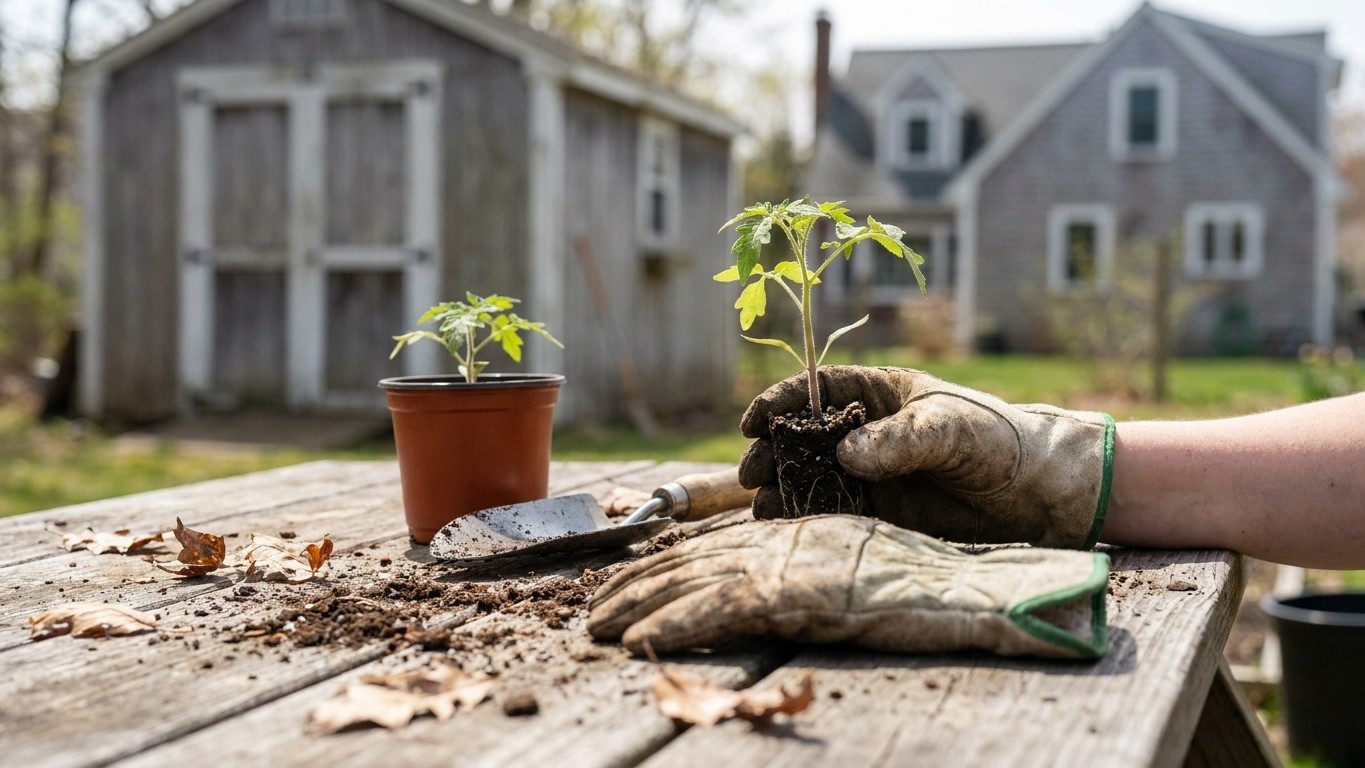

Rhode Island’s tomato planting window sits between a last spring frost of April 7 to April 17 and a first fall frost of October 24 to November 3, both measured at Providence by NOAA’s 1991-2020 climate normals. Transplant tomato seedlings outdoors only after that spring window has passed in your own yard, not on a fixed calendar date. Check how many days your chosen variety needs to mature, then count backward and forward from these ranges before you buy a single seedling.
What this comes down to in Rhode Island

Rhode Island’s last-frost window runs roughly from April 15 to May 15 depending on where you garden, and that ten-day-to-month spread is the whole game — not a single date to circle but a band of risk that shrinks as the season moves on. Transplant too early inside that window and you’re betting seedlings against a late freeze; wait too long and you’re trading away ripening days you’ll want in September. Cold, wet soil can stall roots even on a frost-free morning, which is a different hazard entirely and worth checking with a soil thermometer before you commit a flat of plants to the ground.
The mistake gardeners make is treating either end of that window as a fixed date. It is not a date, it is a probability band. Transplanting on April 7 in a year when the freeze risk runs to April 17 is a gamble that will occasionally cost you a whole flat of seedlings. The safer read is to treat the entire ten-day span as live risk and let your own soil conditions, not the calendar, make the final call. Soil that is still cold and wet stalls tomato roots even without a frost, which is a separate problem from the freeze date itself and one worth checking with a simple soil thermometer before you dig.
Once you have a transplant date in mind, the next question is whether the cultivar you want actually finishes in time, and that calculation is worth doing before you fall in love with a packet of heirloom seed at the garden center. If you have not settled on varieties yet, the companion page on Tomato Varieties That Ripen in Time in Rhode Island works through named cultivars against this same frost math.
Working it out for your own garden
Counting back for seed starting
Most tomato-growing guides call for starting seeds indoors six to eight weeks before the transplant date. Run that against Providence’s last-frost range from NOAA’s 1991-2020 normals: eight weeks before April 7 lands near the start of February, and six weeks before April 17 lands in the first days of March. So the realistic indoor seed-starting window for a Providence-area garden runs from early February to early March, not a single day. Pick a point inside that range based on how much windowsill or grow-light space you have, and lean later rather than earlier if you cannot give seedlings strong light, since leggy plants started too soon do worse than compact ones started a little later.
Counting forward to the fall frost
Once seedlings go into the ground sometime in the April 7 to April 17 window, add the cultivar’s days-to-maturity figure from the seed packet to see where harvest lands. A short-season tomato such as ‘Early Girl‘, listed at about 50 days from transplant, ripens by late May to early June if set out at the start of the window, or by early-to-mid June if set out at the end of it. Either way that is roughly four months clear of Providence’s first fall frost of October 24 to November 3, so there is no real risk of running out of season.
A longer-season cultivar tells a different story once you push the transplant date later, which is exactly what happens with a succession planting rather than the main spring crop. Take a variety like ‘Brandywine‘, typically listed near 90 days to maturity, and set it out in early July instead of April, maybe as a second planting after clearing spring greens. Ninety days from early July lands around mid-October, which sits right against the front edge of Providence’s fall frost window rather than safely ahead of it. That is the line: the same cultivar that finishes with weeks to spare from an April transplant can finish with almost no margin from a July one, and an early frost in a colder inland yard can end the crop before the fruit fully ripens.
What changes across the state
The Providence figures are a starting point, not a state-wide guarantee, and Rhode Island is small enough that gardeners forget how much its coastline changes the numbers. Coastal areas along South County and Narragansett Bay, along with Block Island offshore, sit closer to open water, which moderates temperature swings in both directions: the ocean tends to push the last spring frost earlier and the first fall frost later than an inland site at the same latitude. USDA’s Plant Hardiness Zone Map, using the 1991-2020 normals, places the state across a 6a to 7b range, with the warmer end concentrated near the coast and the cooler end inland and at higher ground.
Inland and northern parts of the state, including higher ground in Providence County away from the coast, typically run colder than the Providence airport reference station that NOAA uses for its normals. Cold air also pools in low-lying spots, so a garden in a valley bottom or a frost pocket can see freezing temperatures well after a garden a mile away on a slope has cleared. None of this changes the shape of the calculation, only where the ranges fall for your specific address.
Elevation matters too, though Rhode Island has little of it compared to inland New England. Even a modest rise into the state’s northwestern corner can add a few extra frost-risk days at either end of the season compared with the coastal plain. The practical takeaway is the same wherever you garden: use the Providence figures as your baseline, then watch your own thermometer and your own soil in the two or three weeks around each edge of the window rather than assuming your yard matches the reference station exactly.
The mistakes this state punishes

The most common and costly mistake is planting into cold soil right after a warm early-spring stretch. A run of 70-degree days in late March or early April feels like permission, but Providence’s own last-frost range from NOAA runs as late as April 17, and a single cold night after a premature transplant can wipe out a season’s worth of seedlings. Wait until the window has genuinely passed for your area, not until the weather feels warm for a few days.
The second mistake is choosing a long-season cultivar without checking it against the frost math shown above, then compounding the error by transplanting later than planned because of a wet spring or a late seedling order. A variety that would have finished comfortably from an April transplant can end up racing the fall frost from a June one. If you are unsure which cultivars have the margin to spare in a Providence-length season, the varieties page linked above walks through that comparison by name.
The third mistake is timing pest management by habit rather than by the calendar this state actually runs on. Tomato pests here have their own seasonal windows, and treating too early or too late wastes a spray and misses the stage that actually causes damage. Rather than guess, check Tomato Pests in Rhode Island: Which Ones Actually Show Up Here for what to watch for and when, and cross-reference that against your own transplant date rather than a generic calendar.
A quieter mistake is skipping hardening off because the frost window has technically passed. Even after the last-frost risk clears, a seedling raised indoors or under lights needs several days of graduated outdoor exposure before it goes into open ground, and skipping that step stunts plants in a way that looks like frost damage but is not fixable the same way.
Checking this against your county
Before you commit to a planting date, check your own frost history with your county’s Cooperative Extension office, part of the University of Rhode Island’s Extension Service network, which fields exactly this kind of local question. If you have not yet worked through the basics of the crop itself, the main growing tomatoes in Rhode Island guide covers site selection and soil prep.
If you follow the almanac, here is when to plant tomatoes by the moon. It is a tradition, not a proven method.
Common questions
Can I just plant on a fixed date every year, like Mother’s Day?
You can, but you are relying on habit rather than the actual freeze risk for that year. NOAA’s frost window for Providence spans a full ten days on either end of the season, and a fixed calendar date ignores whether that particular spring is running early or late. Check a current forecast and your soil temperature before committing, especially in a cold spring.
What if my seedlings get hit by a late frost anyway?
A light frost sometimes only damages the top leaves, and a plant with intact lower growth can recover if you cut off the blackened tissue. A hard freeze that blackens the whole plant usually kills it outright, and replacing it with a fresh transplant is faster than nursing a badly damaged one back.
Does starting seeds earlier indoors give me a longer harvest?
Only up to a point. Seedlings started well beyond the six-to-eight-week window before transplant tend to get root-bound and leggy on a windowsill, and they do not outperform a properly timed, stockier transplant once both are in the ground. The extra indoor weeks buy you stress, not extra tomatoes.
Is it worth trying a second planting in midsummer for a fall crop?
It can work for a short-season cultivar but gets risky for a long-season one, since a July transplant leaves far less cushion before Providence’s first fall frost of October 24 to November 3 than an April transplant does. Run the days-to-maturity math for your specific cultivar and transplant date before you commit garden space to it.