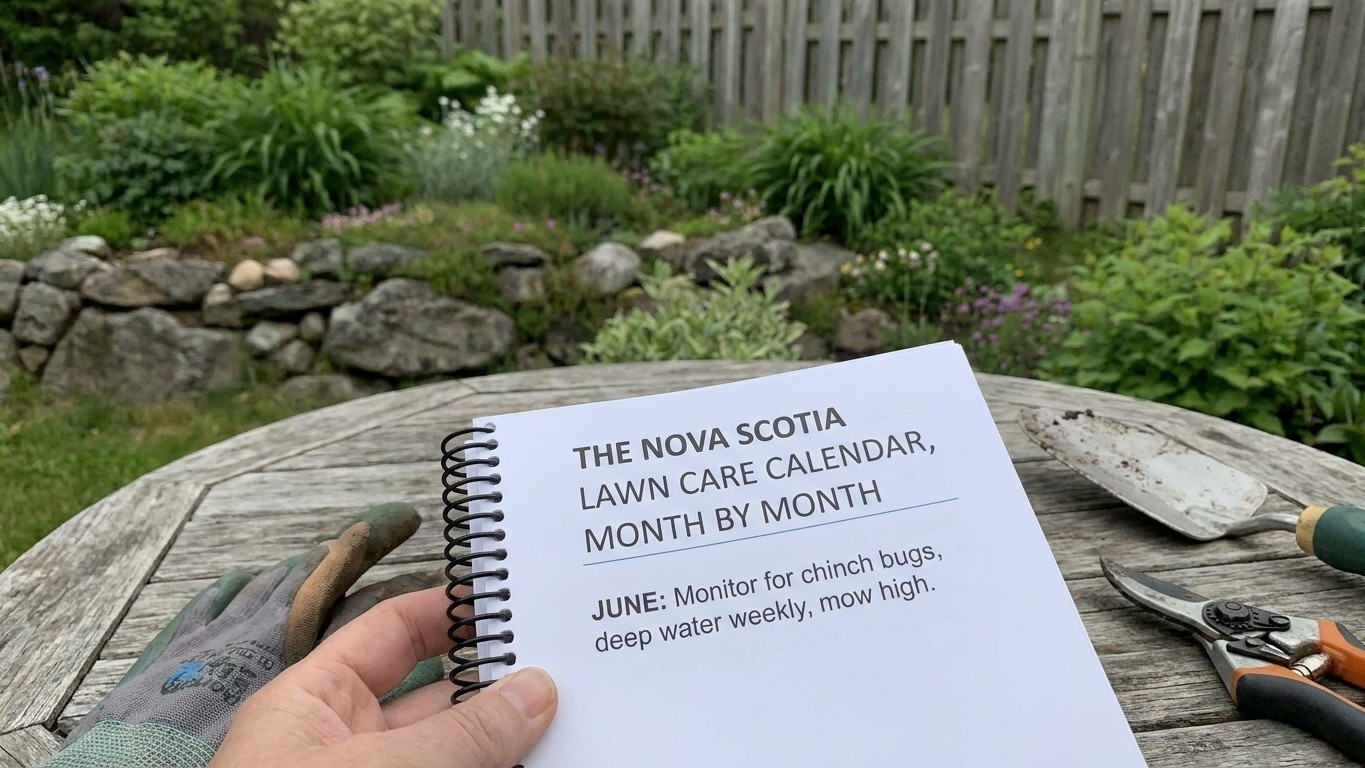

Nova Scotia lawns run on cool-season grass from one end of the province to the other, and the hinge date for the whole calendar is the average first fall frost of October 18 at Halifax, recorded by Environment and Climate Change Canada from the Halifax Stanfield Int’l A station’s 1981-2010 climate normals. Every mowing, feeding and seeding decision here works backward from that date, since it marks the point where active growth stops and winter prep needs to already be finished. Mark the weeks from early September to early October as your main feeding and seeding window, and treat anything after that as a race against falling soil temperatures.
The short answer for Nova Scotia
Nova Scotia sits in the cool-season turf zone, a classification this publication assigns from the climate normals at the reference city against the season tolerances published by Clemson Cooperative Extension (HGIC 1214). That means the grasses that actually hold up here are Tall Fescue, Kentucky Bluegrass, Perennial Ryegrass, Fine Fescues, and Rough Bluegrass, the cool-season species named by Clemson HGIC 1214 and Penn State Extension. A warm-season lawn, the kind that thrives through a Carolina or Georgia summer, will not survive a Nova Scotia winter, so there is no substitute list to weigh here.
The answer depends heavily on where in the province you are standing. The dated figures come from the Halifax Stanfield Int’l A weather station, and Environment and Climate Change Canada is explicit that this is a mean date, not a guarantee: in one year out of two, the first fall frost at Halifax actually lands later than October 18. Inland valleys, higher ground, and the northern mainland run on a different schedule again. Treat every date below as the middle of a window, not a line drawn on a specific day, and lean early rather than late when you are unsure which side of that window you are on. For the seed choice itself, the fuller breakdown of which cool-season species suits a given yard is worth reading before you buy: see The Best Grass Seed for Nova Scotia Lawns for how Tall Fescue’s coarser blade and Kentucky Bluegrass’s slower establishment trade off against each other.
Working through the year

Clemson Cooperative Extension’s HGIC 1219 Tall Fescue Maintenance Calendar is written for a species, not a state, and its published rates for mowing height, nitrogen, and irrigation apply wherever tall fescue is grown. What does not transfer directly are the calendar’s South Carolina month labels, since a Nova Scotia lawn is weeks or months behind a South Carolina one on the same species. The rates below follow HGIC 1219; the timing is translated to run off the Halifax frost date instead.
Feeding, mowing and watering by season
| Season | Mowing height | Nitrogen (per 1,000 sq ft) | Irrigation |
|---|---|---|---|
| Early spring, once growth resumes | 2.5 in | Light or none | Rain usually enough |
| Summer | 3 to 3.5 in | Skip or minimal feeding | About 1 in/week if drought-stressed |
| Early fall into September | 2.5 to 3 in | Split applications, up to about 1 lb per feeding | Taper off as growth slows |
| Late fall, before frost | Final cut slightly lower | Last feeding done well ahead of dormancy | None needed |
Raise the mower in summer rather than scalping the lawn to save time. Tall fescue and Kentucky Bluegrass both lean on deeper roots to survive heat and dry spells, and a taller cut shades those roots. Nitrogen is the one input this calendar treats as seasonal rather than steady: HGIC 1219 puts the bulk of a tall fescue lawn’s yearly nitrogen into the fall applications, with spring and summer feeding kept light or skipped entirely, because a flush of soft, nitrogen-fed growth heading into a Nova Scotia winter is exactly the kind of top growth that gets hit by frost and invites snow mold.
Aeration, overseeding and pre-emergent timing
Core aeration and overseeding both belong in the same early fall window as the main feeding, while soil is still warm enough for new grass to germinate but cool enough that it will not be competing with summer weeds. Given the October 18 average first frost at Halifax, and remembering that half of all years run later than that, aim to have overseeding down and germinating well before the first week of October so seedlings have real roots by the time frost arrives. A pre-emergent herbicide for crabgrass, if you use one, goes down in spring, timed to soil warming rather than a calendar date, since pre-emergents work by blocking germination and are wasted if put down before or long after the weed seed actually sprouts.
What changes across Nova Scotia
The Halifax Stanfield figures describe one station, and Nova Scotia is not one climate. The Annapolis Valley, sheltered inland and known for its orchards, tends to warm up earlier in spring and hold heat a little longer into fall than the coast, which can push its own frost window later than Halifax’s. The Atlantic coastline and South Shore, by contrast, get a moderating effect from the ocean that softens both the coldest winter lows and the hottest summer days, but that same maritime air brings fog and dampness that favor fungal disease on a lawn cut too short or fed too heavily late in the season.
- Annapolis Valley: warmer, sheltered, likely later frost than Halifax
- South Shore and coastal strip: moderated by the ocean, damp, disease-prone if overfed
- Cape Breton Highlands and inland uplands: higher elevation, colder, earlier frost
- Northern mainland counties: further from coastal moderation, wider temperature swings
Elevation matters as much as latitude here. Higher ground in Cape Breton or the interior highlands cools faster in fall and holds snow longer in spring than low-lying coastal land at the same latitude, which means a lawn calendar timed off Halifax can run two or three weeks ahead of what a highland lawn actually needs. If you garden well inland or well north of Halifax, or at meaningfully higher elevation, shift every date earlier rather than later, and watch your own lawn’s growth rather than the calendar alone.
The mistakes this climate punishes
Seeding cool-season grass in late spring is the most common one, and it shows up as a lawn that never quite fills in by summer. Cool-season seed germinates best in cool soil with steady moisture, conditions that early fall offers reliably and late spring does not, since a late-May seeding is racing a Nova Scotia summer’s heat and dry spells before roots are established.
Feeding heavily in late fall is the second, and it shows up not that autumn but the following spring, as patches of matted, grey or pinkish turf under the melting snow. That is snow mold, a fungal disease favored by lush, nitrogen-soft grass going into winter under snow cover, and it is exactly why HGIC 1219’s fall nitrogen schedule calls for the last feeding to be well ahead of dormancy rather than pushed right up against the first frost.
Cutting too short in summer is the third, and the damage is not always obvious right away. A lawn scalped to save mowing trips loses the shade its own blades cast over the crown and root zone, and under a dry summer stretch that stress compounds until the lawn thins and browns well before frost would normally slow it down. Brown turf in a Nova Scotia summer is usually drought stress on a cool-season lawn, not a dead lawn, and it typically greens back up once rain returns and mowing height goes back up. The fix is prevention rather than a summer rescue: keep the mower at the taller end of the range named above through the hottest stretch and the browning rarely gets that far.
Checking this against your county
Every date is built from one weather station and one province-wide extension calendar borrowed from another province’s species guide, and neither one substitutes for a local check. Nova Scotia’s own agricultural extension service, reachable at novascotia.ca/agri, is the place to confirm anything specific to your county before you commit seed or fertilizer to the ground. If you are new to lawn care in the province generally, it is also worth starting from the fundamentals laid out in Nova Scotia Lawn Care before working through this month-by-month version.
Common questions
Can I grow a warm-season grass like Bermuda or Zoysia in Nova Scotia?
No. Nova Scotia sits in the cool-season turf zone, and warm-season species do not survive a Nova Scotia winter regardless of how they are managed through summer. Stick to the cool-season species named above.
Is October 18 the day I need to have everything done by?
No, it is an average, not a deadline. Environment and Climate Change Canada’s own normals mean the actual first frost falls later than October 18 about half the time at Halifax, but building your schedule around the earlier possibility is safer than gambling on a late one.
My lawn turned brown in August. Is it dead?
Probably not. Cool-season turf commonly browns under summer drought stress and greens back up once rain returns, especially if it was not cut too short beforehand. Give it a few weeks after rain resumes before assuming it needs reseeding.
Why does the same calendar not work for my cousin’s lawn in Cape Breton?
Because every date here is anchored to the Halifax Stanfield station, and higher, more northern or more inland ground runs on a different, generally colder schedule. Shift the dates earlier the further you are from Halifax in elevation or latitude, and watch the actual lawn rather than the calendar.