
Six insects cause nearly all the tomato damage reported across Wisconsin gardens: cutworms, flea beetles, Colorado potato beetles, aphids, tomato hornworms, and tarnished plant bugs. They show up in roughly the same order every year, timed to the state’s growing season, which NOAA’s 1991-2020 climate normals put at a last spring frost window of April 16 to April 29 and a first fall frost window of October 17 to October 29, both measured at Milwaukee. Once you know which stretch of that calendar you’re in, you can usually guess the pest before you even find it on the plant.
What this comes down to in Wisconsin

This page picks up after you’ve already handled the basics of growing tomatoes in Wisconsin and have plants in the ground. From that point, the pests arrive in a predictable sequence: soil-dwelling cutworms and leaf-chewing flea beetles right after transplant, Colorado potato beetles as foliage fills in, aphids building through early summer, and the big caterpillars and fruit-piercing bugs in the second half of the season. Missing the first two weeks after transplant is when cutworms do the most damage, since a single night’s feeding can fell a young plant at the soil line before you’ve even started scouting.
Cutworms

Cutworms are gray-brown caterpillars, about an inch long, that curl into a tight C shape when disturbed. They spend the day just under the soil surface and come out at night to chew through a transplant’s stem right at ground level, dropping the whole plant before you ever see the insect responsible. A cardboard or foil collar pushed an inch into the soil around each stem stops them cold.
Flea beetles

These are shiny black or bronze beetles the size of a pinhead that jump like fleas when you brush the plant. They chew small round “shot-holes” through young leaves. Established plants usually outgrow the damage, but seedlings hit hard right after transplant can be stunted for weeks.
Colorado potato beetle
The adult is oval, about 3/8 inch, yellow-orange with black stripes running down the wing covers. The larvae that do most of the real damage are soft, hump-backed, and orange-red with a row of black spots along each side. Check leaf undersides for clusters of bright yellow-orange eggs and crush them before they hatch.
Aphids

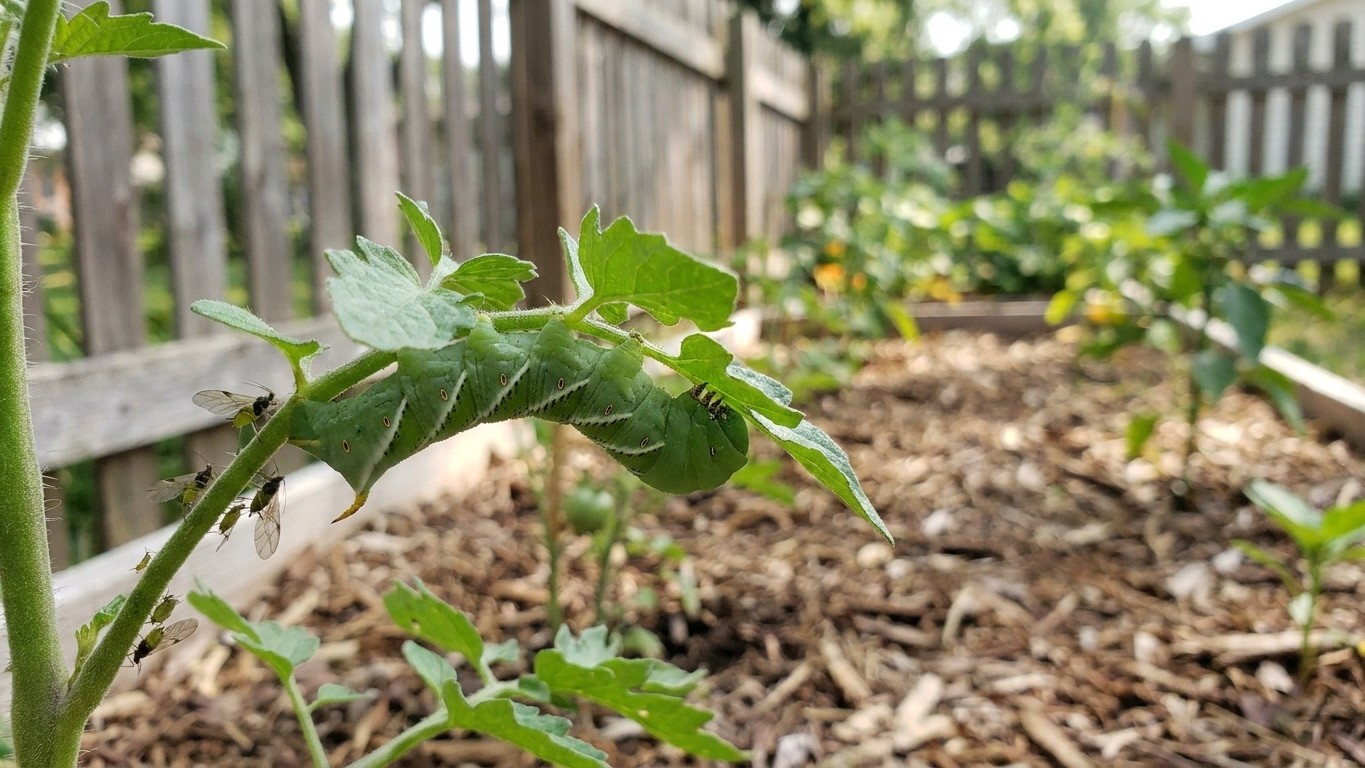
Aphids are small, pear-shaped, soft-bodied insects, usually pale green, that cluster on the undersides of leaves and on new growth. Heavy colonies curl leaves and coat them in sticky honeydew that later grows black sooty mold. A hard spray of water or insecticidal soap knocks numbers down fast, and lady beetles will usually finish the job if nothing broad-spectrum has been sprayed nearby.
Tomato hornworm

This is a large green caterpillar, up to four inches long, with faint white diagonal stripes and a single curved horn at the tail end. It’s remarkably well camouflaged against tomato foliage, and the caterpillar stage is the one that strips a branch bare overnight, so black droppings on the leaves below are often the first sign you’ll spot, not the insect itself. Hand-picking works once you find them, since they’re too large to miss at that point.
Tarnished plant bug (stink bug)
A shield-shaped insect about half an inch long, mottled brown or green, that pierces developing fruit with needle-like mouthparts. The damage shows up as cloudy white or yellow blotches and distorted, puckered scarring near the blossom end. It’s mostly cosmetic on slicing tomatoes but can ruin fruit meant for canning or sale.
Working it out for your own garden
Match the symptom to the pest, not the other way around
The fastest way to identify a Wisconsin tomato pest is to work backward from three things: when in the season you’re seeing damage, where on the plant it shows up, and what the damage actually looks like. Match the timing and the location on the plant before you match a photo, because several of these insects leave similar-looking chew marks and guessing from a picture alone leads to the wrong fix.
| Pest | Typical timing | Where on the plant | Damage signature |
|---|---|---|---|
| Cutworms | First two weeks after transplant | Stem at soil line | Stem severed, plant toppled |
| Flea beetles | Right after transplant into early summer | Young leaves | Small round shot-holes |
| Colorado potato beetle | Late spring through midsummer | Leaf undersides, whole plant | Stripped foliage, yellow egg clusters |
| Aphids | Early summer onward | Leaf undersides, new growth | Curled leaves, sticky honeydew |
| Tomato hornworm | Midsummer to late summer | Upper foliage, stems | Stripped branches, dark droppings |
| Tarnished plant bug | Midsummer through harvest | Developing fruit | Cloudy blotches, catfacing near blossom end |
The exact week each of these shows up shifts with when you actually transplanted, which is why the Tomato Planting Dates in Wisconsin: Counting Back From Your Frost Window guide is worth working through before you start scouting, since it counts backward from Milwaukee’s frost window to give you a transplant range rather than a single date. If the damage is on fruit rather than leaves, start with tarnished plant bug, not hornworm, since hornworms feed almost entirely on foliage and stems. It also matters how long your plants sit in the garden: a longer-season cultivar is exposed to more weeks of aphid and hornworm pressure than a short-season one, which is one more reason the maturity numbers in Tomato Varieties That Ripen in Time in Wisconsin are worth checking against your own frost window.
What changes across the state
North versus south, lake versus inland
Wisconsin runs from USDA hardiness zone 3b in the far north to 6a near Milwaukee, according to the USDA’s Plant Hardiness Zone Map, and that spread changes how long each pest has to build a population, not which pests show up. A shorter frost-free window in the north compresses the whole sequence into fewer weeks, so a gardener there may see cutworm damage and Colorado potato beetle activity crowded closer together than a gardener near Milwaukee does. The far north’s shorter season compresses the pest calendar rather than skipping stages of it.
The Lake Michigan shoreline behaves differently again. NOAA’s climate normals note that the lake delays the first fall freeze right along the shore, while inland southern Wisconsin typically freezes earlier in the fall and the north freezes earlier still. That extra lakeside stretch of frost-free weather in autumn gives late-season pests like tarnished plant bug more time on the fruit before the season ends, while gardens well inland or in the north lose that insect pressure sooner simply because the plants themselves are done. None of this changes which six pests you’re dealing with, only how much of the season each one gets.
The mistakes this state punishes

What to do instead
The single most common mistake is spraying before identifying the insect. A broad-spectrum insecticide aimed at flea beetles will also kill the lady beetles that would otherwise have kept an aphid colony in check, and you end up trading one pest problem for a worse one two weeks later. Don’t spray before you’ve matched the damage to a pest on the table above, and reach for the narrowest option that works, whether that’s a cutworm collar, hand-picking, or a soap spray.
The second mistake is planting tomatoes, potatoes, or peppers in the same bed year after year. Colorado potato beetle overwinters in the soil as an adult and walks straight into the nearest nightshade planting come spring, so rotate nightshade-family crops to a different bed each year if you had a beetle problem the season before. Skipping this step is the reason some gardens fight the same infestation every single year while a bed two plots over never sees one.
The third is assuming a warm early spring means it’s safe to skip scouting. A run of warm days can bring flea beetles and cutworm moths out earlier than the calendar suggests, and a gardener who transplants during that warm spell without checking for either one often doesn’t notice the damage until a plant is already down.
Checking this against your county
Everything above is anchored to Milwaukee’s climate data, and pest pressure shifts with the same distance-from-the-lake and north-south differences that shift the frost dates. Before you plan a spray schedule around any of this, check with your county Extension office through Wisconsin Extension at extension.wisc.edu, since county agents track local outbreaks of Colorado potato beetle and aphid populations that a statewide page can’t capture. If you’re still working out the basics of the crop itself, the state’s tomato guide is the place to start before narrowing down to pests.
Common questions
How do I know if it’s a hornworm or an armyworm?
Look at the tail end. A tomato hornworm has a single curved horn there, while armyworm caterpillars don’t have a horn at all and tend to be smaller and stripe-patterned along the body rather than diagonally. If you see a horn, it’s a hornworm.
Are Japanese beetles a problem on tomatoes here?
They’re present in Wisconsin but tomatoes aren’t their preferred host, so damage on tomato foliage specifically is usually one of the six pests covered above rather than a Japanese beetle. If you’re seeing metallic green beetles skeletonizing leaves on roses or grapes nearby, that’s a separate issue from your tomato patch.
Do ladybugs actually help with aphids or is that a myth?
They genuinely help. Both adult lady beetles and their larvae eat aphids in large numbers, which is exactly why spraying a broad-spectrum insecticide for an unrelated pest often backfires by wiping out the lady beetles along with it.
Why are my tomatoes fine one week and stripped the next?
That sudden a change almost always means tomato hornworm, since a single caterpillar can strip a branch overnight once it reaches full size and its green color hides it well against the foliage until then. Check the undersides of nearby leaves and look for dark droppings on the leaves below the damage.