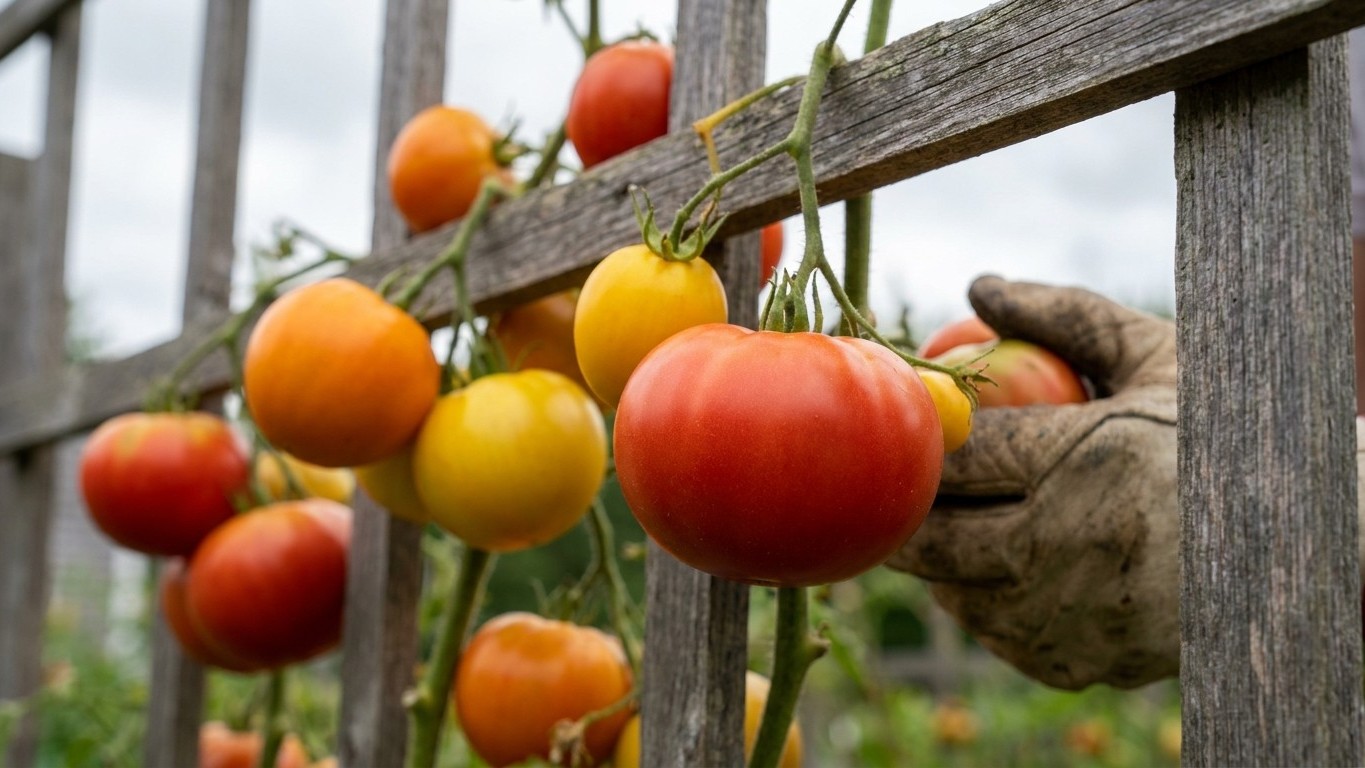

Portland’s frost-free window runs from late April to mid-October at best, and that’s the mild end of Maine — inland and northern gardens get less. Five months sounds generous until you subtract a cold, slow June and realize your tomato’s days-to-maturity number is the whole ballgame. A plant rated under 60 days carries 80-plus days of slack before frost; one rated past 80 leaves barely two months, none of it spare. That number, not the seed packet’s pretty photo, decides what actually ripens on your vine before October.
What this comes down to in Maine

Portland’s frost-free window, per NOAA’s 1991-2020 climate normals, runs from a last spring freeze of April 22 to May 1 to a first fall freeze of October 9 to October 21. That’s roughly five months at the mild, coastal end of the state to take a tomato from transplant to a full harvest, not just a first ripe fruit. Inland and northern Maine, covered in more general terms on growing tomatoes in Maine, work with a shorter window than this, so treat the Portland figure as the generous end of what’s possible statewide.
The practical result is that a cultivar’s days-to-maturity rating decides whether it’s a safe bet or a photo finish. Varieties reaching first ripe fruit in under 60 days from transplant carry 80 to 90 days of margin before the average Portland frost, room enough to absorb a slow June or a bout of blight and still bring in a real crop. Varieties past 80 days leave barely two months of slack, and a cool, wet start to the season can eat most of it before the plant sets a single ripe fruit.
Sakura
Sakura reaches first ripe fruit in about 55 days from transplant, the shortest season of any variety here. Set out early to mid May, it typically starts ripening in early July with roughly 92 days of margin before the average fall frost. The small, round red cherry fruit is a fresh-eating tomato, and its resistance to nematodes, Fusarium and Tomato Mosaic Virus makes it forgiving in soil with a history of disease.
Sun Gold
Sun Gold needs about 57 days from transplant to first ripe fruit, putting harvest in mid July with around 90 days of margin before frost. The small, golden-orange cherry tomatoes grow in long clusters and are bred for sweetness, not for storage or sauce. Its resistance to Tobacco Mosaic Virus and Fusarium Wilt makes it a low-drama pick for a first tomato bed.
Jasper
Jasper matures in about 60 days from transplant, ripening by mid July with roughly 87 days of margin before frost. The fruit is a small, glossy red cherry tomato for fresh eating. Its high resistance to Late Blight matters more here than in drier states, since Maine’s damp coastal summers give the disease plenty of chances to spread.
Juliet
Juliet also finishes around 60 days from transplant, ripening mid July with about 87 days of margin. The fruit is a small, elongated red grape tomato borne in long clusters, good halved into salads or roasted whole. Its intermediate resistance to both early and late blight is useful given how often Maine’s humid summers bring one or the other.
Amalfi
Amalfi takes about 68 days from transplant to first ripe fruit, putting harvest in late July with roughly 79 days of margin. It’s a determinate paste tomato, oblong and deep red, bred for sauce rather than slicing, and its compact bush suits a container or a small raised bed. Intermediate resistance to both early and late blight is a real asset where foliage disease shows up most summers.
Cherokee Purple
Cherokee Purple takes about 72 days from transplant, landing in late July with roughly 75 days of margin, the same window as several of the hybrid slicers on this list. The fruit is a large, flattened beefsteak with dusky pinkish-purple skin and darker shoulders, grown for flavor rather than disease resistance, since it carries none of the resistance codes bred into newer varieties. That makes it a variety to plant alongside more resistant types, not to rely on as the main crop.
Celebrity Plus
Celebrity Plus reaches first ripe fruit in about 78 days from transplant, putting harvest in early August with roughly 69 days of margin, a window that starts to feel tight in a cool or late-starting year. It’s a determinate, red, medium-large slicer bred for a heavy, concentrated fruit set. Resistance to Gray Leaf Spot, Tomato Mosaic Virus and nematodes helps it hold up through a full Maine season despite the later finish.
San Marzano II
San Marzano II also needs about 78 days from transplant, ripening in early August with around 69 days of margin. The fruit is a classic elongated, deep red plum tomato with a pointed blossom end, grown for canning and sauce. Because it’s indeterminate and carries no listed disease resistance, it needs an on-time transplant and steady care to finish reliably this far north.
Amish Paste
Amish Paste is the longest-season variety worth considering here, at about 85 days from transplant to first ripe fruit. Set out at the very start of the early-to-mid-May window, it typically ripens in early August but carries only around 62 days of margin, the thinnest cushion on this list. It’s a large, oxheart-shaped paste tomato with reddish skin and some ribbing, and it belongs in gardens with a reliably on-schedule spring rather than one prone to a cool, late start.
| Variety | Days to Maturity | Type | First Ripe (Portland estimate) | Margin Before Frost |
|---|---|---|---|---|
| Sakura | 55 | Cherry | Early July | ~92 days |
| Sun Gold | 57 | Cherry | Mid July | ~90 days |
| Jasper | 60 | Cherry | Mid July | ~87 days |
| Juliet | 60 | Grape | Mid July | ~87 days |
| Amalfi | 68 | Paste (determinate) | Late July | ~79 days |
| Cherokee Purple | 72 | Beefsteak (heirloom) | Late July | ~75 days |
| Celebrity Plus | 78 | Slicer (determinate) | Early August | ~69 days |
| San Marzano II | 78 | Paste | Early August | ~69 days |
| Amish Paste | 85 | Paste (heirloom) | Early August | ~62 days |
Working it out for your own garden
Start with the frost window itself, not with a seed catalog. NOAA’s 1991-2020 climate normals put Portland’s last spring freeze between April 22 and May 1 and its first fall freeze between October 9 and October 21. That gap, a little over five months, is the outer limit of what any tomato has to work with at the mild end of the state. The Tomato Planting Dates in Maine: Counting Back From Your Frost Window page walks through the transplant-date arithmetic in full, but the short version is that transplants go out once the frost risk has dropped, not on a fixed calendar date.
A variety that finishes with room to spare
To check whether a specific variety fits, take its days-to-maturity figure and count forward from the transplant window, since the frost date itself is a range, not a point. Sun Gold, at 57 days from transplant, set out early to mid May, reaches first ripe fruit in mid July and still has roughly 90 days left before the earliest expected fall freeze. That’s enough slack to absorb a slow, cool June and still bring in a full harvest, not just the first fruit.
A variety that cuts it close
Amish Paste, at 85 days from transplant, tells a different story even at Portland. First ripe fruit doesn’t arrive until early August, and only about 62 days of margin remain before the average frost. That margin assumes an on-time transplant and a normal summer. Push the transplant back two weeks because of a cold, wet spring, or garden further inland where the season starts later and ends sooner than Portland’s, and an 85-day variety can run out of season before it sets a full crop, even though the plant itself survives fine.
The method scales to any variety not covered here: find its days-to-maturity, add it to the early-to-mid-May transplant window this frost data supports, and see where that lands against the October frost range. Anything landing inside the first half of October has real margin. Anything crowding the back half of that range, or past it, is worth a plant or two, not a whole bed.
What changes across the state
Portland sits at the mild, coastal edge of Maine’s growing conditions, and the frost dates NOAA’s normals give for it are about as early-to-thaw and late-to-freeze as the state gets. Moving inland, away from the ocean’s moderating effect, both ends of the season work against the gardener: spring frost risk lingers later into the calendar, and the first fall freeze arrives earlier. The coast buys extra weeks that inland valleys and hill towns simply don’t get, even at a similar latitude.
Elevation compounds this. Cold air is heavier than warm air and drains downhill overnight, so a garden sitting in a low-lying frost pocket, whether inland or in a river valley, can see frost on nights when a garden a few hundred feet higher up the same slope stays clear. A tomato bed at the bottom of a hollow can lose two or three weeks of growing season compared with one on a gentle rise nearby, even within the same town.
Northern Maine runs on an entirely different clock than the coastal south. USDA’s Plant Hardiness Zone Map puts the state across zones 3b to 6a, and a five-zone spread inside one state’s borders is the clearest sign that a single frost date can’t stand in for Maine as a whole. The far north and the high interior sit at the cold end of that range, with a meaningfully shorter frost-free season than Portland’s, which is exactly why longer-season varieties like Amish Paste or San Marzano II carry more risk there than the Portland-based math above suggests.
Large inland lakes create a small exception of their own, moderating the immediate shoreline the way the ocean does on a smaller scale, so a garden right on a big lake can outperform a low-lying field a few miles away with no water nearby. None of this reduces to a single adjusted date without local data, which is exactly why checking against your own county matters more than any statewide figure.
The mistakes this state punishes

The most common mistake is planting by the calendar instead of by the soil. A warm stretch in mid or late April can push air temperatures up fast near the coast, and it’s tempting to set transplants out the moment the forecast looks friendly. But NOAA’s frost normals describe air temperature, not soil, and a late cold snap inside the April 22 to May 1 window at Portland, or later inland, can still stunt or kill tomatoes set out too early. Wait for the transplant window this frost data supports, not for the first nice weekend.
The second mistake is choosing fruit size and flavor over days-to-maturity, especially with heirlooms. Cherokee Purple carries no listed disease resistance and takes 72 days from transplant, and a gardener who plants a whole bed of a variety like it, in a year the spring turns out cool and late, can watch the first frost arrive before more than a handful of fruit have ripened. Grow one or two heirlooms for flavor, and lean on shorter-season, resistant varieties for the bulk of the harvest.
The third is ignoring disease timing that’s specific to this state’s damp, cool summers. Late blight moves fast in humid coastal weather and can take out an entire planting of a susceptible variety within a couple of weeks, which is why cultivars with intermediate or high blight resistance, like Jasper or Amalfi, are worth choosing over a flavor-only heirloom in a wet year. The Tomato Pests in Maine: Which Ones Actually Show Up Here page covers what to watch for and roughly when it shows up.
The fourth is transplanting every variety on the same day regardless of season length. Setting out an 85-day paste tomato and a 55-day cherry on the same date wastes the cherry’s margin and doesn’t buy the paste tomato any extra time it doesn’t already have from the calendar.
Checking this against your county
Every figure in this article comes from one weather station near Portland, and Maine’s coast, hills and northern counties all depart from it in one direction or another. Before betting a bed on a longer-season variety like Amish Paste or San Marzano II, check your own county’s typical frost dates with UMaine Cooperative Extension, which keeps offices across the state and can be reached through extension.umaine.edu. A county office can also tell you how your specific microclimate tends to run relative to the coastal normals used here, which is the number worth weighing against the seed packet, not the statewide range.
Common questions
What’s the earliest tomato I can grow in Maine?
Of the varieties covered here, Sakura and Sun Gold are the fastest, both reaching first ripe fruit in under 60 days from transplant. It’s less about a special “earliest” category of tomato and more about picking a short-season cultivar and setting it out inside the early-to-mid-May window that Portland’s frost data allows.
Is it too late to plant tomatoes in June in Maine?
Not necessarily, but it narrows your options fast. A June transplant of an 85-day variety like Amish Paste, counted forward, can land uncomfortably close to the October frost window at Portland, and later still further inland. Stick to varieties in the 55 to 65 day range, like Sakura, Sun Gold, Jasper or Juliet, if you’re starting that late.
Do container tomatoes ripen faster in Maine?
Container soil warms up faster in spring than garden soil, which can give a plant a small head start, but it doesn’t change a variety’s days-to-maturity rating. A 78-day variety in a pot still needs roughly 78 days from transplant to first ripe fruit, so the same short-season cultivars that work in the ground are the safer bet in containers too.
Why did my tomatoes stop ripening before I got a full harvest, even though the seed packet said they had time?
Days-to-maturity figures on seed packets are counted under close-to-ideal conditions, and Maine’s actual weather rarely delivers all of it. A cold spring that delays transplanting by even a week or two eats directly into a variety’s frost margin, and a cool, cloudy summer slows ripening on top of that. Build in extra margin by choosing a variety shorter than the bare minimum the calendar seems to allow, rather than planting right up to the line.