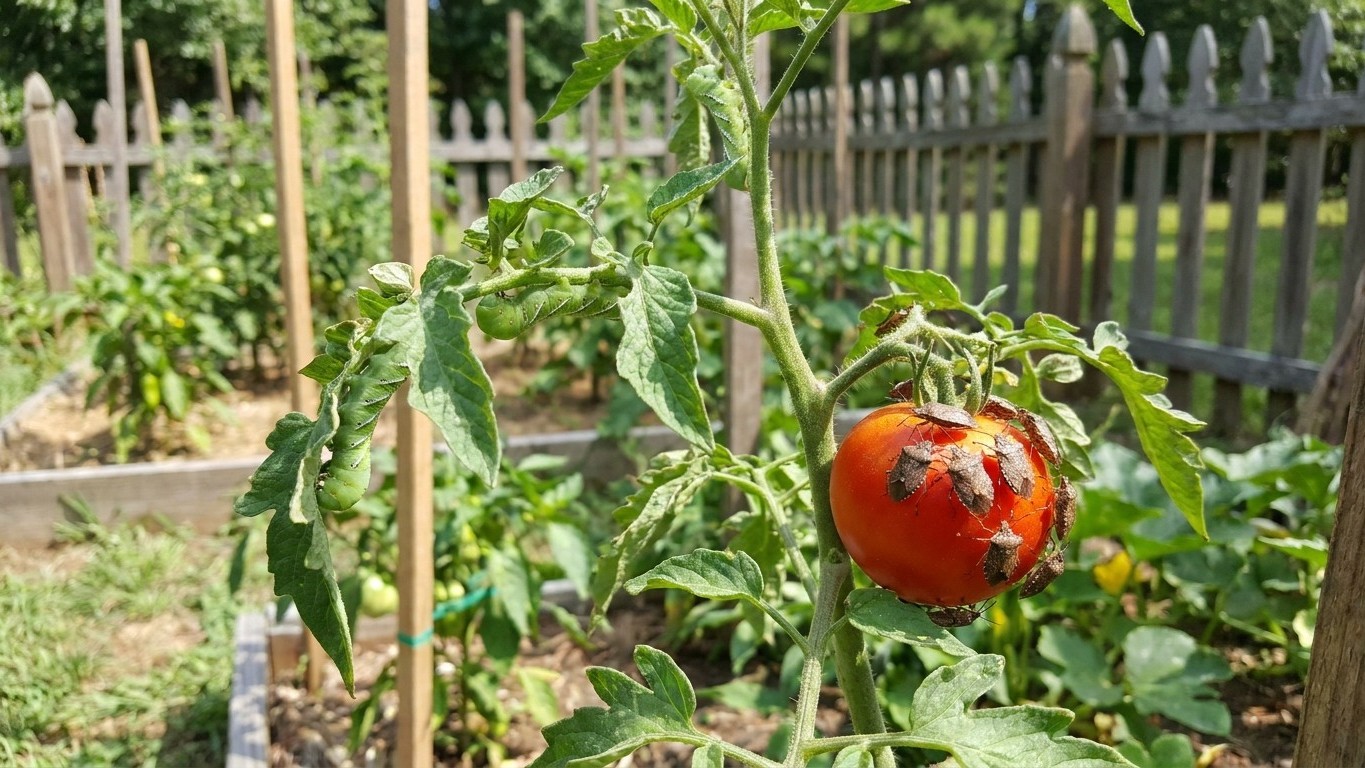

Alabama tomato growers deal with a short, repeatable list of pests: flea beetles, aphids, stink bugs, tomato hornworms, leaffooted bugs and spider mites show up almost every year, while something like Colorado potato beetle stays rare here. The single move that saves the most fruit is scouting leaf undersides and green shoulders weekly starting the week transplants go in, which for the Huntsville area falls early April to mid April, following NOAA’s 1991-2020 climate normals for the last spring freeze.
What this comes down to in Alabama

Six insects account for nearly every tomato problem Alabama gardeners deal with in a given season: flea beetles first, aphids close behind on new growth, then stink bugs once fruit sets, followed by hornworms, whiteflies, and spider mites as the heat builds. Each shows up on its own schedule, does its own kind of damage, and calls for its own fix — no single spray or trick covers all six. Knowing which one you’re actually looking at is most of the battle.
Once transplants are established using the method covered on growing tomatoes in Alabama, what happens next is mostly a question of which of six insects finds the plant first.
Flea beetles
Flea beetles show up first, often within days of setting transplants out, and they are the reason a young tomato plant sometimes looks peppered with tiny round holes overnight. The adults are shiny black or bronze beetles smaller than a sesame seed, and they jump when you brush the leaf, which is the easiest way to confirm what you are looking at. A few holes rarely slow down an established plant, but a heavy hit on a transplant under six inches tall can stunt it. Row cover kept on until the plant is growing hard usually solves the problem without a spray.
Aphids
Aphids build up on new growth through late spring, clustering in tight groups on stem tips and the undersides of the youngest leaves. They are soft, pear-shaped, and range from pale green to black depending on the population, and heavy feeding curls and yellows the leaf before you spot the insects themselves. A strong jet of water knocks most colonies down, and lady beetles usually finish the job if nothing broad-spectrum has already wiped them out.
Stink bugs
Stink bugs move in once fruit starts to set, and their damage shows up as firm, pale or cloudy spots just under the skin rather than as a hole. The adults are shield-shaped, roughly a half inch to three-quarters of an inch long, and green or brown depending on the species. They feed by piercing rather than chewing, so the fruit often looks fine from a distance and only shows the damage once you slice into it. Keeping the area around the tomato bed free of tall weeds cuts down on the population that moves in from field edges.
Tomato hornworm
Hornworms arrive in early to midsummer and do the most visible damage of any pest on this list. A plant that looked full one evening can be half-stripped by morning. The caterpillar itself is easy to miss, pale green with white diagonal stripes and a curved horn at the tail end, sometimes growing to four inches long before it pupates. Handpicking works fine once you know to look for the dark droppings on the leaves below the feeding, which is usually how gardeners find the caterpillar rather than the other way around.
Leaffooted bugs
Leaffooted bugs turn up as fruit ripens, usually a few weeks behind stink bugs, and cause the same kind of internal spotting from their piercing feeding. The adults are slender, brownish-gray, three-quarters of an inch to an inch long, with a flattened, leaf-shaped section on each hind leg that gives the insect its name. They tend to gather in numbers on a single ripening cluster, which makes handpicking into a bucket of soapy water more practical than it sounds.
Spider mites
Spider mites show up last, during the hottest, driest stretch of summer, and they are the pest most gardeners identify by its damage rather than the mite itself. Look for fine webbing and a pale, dusty stippling on the underside of leaves. The mites themselves are nearly invisible without a hand lens. Regular overhead watering during a dry spell keeps populations down, since mites thrive in dust and heat and struggle when leaves stay damp.
Working it out for your own garden
The fastest way to identify a pest problem is to work backward from the damage instead of trying to catch the insect in the act. Chewed leaves with visible holes point to flea beetles or hornworms, depending on the size of the hole and whether dark frass is present nearby. Curled, yellowing new growth points to aphids. Fruit that looks fine on the outside but shows a firm pale spot when you cut it open points to stink bugs or leaffooted bugs, and the only way to tell those two apart is to catch an adult on the plant. Fine webbing and stippled, dusty-looking leaves in the middle of a hot dry stretch is almost always spider mites.
Timing follows the same logic as planting. If you already worked out your transplant date using the method on Tomato Planting Dates in Alabama: Counting Back From Your Frost Window, you have a rough calendar for when each pest becomes a risk. Flea beetles hit hardest in the first few weeks after transplants go in, when the plant is small and every bite counts. Stink bugs and leaffooted bugs become the main worry once the first fruit sets, roughly six to eight weeks after transplant for a fast cultivar, and spider mites become the concern in the hottest stretch of summer regardless of when you planted.
Matching damage to pest
| What you see | Likely pest | When it shows up | What to check |
|---|---|---|---|
| Small round holes in young leaves | Flea beetles | First weeks after transplant | Jump when leaf is brushed |
| Curled, yellow new growth | Aphids | Late spring | Clusters on stem tips and leaf undersides |
| Stripped foliage overnight | Tomato hornworm | Early to midsummer | Dark droppings on lower leaves |
| Firm pale spot under skin | Stink bugs or leaffooted bugs | Once fruit sets | Adult insect on or near fruit clusters |
| Fine webbing, dusty stippling | Spider mites | Hot, dry midsummer | Hand lens on leaf underside |
What changes across the state
The frost dates and season length used above come from the weather station near Huntsville, and every county south of there gets a longer season, which changes pest pressure more than it changes planting dates. USDA’s 2023 hardiness map places the state across zones 7a to 9a, and the gap between those zones tracks roughly with distance from the Gulf coast. A longer frost-free season in the southern tier gives aphids, stink bugs and spider mites time to run through additional generations before the year is over, so gardens near Mobile or Baldwin County typically deal with heavier late-season pressure from those three than gardens in the Tennessee Valley.
Elevation works the other way. The higher ground in the northeastern corner of the state, up toward the Appalachian foothills, holds a shorter season and cooler nights than Huntsville itself, which tends to delay both flea beetle emergence in spring and spider mite buildup in summer. Humidity matters too. Gardens closer to the coast or near large rivers stay damper through summer, which keeps spider mites in check but can extend the window when stink bugs and leaffooted bugs find a plant attractive, since both prefer humid, sheltered growth.
None of this changes which six pests you are watching for. It changes how early they show up and how many rounds of each you get in a season. A gardener in the Wiregrass region should expect to scout longer into fall than the Huntsville figures suggest, and a gardener at higher elevation in the north should expect the opposite. Check your own county’s frost record before assuming the reference-city numbers apply directly to your yard.
The mistakes this state punishes

The most common mistake is reaching for a broad-spectrum insecticide the first time a hole shows up in a leaf. That kills the lady beetles and parasitic wasps that would otherwise keep aphids and hornworm eggs in check, and it often makes the season worse rather than better. Save the spray for a confirmed, spreading problem, not the first flea beetle hole.
The second mistake is running a long-season cultivar in a garden that also fights heavy late-season stink bug and leaffooted bug pressure. A cultivar like Amish Paste, at 85 days from transplant, still clears Huntsville’s fall frost window with room to spare, but it also spends more weeks with ripening fruit exposed to piercing insects than a 55 to 60 day cultivar such as Sakura or Jasper would. Where pest pressure runs high, choosing a shorter-season cultivar from the list on Tomato Varieties That Ripen in Time in Alabama also shortens the window stink bugs and leaffooted bugs have to work on the fruit, on top of the frost margin it already buys.
The third mistake is letting weeds and volunteer tomato plants stand at the edge of the garden through fall. Stink bugs and leaffooted bugs overwinter in plant debris and tall weeds nearby, and a bed cleared of both gives next year’s population fewer places to start from. Pulling spent plants and cutting back weedy edges once the last fruit is picked costs an afternoon and measurably reduces what shows up the following spring.
Checking this against your county
Everything above is anchored to the weather station near Huntsville, and the Alabama Cooperative Extension System publishes county-level guidance that accounts for the state’s real range from the Tennessee Valley to the Gulf coast. Call or visit your county extension office through the Alabama Cooperative Extension System for a pest calendar built around your own location, especially if you garden south of Montgomery or at meaningful elevation in the northeast. The state-wide pattern in this piece gets you started, but your county office is where the frost dates and pest timing get corrected for your actual ground.
Common questions
Do I need to spray for tomato hornworms every year?
Not usually. Hornworms tend to show up in patches rather than in every garden every year, and a plant with only one or two caterpillars usually survives fine once you pick them off by hand. Save any spray for an infestation you genuinely can’t keep up with by hand.
Why are my tomatoes fine on the outside but mushy or spotted when I cut them open?
That is the classic sign of stink bug or leaffooted bug feeding rather than a disease. Both insects pierce the fruit to feed without leaving an obvious entry wound, so the damage only becomes visible once you slice into it.
Are ladybugs actually eating my aphids or is that a myth?
Ladybugs and their larvae genuinely eat large numbers of aphids, and a colony that looks out of control can collapse within days once lady beetles find it. That is the main reason to hold off on a broad-spectrum spray the first time you see aphids on a plant.
Can Colorado potato beetle show up on Alabama tomatoes?
It can, since tomato is a host plant, but it is far less common here than on potatoes and much less common than the six pests covered above. If you find a yellow-and-black striped beetle on a tomato plant in Alabama, treat it as an occasional visitor rather than an annual threat.