
Georgia’s frost-free stretch runs roughly eight months near Atlanta, where NOAA’s NCEI 1991-2020 climate normals put the last spring freeze between March 11 and March 29 and the first fall freeze between November 13 and December 1. That’s long enough for several insect generations to build up before the season ends, and it’s why the pest list changes as summer goes on instead of staying fixed. Walk your rows twice a week once fruit starts to set, checking leaf undersides and the green shoulders of the fruit, since that’s where the damage shows first.
What this comes down to in Georgia

The insects that matter most here are the ones that show up at a predictable point in the tomato’s life, not the ones that could theoretically appear anywhere. Eight pests account for nearly all the tomato damage reported across the state, and they arrive in roughly the same order every year: sap feeders on young transplants first, fruit and foliage feeders once plants are producing, then the heat-loving pests that build up hardest in the driest stretch of summer.
Aphids

Aphids are soft-bodied insects about the size of a pinhead, green to yellowish-green, clustered on the undersides of young leaves and stem tips in the cool weeks right after transplanting. They suck sap and leave curled, sticky leaves coated in honeydew and sooty mold. A strong water spray or insecticidal soap knocks small colonies down before they produce the winged stage that spreads to the rest of the row.
Flea Beetles

Flea beetles are tiny, shiny black beetles, barely a sixteenth of an inch long, that jump like fleas when a leaf is disturbed. They chew small round holes through young foliage, giving transplants a shotgun-blast look within days of going into the ground. Row covers left on until plants flower keep them off entirely, since the damage is worst on tender seedlings and tapers off once plants toughen up.
Thrips

Thrips are slender, straw-colored to dark brown insects, smaller than a grain of rice, feeding by rasping the leaf surface and leaving silvery, stippled patches along the midrib. The bigger risk isn’t the feeding scar but the virus some thrips carry from plant to plant before you’ve spotted a single insect. Picking varieties known for strong disease resistance, covered on the Tomato Varieties That Ripen in Time in Georgia page, is one more layer of protection once a virus is already circulating in the area, along with reflective mulch and knocking back weedy borders where thrips overwinter.
Tomato Hornworm

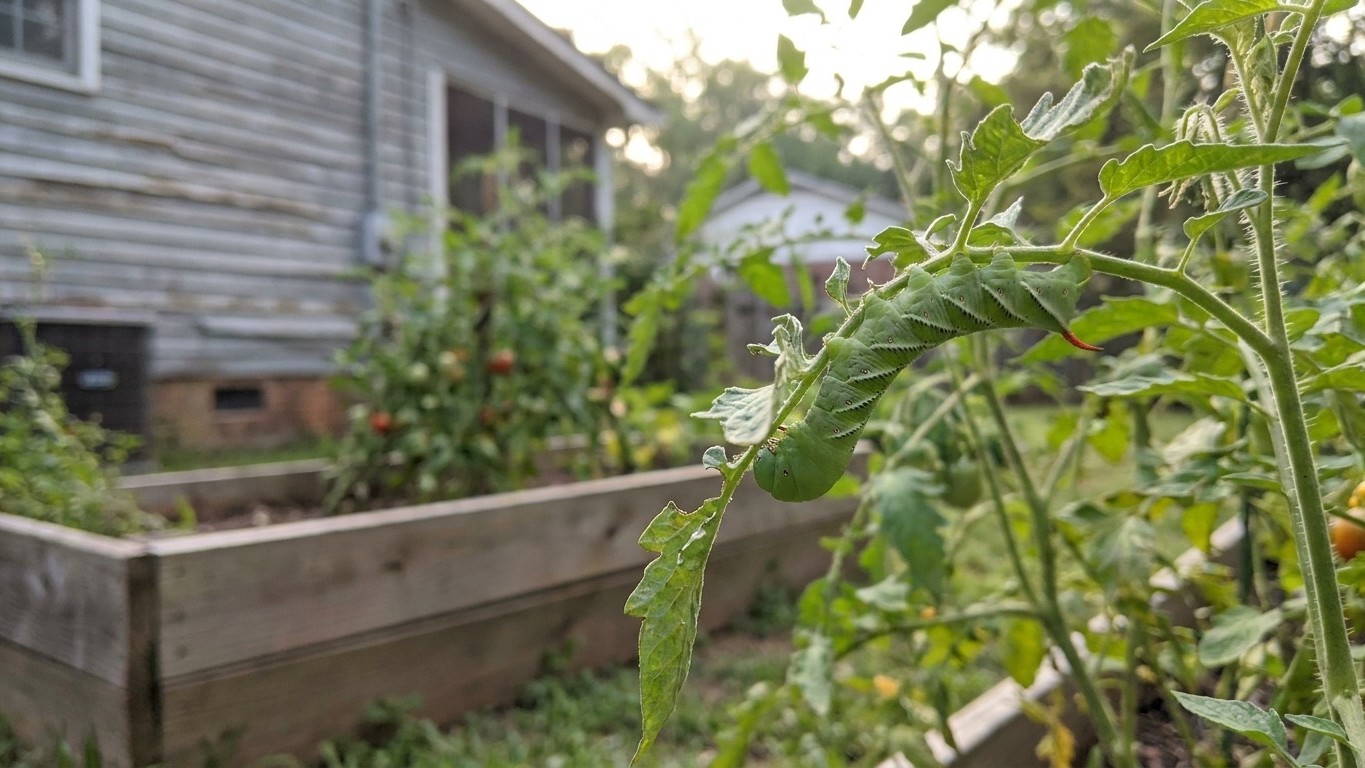
The tomato hornworm is hard to miss once it’s grown: a fat green caterpillar up to four inches long, marked with pale diagonal stripes and a curved horn at the tail end, usually found stripping whole branches of leaves and biting into green fruit. It’s the larval stage that does the damage. The adult is a large gray sphinx moth that never touches the plant, so hand-picking the caterpillar works fine on a few plants, and Bacillus thuringiensis handles larger infestations without harming pollinators.
Stink Bugs

Stink bugs are shield-shaped, about half an inch long, either solid green or mottled brown depending on species, and they feed by piercing developing fruit rather than chewing leaves. The damage shows up later as hard, pale blotches under the skin called cloudy spot, which ruins slicing tomatoes even when the rest of the fruit looks sound. They’re hardest to control once fruit is already forming, so managing weedy field edges where they overwinter matters more than spraying an established population.
Tomato Fruitworm

The tomato fruitworm, the same species known as corn earworm, is a caterpillar that ranges from green to brown to pink with faint lengthwise stripes, growing to about an inch and a half. It bores a clean, round entry hole straight into the fruit and feeds from the inside, so the surface damage is easy to miss until you cut into what looked like a sound tomato. Picking off visible caterpillars and removing damaged fruit promptly keeps a small problem from becoming a season-long one.
Whiteflies
Whiteflies are tiny white insects, about the size of a gnat, that rise off the plant in a small cloud when a leaf is brushed. Adults and their flat, scale-like nymphs cluster on leaf undersides, and heavy infestations in late-summer heat leave leaves yellowed and sticky with honeydew. Insecticidal soap applied to the underside of leaves, where the colony actually lives, does more than spraying the tops of the plant.
Spider Mites
Spider mites are barely visible without a hand lens, pale yellow to reddish specks that build up fast in hot, dry stretches, leaving fine stippling on leaves along with wisps of webbing near the growing tips. They thrive in dust and drought stress, so a plant that’s gone without water for a week in the heat of summer is the one to check first. A strong hose-down or insecticidal soap breaks up light infestations before webbing takes over the plant.
Working it out for your own garden
Start by asking two questions: what part of the plant is damaged, and when in the season did it show up. A leaf riddled with round holes on a three-week-old transplant points to flea beetles. A leaf stripped down to the veins by a thick green caterpillar in midsummer points to hornworms. A fruit with a clean, round entry hole is fruitworm. A fruit with no visible hole but hard, pale blotches under the skin is stink bug feeding. Matching the damage to the plant part narrows the list to two or three suspects before you ever need a hand lens.
| Pest | Plant part hit | Typical timing | Damaging stage |
|---|---|---|---|
| Aphids | New growth, leaf undersides | Early season | Nymph and adult |
| Flea beetles | Young leaves | Right after transplanting | Adult |
| Thrips | Leaf surface, whole plant via virus | Early to mid season | Larva and adult |
| Tomato hornworm | Foliage and green fruit | Mid to late season | Larva |
| Stink bugs | Developing fruit | Mid to late season | Nymph and adult |
| Tomato fruitworm | Fruit interior | Mid to late summer | Larva |
| Whiteflies | Leaf undersides | Late season, hot weather | Nymph and adult |
| Spider mites | Leaves, growing tips | Hot, dry stretches | Adult and nymph |
Timing also tracks closely with the planting decisions covered on the Tomato Planting Dates in Georgia: Counting Back From Your Frost Window page. A crop set out at the earliest safe date in the March 11 to March 29 window near Atlanta meets flea beetles and aphids on tender young growth first, then runs into hornworms and stink bugs once fruit is setting, and finishes ahead of the worst spider mite pressure that builds in the driest part of late summer. A late-set crop compresses all of that into a shorter window and often meets several pests at once. If you can only scout once a week, do it while fruit is sizing up, since that’s when stink bugs, fruitworms and hornworms all do damage that’s expensive to lose.
What changes across the state
The frost window and pest calendar described above come from a NOAA weather station near Atlanta, and Atlanta’s airport sits in an urban heat island that runs warmer than the surrounding countryside, so both the frost dates and the length of the pest season shift once you leave the metro area. North Georgia’s mountains and higher elevations cool off earlier in fall than Atlanta does, which shortens the window for late-season pests like fruitworm and cuts one or two generations off pests that need sustained heat to build large populations, such as spider mites and whiteflies.
The coastal plain in south Georgia runs milder and holds warmth later into fall, which stretches the season for insects that thrive in heat and humidity. Whiteflies and spider mites, both of which build up fastest in hot, dry conditions, tend to be a bigger problem farther south and later in the year than they are near Atlanta. Stink bugs also move in from surrounding field crops such as soybeans and cotton, so a garden near large-scale row crop farms can see heavier pressure than one in a purely residential area, regardless of which region of the state it sits in.
Humidity matters as much as temperature for some of these pests. The Piedmont and the coastal plain both run more humid through summer than the mountains, and that humidity favors the fungal problems that often follow behind insect damage, not just the insects themselves. None of this changes which pests are possible in Georgia, only how early they arrive and how many generations they get through before frost. A gardener in the mountains should expect the whole pest calendar described above to run a few weeks behind a garden near Atlanta, and one on the coastal plain to run a few weeks ahead.
The mistakes this state punishes

The most common mistake is treating a pest problem after the damage is already done, since several of Georgia’s tomato pests do their worst work inside the fruit or under the skin where it can’t be seen happening. By the time cloudy spot from stink bugs or a fruitworm’s entry hole shows up on a ripe tomato, the feeding happened days earlier. Scouting has to happen while fruit is still green and sizing up, not after the first ripe tomato tells you something was wrong.
Skipping row covers on young transplants is the second one. Flea beetles and aphids do the most damage in the first few weeks after planting, right when the frost window near Atlanta tempts gardeners to set plants out and then stop paying close attention while the plant establishes. A cover left on until first bloom keeps both off the plant during the exact stretch when a small transplant can least afford the loss.
Letting weedy borders and old crop residue sit through winter costs gardeners here more than it does farther north, because Georgia’s mild winters let stink bugs and thrips overwinter successfully in leaf litter and weedy edges rather than being killed off by hard cold. Clearing old tomato plants and nearby weeds at the end of the season removes the overwintering site, instead of leaving next year’s first generation waiting a few feet from the garden.
Reaching for a broad-spectrum insecticide at the first sign of any insect wipes out the lady beetles, lacewings and parasitic wasps that would otherwise keep aphids and hornworm eggs in check, and it often makes spider mite outbreaks worse rather than better since mites rebound faster than their predators do.
Checking this against your county
Every figure above comes from one NOAA weather station near Atlanta, and pest pressure shifts even more than frost dates do once you move to a different part of Georgia. Your county’s UGA Extension office tracks pest activity specific to your area and can confirm whether an insect you’ve found matches what’s actually active locally that week, rather than what’s typical for the state as a whole. If you’re still working out your planting window before pests even become a concern, the basics are covered on the growing tomatoes in Georgia page.
Common questions
Do I need to spray something before I actually see any bugs?
No. Spraying on a schedule instead of in response to what you find on the plant kills off the beneficial insects that keep aphids and hornworm eggs under control, and most of the pests here are easy to identify once you know what to check and when.
Can I just cut the damaged part off a tomato with stink bug spots and eat the rest?
Yes, cloudy spot from stink bug feeding is a texture and cosmetic issue under the skin, not a food safety problem, and the unaffected flesh is fine to eat once you’ve cut around the hard, pale blotch.
Will ladybugs actually get rid of aphids on my tomatoes?
They help, but buying and releasing them rarely works on its own, since store-bought ladybugs tend to fly off within a day or two if there isn’t already a large aphid colony to hold them there. Naturally occurring lady beetles that show up on their own are more reliable, which is another reason to avoid broad-spectrum sprays that kill them off early in the season.
Do marigolds or other companion plants keep pests off tomatoes?
Not reliably enough to skip scouting and row covers. Some gardeners report fewer pest issues near marigolds and basil, but none of Georgia’s main tomato pests are consistently repelled by companion planting alone, so treat it as a nice extra rather than your main line of defense.