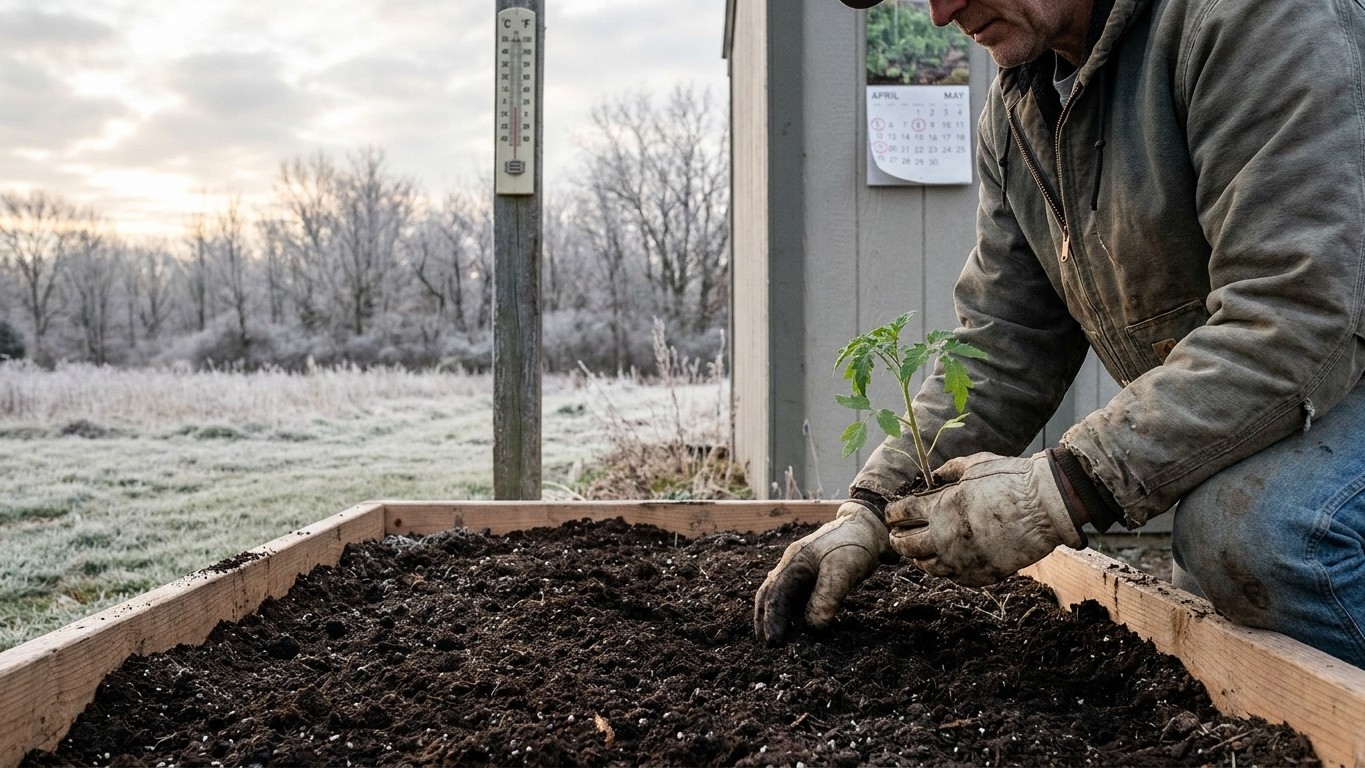

Michigan’s growing season runs on one number that most gardeners never actually calculate: the frost-free window. Between a hardiness range of 4a to 6b and a last frost that lingers into May across much of the state, the state allows a solid five months of open ground in its warmer pockets, and noticeably less everywhere else.
How long your season really is

Start with the three numbers that actually govern a Michigan garden. The USDA Plant Hardiness Zone Map (2023 edition, built on 1991-2020 normals) places the state across a 4a to 6b range, a spread wide enough that a planting decision good for one county can be wrong for another. The Detroit area, used here as the reference point, sees an average last spring frost around April 30, while most of the Lower Peninsula runs later, into early or mid May. On the other end, MSU Extension’s Michigan Garden Calendar puts the average first fall frost between October 6 and October 21 for zone 6a, the warmest slice of the state.
Put those together and the Detroit-area frost-free window comes out to roughly 159 to 174 days, call it five to five and a half months. That’s the number that decides everything else. A tomato variety rated at 80 days to maturity fits comfortably. A pumpkin variety rated at 100-plus days, started from seed outdoors rather than transplanted, is cutting it close even in the warmest counties, which is why knowing When to Carve a Pumpkin in Michigan depends so heavily on getting the planting date right. Watermelon, okra, and long-season winter squash are workable here, but they’re a calculated risk, not a default choice, and they get riskier fast as you move north or away from the lake-moderated southeast. Shorter-season heat lovers fare better within this window, which is also why Growing Peppers in Michigan tends to be a more forgiving bet than the longer-season crops mentioned above, and it’s part of why Growing Potatoes in Michigan fits so well within this same frost-free window, much like the shorter, cool-tolerant timeline behind Growing Carrots in Michigan, and it’s the same reasoning that makes Growing Sweet Corn in Michigan such a reliable fit for the state’s frost-free stretch, Growing Beets in Michigan, Growing Parsnips in Michigan, and Growing Spinach in Michigan, not to mention the perennial patience required for Growing Asparagus in Michigan.
The part worth saying plainly: those frost dates are averages, not promises. By definition, half of all years land later than the average last frost or earlier than the average first frost. A gardener who plants tender crops exactly on the average date is gambling on better-than-average luck in roughly half the years on record. Building in a one-to-two week buffer on both ends isn’t overcaution, it’s just reading the statistic correctly. The frost-free window is the ceiling on what this state’s season allows. Everything else, heat, pests, soil, works inside that ceiling, not around it.
What the summer does to a garden here
Length isn’t the only constraint. NOAA’s 1991-2020 climate normals for the Detroit reference station put the average number of days at or above 90F at 10.3 a year, and the average daily minimum for the coldest month at 19.2F. Neither number sounds dramatic on its own, but both shape the season in specific ways.
The 90F threshold matters because heat above that point does concrete damage to specific crops. Tomatoes stop setting fruit when daytime highs push past roughly 90F for stretches, because the flowers drop instead of pollinating. Lettuce and spinach bolt, turning bitter and running to seed, in the same conditions. That means the cool-season half of the garden, lettuce, spinach, peas, and similar crops, has to be timed for the spring and fall shoulders, not planted straight through midsummer and expected to hold.
At only 10.3 days a year averaging 90F or hotter, Michigan doesn’t produce the long, punishing heat stretch that some southern states deal with. The practical shape of the season here is one continuous stretch rather than two separate seasons split by a dead summer. But those heat days tend to cluster in short bursts during July, and a gardener who ignores them loses a tomato flush or bolts a lettuce bed for the year. The 19.2F winter minimum, meanwhile, is the figure behind the hardiness zone itself. It’s the number that decides whether a perennial, fruit tree, or overwintering crop survives here at all, not just whether it grows well in summer.
What tends to go wrong in Michigan
MSU Extension’s home garden guidance flags a handful of pests that show up reliably enough to plan around, rather than the dozens that exist in theory. Striped and spotted cucumber beetles arrive early, often on young cucumber, squash, and melon transplants right as seedlings emerge. Beyond the feeding damage on leaves, they carry bacterial wilt, which can take down an otherwise healthy plant within weeks of a beetle visit.
Squash vine borer follows later, typically as plants are sizing up in early summer. The adult moth lays eggs at the base of the stem, and the larva tunnels inside, so the first sign is often a vigorous squash or pumpkin plant that wilts suddenly despite adequate water, the damage already done before it’s visible from outside. Squash bug shows up in a similar window and through late summer, feeding on sap and causing leaves to wilt and blacken, working in clusters that can be easy to miss until the population is established.
One pest on the state’s list isn’t a vegetable-garden problem at all: emerald ash borer targets ash trees specifically, and has reshaped the tree canopy in yards and neighborhoods across the state over the past two decades. It’s worth knowing about for anyone with an ash tree on the property, separate from anything happening in the raised beds. None of this is a spray schedule, and none of it should be treated as one. It’s a heads-up on timing and symptoms, so a wilting plant in July reads as a clue rather than a mystery.
Where to check before you plant
Everything above is a state-level average, and Michigan spans enough latitude and lake effect to make that average useful mainly as a starting point. A hardiness range of 4a to 6b means the same state contains conditions roughly two full zones apart, and a planting calendar built around one reference city can run two to three weeks off at either edge of the state, whether that’s the Upper Peninsula, the interior, or the far southeast corner.
The reliable next step is Michigan State University Extension, the state’s land-grant extension service, which publishes region-specific frost dates, planting calendars, and pest alerts drawn from local data rather than a single reference station. From there, the county extension office is worth a direct call or visit, since county staff can speak to conditions on your actual soil and microclimate rather than a statewide average. The county office is where those general terms get corrected for the specific patch of ground behind your house.
Where to Go Next for Specific Crops
Michigan’s frost dates and cold stretches don’t hit every plant the same way, so it’s worth reading up on the specifics before you commit seed or clove to soil. If garlic’s on your list, the guide to planting dates, varieties and winter cold walks through why that six-to-eight-week stretch below 40°F matters so much for a proper head instead of a single round bulb. Thinking about the yard itself rather than a bed? The breakdown of what to plant and when to feed a Michigan lawn starts from the state’s short, mild summer and shows why warm-season grasses are fighting an uphill battle here. And if tomatoes are the plan, the piece on planting dates, varieties and local pests tackles the trouble with treating Detroit’s April 30 frost-free date as a statewide starting gun, especially once you’re pushing north of Ann Arbor and Lansing.