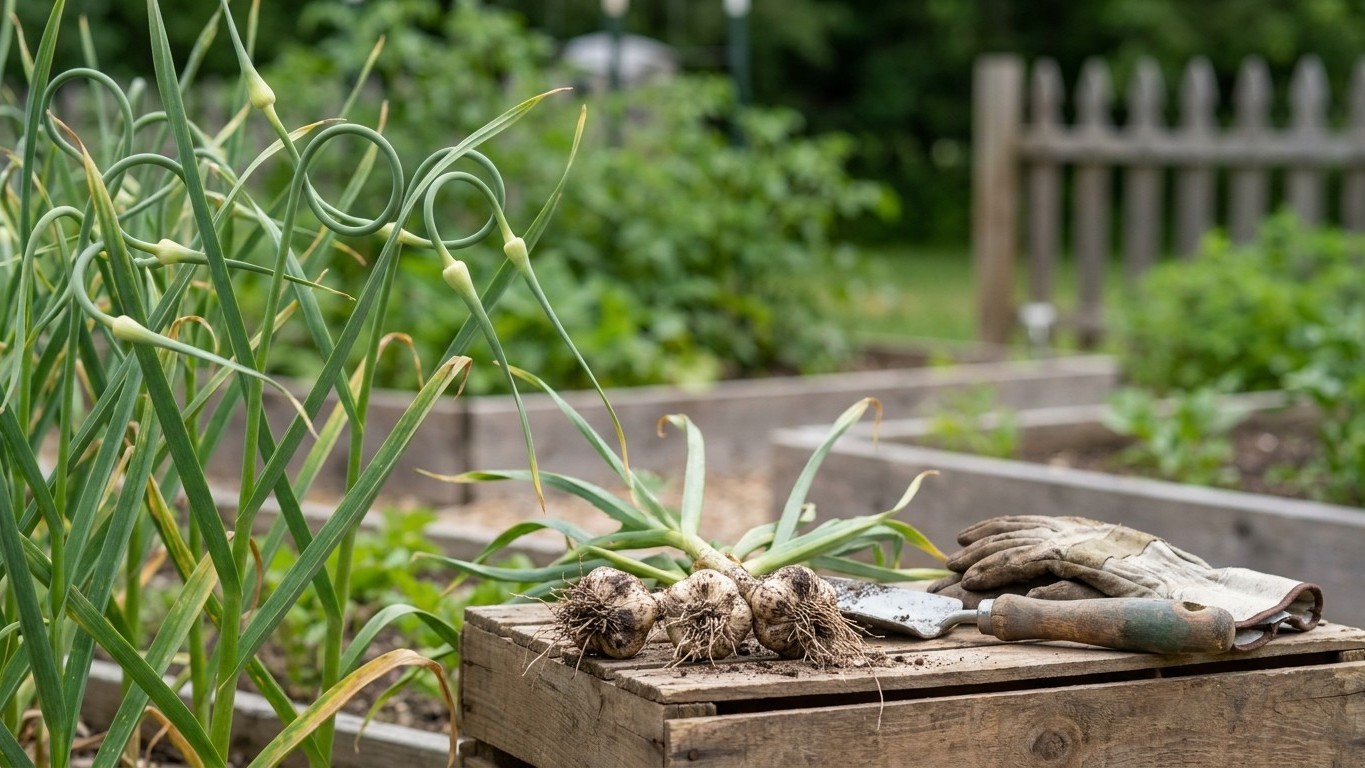

Six to eight weeks below 40°F is the number that keeps garlic growers up at night everywhere south and west of here — that’s the cold stretch a clove needs before spring to split into a proper head instead of a single rock-hard round. Gardeners in milder states watch soil thermometers and gamble on it. Michigan doesn’t gamble. Every county, from the Detroit suburbs to the Upper Peninsula, blows past that requirement without trying.
Will garlic get the cold it needs in Michigan

Garlic clones itself underground every year, and the way a single clove turns into a full head of cloves depends on cold. Plant a clove into soil that never chills down and you get a “round”: one smooth, undivided bulb with nothing to peel apart, the garlic equivalent of a dud. The trigger is a stretch of genuine winter cold after the clove has rooted in but before it resumes active growth in spring.
The vernalization requirement
University of Georgia Extension’s publication C854 puts a number on that trigger: six to eight weeks with soil temperatures below 40°F before the plant breaks dormancy. That clock only starts once the clove has already rooted into the bed, which is the whole reason garlic goes into the ground in fall rather than spring. It needs to be settled in before the cold arrives, not planted into cold ground from a bag in March.
Michigan doesn’t need to think twice about this one. Every county in the state runs well past six to eight weeks below 40°F over a typical winter, from the mildest stretch of the southern Lower Peninsula near Detroit to the Upper Peninsula’s much longer freeze. This is one part of growing garlic here that takes care of itself, which frees growers to focus instead on selecting the Garlic Varieties That Suit Michigan Winters.
Where the cold isn’t a given
That’s not true everywhere garlic gets grown. In a milder state such as Utah, where winters can fall short of that six-to-eight-week window depending on elevation and region, growers either refrigerate cloves for several weeks before planting to force the chilling artificially, or they plant softneck varieties that don’t need as sharp a cold snap to divide (see Growing Garlic in Utah: Planting Dates, Varieties and Winter Cold). Neither workaround is needed here. Plant a hardneck in Michigan without a second thought about the refrigerator.
When to put the cloves in
Garlic planted in Michigan needs to do two things before the ground locks up: grow enough root to anchor itself, and stay clear of any real top growth that winter could damage. Time it around the season’s first hard freeze, not a date on the wall calendar — see When to Plant Garlic in Michigan for county-by-county guidance.
Reading the frost window
Near Detroit, MSU Extension’s Michigan Garden Calendar puts the first fall frost between October 6 and October 21, a two-week span whose midpoint falls around October 13 or 14. Work backward three to five weeks from that midpoint and you land in the second half of September, which lines up with the mid-to-late September set-out window used for every variety. That gap gives the roots time to establish in still-warm soil without pushing the shoot far enough above ground to suffer frost damage.
Treat October 13 as a rough center of gravity, not a safe date circled on the calendar. The actual first frost in any given year could fall anywhere across that three-week band, and some years it slips outside it entirely. Watching soil temperature is a useful second check alongside the frost date: garlic roots best once the soil has cooled from summer’s peak but is still workable, well before the ground itself freezes solid.
What shifts the date around the state
Detroit is one reference point in a large state. Elevation, latitude and the moderating pull of the Great Lakes all move the frost date around, sometimes by weeks. Northern counties and anywhere at meaningfully higher elevation tend to freeze earlier than southeast Michigan, while a shoreline close to Lake Michigan or Lake Huron often stays frost-free longer into fall than inland ground just a few miles away, because the lake releases stored summer heat slowly. A grower on the Leelanau Peninsula and a grower in Monroe County aren’t working from the same calendar, even though both are in Michigan.
Which types suit Michigan
Garlic splits into two groups, and the split matters more in a state with real winters than almost anywhere else in the decision. Hardneck garlic wants a genuine cold season to perform well and produces a stiff central stalk, called a scape, along with a smaller number of large, easy-to-peel cloves. Softneck garlic tolerates milder winters, skips the scape, braids easily, and stores considerably longer in typical kitchen conditions.
Why hardneck leads here
Michigan’s winters are exactly the kind of winter hardneck garlic evolved for, and the catalogue offers plenty of options: Bavarian Purple, Blue Music, Chesnok Red, Duganski, Fall Festival, Georgian Crystal, Georgian Fire, German Red, German White, and Ivan. Growers in even colder parts of the Upper Midwest, covered in Growing Garlic in Minnesota: Planting Dates, Varieties and Winter Cold, lean on the same hardneck logic for the same reason: the cold is there, so the plant might as well use it.
Where softneck still earns a spot
Southern Michigan’s winters, while cold enough for either type, don’t rule out softneck. Inchelium Red and Lorz Italian are both softnecks worth a try for growers who want a longer pantry life out of the harvest, alongside Early Red Italian and Italian Late. Softneck earns its place in Michigan for storage, not hardiness: a well-cured softneck head routinely outlasts a hardneck head in the kitchen.
All fourteen varieties in the table below share the same set-out window, calculated back from the Detroit-area frost date.
| Variety | Type | Set-out window | Notable trait |
|---|---|---|---|
| Early Red Italian | Softneck | Mid to late September | Red-blushed skin, reliable keeper |
| Inchelium Red | Softneck | Mid to late September | Mild flavor, heavy yields |
| Italian Late | Softneck | Mid to late September | Late-maturing, long storage |
| Lorz Italian | Softneck | Mid to late September | Mild flavor, good keeper |
| Bavarian Purple | Hardneck | Mid to late September | Purple Stripe type, striking bulb color |
| Blue Music | Hardneck | Mid to late September | Porcelain type, large cloves |
| Chesnok Red | Hardneck | Mid to late September | Purple Stripe type, popular baking garlic |
| Duganski | Hardneck | Mid to late September | Purple Stripe type, robust hot flavor |
| Fall Festival | Hardneck | Mid to late September | Marbled Purple Stripe type, large bulbs |
| Georgian Crystal | Hardneck | Mid to late September | Porcelain type, vigorous |
| Georgian Fire | Hardneck | Mid to late September | Porcelain type, hot flavor |
| German Red | Hardneck | Mid to late September | Hot flavor, dependable keeper |
| German White | Hardneck | Mid to late September | Porcelain type, large cloves |
| Ivan | Hardneck | Mid to late September | Porcelain type |
Soil and bed preparation
Garlic spends eight to nine months in the same patch of ground, through freeze, thaw and everything a Michigan winter throws at it, so the bed matters more here than for almost any other crop you’ll plant. Drainage comes before anything else. A clove sitting in cold, waterlogged soil through December and January rots before any pathogen even gets involved, and there’s no fixing that once the ground is frozen over.
Getting the bed ready
Work in a generous layer of finished compost or well-aged manure a few weeks before planting, not the same week, so it has time to settle and stop attracting anything that might disturb newly planted cloves. Loosen the soil a full spade’s depth. Garlic roots deep for a bulb crop, and compacted or heavy soil restricts that root run right when the plant needs to be establishing before the cold sets in.
If your ground holds water after a heavy rain, a raised bed or raised row solves the drainage question outright and is worth the extra work for a crop that can’t be moved once it’s in. Clear the bed of weeds before planting rather than after. Garlic doesn’t compete well in spring, and anything already established over winter gets a head start on the garlic once the snow melts.
Skip the fresh manure. Uncomposted manure applied close to planting can burn young roots and tends to carry weed seed that then has all winter to get comfortable in the bed alongside your garlic.
What the climate here favours, and what it does not
UC IPM’s Pest Management Guidelines for Onion and Garlic, UC ANR Publication 3453, publish soil-temperature ranges for the fungal diseases that hit garlic hardest, and comparing Michigan’s monthly average air temperatures against those ranges shows a mixed picture: real exposure to two diseases, and next to none for two others.
The two to watch
White rot, caused by Sclerotium cepivorum, is the one to take seriously here. Its published range of 50°F to 75°F overlaps Michigan’s growing-season air temperature in five separate months, September, October, May, June and July, including one month that sits right at the disease’s published optimum. Fusarium basal rot, caused by Fusarium oxysporum f. sp. cepae, follows close behind, with its 59°F to 90°F range overlapping four of those same months: September, May, June and July.
That overlap doesn’t mean either disease is present in your soil. It means the air temperature during a good chunk of the season sits in the range where, if the pathogen is already there, it can get going. Both fungi survive for years in soil once established and mainly arrive on infected seed garlic, so buying clean planting stock and rotating the bed matter more than anything you could do about the weather.
The two that stay quiet
Southern blight, caused by Sclerotium rolfsii, and pink root, caused by Setophoma terrestris, both need real heat to thrive, with published optimums of 86°F to 95°F and 75°F to 85°F. No month of Michigan’s growing season, at least measured near Detroit, averages into either range. That’s real reassurance for two diseases that hit garlic hard in warmer states, though a mean far outside the optimum only means the disease runs slower here, not that it’s absent if it ever arrives on infected stock.
Read these numbers as a tendency, not a verdict
Three caveats matter more than the count itself. UC IPM’s thresholds are soil temperatures, while the figures above are air temperatures, and soil lags air by weeks and swings far less day to day. A monthly average also hides plenty of range: a month that averages in the 60s still holds days near 50 and days near 80. And all of this comes from one set of averages, not a station in every county, so a reading anchored near Detroit will not match the Upper Peninsula or the far southwest corner of the state exactly.
Getting it through the winter
Michigan’s winter is the whole point of growing garlic here, but an unprotected clove can still lose to it. The two failure modes run in opposite directions: too little cover and the clove heaves out of the ground as it freezes and thaws, too much or too-early cover and it rots or smothers.
When and how much to mulch
Wait until the ground has had its first hard freeze or two before laying mulch, not before. Mulch put down while the soil is still warm just holds that warmth in and can trigger the top growth you’re trying to avoid heading into winter. Straw or chopped leaves both work. Lay it thick enough that you can’t see bare soil through it, since a thin scattering does little against a Michigan winter compared with what growers in milder states get away with. Growers in genuinely colder states pile mulch even higher, but the same logic applies here: skimping on mulch depth in an actual four-season climate isn’t the place to economize.
Frost heave and planting depth
A clove planted too shallow is the most common reason mulch alone doesn’t save a bed. Repeated freeze-thaw cycles can push a shallow clove partway out of the ground over the course of the winter, exposing it to cold air and drying wind that the soil would otherwise have blocked. Plant each clove a couple of inches deep, pointed end up, and the mulch layer becomes backup insurance rather than the only thing standing between the clove and the weather.
Pulling mulch back in spring
Once new growth starts pushing up in spring, pull the mulch back to a thinner layer rather than removing it outright. Left too thick, it holds moisture against the emerging shoot and invites the same rot that a poorly drained bed causes in winter. Pulled back too far or too early, the bed loses the moisture retention and weed suppression that made the mulch worth laying in the first place.
Harvest and curing here
Garlic tells you when it’s ready long before any date on a calendar does. Watch the leaves, not the month. Each leaf corresponds to a wrapper layer around the bulb, so a plant that still looks fully green hasn’t finished forming its papery outer wrappers yet, and one that’s collapsed completely has usually already started rotting or splitting open underground. The point to lift is when roughly the bottom half of the leaves have browned and dried while the top half are still upright and green.
Curing in a humid Michigan summer
Curing is the part that loses more crops than the winter does, and Michigan’s humid summer stretch makes it less forgiving than a dry climate would. Move whole plants, roots and tops still attached, to a shaded, dry space with real airflow immediately after lifting. Direct sun for even a short stretch can scald the bulb through the wrapper. A garage or open-sided shed with a box fan running works better here than it would in a dry western state, since Michigan’s summer humidity slows the natural drying that the wrappers need to seal up properly.
Leave the plants until the wrappers have gone fully papery and the neck where the stalk meets the bulb has tightened down and dried hard, not just gone limp. Only then trim the roots and tops and move the bulbs to storage. Curing too briefly in a humid stretch is the single most common reason a Michigan garlic harvest that looked perfect in July doesn’t make it to the holidays.
Local help
Frost dates, soil types and even which diseases show up shift meaningfully across a state as long as Michigan, from the fruit belt along Lake Michigan to the Upper Peninsula. For county-level planting dates and a soil test before you commit a bed to garlic for the winter, contact MSU Extension, the state’s land-grant extension service. A soil test costs little next to a winter’s worth of wasted cloves.
Common questions
Can I Plant Garlic in spring in Michigan instead of fall?
You can put cloves in the ground in spring, but don’t expect the same result. Garlic needs the cold period after planting to divide into cloves, and a spring-planted clove that hasn’t been refrigerated first usually forms a small, undivided bulb rather than a full head. If fall planting isn’t possible, chilling the cloves in a refrigerator for several weeks before a spring planting is the workaround, not a substitute for the real thing.
Can I plant grocery store garlic instead of ordering seed garlic?
You can, but it’s a gamble. Grocery store garlic is rarely labeled by variety, is often treated to suppress sprouting, and carries no guarantee against the soilborne fungal diseases discussed above. Certified seed garlic from a known source costs more per clove but removes that risk from a bed you’re about to commit for eight or nine months.
What happens if I plant garlic too early, before the recommended window?
Cloves planted well ahead of the set-out window often push several inches of leafy top growth before winter arrives, and that soft growth is what takes the damage when a hard freeze hits, not the clove underground. The plant usually survives, but it wastes energy recovering in spring instead of putting it into bulb size.
Do I need to cut the scapes off my hardneck garlic?
Cutting the curled scape once it appears in early summer redirects the plant’s energy into the bulb instead of the stalk, and most growers see a modestly larger head as a result. It’s not mandatory, and the scapes themselves are edible and worth cooking with, but leaving them on for looks does the bulb no favors.
Does heavy snow cover hurt overwintering garlic?
No, a consistent snow cover generally helps rather than hurts. Snow acts as its own insulating layer over the mulch, evening out the freeze-thaw swings that cause heaving. The riskier pattern is a winter with little snow and repeated freezing and thawing of bare or thinly mulched ground, which is exactly what a good mulch layer is meant to guard against.