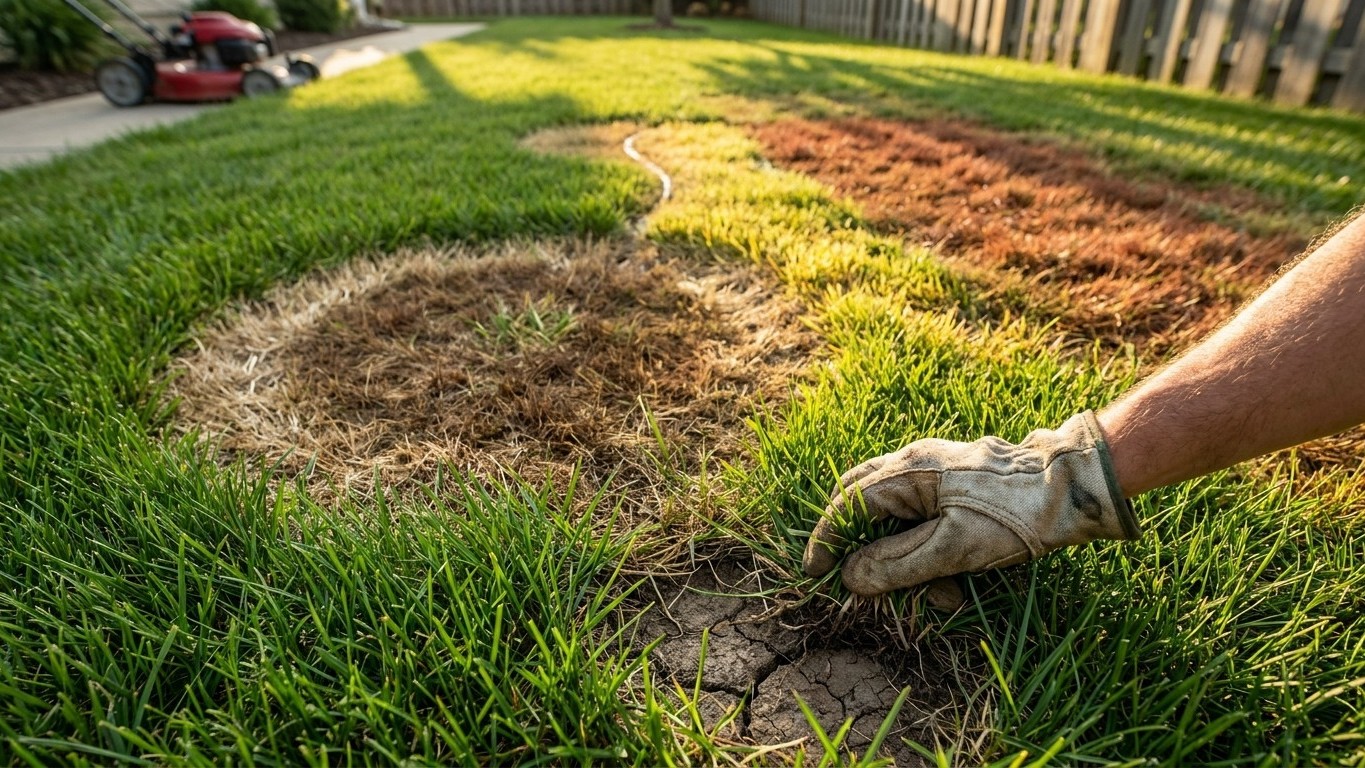

A brown patch, a yellow ring, blades that pull up like carpet: each pattern points somewhere specific. Before searching for a fix, look at what’s actually in front of you. The shape of the damage, how fast it spread, and whether it follows a line (a sprinkler’s reach, a mower’s path) tells you whether you’re dealing with a living organism or a growing condition gone wrong.
Start with what you can see

Grass tells a limited story, but it tells it clearly if you know where to look. Four things matter: blade color and texture, the shape of the damaged area, what’s happening at the soil line, and the roots underneath. Each one narrows the list of possible causes before you ever open a diagnostic guide.
Blade color is the fastest clue. Straw-yellow blades in a uniform haze across the whole yard usually point to a growing condition, most often drought or nitrogen shortage. Blades that turn reddish-brown in irregular blotches, especially in humid weather, suggest a fungal disease at work. Rust gives grass an orange, powdery coating that rubs off on your shoes, an unmistakable sign and one that’s genuinely living, spreading tissue.
Shape matters as much as color. Circular or ring-shaped patches, particularly ones that grow outward over days or weeks, are the signature of a fungus spreading through the soil or thatch. Irregular patches that follow a straight line, say, along a fence where a sprinkler doesn’t reach, or in a strip that gets afternoon shade from a shed, are almost never disease. They’re a growing condition tied to a fixed feature of the yard. If you move the hose and the problem doesn’t budge, that’s your answer.
What’s happening at the soil surface adds another layer. A cottony or web-like growth visible in early morning dew is a fungal sign. A spongy feel underfoot, where the turf lifts like a loose rug, points toward insect activity chewing through roots, most commonly grubs. Compare that to soil that’s simply hard and compacted, where grass thins out but doesn’t detach, which is a structural problem, not a living one.
Roots settle the harder cases. Pull a small plug from the edge of a damaged patch. Roots that are short, brown, and sparse but the crown is intact often mean drought stress or compaction. Roots that are chewed off entirely, with the grass coming up in your hand with almost no resistance, mean something is feeding underground.
The distinction that matters most here is simple: a living cause, whether insect, fungus, or the rare bacterial issue, spreads from where it started, and it needs a different kind of response than a growing condition, which stays wherever the stress originates and corrects itself once that stress is removed.
The ones that are not a disease at all
Most calls about a “sick lawn” turn out to involve no living cause whatsoever. That distinction matters because a spray does nothing for a growing condition, and treating the wrong problem burns through a season while the real cause, usually watering or soil chemistry, keeps working against the grass.
Drought stress is the most common impostor. Grass under water stress folds its blades lengthwise to reduce moisture loss, giving the lawn a dull, grayish cast rather than the fresh green of hydrated turf. A telltale sign: footprints or mower tracks stay visible for hours instead of springing back within minutes. This isn’t damage in the destructive sense, it’s the plant conserving itself, and the fix is a deeper, less frequent watering schedule rather than any treatment aimed at an organism.
Heat dormancy gets confused with dieback constantly, especially with cool-season grasses like Kentucky bluegrass and fescue. When soil temperatures climb through mid-summer, these species can go dormant on purpose, turning brown across large areas while the crown stays alive below the surface. Pull on a few blades: if they resist and the crown is white and firm, the lawn is dormant, not dead, and it will green back up once temperatures drop and rain returns.
Nutrient lockout looks like a deficiency but isn’t always one. In soil with high pH, iron becomes chemically unavailable to grass roots even when it’s present in the soil, producing the same pale yellowing you’d see from an actual iron shortage. A soil test showing adequate iron alongside high pH points to a pH problem, not a feeding problem, and no amount of added nutrient fixes it until the pH shifts.
Pet urine spots are a nutrient excess rather than a shortage: a concentrated dose of nitrogen kills the center of the spot while the nitrogen-rich edges green up darker than the surrounding lawn, creating the classic dead-circle-with-green-ring pattern. Mower scalping, where a dull blade or an uneven deck cuts some spots shorter than others, shows up as brown stripes that follow the mowing pattern exactly, a dead giveaway that has nothing to do with pests or fungus.
When it is worth acting, and when it is not
Not every brown spot deserves a response, and knowing which ones do is worth more than any product on a shelf. Some damage is purely cosmetic: a light dusting of rust on blades in a lawn that’s otherwise thick and healthy costs nothing beyond appearance, and mowing more frequently to remove the affected tips often resolves it without any other intervention.
Some damage is already finished by the time you notice it. Winter-related fungal damage, the kind that shows up as matted, gray-white patches when snow melts, reflects an infection that ran its course under snow cover months earlier. There’s nothing to treat in that moment; raking the area to improve airflow and overseeding in spring addresses what’s left, and the real prevention work happens the following autumn, not this week. Grub damage discovered in fall often falls into the same category: by the time the spongy turf gives it away, the grubs have already moved deeper into the soil for winter, and the window for addressing them at the surface has closed until their active feeding period returns.
A short list of situations genuinely call for prompt attention: turf that’s actively spreading a fungal patch during warm, humid stretches, a spongy area expanding week over week that signals live grub feeding, or thinning that follows a clear insect pattern rather than a watering or mowing habit. In those cases, the timing matters more than the specific product, and the dedicated page for that particular problem covers the details of the response.
The larger point holds across nearly every case: identify what’s living and spreading versus what’s a fixed growing condition, and match your response, or your patience, accordingly.
Match What You See to the Specific Problem
Once you’ve got a general read on the damage, the next step is looking closer at its exact shape and setting. If it’s soil showing through with no grass at all, go to bare spots, where the outline of the spot points to the cause. Damage that’s discolored but not bare instead belongs with brown patches, read the same way, by shape. A tight dead circle with a dark green ring is almost always a dog urine spot, while grass that’s merely tan and dormant rather than dead is covered under drought-stressed grass. Ground that stays hard and won’t drink water gets checked with compacted lawn soil‘s screwdriver test, and grass that just refuses to grow at all works through the four causes behind a stalled lawn. Green cushiony patches are explained at moss, and fungal growth pushing up overnight is covered at mushrooms. Mower damage has its own page at a scalped lawn, pooling water is sorted out at standing water, and a spongy mat under the blades is measured at thatch. Thin turf under a tree canopy is diagnosed at grass that thins under trees, a bumpy surface is worked out at an uneven lawn, an overrun lawn is addressed at a lawn taken over by weeds, and off-color turf that isn’t dying is sorted out at a yellow lawn.