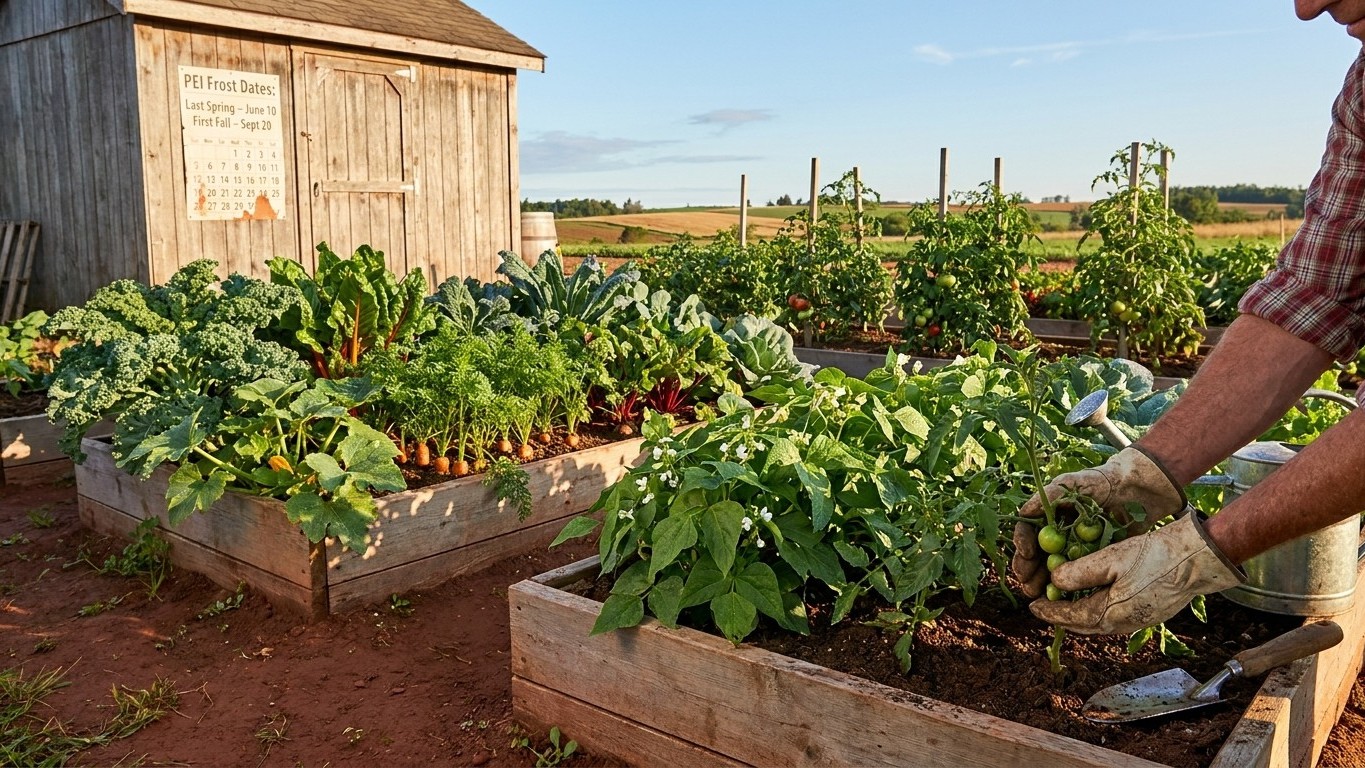

Prince Edward Island gardeners work with a frost-free window of roughly five months, bracketed by a Canadian hardiness zone that has nothing to do with the USDA scale used across the border. That window, not the calendar month or the zone number alone, is what actually decides which crops make sense here and which ones are a bet against the odds.
How long your season really is

Three numbers frame everything a gardener on the Island can realistically plan for. The province sits in Canadian hardiness zone 5b, based on the reference station at Charlottetown. The average last spring frost falls on May 16. The average first fall frost falls on October 17. Subtract one from the other and you get the number that matters more than any of them individually: about 154 frost-free days to work with, start to finish.
| Metric | Value |
|---|---|
| Hardiness zone (Canadian system) | 5b |
| Average last spring frost | May 16 |
| Average first fall frost | October 17 |
A word of caution on that zone number before anyone reaches for a US seed catalog: the Canadian hardiness system and the USDA system are not the same scale and do not convert cleanly into each other. Natural Resources Canada builds its zones from seven climate variables, including wind and snow cover, while the USDA relies on one, the average annual minimum temperature. The two agencies have said outright there is no simple conversion table between them, and a single Canadian zone can span nine different USDA zones. Call it Canadian zone 5b when you talk about it, and don’t assume it lines up with a “zone 5b” printed on a plant tag from a Vermont nursery.
The frost dates deserve the same caution. These are averages pulled from the 1981-2010 Canadian Climate Normals at Charlottetown, and an average, by definition, means half of all years land on the other side of it. In roughly one year out of two, frost arrives after May 16 in spring or before October 17 in fall. Treat these dates as the midpoint of a moving window, not a green light to plant tender seedlings or a guarantee your tomatoes are safe in mid-October — the same logic applies to timing fall favorites like winter squash and pumpkins, as this guide on When to Carve a Pumpkin in Prince Edward Island explains, and as covered in more depth in Growing Pumpkins in Prince Edward Island.
What a season this length rules out matters as much as what it allows. A 154-day window is enough for most short and mid-season vegetables, including quick-maturing greens, and it also supports longer-term perennial investments like asparagus, as detailed in Growing Asparagus in Prince Edward Island, and it’s also workable for longer-season crops like corn, as detailed in Growing Sweet Corn in Prince Edward Island, though timing still matters mcovered in Growing Spinach in Prince Edward Island, whether started indoors or direct-seeded after the frost risk clears — including reliable staples like Growing Potatoes and cold-hardy root crops such as those covered in Growing Parsnips in Prince Edward Island in Prince Edward Island, as well as heat-loving crops that need an indoor head start, as covered in this guide on Growing Peppers in Prince Edward Island and root crops covered in this guide on Growing Carrots in Prince Edward Island and quick-maturing root crops like Growing Beets in Prince Edward Island in Prince Edward Island — but it leaves little margin for crops bred for a Southern growing season, anything needing 100-plus frost-free days after transplant, or a second full round of a long-maturing crop once the first is done. Long-season varieties aren’t impossible here, but they’re a gamble against an average that already tells you half the years will be shorter than this.
What the summer does to a garden here
Heat load, not warmth in general, is the number that shapes an Island growing season, and by that measure the Island barely registers. The Charlottetown normals show zero days a year averaging 90F or above. That’s not a typo or a rounding error, it’s the defining feature of gardening in this climate: there’s essentially no stretch of the summer where heat itself becomes the limiting factor.
That absence of extreme heat cuts both ways. Above roughly 90F, tomato flowers drop without setting fruit, lettuce and other cool-season greens bolt and turn bitter, and plants generally shift energy into survival instead of growth. Gardeners in hotter US states plan around that dead zone, timing cool-season crops before and after it and accepting a gap in the middle where little thrives. On the Island, that problem mostly doesn’t exist. Tomatoes, peppers, and squash get a long, mild stretch to develop rather than a short, blistering one, and cool-season crops like lettuce, spinach, and brassicas can often run further into what would be the “heat gap” elsewhere without bolting.
The tradeoff shows up on the other end of the thermometer. The coldest month here averages a daily minimum of 10.3F, a figure that has less to do with how hot your tomatoes get and everything to do with what survives the winter in the ground. Perennials, fruit bushes, and anything left unprotected outdoors have to tolerate that minimum, not just the zone number, and it’s this figure, not the summer heat, that decides whether a borderline-hardy plant makes it to spring.
Put together, these two numbers describe one long, moderate growing season rather than the two-shoulder-seasons-and-a-dead-middle pattern common further south. The practical upshot: a gardener here plans one continuous stretch from late spring to mid-fall, watching frost risk at both ends, rather than working around a midsummer heat shutdown that simply doesn’t arrive.
What tends to go wrong in Prince Edward Island
No Canadian provincial extension service publishes an equivalent home-garden pest list for the Island, so the pests below come from the University of Maine Cooperative Extension, just across the border. The biology crosses that line freely, even if the reporting agency and the calendar don’t always match exactly. Treat this as a starting point for identification, not a confirmed provincial list, and check with PEI’s own agriculture office before assuming any of these is or isn’t present on your property.
- Colorado potato beetle: shows up as soon as potato and eggplant foliage emerges in late spring, stripping leaves down to the veins if left unchecked.
- Cabbage maggot: attacks young brassica roots early in the season, right after transplanting, causing wilting seedlings that look otherwise healthy above ground.
- Squash vine borer: moves in during early to midsummer, tunneling into squash and pumpkin stems until the vine collapses seemingly overnight.
- Spotted wing drosophila: arrives as soft fruit ripens in mid to late summer, laying eggs in berries and stone fruit before harvest rather than after.
Two more worth knowing by name if you’re growing ornamentals or trees: the lily leaf beetle, active from spring through summer on true lilies, and the emerald ash borer, a slower-moving threat to ash trees that shows itself over years rather than weeks. Neither has a home-garden treatment schedule worth guessing at here. If you spot damage matching any of these, PEI’s provincial agriculture office is the right place to confirm identification and get current guidance, rather than relying on advice written for a different border.
Where to check before you plant
Everything above is built from a single reference station at Charlottetown, and Prince Edward Island, small as it is, still runs from Tignish to Souris with real differences in exposure, elevation, and coastal influence along the way. A planting calendar tuned to the capital can run a couple of weeks off at either tip of the province, especially in a cooler spring or an early fall.
The province’s own agriculture resources are the place to confirm anything specific to your part of the Island: Prince Edward Island’s agriculture department maintains current guidance for growers here, and it’s a better source than a US state extension service for anything specific to provincial regulations, local varieties, or regional advisories. Where the Island doesn’t have a direct local equivalent for a given question, particularly on pest identification, the neighboring Maine extension service remains a reasonable second reference given how closely the region’s growing conditions track across that border.
None of that replaces watching your own yard. Frost pockets, wind exposure, and soil type vary from one lot to the next even within the same town, and the averages here are exactly that: averages, built for planning, not for betting the season’s first tomato transplant on a single date.
Growing Specific Crops on the Island
The general climate picture only goes so far — what matters is how it plays out for the things you actually want to grow. Take garlic, for instance: the same cold winters that limit so much else on PEI are exactly what pushes a planted clove to split into a full head rather than sitting there as one round bulb. Your lawn faces a different set of numbers entirely, and a guide to Island lawn care lays out what cool-season turf needs when the province never sees a 90°F day and winters stay hard. Tomatoes ask for the opposite kind of patience — they need every bit of the season to ripen before frost closes things out, and the tomato planting guide works backward from Charlottetown’s own climate normals to tell you when to start and what to expect. Each of these pages takes the same station data referenced above and turns it into planting dates and variety choices for that one crop, rather than leaving you to do the math yourself.