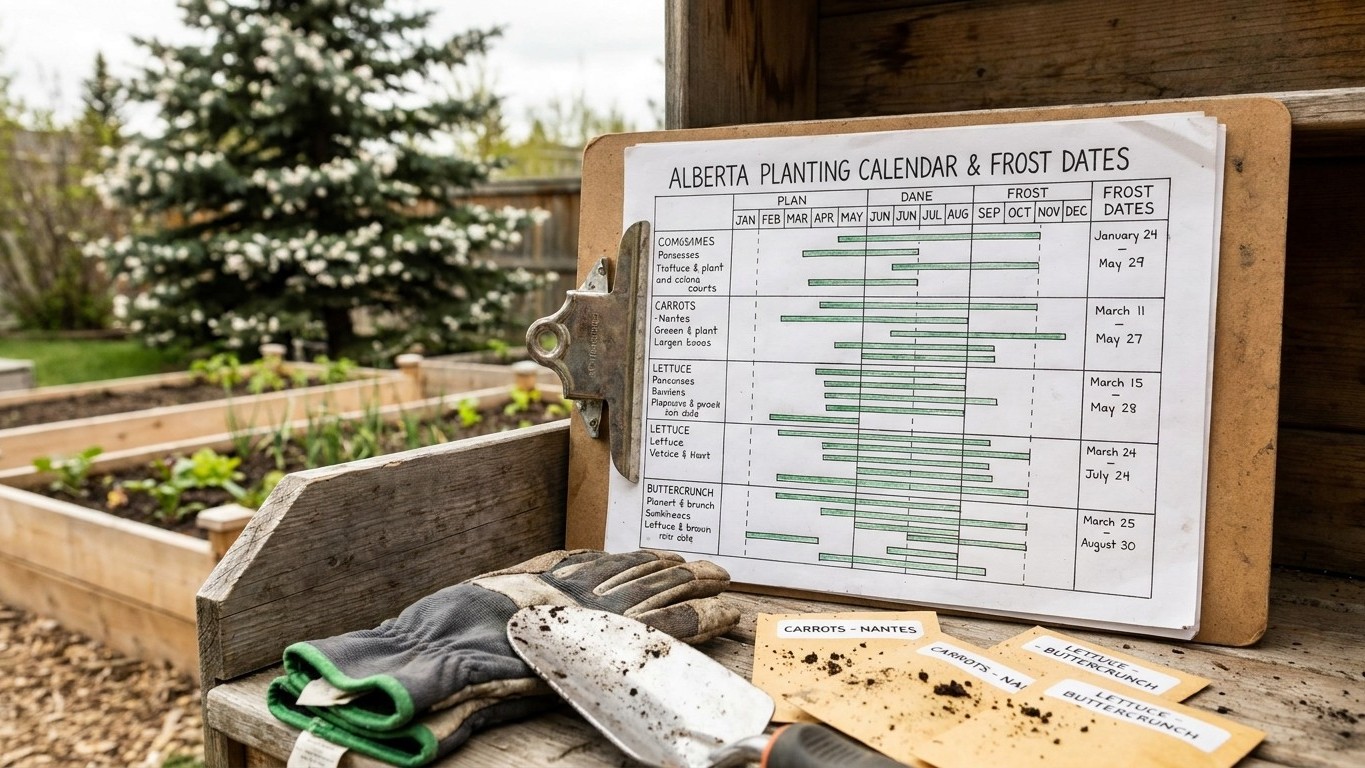

May 21 to September 16: that’s the frost bracket Calgary’s climate record hangs on, and it’s the single mechanism that decides sowing dates everywhere else in this calendar. Roughly 118 days sit between those two averages, but an average is just where half the years land on either side — some springs frost lingers into June, some autumns it holds off past mid-September. Farther north, at elevation, or into the Peace Country, push that whole window later and shorter.
The frost window in Alberta

Environment and Climate Change Canada’s 1981-2010 Climate Normals, recorded at the Calgary Int’l A station, give a mean last spring frost of May 21 and a mean first fall frost of September 16. Subtract one from the other and you get a growing season of roughly 118 days near Calgary, frost to frost.
Treat both figures as the midpoint of a spread, not a guarantee. A mean date means half of the years in the record saw frost after May 21, sometimes well after. Environment and Climate Change Canada does not publish this as a “safe to plant” date, and neither should a gardener. The same caution runs the other way in fall. September 16 is an average, and a warm September can push the first frost weeks later, while a cold one can bring it weeks earlier.
Calgary sits at the milder end of Alberta’s climate range. Northern communities and anywhere at meaningfully higher elevation run their frost windows weeks behind the Calgary normals, with a shorter frost-free season on both ends. If you garden in the Peace Country, the foothills, or anywhere north of Edmonton, treat the Calgary dates as a rough southern benchmark and lean toward the later end of any planting window described here.
What a 118-day season means for crop choice
A season measured in frost-free days, not calendar months, is what actually limits which vegetables ripen outdoors in Alberta. A tomato variety that needs 78 days from transplant to first fruit is not automatically a poor fit for a 118-day window, but it leaves far less room for a late spring frost, a cool August, or a wet week that delays ripening. That margin, not the raw days-to-maturity number printed on the seed packet, is what decides whether a variety is worth the space in a short season.
Cool-season crops
Peas, spinach, lettuce, radishes, and the brassica family (kale, cabbage, broccoli) tolerate a light frost and germinate in cold soil, which is what lets them go into the ground well before Calgary’s mean last frost of May 21 — for a fuller breakdown of timing, see What to Plant in Alberta in March, and for how th, along with what comes right after in What to Plant in Alberta in Mayis same frost window shapes late-season sowing, see What to Plant in Alberta in November, and What to Plant in Alberta in April, and for the earliest cold-hardy starts, see What to Plant in Alberta in February, and for the second half of the season, including fall crop timing, see What to Plant in Alberta in August, for the month these crops typically go in, or What to Plant in Alberta in June, and for guidance on planning the other end of the season, see What to Plant in Alberta in December, and for guidance on wrapping up the season as the mean first fall frost approaches, see What to Plant in Alberta in September, and for guidance on closing out the season, see What to Plant in Alberta in October, and for What to Plant in Alberta in July, and for what indoor starts and early prep look like months earlier, see What to Plant in Alberta in January. These crops are not gambling against frost the way a tomato would. Seedlings shrug off a dip to just below freezing, and the seeds germinate at soil temperatures too cool for anything in the tomato or squash family.
Peas and spinach go in first, as soon as the soil can be worked in spring rather than on a fixed date. In practice that is often four to six weeks before the mean last frost, which in the Calgary area puts direct sowing somewhere in early to mid April, though a colder spring pushes that later, and gardeners north of Calgary should expect a shorter head start. Lettuce and radishes follow similar logic: both germinate poorly in warm soil anyway, so there is no advantage to waiting for the frost date to pass.
Brassica transplants (broccoli, cabbage, cauliflower) are usually started indoors and set out around two to four weeks before the mean last frost, since young transplants handle a light frost better than direct-sown seedlings just breaking the soil surface. Root crops like carrots and beets go in a little later than peas, generally from around the mean last frost date onward, since they need the soil slightly warmer before germination is reliable.
- Peas and spinach: seeds germinate in cold soil and tolerate frost as seedlings.
- Lettuce and radishes: germinate poorly in warm soil, so early sowing helps rather than hurts.
- Brassica transplants: handle a light frost once hardened off, less so as tiny direct-sown seedlings.
- Carrots and beets: wait for soil to warm slightly past the cool-season minimum before sowing.
None of these timings depend on May 21 arriving on schedule. What matters is soil temperature and workability, which is exactly why cool-season crops are the most forgiving place to start a short Alberta season. A late frost costs you very little, and an early one costs you almost nothing at all.
Warm-season crops

Tomatoes, peppers, squash, beans, and corn all originate from warmer climates and stall out, or die outright, in cold soil regardless of what the calendar says about frost. This is why Alberta gardeners set these out well after the mean last frost date of May 21, rather than on the day it passes. Most Alberta gardeners aim for early June for tomato and pepper transplants, giving the soil an extra couple of weeks past the mean frost date to warm enough for roots to actually grow rather than sit stalled.
Soil temperature, not air temperature, is what a tomato root system responds to. A frost-free night does not mean the soil four inches down has warmed enough to support new root growth, which is the practical reason for waiting past May 21 rather than planting the moment frost risk clears on paper.
Counting back from an early-June set-out date
Seed packets for tomatoes and peppers list days to maturity counted from transplant, not from seed, and most tomato transplants need roughly six to eight weeks indoors before they are ready to go in the ground. Counting back from an early-June set-out date puts the indoor seed-starting window at mid to late April for most tomato varieties, a week or so earlier for peppers, which are slower to size up.
The table below applies each variety’s published days-to-maturity figure to an early-June set-out date and Calgary’s mean first fall frost of September 16, to show how much ripening time each one leaves before frost risk returns. Margin, not days-to-maturity alone, is the number that should drive variety choice in a short season: a 55-day variety set out in early June and ripening in late July leaves roughly seven weeks of harvest before the mean frost date, while a 78-day variety leaves less than four.
| Variety | Days to maturity (from transplant) | Type | First ripe (early-June set-out) | Margin before mean fall frost |
|---|---|---|---|---|
| Sakura | 55 | Indeterminate | Late July | 49 days |
| Edox | 55 | Indeterminate | Late July | 49 days |
| Valentine | 55 | Indeterminate | Late July | 49 days |
| Glacier | 55 | Determinate | Late July | 49 days |
| Sun Gold | 57 | Indeterminate | Late July | 47 days |
| Supersweet 100 | 60 | Indeterminate | Early August | 44 days |
| Juliet | 60 | Indeterminate | Early August | 44 days |
| Amalfi | 68 | Determinate | Mid August | 36 days |
| Cherokee Purple | 72 | Indeterminate | Mid August | 32 days |
| Big Beef Plus | 72 | Indeterminate | Mid August | 32 days |
| Tiren | 75 | Indeterminate | Mid August | 29 days |
| Granadero | 75 | Indeterminate | Mid August | 29 days |
| San Marzano II | 78 | Indeterminate | Late August | 26 days |
| Celebrity Plus | 78 | Determinate | Late August | 26 days |
These margins are calculated against Environment and Climate Change Canada’s mean first fall frost of September 16 for the Calgary Int’l A station. Since that date is itself a mean, treat the margin figures as a comparison between varieties rather than a guaranteed number of harvest days, and expect gardens north of Calgary or at higher elevation to have less margin than shown here.
Peppers, squash, beans, and corn follow the same soil-temperature logic as tomatoes, even though none appear in the table above. All are direct-seeded or transplanted after the soil has warmed past the point where tomatoes go in, and none gain much from being rushed out earlier than early June.
The fall planting window
Working backward from Calgary’s mean first fall frost of September 16, a second planting window opens in mid-to-late summer for quick-maturing cool-season crops. The math follows the same logic used in spring: take the days to maturity printed on the seed packet, add a margin for the slower growth that comes with shortening daylight in late summer, and count back from September 16 rather than forward from a sowing date.
Adding slack for slowing growth
A crop that lists 30 days to maturity in the seed catalogue does not actually mature in 30 days when sown in August, because daylight is dropping and nights are cooling even before the first frost shows up. Add roughly two extra weeks of slack to any catalogue maturity figure for a fall sowing, and count back from September 16 rather than from the date of the first hard freeze, since the mean date is only a midpoint and a cold snap can arrive earlier in any given year.
Floating row covers or a cold frame can buy an extra two to three weeks past the mean first frost for crops already in the ground, which is often enough to finish a planting of lettuce or spinach sown a little later than planned. That buffer is worth more in fall than in spring, since a fall crop that stalls out has no second chance the way a spring planting does.
Crops worth a fall sowing
Spinach, lettuce, radishes, and quick turnips are the safest bets for a fall crop in Alberta, since all mature fast enough to fit behind a summer crop and ahead of September 16 even with the added slack for slowing growth. Kale and carrots go further: both improve in flavor after a light frost, as the plant converts starches to sugars in response to the cold, so there is little reason to rush them out of the ground the moment frost is forecast.
Beets and late cabbage sit in between. They take a light frost without damage but do not sweeten the way kale and carrots do, so timing them to finish just before the mean frost date, rather than deliberately after it, gets the most usable harvest. None of this fall-window math holds for tomatoes, peppers, squash, or other warm-season crops. Once a real frost arrives, those are finished for the year regardless of how much size they still have to gain.
Reading a planting calendar properly
Elevation alone can shift a frost date by weeks: a garden in the foothills or at higher elevation sits colder than Calgary on the same night, while a river valley or a lake-moderated site nearby can run milder. Urban gardens also run warmer than the open airport site where Environment and Climate Change Canada takes its readings, since pavement and buildings hold heat overnight.
A single late cold snap can undo a calendar’s careful math in one night. No planting calendar, provincial or otherwise, protects a crop from a frost event outside the normal range, which is exactly what a mean date does not capture. The only real defense is watching your own forecast in the two weeks around the mean date and keeping row cover or cloches on hand for anything already in the ground.
What to track instead of the calendar
Soil temperature at planting depth tells you more than the date on a calendar, and a simple soil thermometer costs less than a single flat of tomato seedlings lost to cold, wet ground. Microclimates within one yard matter too. A bed against a south-facing wall warms weeks ahead of an open bed twenty feet away, and a low spot that collects cold air overnight can frost when the rest of the garden does not.
Gardeners comparing notes across provinces will notice the same caution applies everywhere frost dates get published. The British Columbia planting calendar deals with a coastal climate that runs frost-free far longer than most of Alberta, while the Alaska planting calendar covers a season short enough that almost every crop decision comes down to margin before frost, the same math used for tomatoes above. For more on gardening across the province, see our full set of Alberta guides.
Local help
County-level frost dates, soil testing, and crop-specific guidance for your part of the province are available through Alberta’s agriculture and irrigation services, which cover conditions well beyond what a single Calgary weather station can tell you. A soil test through this service is worth doing before a first Alberta garden season, since it tells you what a planting calendar never can: what is actually in your ground.
Common questions
Is it too late to plant if I miss the May 21 frost date?
No. May 21 is a mean last frost date from Environment and Climate Change Canada, not a deadline, and most cool-season crops go in around that date anyway. Warm-season crops like tomatoes are usually set out in early June regardless, so missing May 21 by a week or two changes very little for most of the garden.
How much shorter is the season north of Calgary?
Environment and Climate Change Canada’s normals for stations farther north or at higher elevation run behind Calgary Int’l A, sometimes by weeks on both ends of the season. Check the normals for a station closer to your own location, or contact Alberta’s agriculture and irrigation services for a more local reference point.
Can I direct-sow tomatoes outdoors in Alberta?
Not reliably. Alberta’s frost-free season, roughly 118 days near Calgary based on the mean frost dates above, is too short for most tomato varieties to go from seed to ripe fruit outdoors, which is why they are started indoors six to eight weeks before an early-June set-out date instead.
What happens if there’s a frost after I’ve already planted warm-season crops?
A light frost can kill tomato, pepper, and squash seedlings outright, since none of these tolerate temperatures at or below freezing at any growth stage. Covering plants overnight with cloches, buckets, or row cover when a late frost is forecast after an early-June planting is the standard defense, and it is worth keeping that cover on hand through at least the first couple of weeks after set-out.
Do the frost dates apply to Edmonton or the rest of the province?
Not exactly. These figures come from the Calgary Int’l A station specifically, and Environment and Climate Change Canada publishes separate normals for other stations across Alberta that can differ by days or weeks. Treat the Calgary dates as a reference point for southern Alberta and check the normals for a station nearer your own garden before relying on them.
Some gardeners layer an older custom on top of frost dates: planting by the moon, which we explain as almanac tradition, not fact.
Related guides
- British Columbia Planting Calendar: When to Sow and Plant, Frost Dates Included
- Saskatchewan Planting Calendar: When to Sow and Plant, Frost Dates Included
- Manitoba Planting Calendar: When to Sow and Plant, Frost Dates Included